




Hall capacities in warehouse logistics
Table of Contents
- Hall Capacities: The Backbone of Modern Logistics Value Creation
- Definition: What is Meant by Hall Capacity?
- The Logistics Property: Architecture of Efficiency
- Contract Logistics: Capacity as an Elastic Commodity
- Key Figures and Calculation: How Professionals Measure
- Questions and Answers (FAQ)
- Digitalization and AI: The Capacity Planning of the Future
- Practical Value: Capacity Check Checklist
- Conclusion
Hall Capacities: The Backbone of Modern Logistics Value Creation
The capacity of a logistics hall is much more than the mere number of square meters on the ground. In the professional world of warehouse logistics and contract logistics, it describes the complex interplay of physical space, technical equipment and process throughput speed. Anyone who looks at hall capacities purely two-dimensionally is giving away money.
Definition: What is Meant by Hall Capacity?
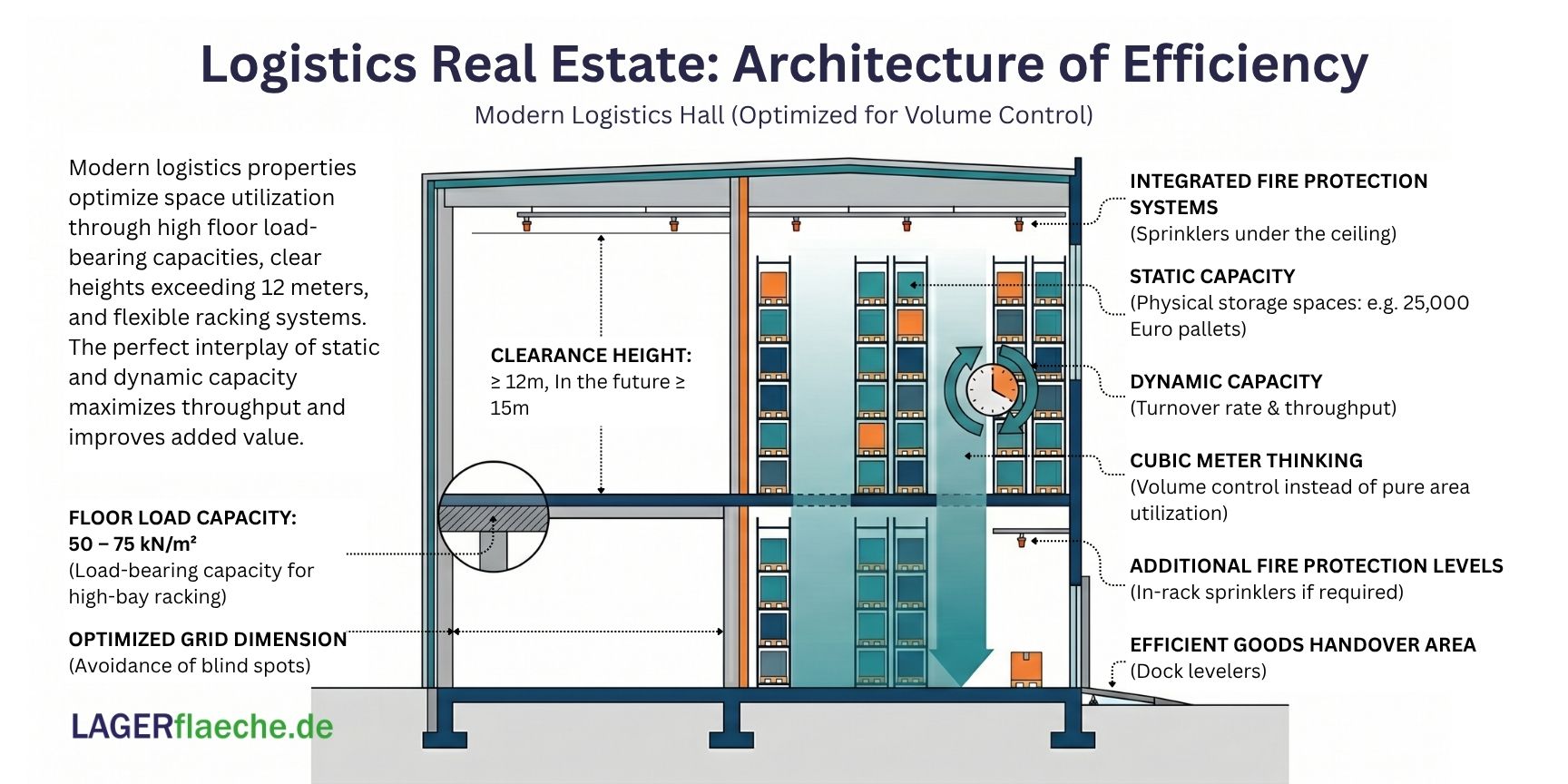
In essence, hall capacity refers to the maximum volume of goods that a property can hold in compliance with all safety and process requirements. We distinguish between two essential levels:
- Static capacity: The number of physical locations (e.g. pallet spaces in a high rack).
- Dynamic capacity: The throughput, i.e. how quickly these spaces can be occupied and emptied again (turnover frequency).
In logistics real estate, capacity is now primarily thought of in cubic meters (m³), as the clear height (UKB – lower edge of truss) is a decisive factor in determining how many shelf levels can be realized.
The Logistics Property: Architecture of Efficiency
Today, modern halls are planned "from the inside out". The requirements of contract logistics dictate the architecture. Important key figures for evaluating the capacity of a property are:
- Floor load capacity: Today, 50 to 75 kN/m² (kilonewtons per square meter) are common to carry heavy high-bay systems.
- Clear height: Standard logistics properties are 10 to 12 m. New buildings often aim for 15 m or more in order to optimize the volume-benefit ratio.
- Grid dimensions: The distances between the columns must be chosen in such a way that shelving systems can be integrated without massive loss of space due to "blind spots".
Contract Logistics: Capacity as an Elastic Commodity
In contract logistics, hall capacity is often part of a service level agreement (SLA). Service providers are faced with the challenge of maintaining capacities in such a way that they can absorb peaks (e.g. Black Friday) without being left sitting on expensive vacancies in quiet phases.
This is where multi-user warehouses come into focus. By bundling different customers in one hall, volatilities can be compensated for (smoothing effect). Capacity becomes "breathing logistics" here.
Key Figures and Calculation: How Professionals Measure
To evaluate the efficiency of a hall, it is not enough to look at the shelf. The following key figures are relevant in practice:
- Space utilization rate: The ratio of effectively used storage space to total usable area.
Space utilization rate = (Used area) / (Total area) * 100%
- Volume utilization rate: Often more decisive because it includes the airspace.
- Storage capacity: The absolute number of standard load carriers (usually Euro pallets).
Practical tip: A warehouse is considered "full" from a filling level of 85%. Why? Because above this value, the effort for transfers (chaos avoidance) increases exponentially and operational efficiency decreases.
Questions and Answers (FAQ)
Question: How can I increase the hall capacity in the short term without building a new one?
Answer: Use the vertical plane. The installation of mezzanines can double the floor space. The change from wide-aisle to narrow-aisle warehouses or the use of mobile racking also massively increases density.
Question: What influence does the Fire Protection Ordinance have on capacity?
Answer: A massive one. Fire protection walls, sprinkler systems and necessary escape routes limit the maximum storage height and the compaction of the goods. A hall with a height of 12 m is of no use if the sprinkler system is only certified for a storage height of 7.50 m.
Question: Why is "air" so expensive in the hall?
Answer: Because you pay for the converted space (rent/heating/maintenance). Every cubic meter of unused space under the hall ceiling reduces the margin per unit stored.
Digitalization and AI: The Capacity Planning of the Future
The future of hall capacity lies in the digital twin. AI-supported slotting algorithms are used to calculate which goods must be in which place in order to minimize distances and make optimal use of space.
AI systems can now predict when capacity bottlenecks will occur by comparing external market data (weather, trends, supply chain delays) with internal warehouse data. This turns a static property into an intelligent, responsive system.
Practical Value: Capacity Check Checklist
Before you invest in new space, check the following points:
Conclusion
Hall capacities are not a fixed value in modern logistics, but a dynamic variable. Those who master the interplay of real estate KPIs, modern intralogistics technology and intelligent software generate a decisive competitive advantage. In a niche where every inch counts, knowledge of space optimization is the most valuable currency.