




Heavy-duty shelving in warehouse logistics
Inhaltsverzeichnis
- The heavy-duty rack: definition and significance in intralogistics
- The most important types of racks and their areas of application
- Understanding statics: Shelf load vs. bay load
- Logistics Property Interface: Requirements for the Hall Floor
- Safety and standards: DIN EN 15635
- Questions & Answers (FAQ) from practice
- Figures, data, facts about planning
- Future trends: The shelf as part of automation
The heavy-duty rack: definition and significance in intralogistics
A heavy-duty shelving unit is much more than just a steel storage surface; it is a highly complex technical system designed for the storage of goods with extremely high weights. As a rule, we speak of heavy-duty racks when the shelf load (load per level) and the bay load (load between two uprights) are significantly higher than the values of conventional archive or workshop racks.
In warehouse and contract logistics , these systems are essential to make maximum use of the cubic space of a logistics property (hall). They transform floor space into volume. They must be flexible enough to react to changing customer requirements in contract logistics and at the same time rigid enough to safely carry loads weighing tons for years.
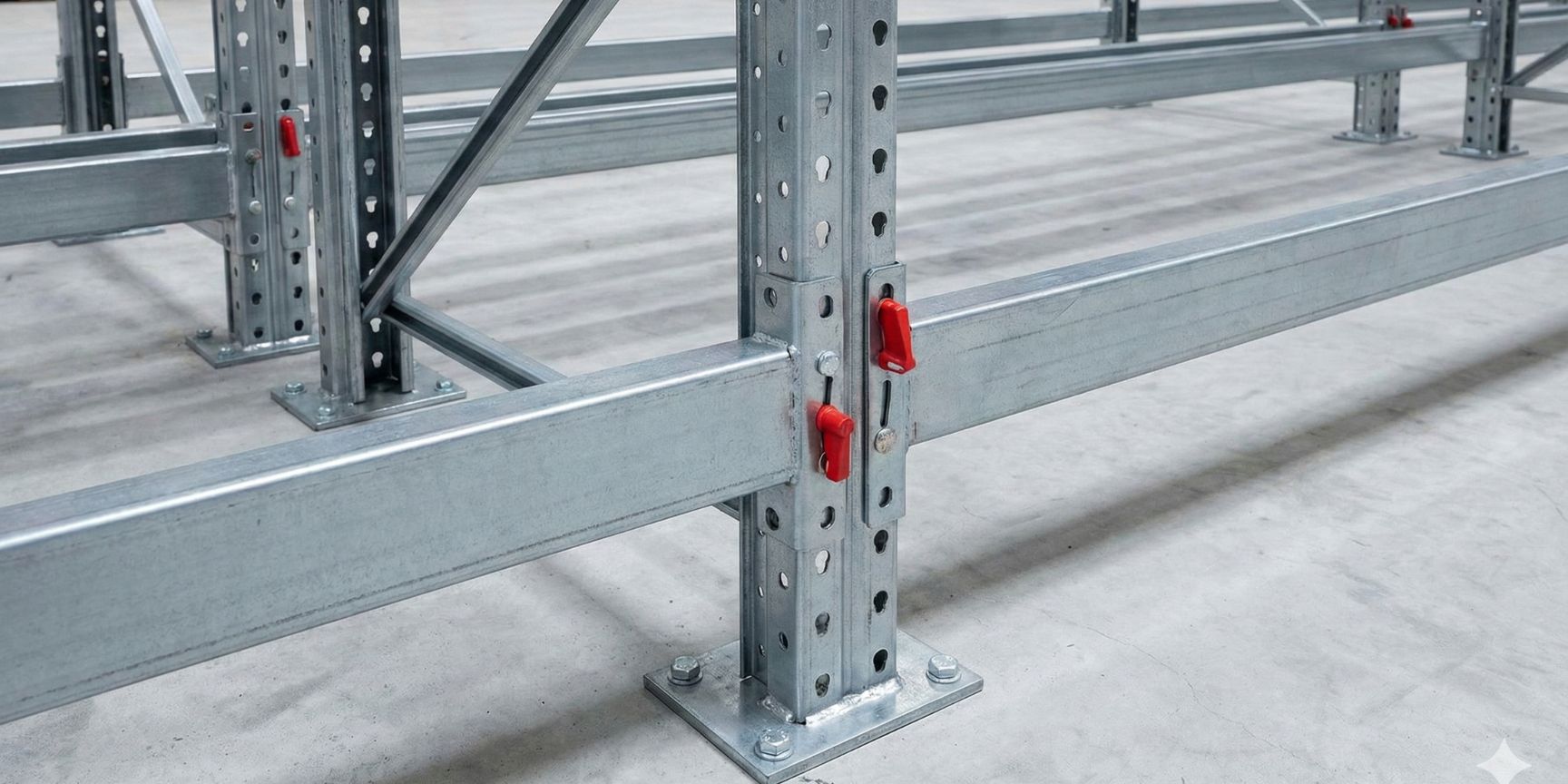
The most important types of racks and their areas of application
Not every heavy-duty rack is the same. The choice of system determines the throughput speed and the use of space.
- Pallet racking: The classic in almost every logistics property. They are optimized for Euro pallets and lattice boxes.
- Advantage: Direct access to each pallet, high flexibility.
- Disadvantage: Lower surface density compared to compact warehouses.
- Cantilever racks: Indispensable for long goods such as pipes, wooden beams or steel profiles. There are no annoying front outriggers here.
- Wide-span shelving: The link between normal shelving and pallet racking. Ideal for bulky, non-palletized goods that are picked manually.
- Drive-in and flow racks: These systems eliminate tramlines and massively increase storage density (LIFO or FIFO principle).
Understanding statics: Shelf load vs. bay load
For specialist planners and warehouse managers, understanding the static key figures is essential for survival. Misunderstandings quickly lead to the risk of collapse.
- Shelf load: This refers to the maximum load capacity of a single shelf compartment (e.g. a pair of trusses). Important: The load must be evenly distributed (equal load). Point loads can deform trusses prematurely.
- Bay load: This is the total load of all compartment levels that is loaded on two shelf stands (one shelf field).
Attention in practice: If you have a rack with a bay load of 10,000 kg and pull in 5 levels, each level can theoretically carry 2,000 kg. If you subsequently install a 6th level, the permissible load per level is drastically reduced, or the overall statics of the field are exceeded.
Logistics Property Interface: Requirements for the Hall Floor
A heavy-duty shelf is only as strong as the floor on which it stands. In logistics real estate development , the floor slab is one of the most expensive and critical components.
The weight of the shelf and the goods is introduced into the floor via the foot plates of the shelf uprights as a point load .
- The challenge: A standard industrial screed is often not enough. Logistics halls require heavy-duty industrial floors (often steel-fibre-reinforced concrete) in accordance with DIN 18202.
- Subsidence: Subsidence can occur, especially in new development areas on less load-bearing subsoil. Heavy-duty racks tolerate only minimal misalignments (perpendicular deviations), otherwise the risk of tipping over increases exponentially.
In contract logistics, where leases often run shorter than the lifespan of a property, it is important that the floor remains "third-party" – i.e. designed for different shelving systems.
Safety and standards: DIN EN 15635
The operation of heavy-duty racks is subject to strict safety regulations. The most important standard is DIN EN 15635 ("Stationary steel shelving systems – Application and maintenance of storage equipment").
Companies are required by law to regularly inspect their shelves:
- Weekly visual inspection: By instructed personnel. Attention is paid to obvious damage (e.g. due to forklift collisions).
- Annual expert inspection: By a competent person (shelf inspector). This test must be documented.
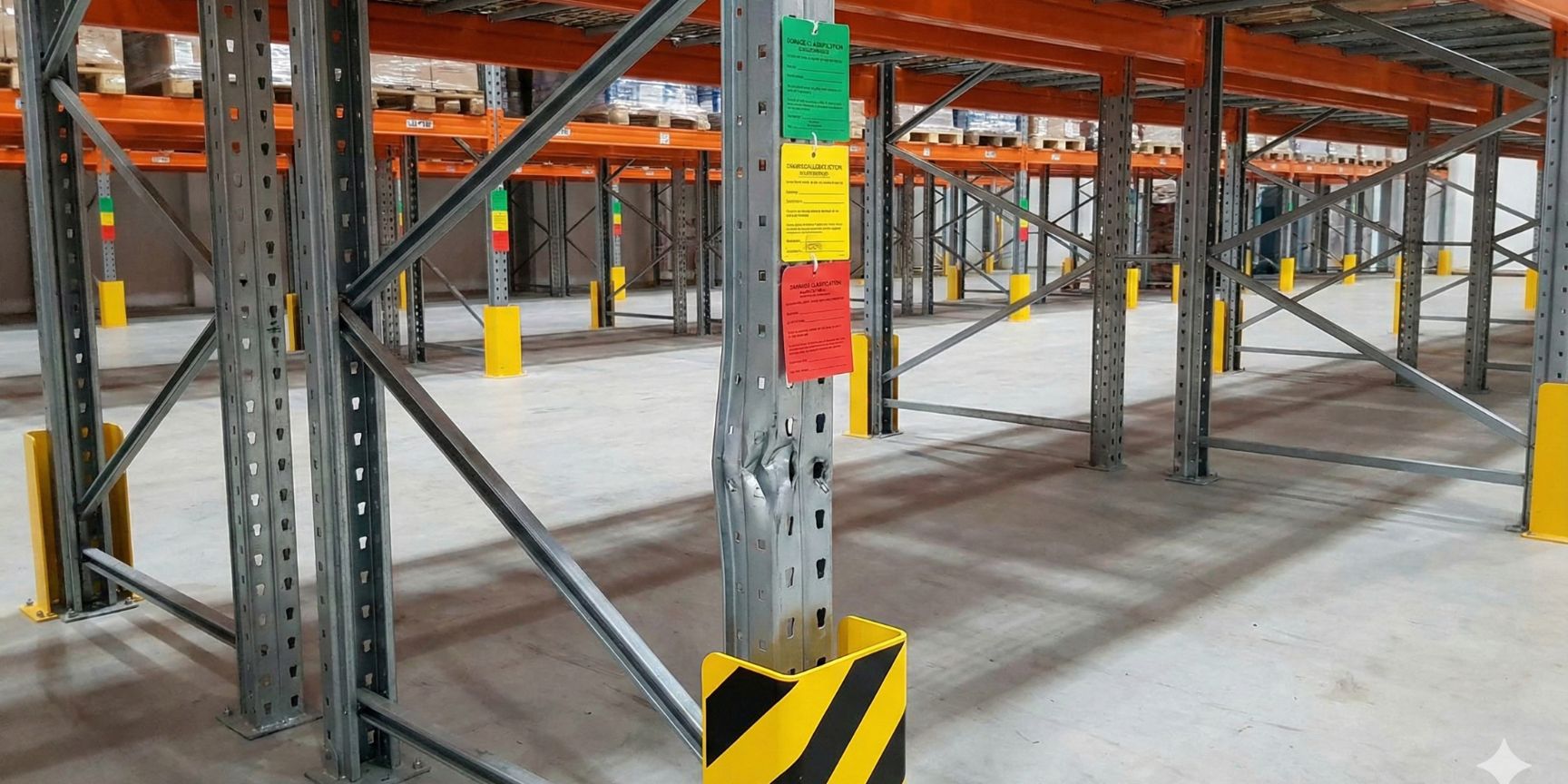
Common defects: Damaged supports, missing locking pins on trusses (lift-out protection) or missing load shields. A damaged stand often loses over 40% of its load-bearing capacity, even if the dent looks small.
Questions & Answers (FAQ) from practice
Question: Does every heavy-duty rack have to be anchored to the ground?
Answer: In the vast majority of cases, yes. This is especially the case if the ratio of shelf depth to shelf height is unfavourable (risk of tipping over) or if industrial trucks (forklifts) are used. The anchoring also absorbs horizontal forces.
Question: Can I use used heavy-duty shelving in my new hall?
Answer: In principle, yes, but with caution. You will need the original assembly instructions and the manufacturer's load tables. Often, static evidence is missing in used purchases. Without stress signs, operation is prohibited. In addition, it must be checked whether the used rack is approved for the specific earthquake zone of the new location.
Question: What does "collision protection" mean and is it mandatory?
Answer: At corner areas of aisles and passageways, a stationary collision protection (usually yellow-black, L-shape, min. 40 cm high) is mandatory. It protects the corner uprights from collisions with forklifts.
Figures, data, facts about planning
The following rules of thumb and values help with the design of a warehouse with heavy-duty racks:
- Pallet height: Always plan incl. pallet + goods + min. 10 cm "lifting height" (distance to the next crossbeam).
- Aisle width (aisle width - AST): This depends on the forklift.
- Reach truck: approx. 2.80 m – 3.00 m
- Forklift (3-wheel/4-wheel): approx. 3.50 m – 4.00 m
- Narrow-aisle forklift (VNA): from approx. 1.80 m
- Steel quality: High-quality racks are often made of high-strength steel in order to carry higher loads with a lower material thickness (work hardening).
Future trends: The shelf as part of automation
In modern "brownfield" or "greenfield" projects, the boundaries are blurred. The heavy-duty rack is increasingly becoming the carrier of automation technology. Shuttle systems drive on the profiles, which used to hold only pallets.
For contract logistics, this means that the investment in racking systems will increase, but efficiency (picks per hour) will increase drastically. Anyone who builds or rents a hall today should already design the statics of the racks in such a way that partial automation is possible later (tighter tolerances).