




Handling Units in Logistics
Table of Contents
- Handling Units (HU): The backbone of modern intralogistics
- Anatomy of a Handling Unit: More Than the Sum of Its Parts
- Handling Units in Warehouse Logistics: Efficiency through Standardization
- Contract logistics: HU as a provider of value-added services
- Requirements for the logistics property and the hall
- Questions and answers (Q&A) for practice
- Facts & Figures: Increased Efficiency through Technical Inspection Management
- Conclusion for niche practice
Handling Units (HU): The backbone of modern intralogistics
In the world of logistics, the handling unit (HU) is much more than just a package or a pallet. It is a physical unit consisting of load carriers (e.g. Euro pallet, lattice box) and the packages on them. From an information technology point of view, it is a clearly identifiable entity that is managed as a single object in the Warehouse Management System (WMS).
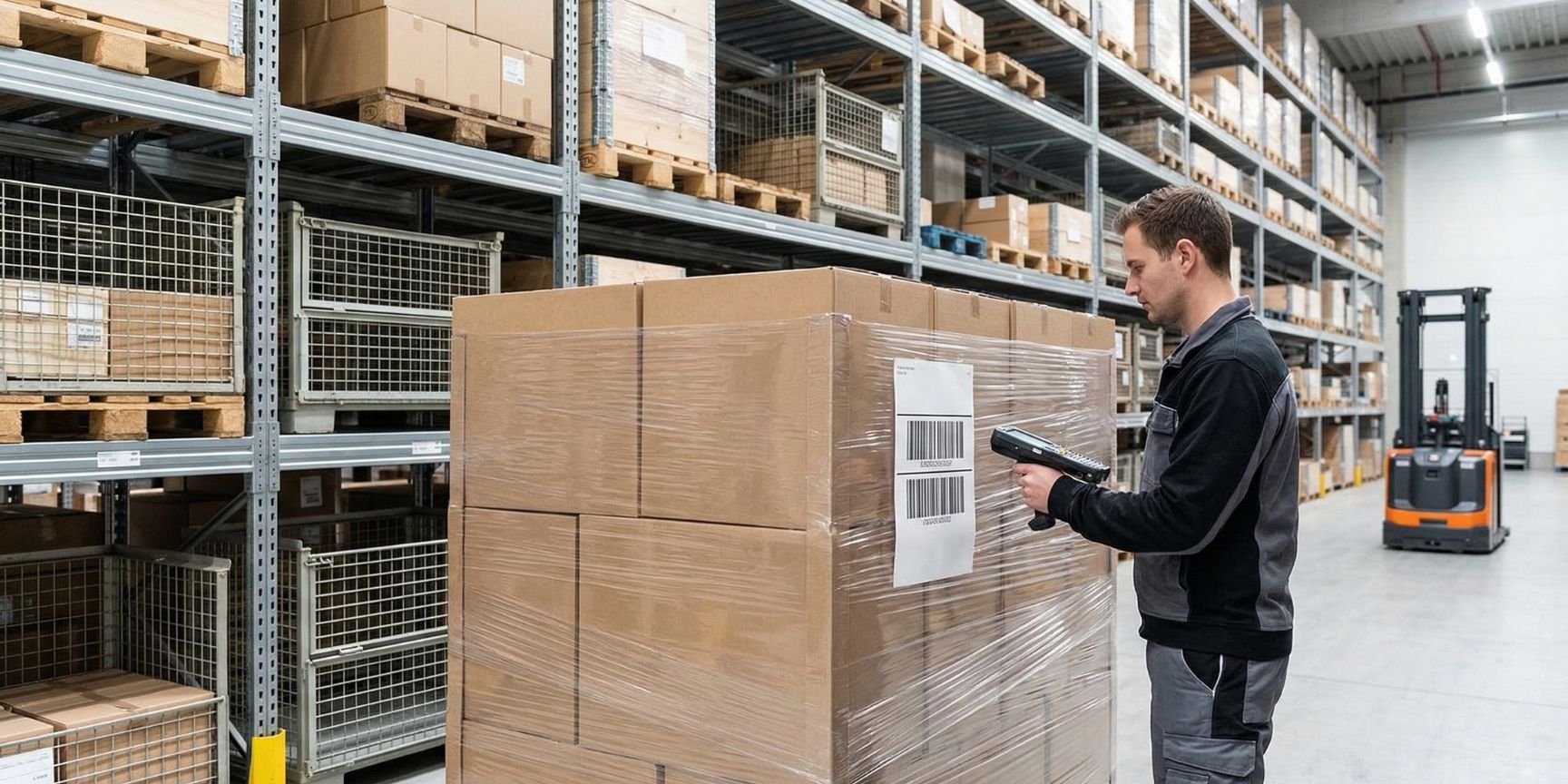
Anatomy of a Handling Unit: More Than the Sum of Its Parts
An HU has a modular structure. It essentially consists of three components:
- The load carrier: The foundation (e.g. pallet, container, tray).
- The packaging material: protective agents such as stretch film, strapping or edge protection.
- The content: The actual goods (materials or products).
The decisive factor for deep logistics is uniqueness. Each HU is given a worldwide overlap-free number, usually the SSCC (Serial Shipping Container Code). This 18-digit code makes it possible to track the lifecycle of the unit without having to check the contents again every time you scan.
Handling Units in Warehouse Logistics: Efficiency through Standardization
In the warehouse, the HU serves as a control element. As soon as a technical inspection is recorded in the goods receipt, the system "knows" which dimensions and weights it has to move.
- Master data relevance: A standard Euro pallet is the basis for the shelving and shelving design.
- Storage space optimization: By recording the HU height, modern WMS can operate "chaotic warehousing" and assign pallets to optimal shelf compartments according to their actual height (e.g. 1.20 m vs. 1.80 m).
- Throughput times: Since only the label of the HU has to be scanned during the transfer process, the error rate is reduced by almost 99% compared to individual article booking.
Contract logistics: HU as a provider of value-added services
In contract logistics, HU's flexibility is crucial. Here, a "re-unitization" often takes place. A service provider receives homogeneous HUs (single-type) and uses them to form customer-specific mixed HUs (display construction, sets).
- Nested HUs: Nesting is a complex topic in specialist logistics. A "mother HU" (e.g. a pallet) contains several "child HUs" (e.g. boxes with their own barcodes). IT must be able to map the hierarchies so that all contained subunits are automatically marked as "loaded" when the pallet is loaded.
- Process costs: In contract logistics, services are often billed per "handling". The more stable and standardized the HU, the lower the process costs per pick.
Requirements for the logistics property and the hall
The nature of the handling units defines the architecture of the logistics hall. A modern logistics property must be optimized for the common HU types.
| Feature | Request by HU |
| Floor load capacity | Point loads due to heavy HUs (e.g. lattice boxes) |
| Hall height | Usable height for stacking HUs |
| Ground level | Vibration-free transport of unstable HUs |
| Gate width | Manoeuvring room for forklifts with wide HUs |
Especially in the case of automated high-bay warehouses (HRL), the contour control of the HU is essential. Protruding film residues or deformed pallets immediately lead to system stops.

Questions and answers (Q&A) for practice
Question: What is the difference between a load unit (LE) and a handling unit (HU)?
Answer: The unit of cargo is a purely physical concept (commodity + carrier). The handling unit is the logistical and IT term that includes identification (labeling) and traceability in the system.
Question: Why do HU processes often fail in practice?
Answer: It is usually due to poor master data quality or damaged labels. If the scanner cannot read the SSCC, the digital chain breaks and it has to be re-recorded manually, negating the efficiency benefits.
Question: Can HUs also be virtual?
Answer: Yes, in modern WMS, virtual HUs can be formed to prepare goods movements (e.g. when picking on a fictitious trolley) before the physical packaging is completed.
Facts & Figures: Increased Efficiency through Technical Inspection Management
Studies show that companies that consistently rely on HU-controlled processes achieve the following improvements:
- Reduction of search times in the warehouse: up to 30%.
- Increase in loading speed: approx. 25%, as loading lists are automatically compared with the scanned HUs.
- Shipping error rate: Drops to less than 0.05% when using scanning methods.
Conclusion for niche practice
The management of handling units is the foundation for automation and digitalization. If you don't have your HUs under control, you will fail to introduce robotics or automated guided vehicles (AGVs), as these systems rely on exact physical and digital definitions. For logistics planners, this means that the property must be planned around the HU, not the other way around.