




Picking area in the warehouse
Table of contents
- The picking area: The strategic center of modern logistics real estate
- Definition and function: Where efficiency takes shape
- Requirements for the logistics property: More than just concrete floors
- The picking area in contract logistics: flexibility as an asset
- Key figures and planning: Making success measurable
- Automation and Trends: The Path to the "Smart Area"
- Expert check: Frequently asked questions about the picking area (FAQ)
- Conclusion for practice
The picking area: The strategic center of modern logistics real estate
In the world of logistics, the picking area is the place where abstract inventory becomes concrete customer orders. Whether in e-commerce, production supply or spare parts, the efficiency of this zone largely determines the throughput times and error rate of a location. For operators of logistics properties and contract logistics companies, the design of this area is a highly complex calculation task between ergonomics, land use and degree of automation.
Definition and function: Where efficiency takes shape
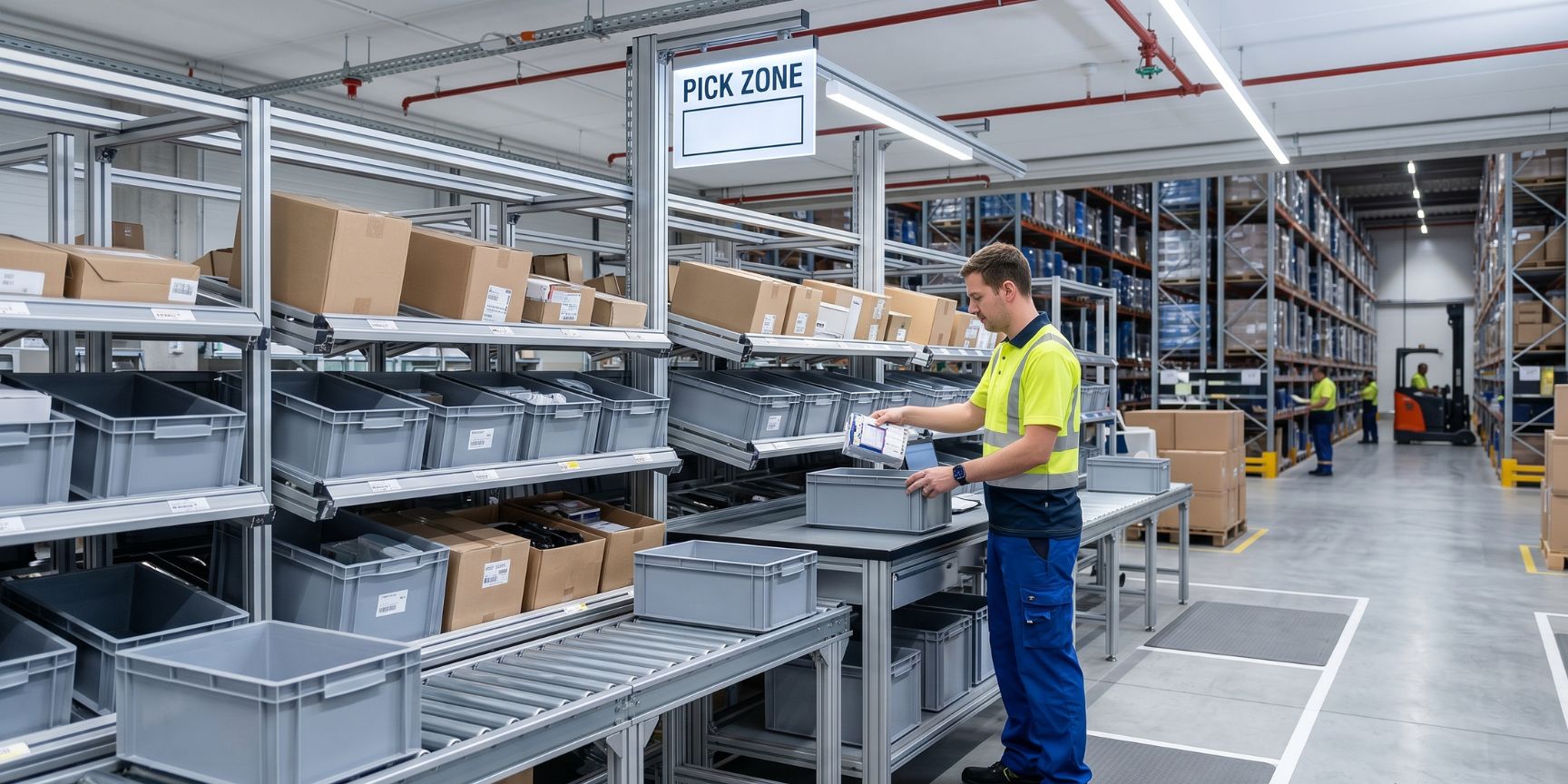
The picking area (also known as the pick zone) is the functional part of a warehouse in which partial quantities are taken from provided assortments and merged into an order. In contrast to the pure storage area, where pallets often rest for months, there is a high level of dynamism here.
In the technical language of warehouse logistics , we distinguish between static provision (man-to-goods) and dynamic provision (goods-to-man). While in the static variant the employees call at the storage locations, automated systems such as shuttles or AGVs (Autonomous Guided Vehicles) transport the goods directly to the picking station.
Requirements for the logistics property: More than just concrete floors
Today, a logistics property must be flexible enough to map a wide variety of picking scenarios. From the point of view of real estate development, three factors are in the foreground:
- Floor load capacity: Picking zones with high racks or automatic small parts warehouses (AS/RS) require an extremely high point load capacity and flatness (according to DIN 18202). As a rule, a floor load capacity of 5 to 7 tons per square meter is targeted.
- Lighting and working climate: Since people work intensively here, occupational health and safety guidelines often prescribe an illuminance of at least 200 to 300 lux . Modern halls rely on LED systems with presence detectors.
- Fire protection: Picking areas are often considered zones with increased fire load (packaging material, cardboard boxes). Sprinkler systems (ESFR sprinklers) must be precisely matched to the shelf heights.
The picking area in contract logistics: flexibility as an asset
In contract logistics, the picking area is often a "breathing system". Since service providers often operate multi-user locations, the space must be quickly adaptable to new customer requirements.
A critical factor here is area productivity. Contract logistics companies often calculate with the pick output per square metre. A practical example: While around 60–80 picks per hour are achieved in manual shelving systems, highly automated picking stations can process over 500 to 1,000 items in the same time. This drastically reduces the space required, but increases the investment costs (CAPEX) in the property.
Key figures and planning: Making success measurable
To evaluate a picking area, logistics planning uses hard facts:
| Key figure | Significance | Target value (example) |
| Pick density | Number of withdrawals per m² | Depending on the depth of the product range |
| Travel time share | Share of walking distances in total time | < 50% (manual) |
| Degree of land use | Ratio of usable area to traffic area | > 80% |
| Error rate | Proportion of incorrectly picked items | < 0.1% |
Well-founded planning uses the ABC analysis to position fast-moving items (A-items) in the ergonomically most favourable places with the shortest distances. B and C items move to the edge zones or higher shelf levels.
Automation and Trends: The Path to the "Smart Area"
The logistics property of the future will be increasingly shaped by technology. Three trends are currently dominating the design of picking areas:
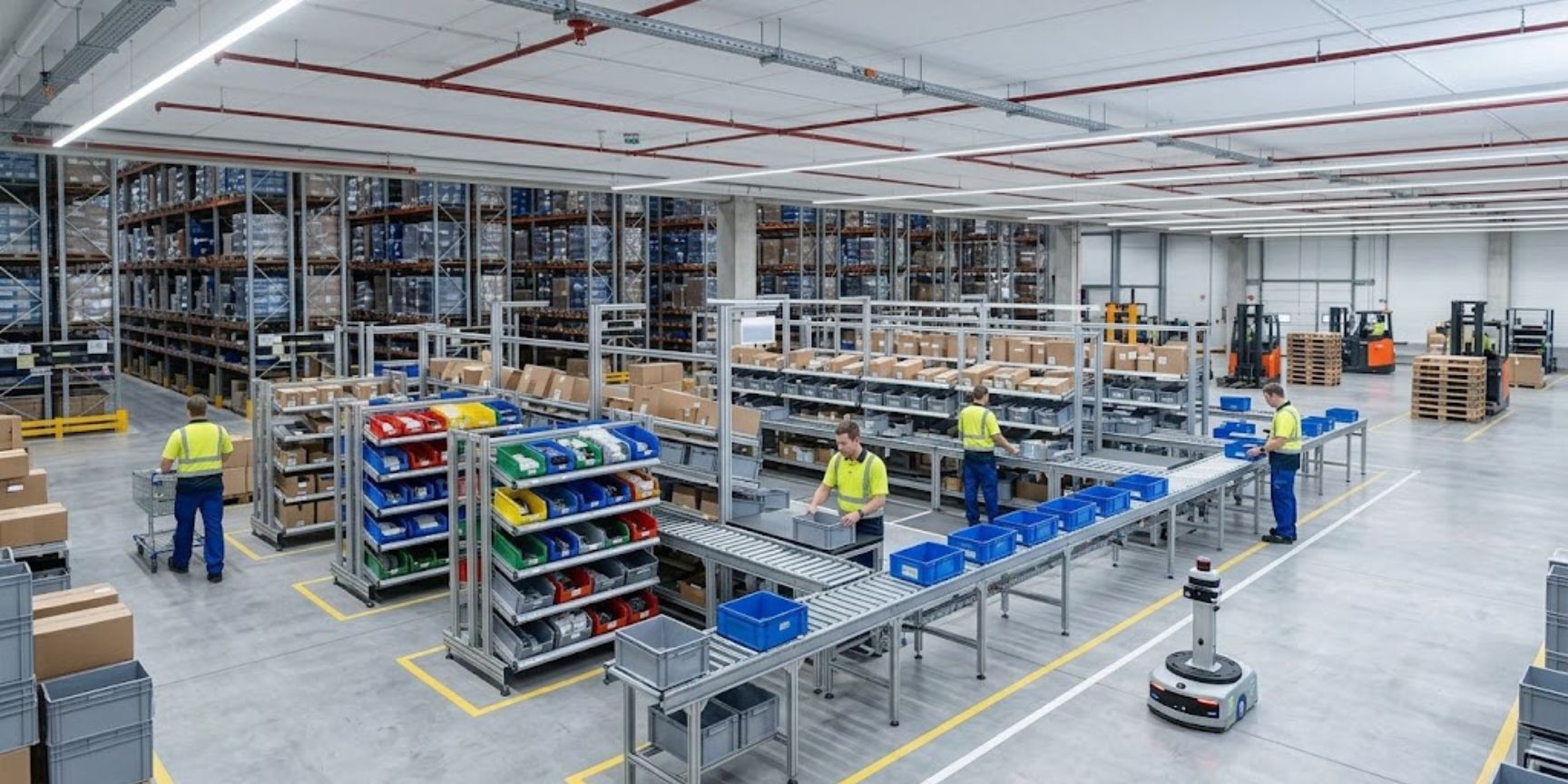
- Mezzanine levels: In order to make optimal use of the hall height (often 12 meters UKB), picking areas are shifted vertically. Steel mezzanines double or triple the pick area without any additional floor space.
- Cobots and robotics: Mobile robots support employees in transporting the picks, which reduces physical strain and minimizes travel times.
- AI-powered slotting optimization: Algorithms recalculate which item should be in which place on a daily basis, based on current order data and forecasts.
Expert check: Frequently asked questions about the picking area (FAQ)
Question: How large should the picking area be in relation to the total warehouse?
Answer: That depends a lot on the business model. In the classic pallet warehouse, it often takes up only 10–15%. In e-commerce with small-scale order picking, this share can increase to over 50% of the floor space.
Question: What role does the ceiling height play in order picking?
Answer: A decisive one. Heights of more than 2.50 metres cannot be used for manual picking without aids. However, in automated systems or stage constructions, a hall height of 10 to 12 meters is essential in order to make economical use of the volume.
Question: Why is soil quality so critical for modern picking zones?
Answer: Automated guided vehicles (AGVs) and narrow aisles in high-bay warehouses do not forgive uneven floors. Even millimeter deviations at high heights can lead to dangerous vibrations of the masts or navigation errors of the robots.
Conclusion for practice
The planning of a picking area is an interdisciplinary task. The logistician looks at the processes, the real estate developer at the structural conditions and the investor at the ability to use it for third parties. Today, an excellently planned picking area is no longer a static structure, but a highly flexible module that adapts to volatile markets. Those who save here will pay more later through high process costs and slow delivery times.
Your Ideal Logistics Warehouse
Browse listings for warehouse space, logistics real estate, industrial land, and contract logistics solutions.
Browse Exposés
Maximize Exposure for Your Warehouse Space
Showcase your logistics properties and attract qualified inquiries.
Discover Products