Visual Location Analysis: The Key to Efficient Logistics Real Estate
The search for the right storage space is much more than comparing prices per square metre. In the complex world of warehouse and contract logistics, geographical location determines the efficiency of the entire supply chain. Our map view on LAGERflaeche.de not only gives you an overview of available halls, but also enables an immediate assessment of the infrastructural connection. Whether it's a "big box" at a motorway junction or a city hub for the last mile, the visualisation of locations helps tenants and logistics service providers to capture macro and micro location factors in a matter of seconds.
Macro Location and Micro Location: Location Factors in Logistics
When choosing a logistics property, two levels must be considered, which can be seen on our map.
- The macro location: It describes the large-scale environment. Is the property located in one of Germany's established logistics clusters (e.g. Rhine-Ruhr, Hamburg, Rhine-Main)? For contract logistics, proximity to sales markets and production facilities is essential to keep transport costs low.
- The micro-location: This is all about the details on site. How far is the nearest motorway entrance? Is there a connection to rail freight transport (CT terminals) or inland ports? Is the property located in a designated 24/7 industrial area that allows night operation, or in a mixed area with noise protection requirements?
The map visualizes these relationships and helps to avoid "blind spots" in the supply chain.
Typology of logistics real estate: From transshipment hall to high rack
Not every hall is suitable for every purpose. Modern logistics properties are highly specialised functional properties. In our database and map view you will find differentiated property types:
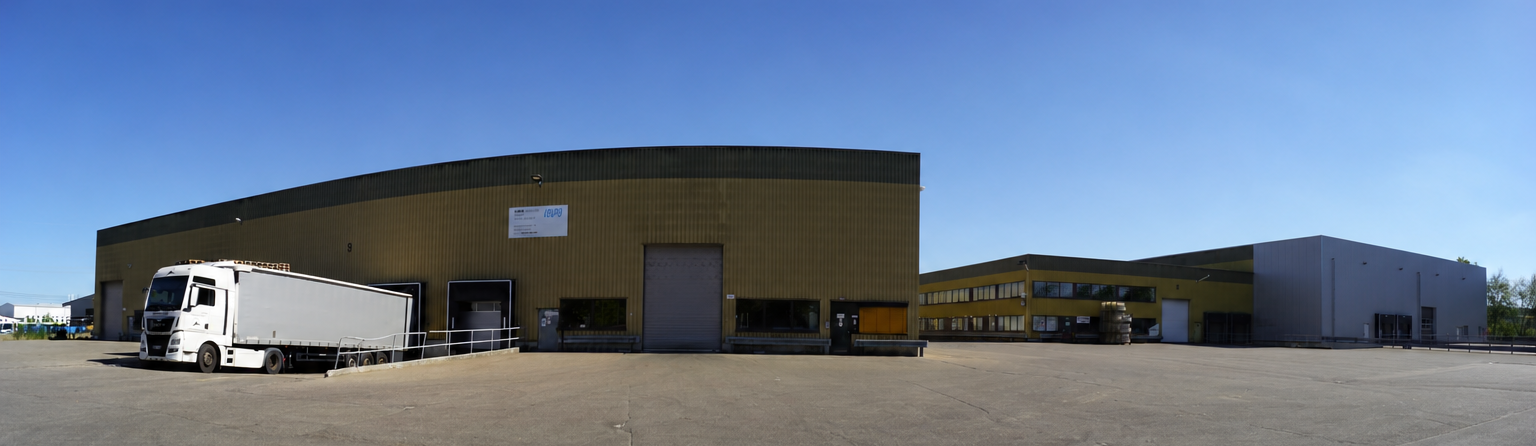
- Distribution halls & big boxes: Large-scale properties (often >10,000 m²) with a hall height of usually 10.00 to 12.00 metres UKB (lower edge of truss). They are designed for high throughput.
- Cross-docking facilities: These properties are characterized by a high number of gates in relation to the floor area. They are used for the rapid turnover of goods without long storage periods. Ideal for CEP services (courier, express, parcel) and fresh logistics.
- Warehouses close to production: Often directly connected to the factory premises, specializing in JIT/JIS (Just-in-Time/Sequence) delivery.
- Hazardous materials warehouses: Properties that have to meet special structural requirements (e.g. WGK films, extinguishing systems).
Technical requirements and third-party usability
For investors and tenants, the so-called "third-party usability" is a decisive criterion. A logistics property should be designed in such a way that it can be used by different users from the retail, industrial or service sectors.
Important technical parameters that can often be found in the detailed views of the map:
- Floor load capacity: Today, 50 kN/m² (approx. 5 tonnes) is standard for carrying heavy industrial trucks and racking systems.
- Column grid: A wide grid (e.g. 12 x 24 metres) enables flexible racking and efficient routes for forklift trucks.
- Delivery: The ratio of ground-level gates to dock levellers (ramps). The rule of thumb is often one door per 1,000 m² of hall space for standard warehouses, significantly more for transshipment halls.
- Lighting and fire protection: LED lighting and early suppression, fast response (ESFR) sprinkler systems are now the market standard, reducing insurance costs and ancillary costs.
Contract logistics: More than just space
Many users of our platform are not just looking for an empty shell, but for a partner for contract logistics. In this case, a logistics service provider (3PL - Third Party Logistics) takes over logistical tasks for the shipper on a long-term basis.
The map view helps companies identify service providers that are strategically located to provide value-added services (VAS). This includes assembly, packaging, returns management or quality control. Here, real estate becomes an enabler for complex services. The decisive factor is often whether the hall already has IT infrastructure and staff on site to ensure a quick "go-live" of new projects.
Market rents and cost structures in logistics
The costs for logistics space vary greatly in Germany. While prime rents of over €7.00 to €8.00 per m² are achieved in top locations such as Munich or Hamburg, B and C locations or peripheral areas in eastern Germany often still offer space between €4.00 and €5.50.
In addition to the basic rent, users must keep an eye on the management costs (operating costs). Older existing properties (brownfields) often have a lower rent, but can cause higher energy costs than modern new buildings (greenfields) that are certified according to DGNB or BREEAM due to poor insulation or outdated heating systems.
Questions and answers (FAQ) on the search for logistics space
What is the difference between warehouse logistics and contract logistics? Warehouse logistics primarily refers to the physical storage and management of inventory. Contract logistics is a long-term, contractually regulated cooperation in which a service provider (3PL) takes over entire process chains – from goods receipt and storage to processing (value-added services) and shipping.
Why are "brownfields" interesting in the site search? "Brownfields" are formerly used industrial wastelands that are being revitalized. Since building land for logistics ("greenfield") is extremely scarce in Germany and often difficult to enforce politically, brownfields often offer the only opportunity to realize large areas in locations close to conurbations. They also often score points with an existing infrastructure.
What is the significance of the UKB hall height? The height "lower edge of the binder" (UKB) determines the storage volume. An increase from 10.00 m to 12.00 m often allows an additional shelf level. This increases the storage capacity per square metre of floor space by up to 20%, which massively increases the cost-effectiveness of the area.
How do I find logistics areas for dangerous goods? Use the filter functions or detailed descriptions in the map view. Hazardous materials storage facilities are subject to the Federal Immission Control Act (BImSchG). Pay attention to features such as WGK-capable floors (water hazard class) and special fire compartments. Not every standard logistics hall is allowed to store dangerous goods.