



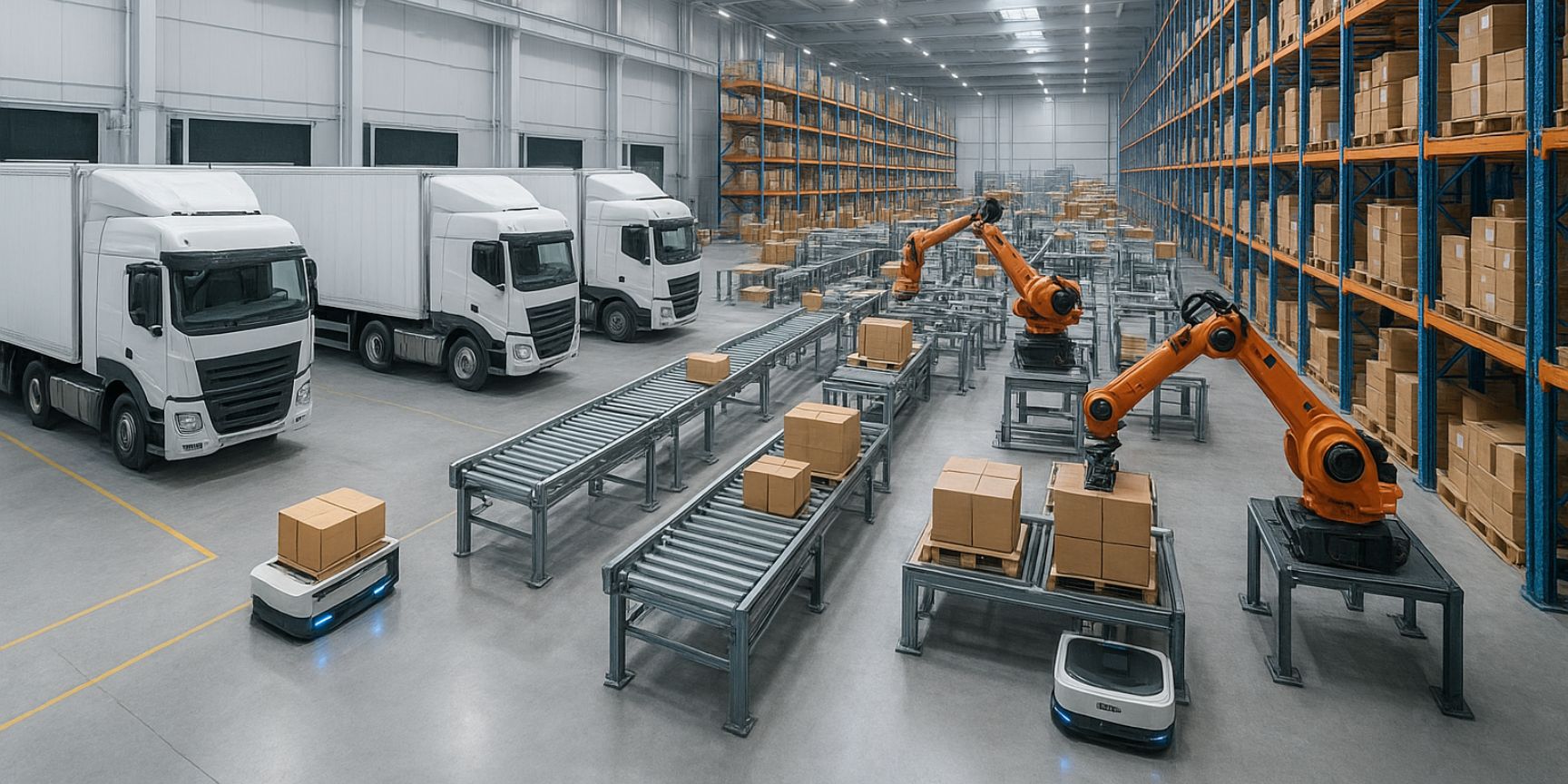
Warehouses, Halls, Logistics Areas: A Compass for the Jungle of Terms used in Logistics Real Estate
Table of Contents
- The basics: More than just four walls and a roof
- The shift to logistics: Why the "logistics space" is more than just a warehouse
- The industrial hall: Where production meets storage
- In the open air: The niche of the open-air warehouse
- The World of Specialization: When Standard Isn't Enough
- A look across borders: What does the world name its camps?
- Why the differences? Law, history and the market drive terminology
- Conclusion: Precision is not an end in itself, but an economic advantage
Have you ever wondered why there seem to be countless terms in German for places where goods are stored? We are talking about storage areas, halls, warehouses, logistics areas, but also industrial halls or outdoor warehouses. Is this just a linguistic peculiarity or are there tangible, practice-relevant differences behind it? And what does that actually look like in an international comparison?
The answer is clear: the variety of names is no coincidence. It is the result of a highly developed, specialised logistics industry and accurately reflects the different functions, equipment and legal frameworks. For anyone working in logistics, e-commerce or the manufacturing industry – from supply chain managers to real estate investors – understanding these nuances is crucial. This article takes you deep into the jungle of terms, sheds light on the subtle differences, shows global deviations and provides you with the practical utility value that you need as a specialist and manager.
The basics: More than just four walls and a roof
Let's start with the most basic terms. A simple hall is initially just a large, covered room. It offers protection from the weather, but its use is not further specified. Only the addition makes the difference:
- Warehouse: Here the purpose is clearly defined. A warehouse is primarily used to store goods. The focus is on pure storage. The technical equipment is often basic: floor, walls, roof, gates.
- Camp: This is the overarching, non-specific term. A warehouse can be a hall, but also a basement room, a shed or a defined area in a larger building.
- Storage: Describes the process itself, i.e. the activity of storage, retrieval and intermediate storage of goods.
The decisive question is therefore not whether, but how to store. A simple warehouse from the 1980s meets basic needs, but is often overwhelmed by today's requirements for fast, efficient movement of goods.
The shift to logistics: Why the "logistics space" is more than just a warehouse
The term logistics space or logistics property marks a decisive development. It was created when pure storage was replaced by more complex logistical processes. This is no longer just about storage, but about the entire flow of goods (supply chain).
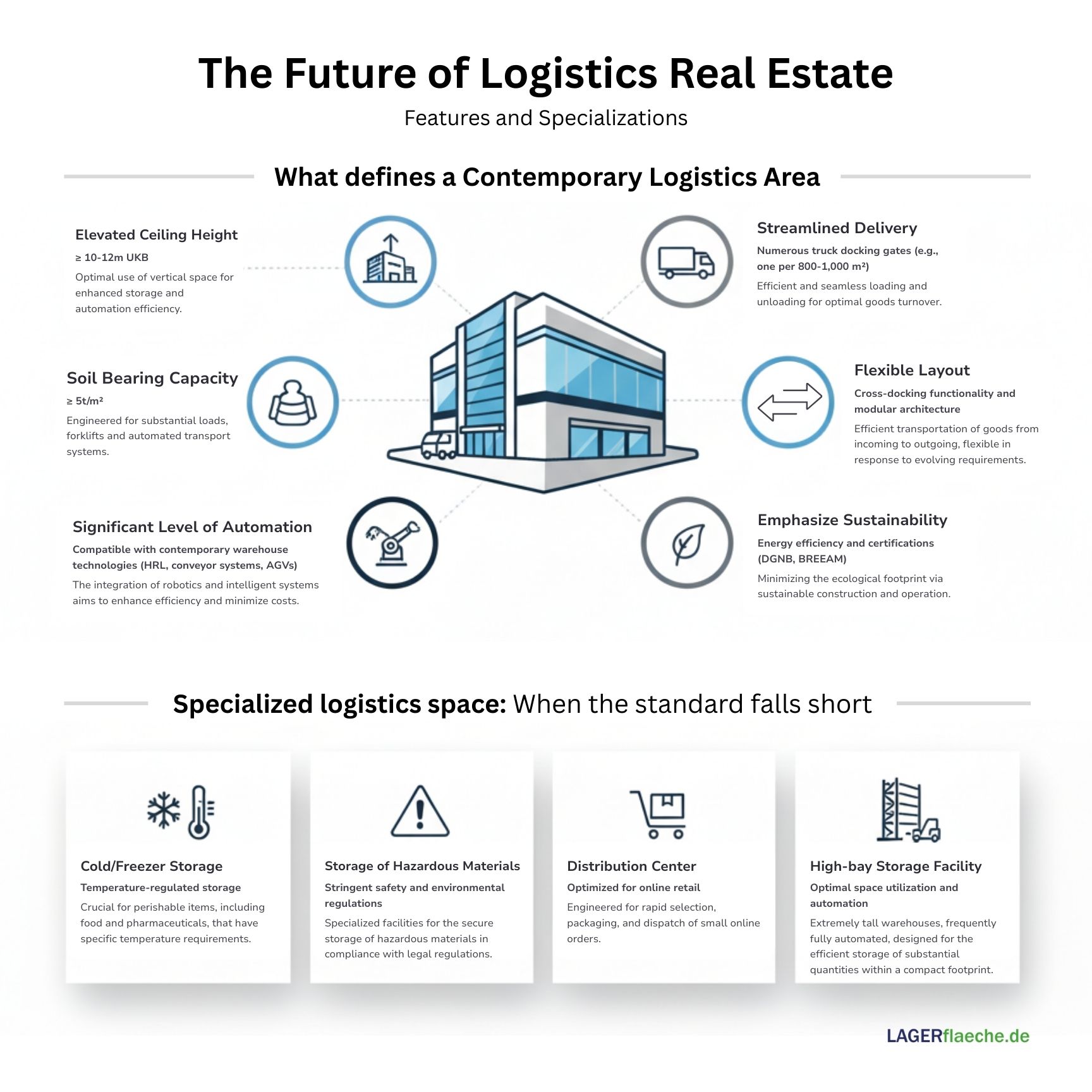
A modern logistics space is characterized by specific features that a pure warehouse often does not offer:
- Delivery: Sufficient truck docking doors, ideally one door per 800 - 1,000 m² of hall space.
- Hall height: At least 10 metres lower edge of trusses (UKB), today often 12 metres or more to enable high-bay warehouses.
- Floor load capacity: Usually at least 5 tons per square meter.
- Layout: Cross-docking capability (incoming and outgoing goods on opposite sides) for fast goods turnover.
- Additional areas: Integrated office, mezzanine and social areas for administration and order picking.
According to the "Logistikimmobilien – Seismograph" of the logistics experts (an expert council led by Fraunhofer IML), the requirements for new-build logistics properties have risen steadily in recent years, especially with regard to sustainability standards (e.g. DGNB certification) and suitability for automation technology.
The industrial hall: Where production meets storage
An industrial hall is primarily designed for industrial manufacturing and production processes. Storage is often only a secondary function that serves to buffer raw materials or finished products. The structural requirements are therefore different:
- Crane runways: Often essential for the transport of heavy machinery or components.
- Media supply: Stronger power connections, compressed air or gas lines.
- Soil conditions: Often has to withstand extreme loads from heavy machinery or chemical substances.
Although an industrial hall can be used as a warehouse, its specific and often more expensive equipment usually makes it overqualified and uneconomical when no production takes place.
In the open air: The niche of the open-air warehouse
As the name suggests, the open-air warehouse is an uncovered storage area. It is only suitable for weather-resistant goods such as building materials, vehicles or containers. The decisive advantage is the significantly lower costs compared to a hall. However, there are special aspects to consider from a legal and insurance point of view, especially with regard to theft protection and environmental requirements.
The World of Specialization: When Standard Isn't Enough
The growing complexity of supply chains and products has given rise to a large number of specialized logistics properties. These meet highly specific requirements:
- Cold storage/fresh food centre: For food and pharmaceuticals with exact temperature requirements (e.g. 2-8 °C).
- Cold storage: Maintain temperatures of -18°C or colder. Construction and operation are extremely energy-intensive and expensive.
- Hazardous materials warehouses: Must meet the strictest legal requirements (Water Resources Act, Federal Immission Control Act), e.g. through special extinguishing water retention systems and explosion-proof areas.
- High-bay warehouse (HRL): Maximum use of space at height, often fully automated.
- Fulfillment Center: Specialized in e-commerce, optimized for the fast picking of small-scale orders.
These specializations show how differentiated the market has become. A logistics consultant looking for a "warehouse" for an online retailer actually means a "fulfillment center". Precision in language is the key to success here.
A look across borders: What does the world name its camps?
While the German language is very precise and descriptive, a more pragmatic approach is often evident abroad.
- Great Britain/USA: The term "warehouse" dominates here. The differentiation is usually made by additions. They are referred to as "distribution centers" (comparable to a logistics property), "fulfillment centers" (e-commerce) or "industrial buildings". The term "shed" is often used colloquially for large, simple logistics halls. The classification is often based on size and quality in "Grade A", "Grade B" etc.
- France: The term "entrepôt" is the equivalent of the warehouse. Similar to English, a distinction is made here between classes (Class A, B), which refer to the year of construction, height and equipment. "Plateforme logistique" describes a more modern logistics location.
- Netherlands: As the European logistics centerpiece, the Netherlands uses terms such as "distribution center" and "warehouse." The proximity to the ports has led to a strong specialization in multimodal logistics centers.
Why the differences? Law, history and the market drive terminology
The reasons for these national differences are complex:
- Legal and regulatory framework: German building law and environmental requirements (e.g. for hazardous substances) are extremely detailed and require a precise classification of buildings.
- Historical development: In Germany, logistics has developed out of production (industrial hall) and trade (warehouse). The terms reflect this evolutionary development.
- Economic structure: Germany's strong industrial base ("Mittelstand") with its focus on production and quality has promoted the need for specific building types such as the industrial hall. In more trade-oriented countries such as Great Britain or the Netherlands, the focus was more on pure distribution (warehouse, distribution center).
- Market practices: International real estate consultants such as CBRE, JLL or Colliers have contributed to harmonization by introducing Europe-wide classifications (e.g. according to hall height, modernity). Nevertheless, the vernacular, historically grown terms remain dominant. According to a 2023 market report by Colliers, a clear trend towards "big box" logistics properties (>10,000 m²) with high sustainability standards (BREEAM, LEED) is being observed in new buildings across Europe, which further harmonizes the terminology.
Conclusion: Precision is not an end in itself, but an economic advantage
The impressive variety of German terms for warehouse and logistics space is more than just a linguistic gimmick. It is a reflection of the precision, specialization and complexity that characterize the German and European economy.
For practitioners, the utility value is obvious:
- Efficient search: If you know exactly what you need – a logistics area with 12 m UKB and cross-docking function instead of just a "large hall" – you save time and money when looking for real estate.
- Legal certainty: Correct naming is crucial for building applications, permits and insurance contracts.
- Operational excellence: The right property is the physical basis for efficient processes. A wrong choice can drive up operating costs and reduce competitiveness.
The next time you stumble across the terms "warehouse", "logistics area" or "industrial hall", you will know that they are worlds that lie in between – worlds whose understanding is crucial in global competition.
Latest Blog Posts
Stay up to date with the newest trends, insights, and tips in warehouse and logistics. Our latest articles help you navigate the industry with confidence.
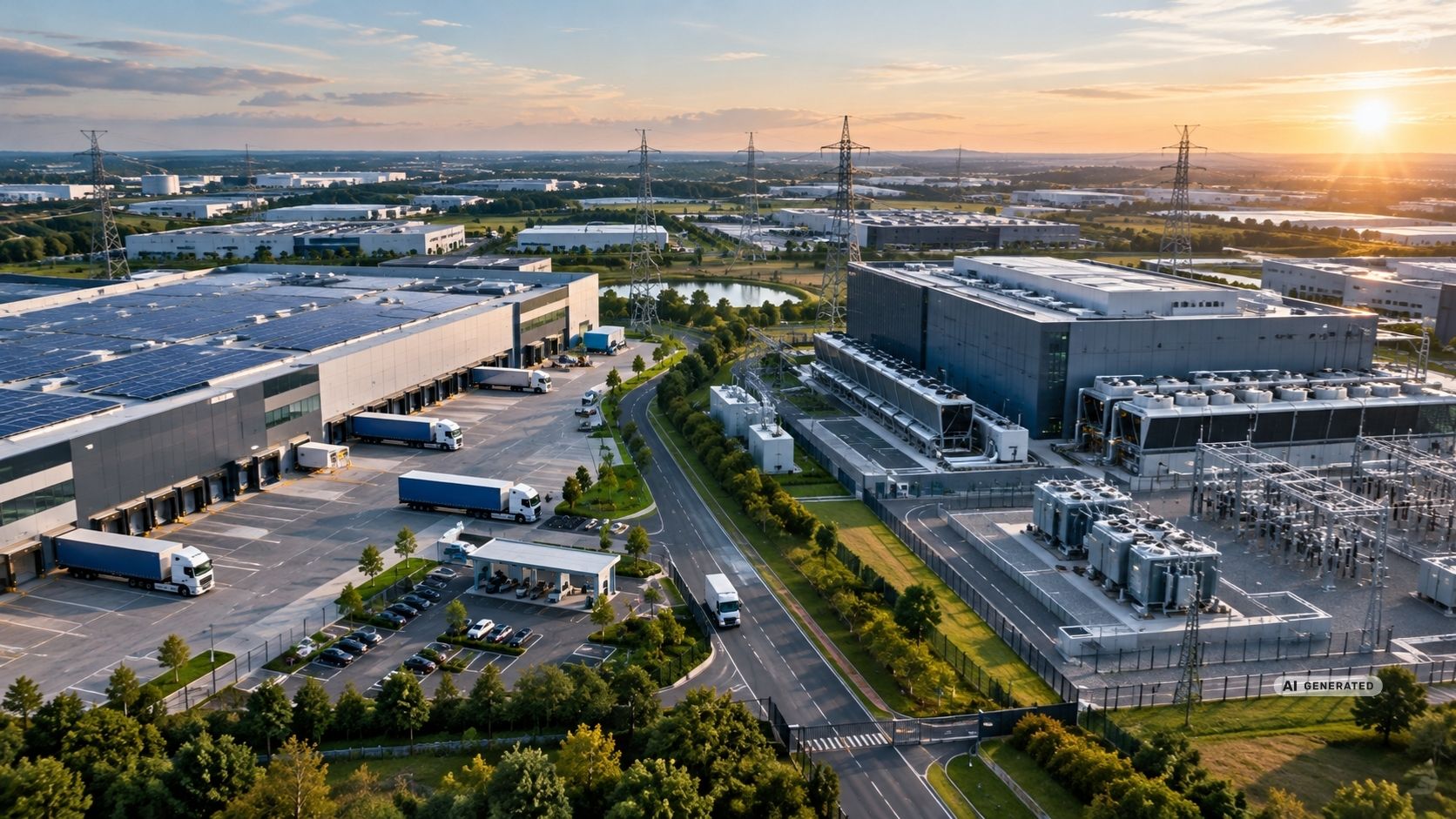
Data Centres vs. Logistics Facilities: The Race for Power and Land
Across Europe, logistics operators are competing for more than land and transport access. They increasingly need something much harder to secure: grid capacity. Data centres are intensifying that competition — and changing how logistics locations are evaluated....

Chinese companies discover Europe's logistics real estate
Chinese companies are becoming an increasingly visible user group in Europe's logistics real estate market. What does this mean for warehouse space, 3PL structures and the requirements for European logistics locations?...
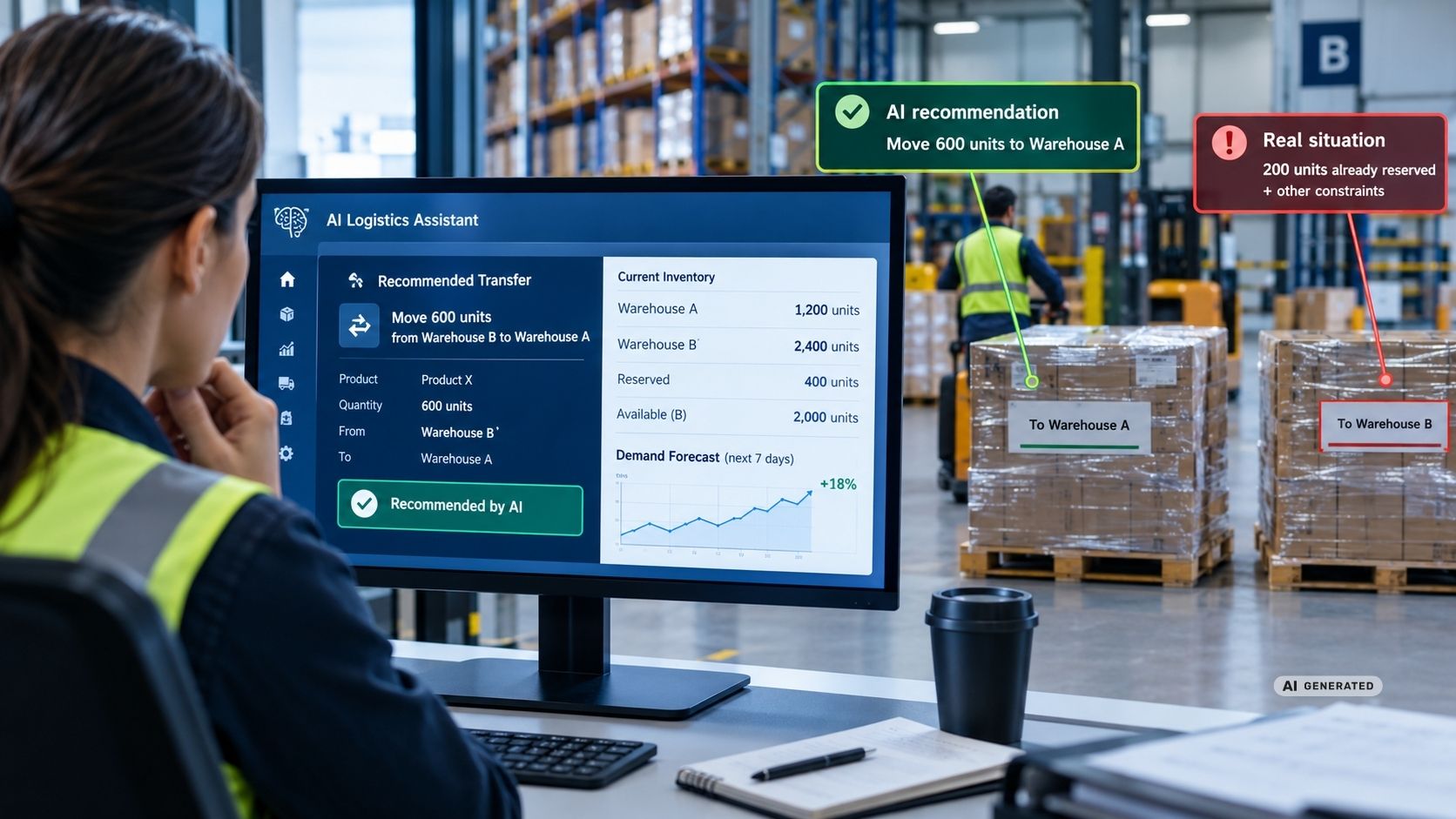
AI Hallucinations in Logistics: When AI Plans the Wrong Delivery
AI can analyze enormous amounts of logistics data — but it can also produce a convincing answer that is simply wrong. The critical question is not whether AI makes mistakes, but what happens when a wrong recommendation becomes an operational decision....
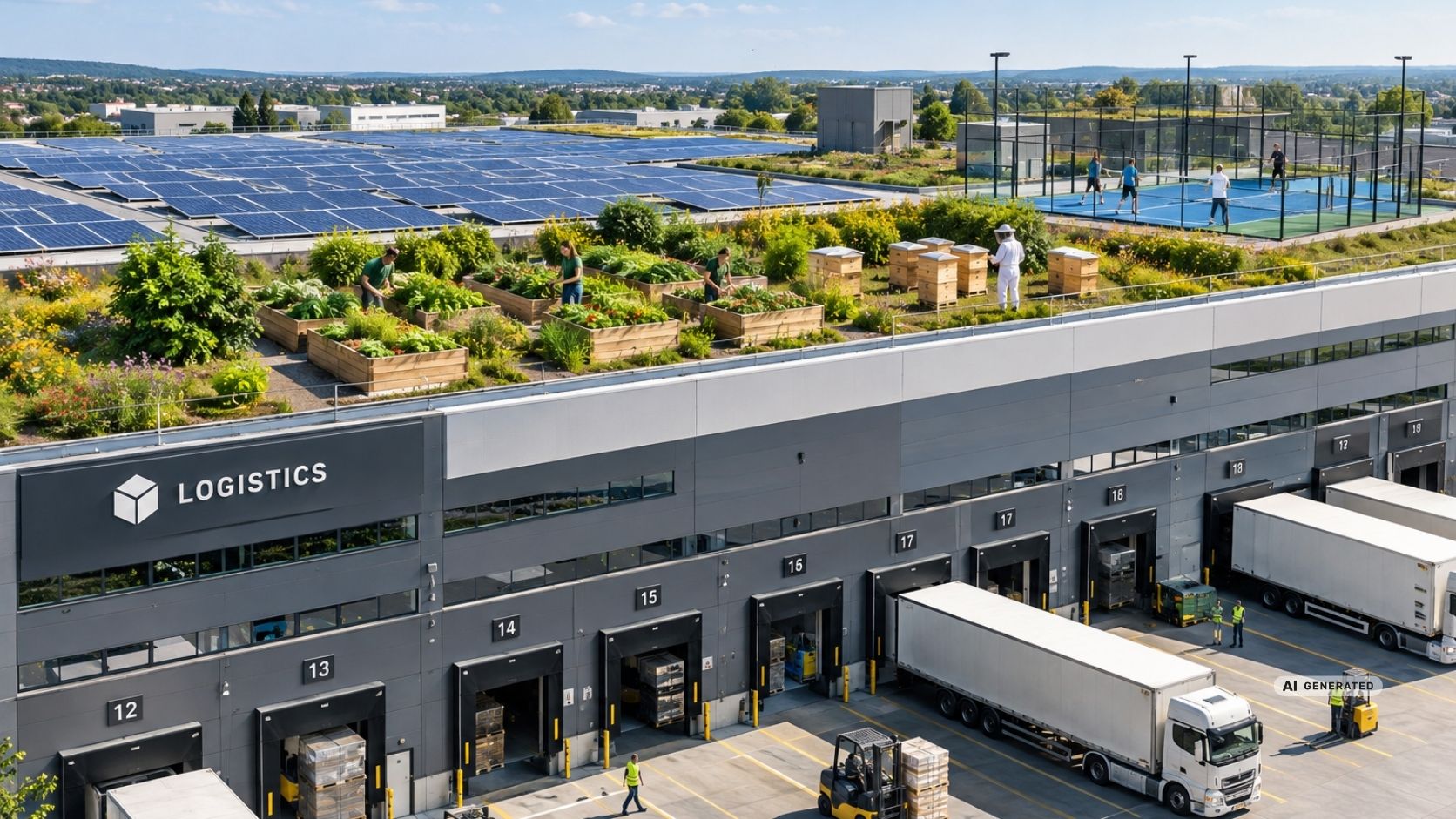
The Green Revolution on the Hall Roof: From Concrete Block to Ecological Power Plant?
Logistics roofs can do more than PV: greening, bees, urban farming and even sports areas turn unused roof space into multifunctional rooms....