



Short-term Storage Space: Why Operational Bottlenecks will become the New Reality in 2026
Table of Contents
- Why Short-term Storage Space is Suddenly Needed
- Overflow Logistics: When the Main Warehouse becomes a Risk
- Why Classic Storage Applications Often Fail
- The Hidden Costs of a Lack of Buffer Stocks
- Why not Every Free Space can be Used
- How Companies are Procuring Short-term Storage Space Today
- Practical Example: Automotive Suppliers under Time Pressure
- The 5 Most Important Test Criteria for Short-term Storage Space
- Why Short-term Warehouse Space will Become Strategically Important in 2026
- Conclusion: Short-term Storage Space becomes an Operational Safety Net
The demand for short-term storage space is increasing massively in Germany and Europe. While companies used to be primarily looking for seasonal additional space for the Christmas business, operational bottlenecks now occur all year round — often within a few hours or days. Production delays, nearshoring, volatile container arrivals, customs problems and fluctuating sales markets ensure that classic warehouse structures are increasingly reaching their limits.
For many companies, storage space available at short notice is thus becoming a critical component of operational risk management rather than a "nice-to-have".
The following are particularly affected:
- Industrial company with just-in-time production
- Automotive Suppliers
- E-commerce merchants
- Consumer Goods Manufacturers
- Trading companies with import dependency
- Contract logistics companies with peak capacity utilization
According to CBRE's European Logistics Real Estate Report, the availability of space in several top German logistics regions has recently been below 3% in some cases. At the same time, the requirements for speed and delivery capability are continuously increasing.
As a result, companies are increasingly looking for short-term buffer storage, overflow space or temporary hall capacities to cushion operational disruptions.
Why Short-term Storage Space is Suddenly Needed
In practice, stock shortages rarely arise slowly. They usually develop into a critical problem within a few days.
A typical scenario:
A delayed container ship arrives at the same time as regular import deliveries. The main warehouse is already operating at high capacity. Additional goods block ramps, driveways and staging areas. Operational efficiency drops dramatically within a very short time.
Exactly such situations have been increasing for years.
Drivers for this include:
- nearshoring and changing procurement networks
- higher safety stocks
- volatile transport times
- unstable global supply chains
- production postponements
- short-term fluctuations in sales
- waves of returns in e-commerce
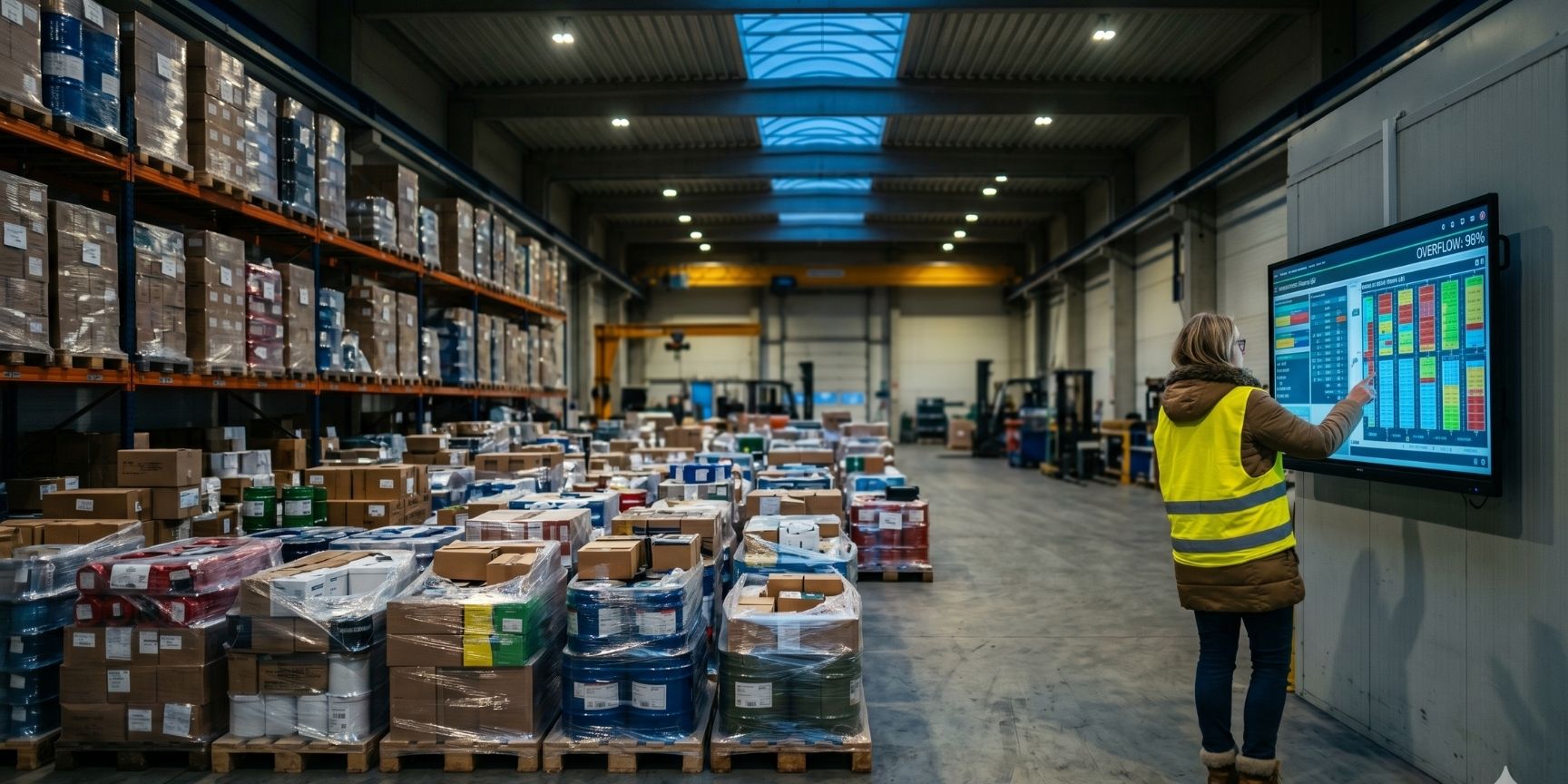
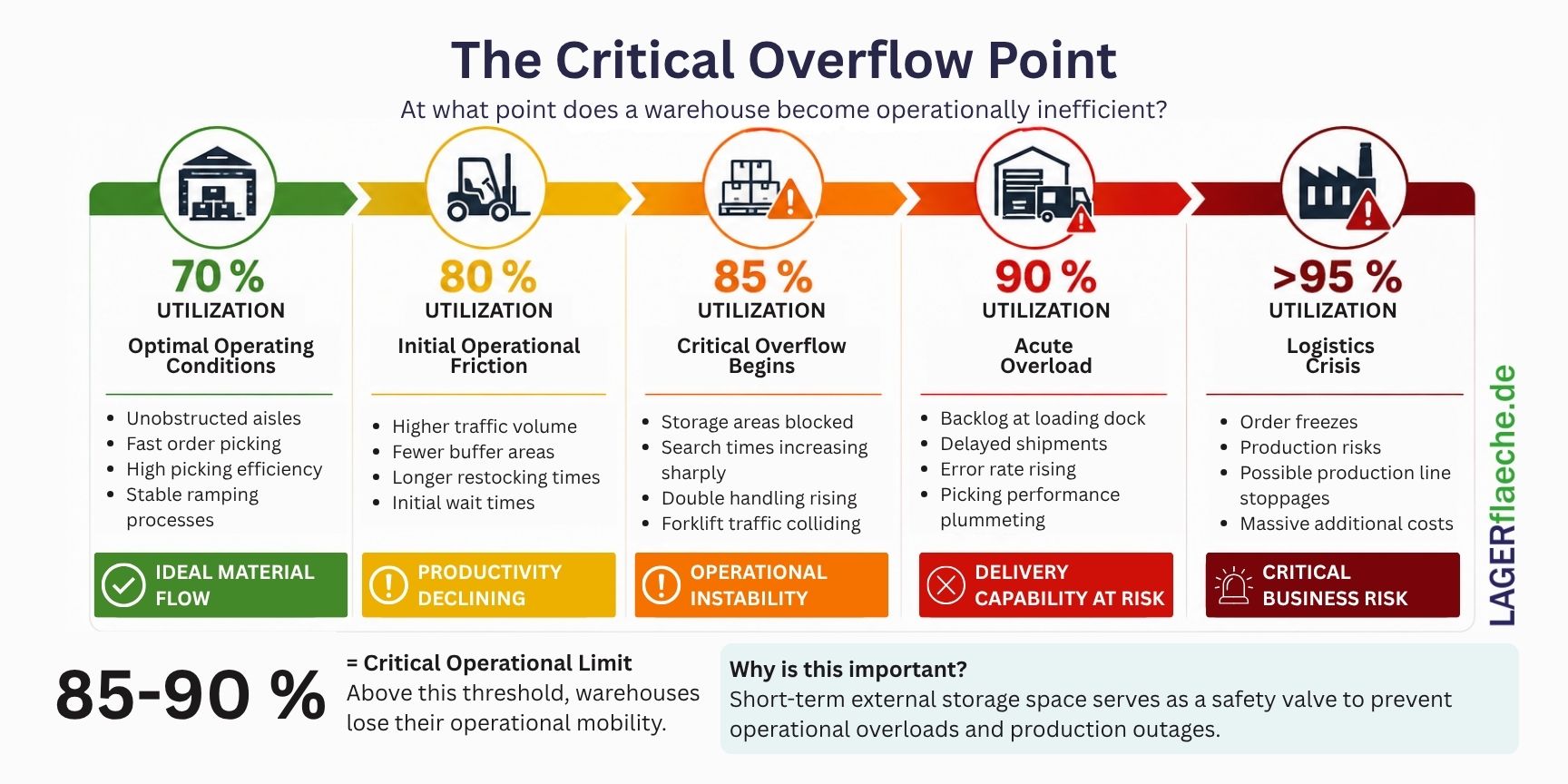
The situation becomes particularly critical from a hall occupancy rate of around 85 to 90%. From this point on, there is a lack of operational movement areas for forklifts, picking and transfers.
The result:
- longer search times
- blocked ramps
- increasing error rates
- delayed loading
- decreasing handling performance
- increasing accident risks
The real problem is often not the lack of square meters — but a lack of surgical freedom of movement.
Overflow Logistics: When the Main Warehouse becomes a Risk
Many companies underestimate the economic consequences of an overloaded warehouse.
As soon as pallets have to be placed on driveways, staging areas or in front of fire doors, the operational loss of control begins.
In practice, the following often arise:
- special stock transfers
- double handling
- manual intermediate storage
- search processes
- additional shuttle transports
- increased personnel costs
A permanently overloaded warehouse quickly becomes a cost multiplier.
Fraunhofer IML has been pointing out for years that inefficient material flows can cause considerable follow-up costs — especially due to multiple movements and decreasing handling speeds.
In addition, there are other risks:
| Risk | Operational consequence |
| Blocked ramps | Delayed truck handling |
| Lack of buffer areas | Production interruptions |
| Overcrowded picking | Higher error rate |
| Acceptance stop | Delivery delays |
| Lack of space in outbound | Line downtimes |
Many companies only calculate the price of additional storage space — but not the actual costs of a logistical collapse.
Why Classic Storage Applications Often Fail
Anyone who needs storage space at short notice quickly realizes that the classic real estate market only works to a limited extent.
Why?
Because many landlords are designed for long-term leases.
A company that is looking for 1,000 pallet spaces for three months at short notice often does not fit into classic marketing models.
In addition, there is another problem:
Free hall space is not automatically operational storage capacity.
An empty hall without:
- Shelving systems
- Forklifts
- Personal
- IT connection
- Fire protection approvals
- Ramp infrastructure
is often hardly usable in acute situations.
Especially under time pressure, companies do not need a "naked property", but logistics areas that are ready for immediate use.
This is why existing warehouse networks and contract logistics companies are becoming increasingly important.
The Hidden Costs of a Lack of Buffer Stocks
Many companies initially consider external storage space as an additional cost item.
However, this view does not go far enough.
The actual costs of a lack of alternative capacities are often significantly higher.
These include:
- production shutdowns
- contractual penalties
- delivery delays
- lost orders
- increased transport costs
- demurrage and deretention fees
- inefficient stock transfers
Especially in the automotive sector or in industry, production interruptions can cause enormous damage.
Even a few hours of downtime can cause costs in the six- or seven-figure range.
Temporary storage areas are therefore increasingly acting as operational risk insurance.
Why not Every Free Space can be Used
A common mistake is to equate available square meters with usable logistics space.
In reality, the requirements are highly specialized.
Depending on the industry, the following are required:
- HACCP or IFS certifications
- Temperature-controlled storage
- ESFR sprinkler systems
- Hazardous substance approvals
- High floor load capacities
- Heavy-duty shelving
- Video surveillance
- Duty-free warehouse functions
This becomes particularly critical in the case of:
- Pharmaceuticals
- Food
- Chemistry
- Automotive
- Battery and electronics storage
Short-term storage space must therefore not only be available — but also operationally compatible.
How Companies are Procuring Short-term Storage Space Today
The procurement of short-term storage capacities is changing significantly.
In the past, searches were usually carried out via:
- broker
- personal networks
- telephone inquiries
- manual tenders
Today, digital B2B platforms are increasingly emerging that make available capacities visible.
This allows companies to check much faster:
- available locations
- hall specifications
- certifications
- durations
- ramp equipment
- available pallet spaces
Especially in acute overflow situations, speed counts.
Many companies need an operational solution within 24 to 72 hours.
Here, digital matching processes are increasingly becoming a decisive competitive factor.
Practical Example: Automotive Suppliers under Time Pressure
A northern German automotive supplier came under massive pressure at the beginning of 2026 due to a blocked production batch.
Within 36 hours, several thousand lattice boxes blocked the internal staging areas.
The risk:
A production line standstill at the OEM.
The internal storage capacities were fully utilized. At the same time, ongoing production had to be continued.
An external storage solution within a radius of 20 kilometers was identified at short notice via a specialized B2B specialist portal.
The area offered:
- sufficient floor load capacity
- ramp connection
- forklift service
- immediate availability
- ERP connection
After just two days, the first shuttle transports to the external overflow warehouse were underway.
As a result, it was possible to:
- relieves the work,
- stabilizes production,
- and a possible line standstill can be prevented.
The cost of the temporary storage solution was significantly lower than the potential production losses.
The 5 Most Important Test Criteria for Short-term Storage Space
Under time pressure, critical points are often overlooked.
Companies should therefore always check these criteria:
Especially in crisis situations, the quality of these details determines the success of the entire alternative logistics.
Why Short-term Warehouse Space will Become Strategically Important in 2026
Logistics is increasingly evolving from stable long-term models to dynamic capacity networks.
Today, companies must expect that:
- supply chains are interrupted at short notice,
- sales volumes fluctuate,
- production volumes vary,
- and transport flows become unpredictable.
Short-term storage space is therefore no longer a niche topic.
They are becoming an integral part of modern risk and supply chain strategies.
Companies with high goods values or time-critical supply chains in particular need access to flexible buffer capacities today.
Conclusion: Short-term Storage Space becomes an Operational Safety Net
The times of fully utilized "lean" warehouses without reserves are increasingly reaching their limits.
Organizations today need operational buffers to:
- delivery delays
- production problems
- import congestion
- peaks in demand
- and short-term market changes
to be able to react.
Short-term storage space is therefore evolving from an exceptional case to a strategic safety net of modern supply chains.
Those who organize early access to external overflow capacities significantly reduce operational risks — and gain a decisive competitive advantage in unstable markets.
Latest Blog Posts
Stay up to date with the newest trends, insights, and tips in warehouse and logistics. Our latest articles help you navigate the industry with confidence.
Data Centres vs. Logistics Facilities: The Race for Power and Land
Across Europe, logistics operators are competing for more than land and transport access. They increasingly need something much harder to secure: grid capacity. Data centres are intensifying that competition — and changing how logistics locations are evaluated....
Chinese companies discover Europe's logistics real estate
Chinese companies are becoming an increasingly visible user group in Europe's logistics real estate market. What does this mean for warehouse space, 3PL structures and the requirements for European logistics locations?...
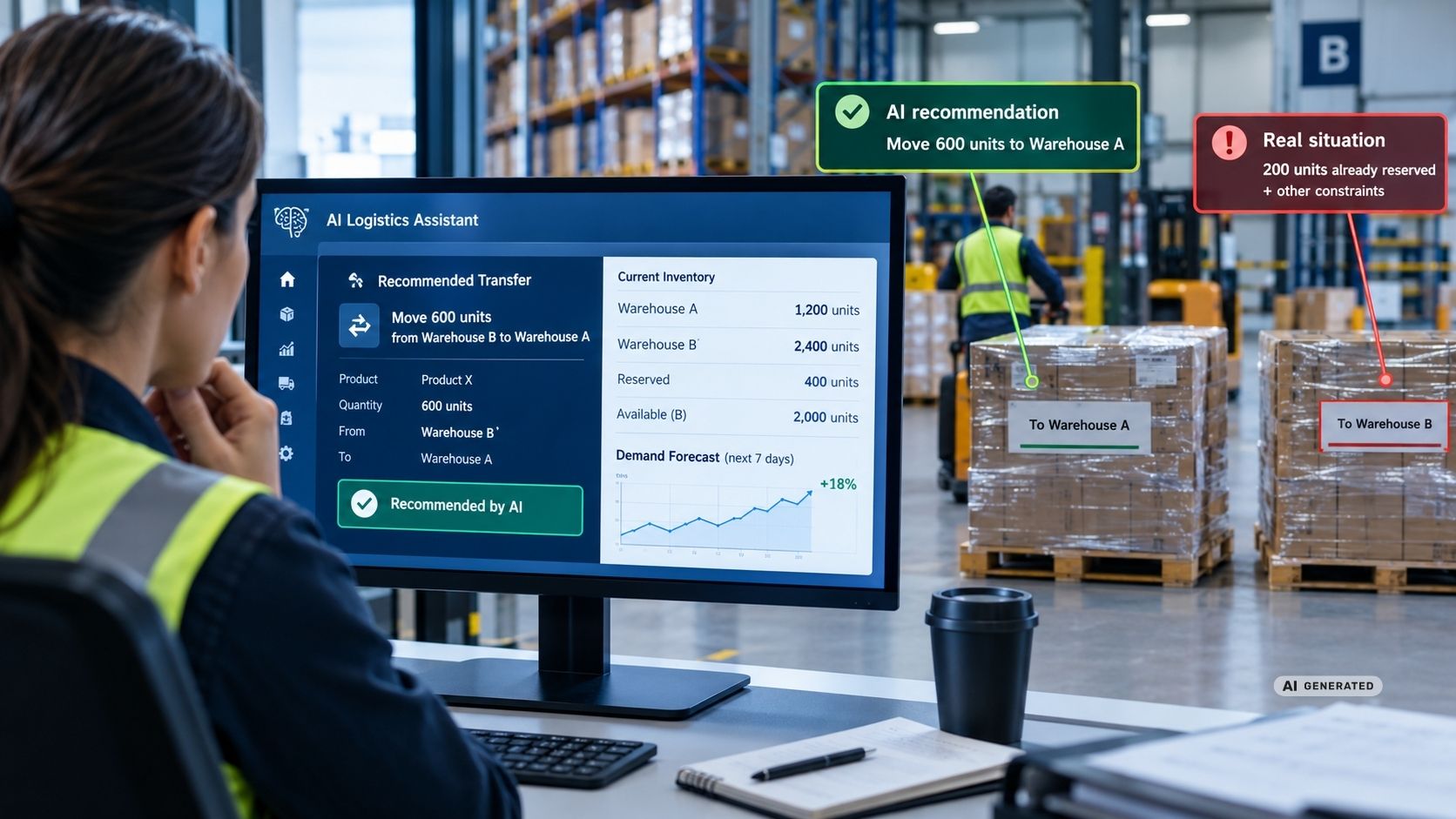
AI Hallucinations in Logistics: When AI Plans the Wrong Delivery
AI can analyze enormous amounts of logistics data — but it can also produce a convincing answer that is simply wrong. The critical question is not whether AI makes mistakes, but what happens when a wrong recommendation becomes an operational decision....
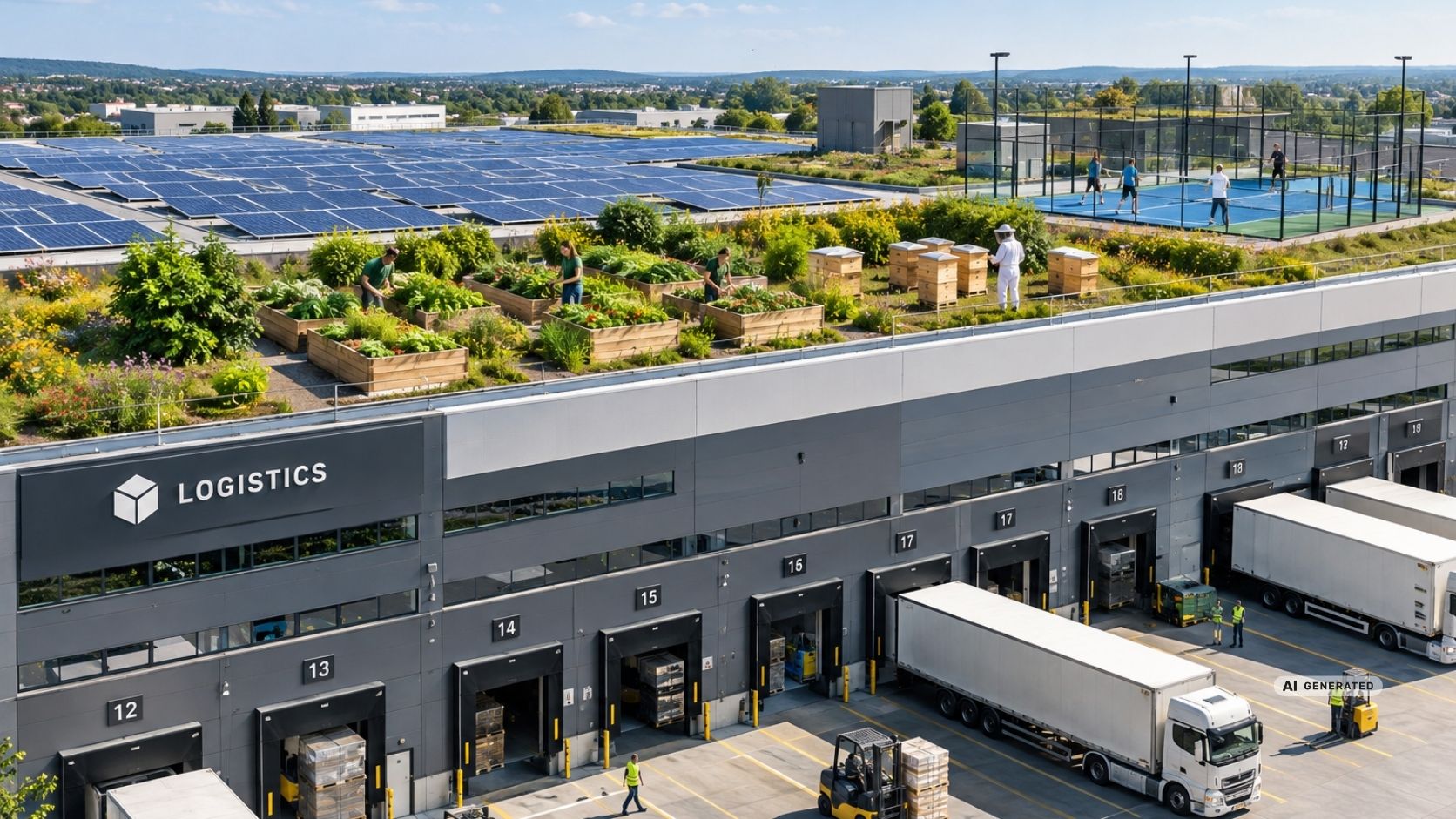
The Green Revolution on the Hall Roof: From Concrete Block to Ecological Power Plant?
Logistics roofs can do more than PV: greening, bees, urban farming and even sports areas turn unused roof space into multifunctional rooms....