


Logistics Real Estate of the Future: Are We Building Down Instead of Out?
Table of Contents
- Space Shortages and Soil Sealing: Is Logistics Running Out of Ground?
- The Third Dimension: Underground Logistics Centers as a Real Alternative?
- The Unbeatable Advantages of Underground Logistics Properties
- Disadvantages and Technical Challenges of Deep Construction
- Automation as the Key: The "Dark Warehouse"
- Cost Comparison: Building Outwards, Upwards, or Downwards?
- International Pioneers: Where in the World is Underground Storage Happening?
- Case Study: SubTropolis – The Largest Underground Logistics Facility in the World
- Further Use Cases: Who Else Will Use the Underground in the Future?
- Conclusion: Is the Underground the Future of Logistics in Europe?
Historically, logistics real estate only knew two directions for expansion: outwards (greenfield developments on undeveloped land) or, more recently due to space constraints, upwards (multi-level logistics centers). But what happens when even the airspace and available urban areas are exhausted? Is building logistics centers downwards—essentially as high-tech bunkers—a serious alternative worth considering?
In this technical article, we examine the feasibility of underground logistics real estate. We clarify the advantages and disadvantages, compare the costs, look at international pioneers, and answer the crucial question: Does this make any practical sense?
Space Shortages and Soil Sealing: Is Logistics Running Out of Ground?
Before we delve deeper, we need to understand the current situation. Why would project developers even consider digging through rock and soil?
Why is logistics pushing underground? The answer lies in the massive scarcity of land in metropolitan areas and increasingly strict environmental legislation. In Germany, for example, the federal government aims to reduce land consumption (often referred to as soil sealing) to under 30 hectares per day by 2030 (Source: German Environment Agency, Land Use Report). Simultaneously, the booming e-commerce sector demands ever-faster delivery times (same-day delivery), necessitating so-called "micro-fulfillment centers" right in the heart of city centers. The traditional "building outwards" approach is simply no longer permissible or affordable in metropolises like Munich, London, or Paris.
The Third Dimension: Underground Logistics Centers as a Real Alternative?
What exactly do we mean by an underground logistics property? We are not necessarily talking about World War II bunkers outfitted with shelving. Rather, we are looking at:
- Repurposing Existing Cavities: Former mining tunnels, salt mines, or limestone caves.
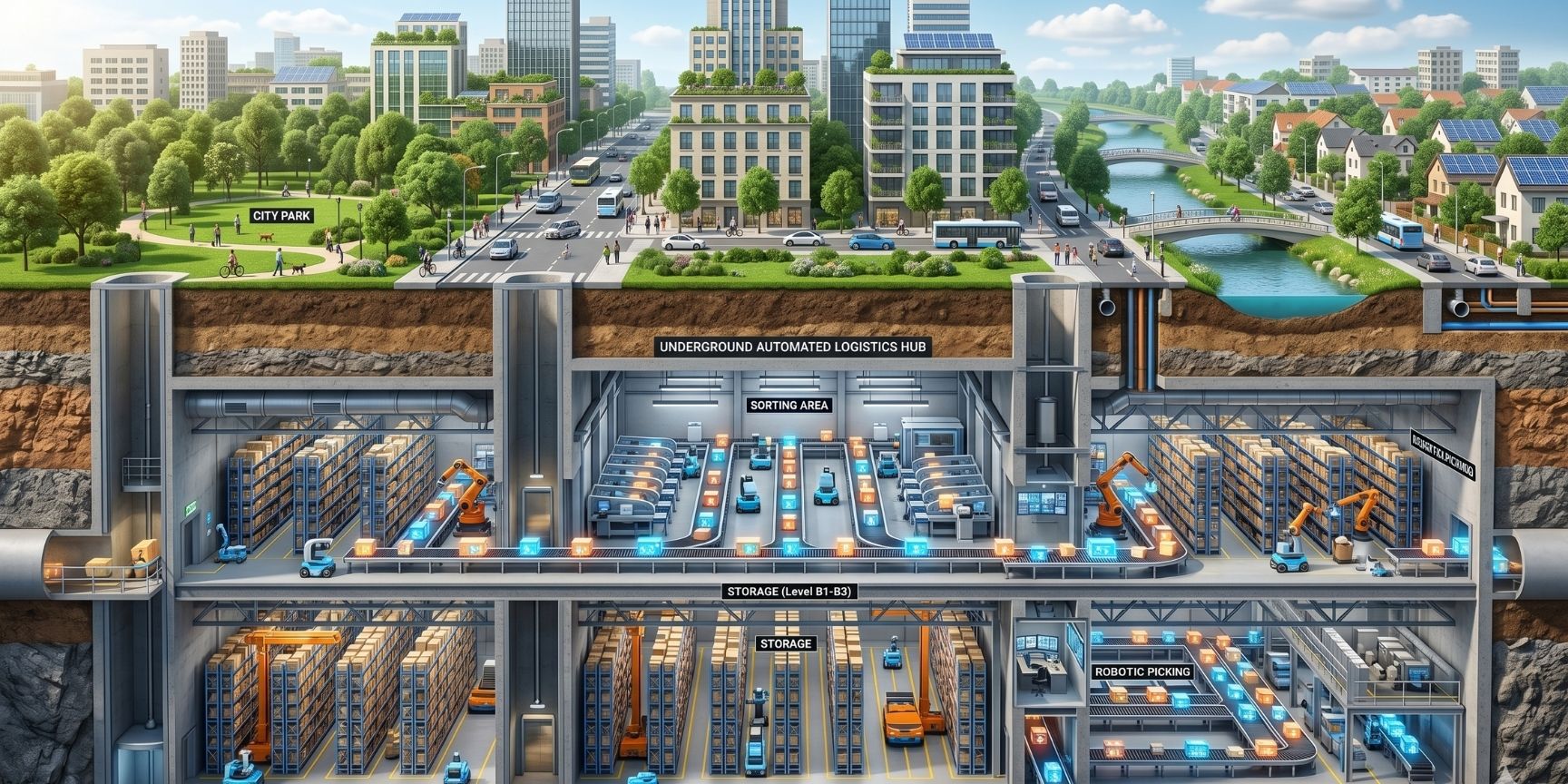
- New Subterranean Developments (Cut-and-Cover): Multi-story basement facilities beneath new commercial parks, shopping centers, or public urban squares.
- Urban Micro-Hubs: Repurposing vacant underground parking garage levels in city centers for last-mile logistics.
Does it make sense to even consider such an alternative? The clear answer is: Yes. Because once land prices in metropolitan regions cross a certain threshold, the profitability curves of purchasing extremely expensive surface land and the high construction costs of underground warehousing intersect.
The Unbeatable Advantages of Underground Logistics Properties
Those who move underground benefit from physical and geopolitical conditions that are almost impossible to replicate above ground.
- Natural Climate Control (OPEX Savings): Below the frost line (approx. 1.5 to 2 meters deep) and deep within the bedrock, temperatures remain relatively constant worldwide. In European latitudes, this is often between 12°C and 15°C year-round. For food logistics companies, pharmaceutical wholesalers, or data centers (which require immense cooling), this translates to massive savings in energy costs for heating and air conditioning.
- Zero Soil Sealing: The roof of the logistics property can be a city park, a residential area, or an agricultural field. Public acceptance is enormously high, effectively avoiding the dreaded NIMBY ("Not In My Backyard") effect.
- Protection from Weather Extremes & Enhanced Security: Underground facilities are immune to storms, hail, or extreme heatwaves. For highly sensitive or valuable goods (gold, critical data, hazardous materials), deep-lying "bunkers" offer the ultimate protection against burglary and sabotage.
- Zero Noise Emissions: The 24/7 operation of a logistics facility generates massive noise (heavy goods vehicle traffic, loading processes). Underground, the noise level is completely absorbed by the earth, enabling night operations right in the middle of residential areas.
Disadvantages and Technical Challenges of Deep Construction
If the advantages are so significant, why aren't we already building everything underground? This is where massive disadvantages come into play, touching deeply upon building physics and labor laws.
- How Do We Solve the Groundwater Problem? The biggest enemy of underground construction is water. The deeper you build, the more robust the so-called "white tank" (waterproof concrete structure) must be. In regions with a high groundwater table (e.g., Hamburg or Amsterdam), construction costs rise exponentially. A water ingress in a fully automated high-bay warehouse underground would result in a total loss.
- Fire Protection and Smoke Extraction: Smoke rises. In the event of a fire in an underground logistics center, the facility can quickly become a death trap. Installing massive high-performance ventilation shafts, sprinkler systems, and escape routes through solid rock and concrete drives costs through the roof.
- Lack of Daylight (Psychology & Law): Can employees be expected to work eight hours a day without sunlight? In many European countries, this is a massive legal hurdle.
Important Legal Excursion (e.g., Germany): The German Workplace Ordinance (Arbeitsstättenverordnung or ArbStättV) strictly dictates that break rooms and permanent workspaces must receive sufficient daylight and should have a visual connection to the outside. Operating a traditional warehouse with human pickers underground is therefore hardly legal in Germany—unless strict special permits are obtained.
Automation as the Key: The "Dark Warehouse"
The solution to the daylight dilemma is full automation. So-called "Dark Warehouses" operate entirely without human workers on the floor. Automated Guided Vehicles (AGVs), robotic arms, and Automated Storage and Retrieval Systems (AS/RS) pick and pack goods in the dark. Humans only enter the facility for maintenance work. Without permanent workstations, many of the stringent occupational health and safety regulations no longer apply, suddenly making underground facilities highly attractive again.
Cost Comparison: Building Outwards, Upwards, or Downwards?
How do the capital expenditures (CAPEX) compare? The following comparison shows average values for new logistics developments (Status: Forecast 2026, Source: Synthesis of construction cost indices from European real estate developers).
| Construction Method | Land Consumption | Construction Cost per m² (Usable Area) | OPEX (Operating/Climate Costs) | Permitting Duration |
| Outwards (Greenfield) | Very High | approx. €800 – €1,100 | Medium to High | 1–3 Years |
| Upwards (Multi-Level) | Low | approx. €1,400 – €1,800 | Medium | 2–4 Years |
| Downwards (New/Cut&Cover) | Very Low | approx. €2,800 – €4,500 | Very Low | 3–6 Years |
| Downwards (Mine Repurposing) | Zero | approx. €400 – €700 (Fit-out) | Very Low | 1–2 Years |
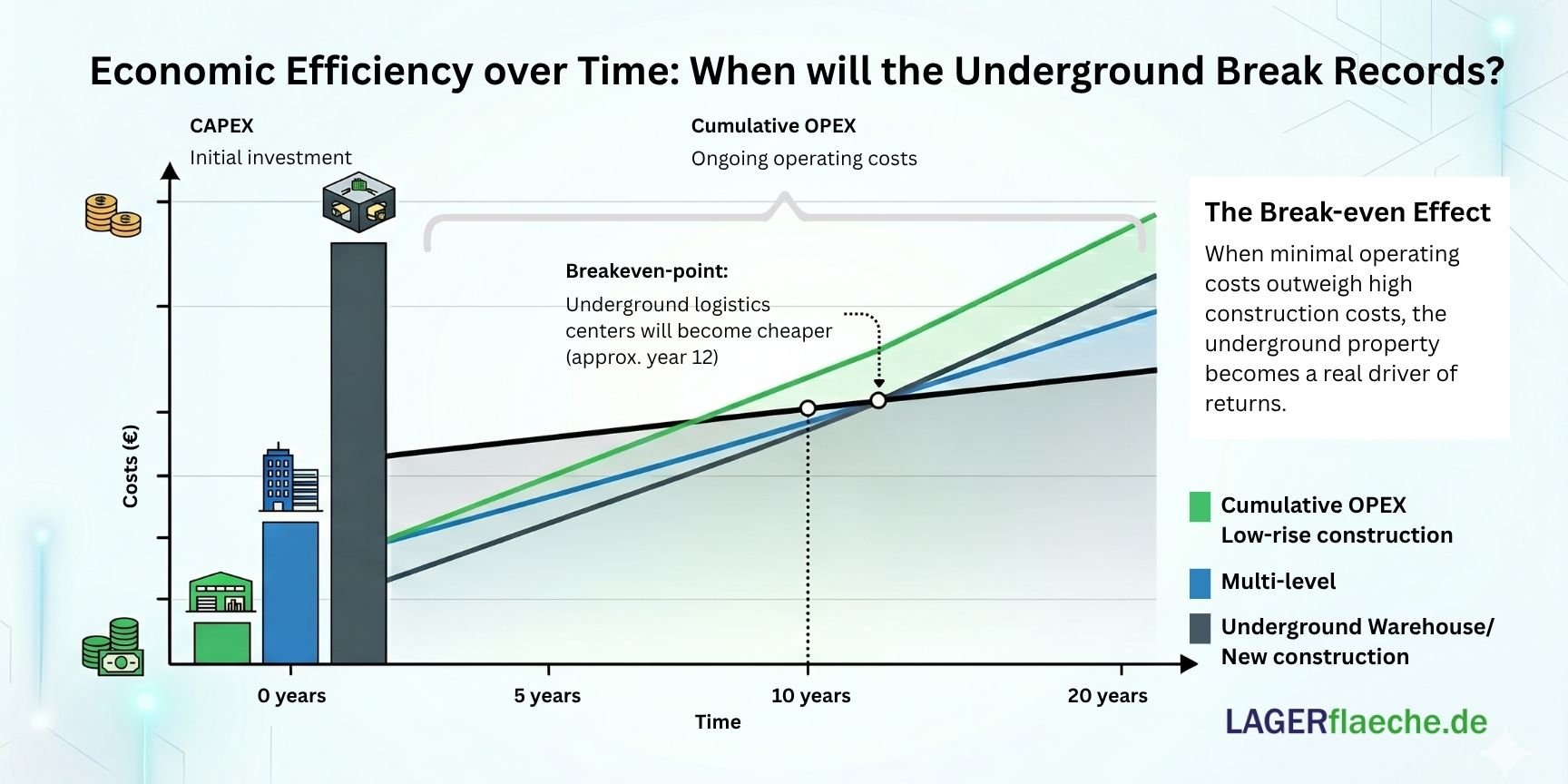
A completely new underground build (involving mass excavation) is extremely expensive and only pays off in heavily subsidized urban development projects or areas with astronomical land prices. Repurposing existing cave systems, however, is economically unbeatable.
International Pioneers: Where in the World is Underground Storage Happening?
A look across borders reveals drastic differences. Whether a nation builds underground depends on two factors: geology and legislation.
Singapore – Into the Rock Out of Necessity
Singapore is a city-state with an absolute lack of space. The government's Underground Master Plan heavily promotes building downwards. Today, millions of barrels of oil are already stored in the "Jurong Rock Caverns" deep below sea level. Singapore is currently evaluating plans to move entire container logistics transshipment centers underground.
Japan – Micro-Hubs Beneath the Streets
In Tokyo and Osaka, there is absolutely no room for large trucks. Here, underground bicycle parking systems and automated micro-fulfillment centers are increasingly being operated below subway stations. Parcels are delivered underground via rail at night and distributed above ground by cargo bikes during the day.
Germany & Central Europe – Underground Parking Logistics
Compared to the Asian or American markets, Germany lags behind when it comes to true, deep "mega-bunkers" (reasons: ArbStättV and fire safety, as mentioned above). However, another trend dominates: The use of ghost parking garages. As city centers increasingly become car-free, massive parking garage basements are standing empty. Logistics companies like DHL or Amazon are already using these spaces in cities like Frankfurt or Munich as urban transit hubs.
USA – The Geological Jackpot
The USA is the absolute pioneer in utilizing underground spaces for logistics. Why? Because the Midwest has perfect geological conditions (limestone) from which material for road construction was mined over the past 100 years. What remained were gigantic, highly stable cavities.
Case Study: SubTropolis – The Largest Underground Logistics Facility in the World
When talking about underground logistics, one name is unavoidable: SubTropolis.
- Where? Kansas City, Missouri, USA.
- Who uses it? E-commerce giants, automotive suppliers, the US National Archives, and food logistics companies.
- The Facts: It is an artificial limestone cave with a floor space of an incredible 6.5 million square meters (equivalent to nearly 1,000 football/soccer fields). The system features more than 11 kilometers of illuminated, paved roads—completely underground. Trucks drive directly into the cave system and unload at the docks of the companies located there.
Why does SubTropolis work so perfectly? The operator, Hunt Midwest, leases the spaces significantly cheaper than above-ground warehouses in the area. The reason: There are no construction costs for walls or roofs; nature (the rock) provides the structure. The temperature remains constant at around 18 to 20 degrees Celsius year-round, completely independent of whether there is a blizzard raging outside in Missouri or a 40-degree heatwave. Food or pharmaceutical companies save up to 70% of their regular energy costs for climate control (Source: Hunt Midwest operating data).
While such an example cannot be replicated 1:1 in Europe geologically, it impressively demonstrates the enormous economic potential when the framework conditions are right.
Further Use Cases: Who Else Will Use the Underground in the Future?
Besides pure parcel logistics, three other beneficiaries are emerging:
- Urban Farming & Food Logistics: Underground farms (vertical farming) directly coupled with underground cold storage. The startup "Growing Underground" in London (located in former WWII bunkers) has already successfully demonstrated this.
- Cold Chain Logistics: Since cooling is required anyway, the natural insulation of the earth helps enormously.
- Reverse Logistics (Returns Management): Since returns do not necessarily have to be processed on the same day, these processes can be relocated to places that are not in prime locations—such as large underground facilities outside the cities.
Conclusion: Is the Underground the Future of Logistics in Europe?
To finally answer the initial questions: Is building downwards a viable alternative? Yes, but currently only in the form of a highly specialized niche.
Building completely new underground mega-logistics centers (bunkers) using the classic "cut-and-cover" method will remain the absolute exception in Europe for the foreseeable future due to exorbitant construction costs and strict occupational health and safety regulations. The upfront investments (CAPEX) are still too daunting compared to building upwards.
Nevertheless, a portion of the future belongs to the underground, specifically in two distinct forms: Firstly, in the form of fully automated Dark Warehouses that no longer require human employees, elegantly bypassing legal hurdles. Secondly, through the smart repurposing of existing urban underground infrastructure (empty parking garages, old subway shafts) as decentralized micro-hubs for city logistics.
Anyone in the logistics industry looking to solve the extreme space problems of megacities must look not only up, but down. The space beneath our feet reveals a massive, highly attractive potential for energy efficiency—provided automation technology builds the bridge to get there.
Latest Blog Posts
Stay up to date with the newest trends, insights, and tips in warehouse and logistics. Our latest articles help you navigate the industry with confidence.
Data Centres vs. Logistics Facilities: The Race for Power and Land
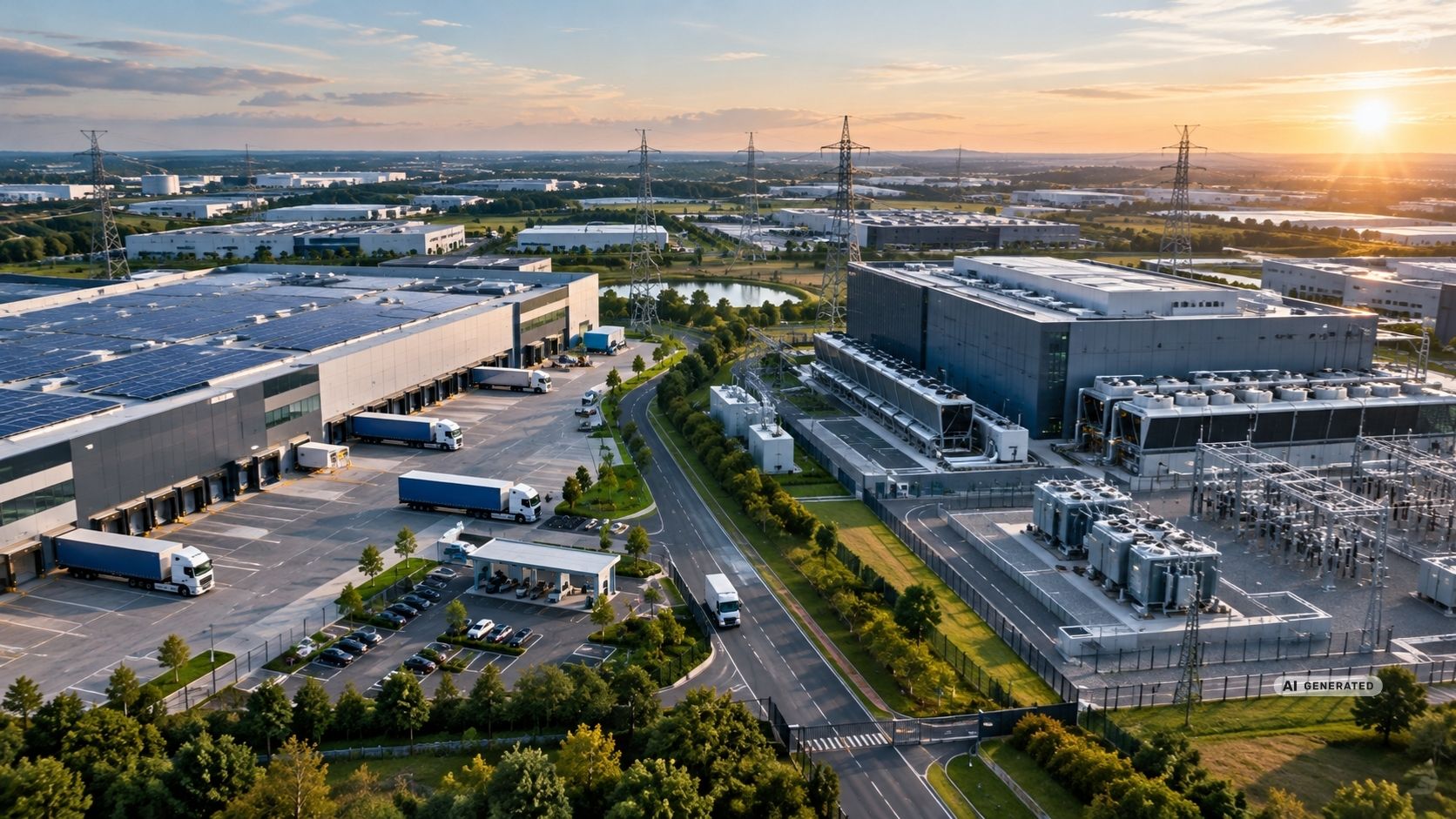
Across Europe, logistics operators are competing for more than land and transport access. They increasingly need something much harder to secure: grid capacity. Data centres are intensifying that competition — and changing how logistics locations are evaluated....
Chinese companies discover Europe's logistics real estate
Chinese companies are becoming an increasingly visible user group in Europe's logistics real estate market. What does this mean for warehouse space, 3PL structures and the requirements for European logistics locations?...
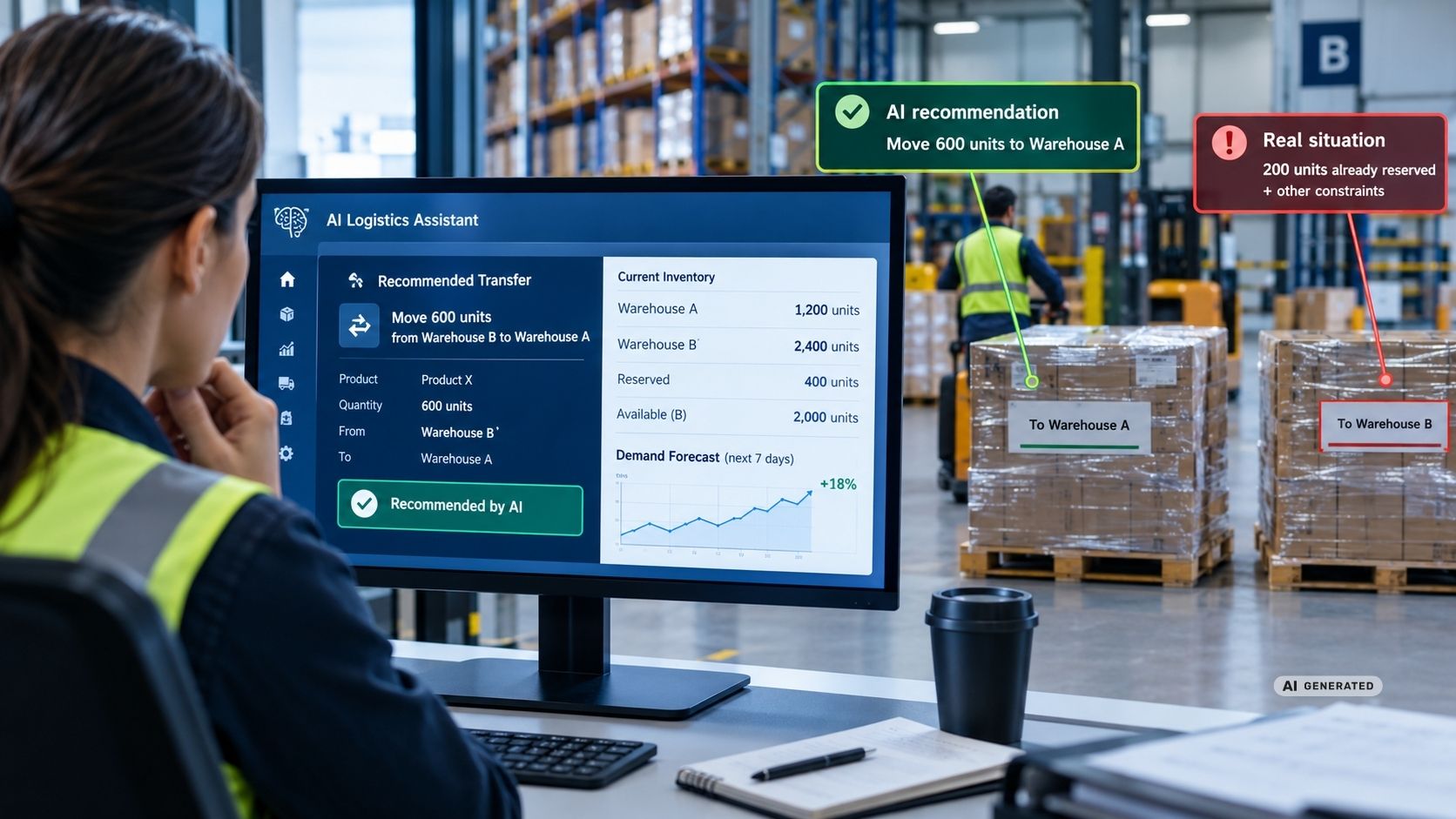
AI Hallucinations in Logistics: When AI Plans the Wrong Delivery
AI can analyze enormous amounts of logistics data — but it can also produce a convincing answer that is simply wrong. The critical question is not whether AI makes mistakes, but what happens when a wrong recommendation becomes an operational decision....
The Green Revolution on the Hall Roof: From Concrete Block to Ecological Power Plant?
Logistics roofs can do more than PV: greening, bees, urban farming and even sports areas turn unused roof space into multifunctional rooms....