


Renting a high-security warehouse: What companies should look out for when choosing
Table of Contents
- What is different about a high-security warehouse?
- What level of security does a company need?
- What requirements should the logistics property meet?
- What certificates should a tenant check?
- Room-in-room or your own high-security property?
- How can security and the flow of goods be combined?
- Why cybersecurity is now part of the camp selection
- What questions should companies ask during the viewing?
- Practical example: Electronics manufacturer is looking for 1,500 m² of high-security space
- Is a high-security warehouse also interesting for medium-sized companies?
- How much does a high-security warehouse cost?
- Conclusion: The right safety surface must fit the business model
Companies that store high-value goods or goods that are particularly at risk of theft need more than a normal warehouse with cameras and electronic access control. In a high-security warehouse, the property, land, flow of goods, personnel and digital systems must be considered as a coherent security concept.
The need is real: TAPA EMEA registered a total of 58,661 cargo crime cases in the Europe, Middle East and Africa region in the 18 months to 30 June 2026. Only 7.8% of the reported cases had financial damage information; these known losses already totalled more than €1 billion.
But when does a company actually need a high-security warehouse? What requirements should a suitable logistics property meet? Which certificates are relevant? And how can it be determined whether a provider really offers a resilient security concept?
This article shows what companies should pay attention to when searching, viewing and selecting a high-security storage space.
What is different about a high-security warehouse?
A high-security warehouse is not simply a particularly well-monitored standard hall. The interaction of several levels of protection is crucial.
These include, for example:
- Property and perimeter protection
- Controlled access roads
- Structural security of the building
- Monitored goods transfers
- Access controls
- Video surveillance and other sensors
- Defined storage and loading processes
- Qualified and vetted personnel
- Protected IT and WMS systems
TAPA describes its Facility Security Requirements (FSR) as minimum requirements for the protection of facilities in which high-value goods at risk of theft are stored or handled.
What goods may require a high-security warehouse?
Whether a special security solution is necessary does not depend solely on the value of the goods.
Among other things, the following are relevant:
- financial value per unit
- Total Inventory Value
- Resale value on black markets
- Size and transportability of the goods
- Confidentiality
- regulatory requirements
- Insurance conditions
- Possible consequential damage of theft
Electronics, high-value pharmaceuticals, luxury goods, precious metals, high-value spare parts or confidential prototypes can therefore have very different security requirements.
If you would like to get an overview of different warehouse terms and forms of storage, you can also read the blog "Warehouse, hall, logistics area: A compass for the jungle of terms".
What level of security does a company need?
More security is not automatically the most economical solution. The security level should match the actual risk.
TAPA distinguishes between three security levels for facility security requirements: Level A for high security requirements, Level B for medium and Level C for standard requirements. Which level makes sense depends, among other things, on the risk analysis and the requirements of shippers, insurers and logistics service providers.
Four questions before looking for a property
Companies should answer four questions before the search:
- What is the maximum value of goods?
Not the average inventory, but the maximum financial exposure can be decisive for safety planning. - How attractive are the goods to thieves?
Small, high-quality and easily transportable products can pose a higher risk than bulky goods with a higher total value. - What consequential damage would be possible?
In addition to the value of the goods, production losses, contractual penalties, recall costs, reputational damage or the loss of confidential information can occur. - What are the requirements of insurers and customers?
In international supply chains, contractual security requirements or insurance conditions can go beyond the requirements of normal warehousing.
The central question is therefore not:
"Which hall is the safest?"
But:
"What security does our specific goods and risk profile require?"
What requirements should the logistics property meet?
The security check should already start at the property. A high-security solution is only as resilient as its weakest interface.
Grounds and driveways
For example, the following must be examined:
- Number and location of access roads
- Access control
- Vehicle Identification
- Visitor regulations
- Lighting
- Visibility of the site
- Parking and waiting areas
- Transition from public to secure areas
The access road in particular is critical, because this is where external people, vehicles and goods meet for the first time.
Building envelope and potential vulnerabilities
Exterior walls, doors, gates, windows and other openings must also be included in the security concept.
The TAPA FSR 2026, for example, contains specific requirements for the monitoring of the exterior of buildings and for the physical protection of exterior walls and roofs. For Level A, the standard provides, among other things, for comprehensive CCTV coverage of the exteriors; at the same time, requirements for the resilience of the building envelope are defined.
This shows an important principle:
Security does not only begin within the storage zone.
Goods receipt and loading
The interface between transport and storage is particularly critical.
Companies should therefore ask:
- How is the driver identified?
- How is the vehicle checked?
- Who is allowed to enter the loading zone?
- Where are the goods located during the handover?
- How is a pickup released?
- Is the loading zone monitored by cameras?
- Is there a controlled transition to the secure storage area?
A highly secured storage zone loses its effectiveness if the goods are handed over uncontrolled beforehand.
Power supply and technical redundancy
Safety systems must remain as functional as possible even in the event of technical malfunctions.
During the inspection, it should therefore be clarified:
- Is there a UPS?
- Is there an emergency power supply?
- Which systems will continue to operate in the event of a power failure?
- What happens in the event of a network or server failure?
- How is an access control failure handled?
What certificates should a tenant check?
Certificates can provide important guidance when choosing a high-security warehouse. However, they should never be considered in isolation.
TAPA FSR: What is actually certified?
The TAPA Facility Security Requirements relate to the security of facilities and define minimum requirements as well as procedures for their implementation and auditing. TAPA offers FSR certifications at three security levels.
For a potential tenant, specific questions are therefore more important than a general "TAPA-certified":
- What is the FSR level?
- Which specific facility is certified?
- Which storage and operating areas are included?
- When was the certificate issued?
- How long is it valid?
- What requirements apply to the specific flow of goods?
TAPA also points out that the security standards are regularly revised. The FSR version 2026 includes updated requirements for physical security and CCTV, among other things.
What role does VdS play?
VdS offers, among other things, certified vaults in solid and modular construction as well as vault doors and other valuables. The systems are classified according to different degrees of resistance.
Again, the following applies:
A VdS certificate should always be considered in the specific context of the required protective function.
For a broader overview of certifications in logistics, the blog "The Certificate Compass for Logistics: Why Quality Is More Than Just a Stamp" is suitable.
Room-in-room or your own high-security property?
Not every company needs a completely independent high-security property.
When can a safety zone within a hall be useful?
A room-in-room solution can be interesting if only part of the storage space needs special protection.
For example, a company might need 1,000 m² of secured space, while the entire logistics property covers 10,000 m².
The solution can be economical and flexible. However, integration into the entire flow of goods is crucial.
The following must be examined:
- Access to the security zone
- Buffer areas
- Internal traffic routes
- Separation of other customer areas
- Access rights
- Expansion options
- Effects on the rest of the hall use
VdS offers both vaults in solid construction and modular solutions in different degrees of resistance.
For multi-user fulfillment centers, such separation can be particularly interesting because different customers may have different security requirements.
How can security and the flow of goods be combined?
A common misconception is that the more security checks, the better.
In practice, however, safety must be compatible with operational performance.
Where do bottlenecks arise?
Each additional checkpoint can lengthen the process:
Truck arrival → identification → access → loading → goods receipt → storage → picking → provision → goods issue
The question is therefore:
How much additional control does the process need – and where must it not unnecessarily slow down the flow of goods?
A property with excellent security can be economically unsuitable if trucks wait too long, goods are handled multiple times, or employees constantly have to travel long distances between security zones.
For the process perspective, the blog "Lean Warehousing: Your Path to a Highly Efficient Warehouse" is a good addition.
Why cybersecurity is now part of the camp selection
A high-security warehouse can be physically excellently protected and still remain vulnerable via digital processes.
What can be digitally manipulated?
Possible points of attack include:
- User Accounts
- Access authorizations
- WMS Data
- Inventory information
- digital pick-up approvals
- Supplier and driver data
- Interfaces to customers and service providers
In addition to FSR, TSR and PSR, TAPA has its own cyber security standard. This makes it clear that physical and digital security are increasingly being considered together.
When choosing a space, you should therefore also ask:
How are digital access rights assigned and recorded?
What happens in the event of an IT failure?
How are external service providers secured?
What systems are connected to the physical security infrastructure?
For a more in-depth perspective, the blog "Cyber Resilience in Logistics: How to Protect Your Company from Cyber Threats" is suitable.
What questions should companies ask during the viewing?
A viewing should not end with the question of whether cameras are available.
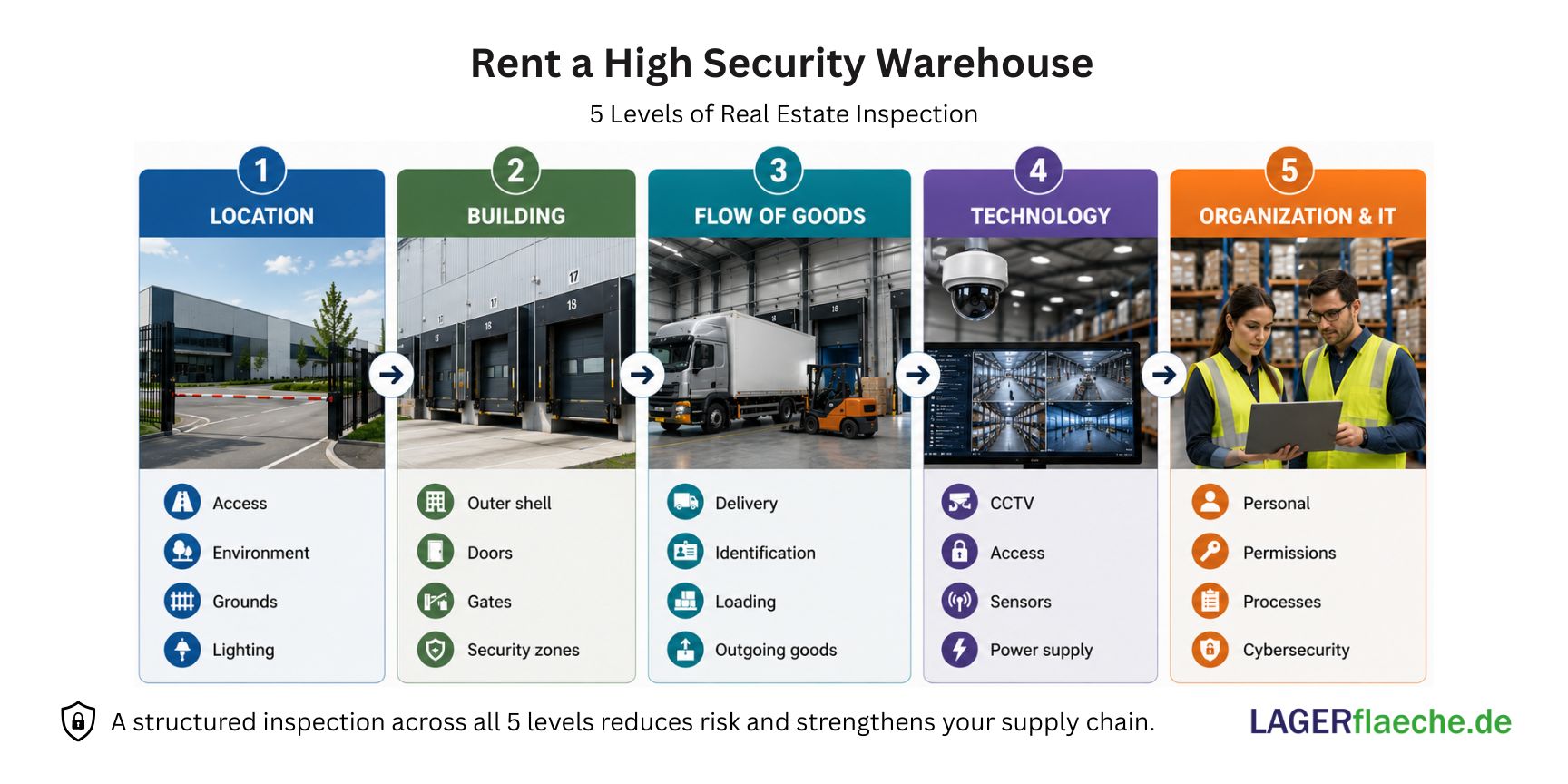
Property Audit Checklist
Location
- How many access roads are there?
- How is vehicle access controlled?
- How is the site illuminated?
- Are there uncontrolled areas?
Buildings
- Which outdoor areas are monitored?
- Which doors, gates and windows are secured?
- Are there specially protected storage zones?
- How are roof and wall areas taken into account?
Flow of goods
- How does the goods receipt work?
- How are drivers identified?
- How is a pickup released?
- How long does the security check take?
Technology
- What CCTV coverage is there?
- What access controls are used?
- Is there alerting and sensor technology?
- How is the power supply secured?
Organization
- Who is responsible for safety?
- How do employees become eligible?
- What training courses take place?
- How are security incidents documented?
Certification
- What certificates are available?
- Which area is certified?
- What is the certification level?
- How long is the certificate valid?
Practical example: Electronics manufacturer is looking for 1,500 m² of high-security space
A medium-sized electronics manufacturer is looking for 1,500 m² of storage space for high-quality components. The maximum storage value reaches several million euros.
Option A: inexpensive standard hall
An available hall offers:
- Good motorway connections
- Modern shelving systems
- CCTV
- Electronic access control
However, a closer examination shows that the goods receiving area is located directly on a generally accessible hall zone. Drivers and external service providers can move around there before the goods have been fully checked.
Option B: more expensive safety surface
A second property is more expensive but has:
- Controlled access
- monitored loading zone
- Separate safety zone
- Documented access processes
- Defined goods transfers
- Separate customer areas
For the manufacturer, therefore, the lower basic rent alone is not decisive.
Rather, the economic valuation must bring together the following factors:
Rent + security costs + litigation costs + insurance requirements + potential damage costs.
The example shows a central point in the search for a high-security camp:
The cheapest area is not automatically the most economical area.
Is a high-security warehouse also interesting for medium-sized companies?
Yes. A company does not necessarily have to build or operate an entire high-security property itself.
Multi-user instead of your own security property
For medium-sized companies, the use of an existing multi-user property can be interesting.
Instead of investing in:
- Buildings
- Security Zones
- Monitoring
- Access control
- Staff
- Technical infrastructure
a company can fall back on an existing infrastructure.
This can be particularly interesting if one's own needs fluctuate or only some of the goods need special protection.
For the strategic decision between in-house operation and external solution, the blog "In-house vs. Outsourcing: The Right Logistics Strategy for Your Growth" is a good choice.
The blog "Shared warehouse vs. dedicated warehouse: Which solution suits your business model?" is also relevant for the evaluation of different space models.
How much does a high-security warehouse cost?
A blanket statement such as "high-security warehouses cost X euros per square meter" is not very reliable.
What factors determine the costs?
The total costs depend on, among other things:
- Level of security
- Size of the secured area
- Structural design
- Room-in-room or stand-alone solution
- CCTV and sensor technology
- Access control
- Staff
- Emergency power and redundancy
- Certification
- Insurance Requirements
- Ongoing monitoring
- Additional process complexity
Therefore, a company should not only look at the rental price per square meter, but also at the total cost of occupancy.
For a general classification of storage costs, the blog "Storage space prices in Germany: What does a square meter of storage space cost?" can be used as a supplement.
Conclusion: The right safety surface must fit the business model
A high-security warehouse is not automatically the right choice just because it has a particularly large number of safety components.
The selection should combine three levels:
1. Risk
What goods are stored? What is the maximum value of the goods? What would be the consequences of a security incident?
2. Real Estate
Are the property, buildings, loading areas and safety zones suitable for this risk?
3. Operation
Can security, the flow of goods, IT and costs be economically combined?
The latest TAPA data shows why this audit is relevant: For the 18 months to June 2026, 58,661 cargo crime cases were recorded in the EMEA region; known financial losses exceeded €1 billion, despite the lack of financial disclosures for more than 92% of cases.
The decisive question when renting is therefore not only:
"How much does this storage space cost?"
But:
"Does this logistics property offer the right balance of security, flow of goods, flexibility and total costs for our specific risk?"
It is precisely this perspective that helps companies to evaluate a high-security area not only according to its equipment, but also according to its actual suitability for their own supply chain.
Sources and further information
- TAPA EMEA – Facility Security Requirements: TAPA describes FSR as minimum requirements for securing facilities for high-value and theft-prone goods.
- TAPA FSR 2026: The current standard includes requirements for CCTV, building envelope and physical security, among other things.
- TAPA EMEA – Certification Process: Information on security levels A, B and C as well as the certification process.
- TAPA EMEA – Cargo Crime 2026: Current figures on reported cargo crime cases and known losses in EMEA.
- VdS – Valuables: Overview of certified safes: Doors and other safes.
Latest Blog Posts
Stay up to date with the newest trends, insights, and tips in warehouse and logistics. Our latest articles help you navigate the industry with confidence.
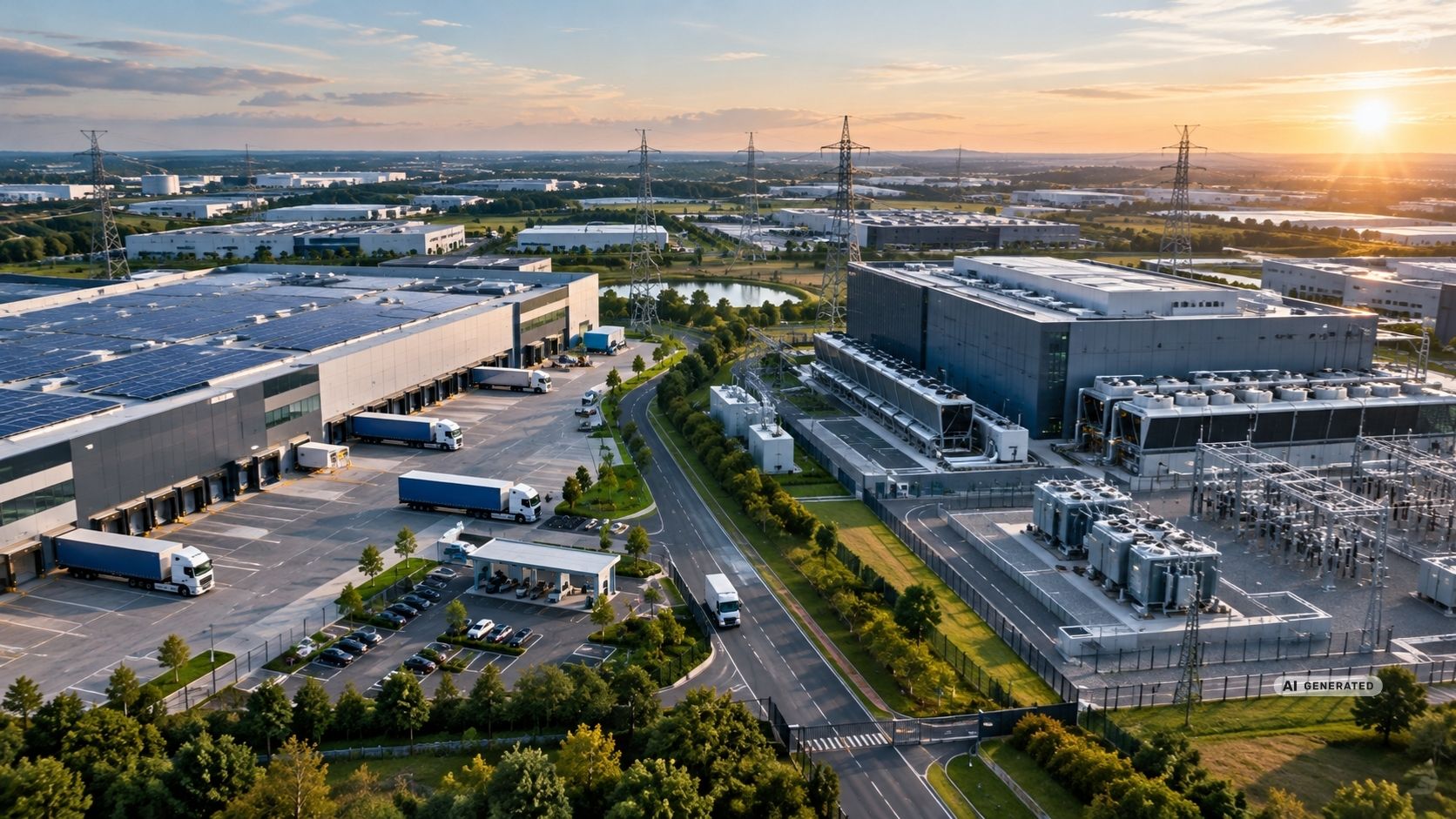
Data Centres vs. Logistics Facilities: The Race for Power and Land
Across Europe, logistics operators are competing for more than land and transport access. They increasingly need something much harder to secure: grid capacity. Data centres are intensifying that competition — and changing how logistics locations are evaluated....
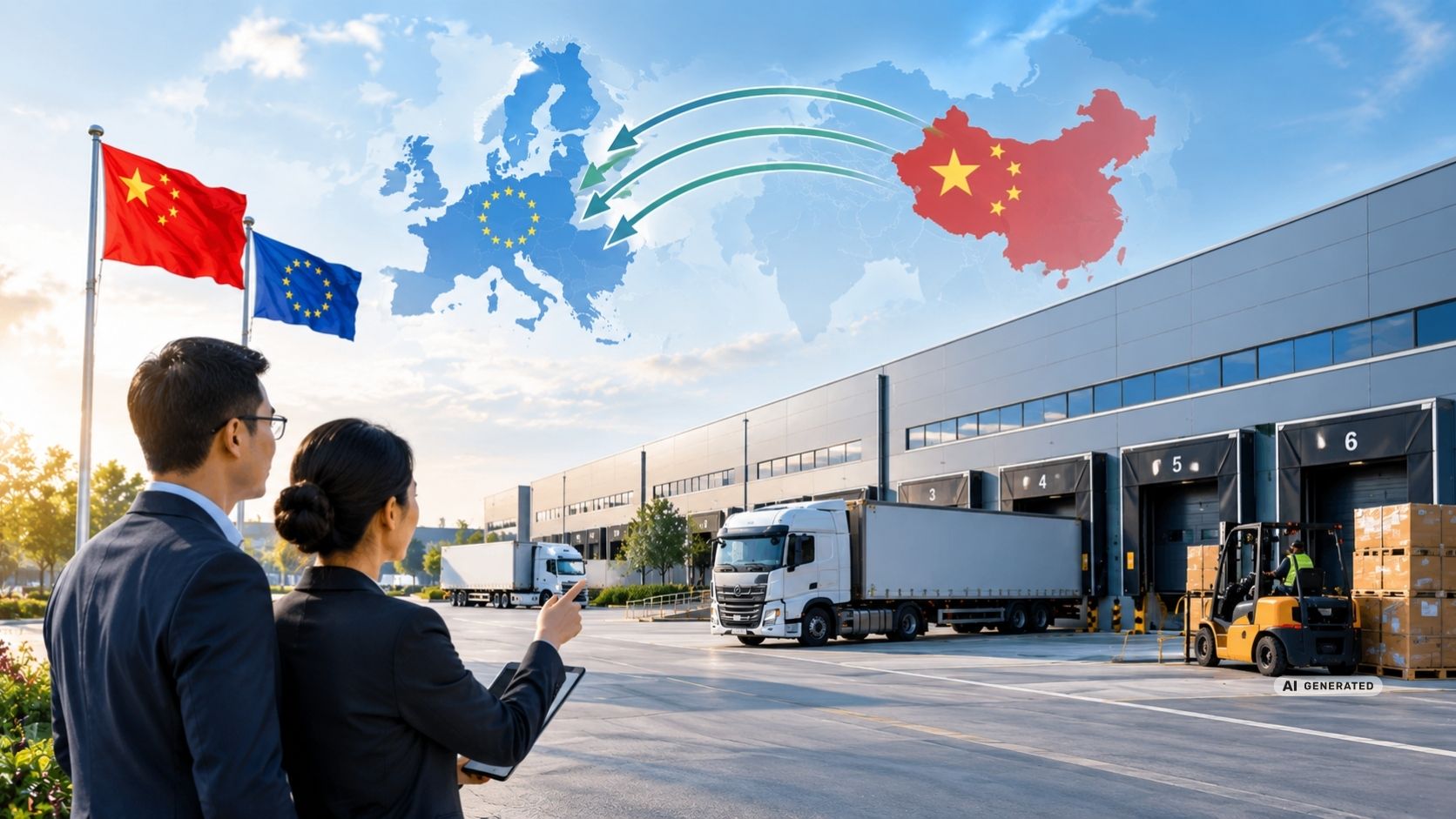
Chinese companies discover Europe's logistics real estate
Chinese companies are becoming an increasingly visible user group in Europe's logistics real estate market. What does this mean for warehouse space, 3PL structures and the requirements for European logistics locations?...
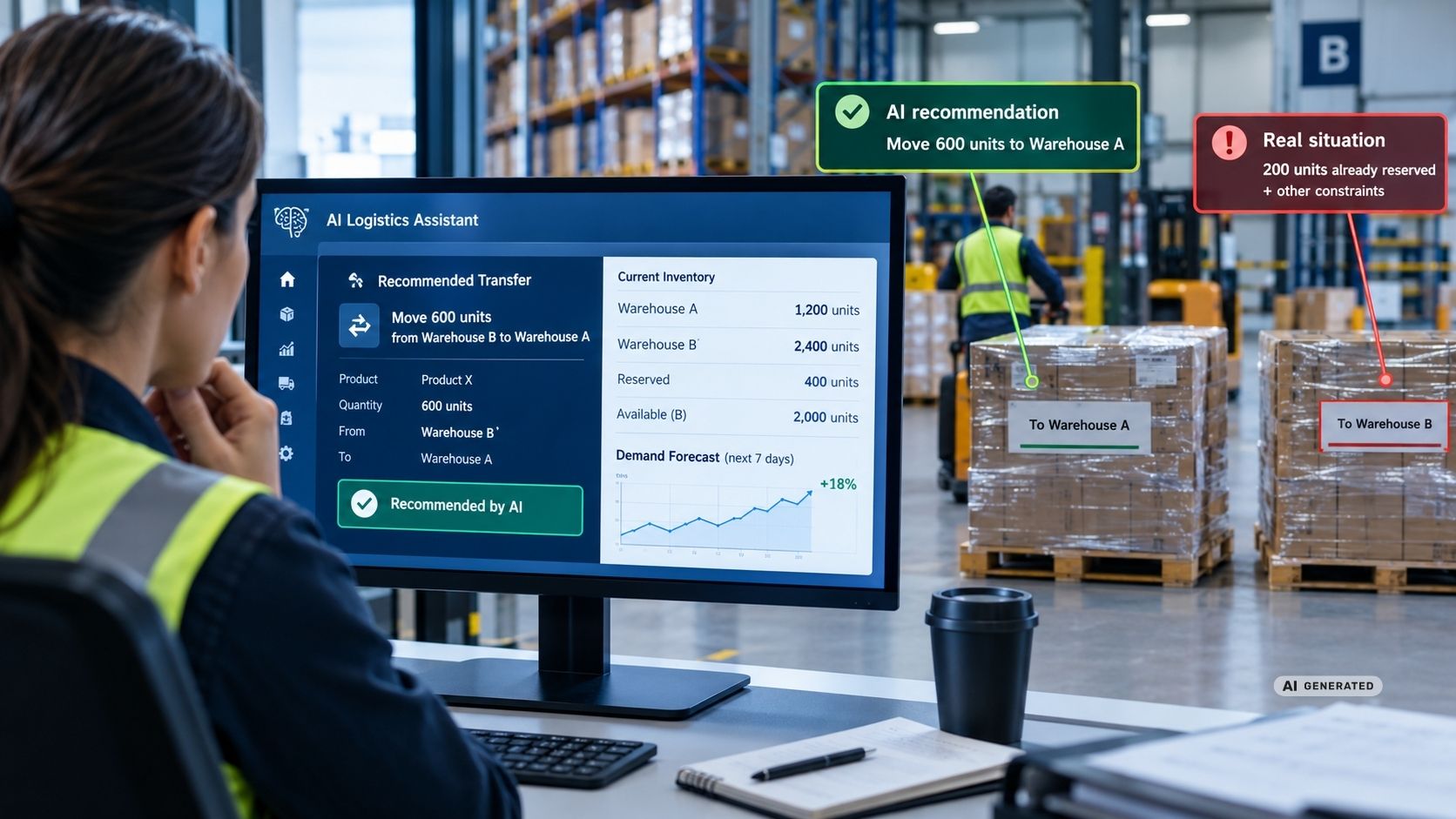
AI Hallucinations in Logistics: When AI Plans the Wrong Delivery
AI can analyze enormous amounts of logistics data — but it can also produce a convincing answer that is simply wrong. The critical question is not whether AI makes mistakes, but what happens when a wrong recommendation becomes an operational decision....
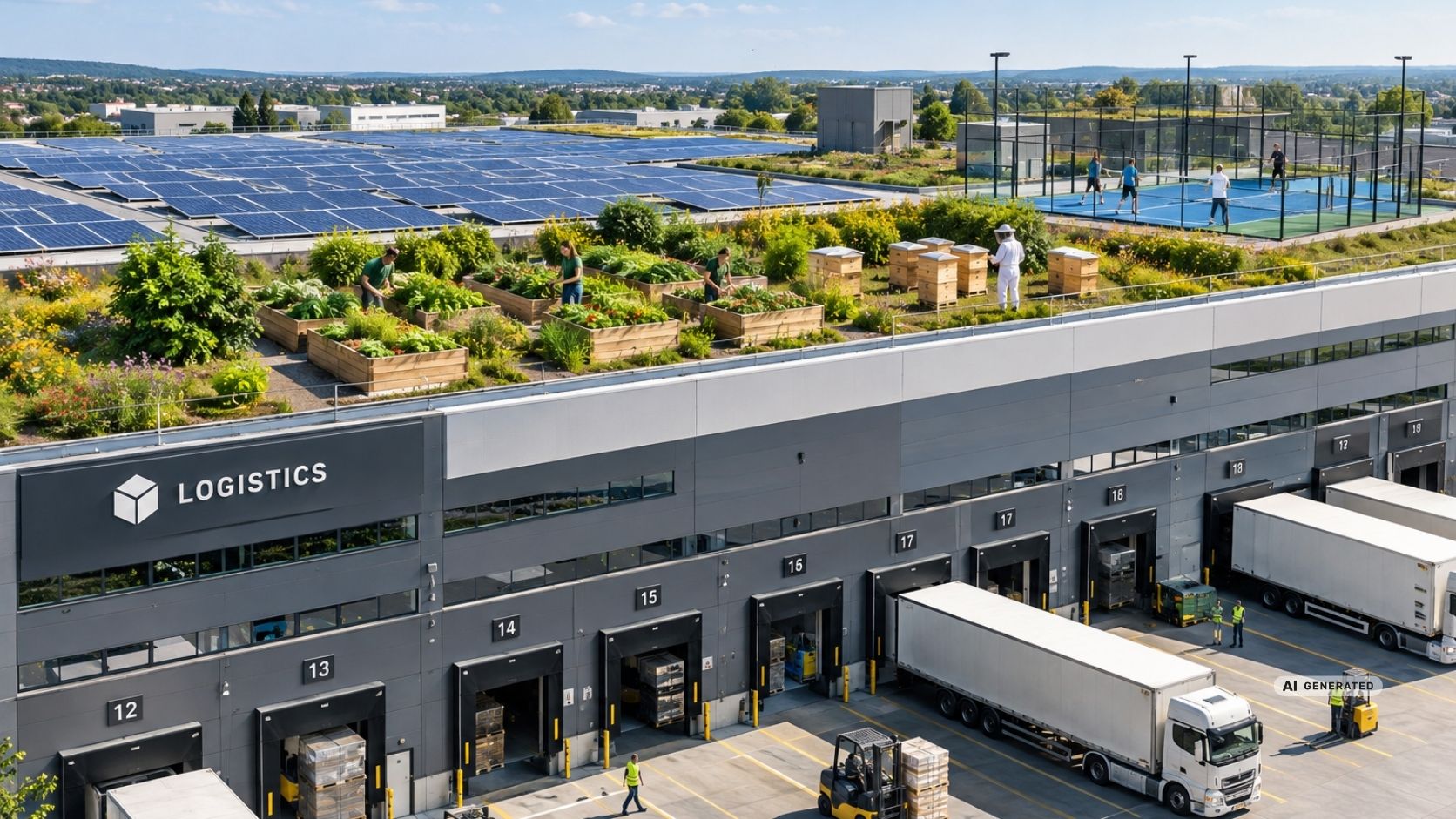
The Green Revolution on the Hall Roof: From Concrete Block to Ecological Power Plant?
Logistics roofs can do more than PV: greening, bees, urban farming and even sports areas turn unused roof space into multifunctional rooms....