




Loading in logistics
Table of contents
- Definition: What does loading mean in warehouse logistics?
- The logistics property: structural requirements for the loading zone
- Technical equipment of the hall for loading
- Contract logistics: Loading as a strategic lever
- Hall layouts: Cross-docking in the I-Shape hall
- Facts, figures, data: Loading in an efficiency check
- FAQ: Frequently asked questions and answers about loading
- Conclusion: From the eye of the needle to a competitive advantage
Loading is the moment of truth in every supply chain. This is where the perfectly orchestrated intralogistics of a hall meets the harsh reality of road freight transport. If this hub does not function smoothly, trucks will pile up in the yard, supply chains will break down and margins will melt. This guide examines the loading process from the perspective of modern warehouse logistics, real estate architecture and contract logistics.
Definition: What does loading mean in warehouse logistics?
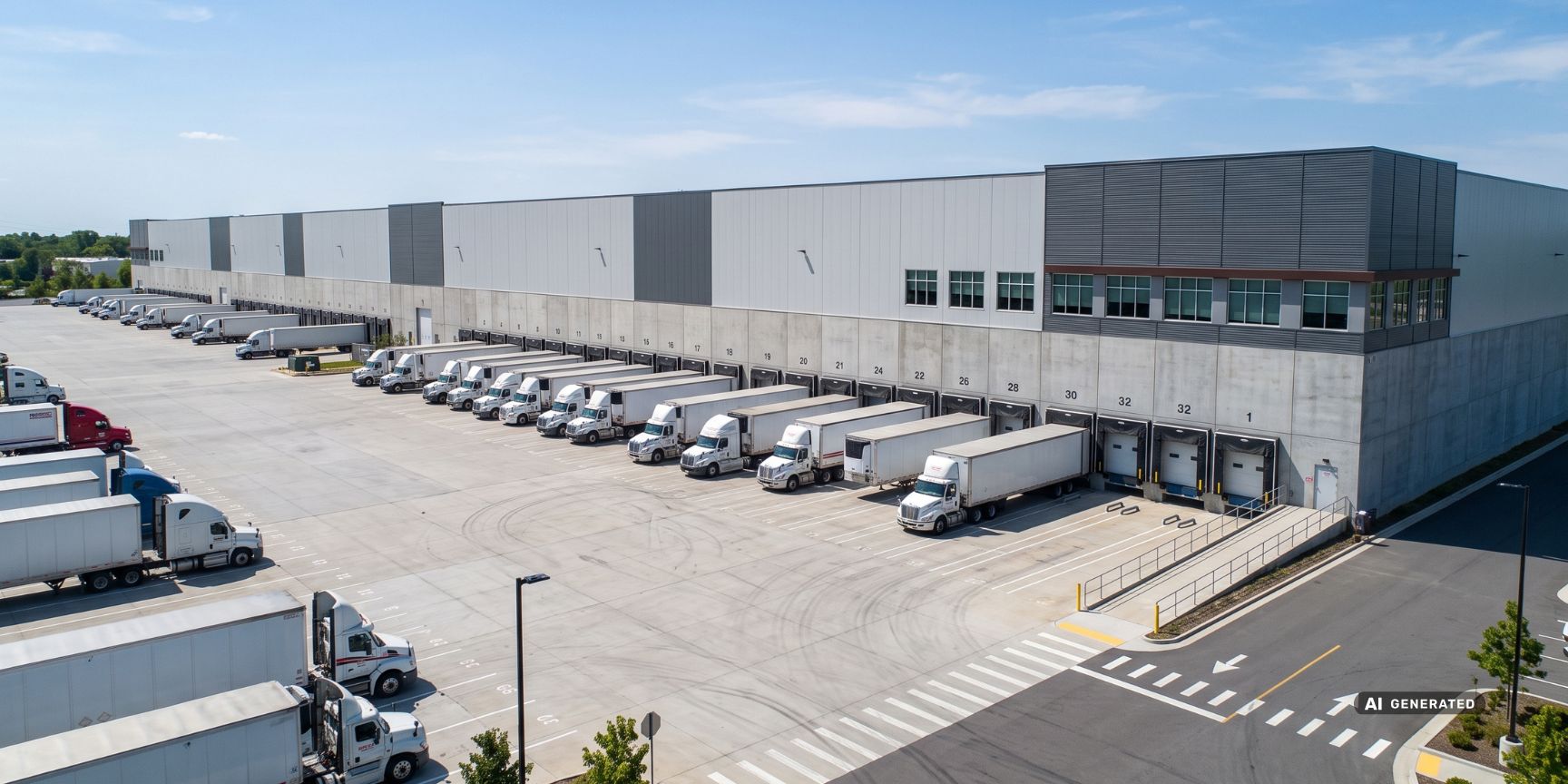
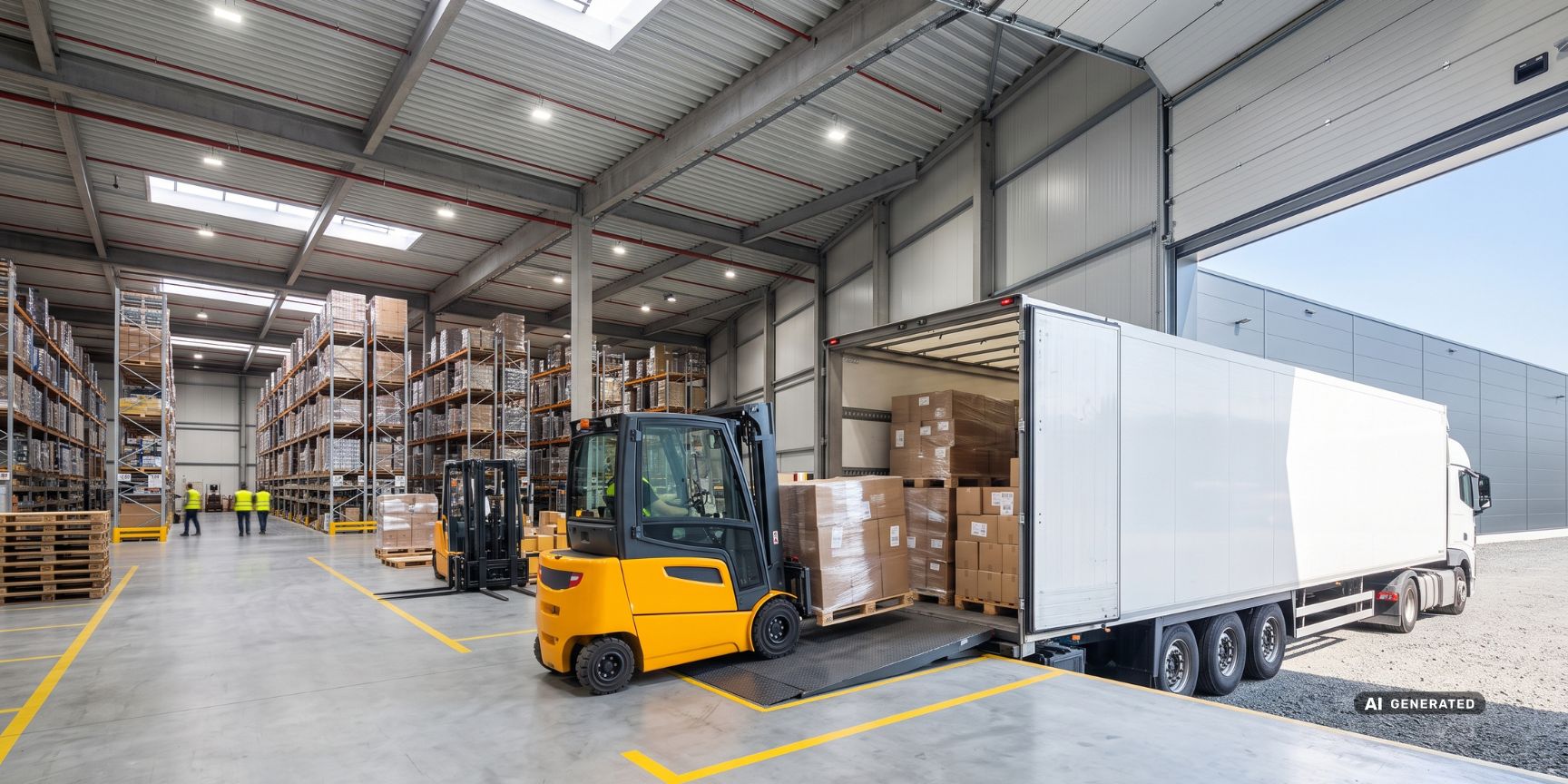
Loading (also unloading) refers to the physical and systemic transition of goods between the storage area and a means of transport (usually trucks, but also wagons or containers). In warehouse logistics, loading marks the end of the internal material flow (outgoing goods) or its beginning (incoming goods). It includes not only the mere movement of pallets, but also load securing, final quality control and the transfer of logistical responsibility (transfer of risk).
The logistics property: structural requirements for the loading zone
The success of the loading is already poured when the foundation of the logistics property is built. A poorly planned hall becomes a permanent bottleneck. Hard structural parameters apply to real estate development today:
- Gates and deliveries: The rule of thumb for warehouse planning is that one dock leveler per 1,000 square metres of hall space is necessary to avoid bottlenecks in incoming and outgoing goods.
- Floor load capacity: In the area of the loading gates, enormous dynamic forces act due to the constant braking and acceleration of forklift trucks. A standard of 50 kN/m² (approx. 5 tonnes per square metre) is absolutely mandatory here.
- Yard management (outdoor areas): The hall requires sufficiently deep pre-zones on the property. Trucks need a lot of space for manoeuvring in order to be able to dock with the ramps at an exact 90-degree angle.
Technical equipment of the hall for loading
A modern loading ramp is a high-tech workplace that is trimmed for safety and speed.
- Dock levelers: They compensate for the difference in height between the hall floor and the loading area of the truck.
- Dock shelters: These are particularly important for energy efficiency and food logistics. To prevent temperature exchange during loading and unloading of trucks, inflatable dock shelters (so-called "box-in-box" systems) are often used.
- Safety systems: Automatic wheel locking systems prevent a truck from accidentally rolling off the ramp while the forklift is still loading.
Contract logistics: Loading as a strategic lever
Many trading and production companies today outsource their loading processes to a service provider in contract logistics. For the contract logistics company, loading is a highly complex service that is billed precisely. The transaction fees bundle several work steps – from scanning the barcode to gripping the goods and loading. A logistics specialist in a state-of-the-art hall needs significantly less time for these steps than a provider in an outdated facility. Through this outsourcing, shippers convert their fixed personnel costs in outgoing goods into variable, predictable unit costs (OPEX).
Hall layouts: Cross-docking in the I-Shape hall
The architecture of the logistics property dictates how loading is carried out. The I-Shape layout is predestined for extremely fast loading processes without intermediate storage (cross-docking). Here, both the front and rear of the building are equipped with loading gates. The goods are unloaded on one side, pulled through the hall and loaded directly again on the opposite side. The goods usually only stay here for a few hours.
Facts, figures, data: Loading in an efficiency check
To illustrate the practical utility value of the hall architecture, the following table shows how the equipment of the logistics property affects the loading times of a standard truck (33 Euro pallets).
| Hall equipment / scenario | Loading time per truck | Set-up costs / handling | Error rate during loading |
| Outdated hall (without dock leveller, at ground level) | 60 - 90 minutes | High (Manual) | 2,5 % |
| Standard logistics property (with ramps & forklifts) | 30 - 45 minutes | Medium | 1,0 % |
| State-of-the-art hall (automated taxiway systems) | 5 - 10 minutes | Low (Automated) | < 0.1% |
FAQ: Frequently asked questions and answers about loading
What is the difference between loading and picking?
Picking is the compilation of partial quantities from a complete assortment. Loading is the downstream process in which these picked and packaged goods are physically placed in the means of transport.
What are the legal requirements for loading?
In addition to occupational safety (ArbStättV), Section 22 of the Road Traffic Regulations (StVO) is particularly relevant for load securing. The shipper (e.g. the contract logistics provider) and the carrier are often jointly liable for the safe stowage of the goods.
Why do trucks often congest at logistics properties? The most common reasons are an insufficient number of doors (less than 1 door per 1,000 m²), inadequate IT interfaces between WMS (Warehouse Management System) and freight forwarder, and a lack of digital time slot management systems.
Conclusion: From the eye of the needle to a competitive advantage
Loading is the physical bottleneck of any warehouse logistics. Only if the structural characteristics of the logistics property, the technical equipment of the ramps and the operational processes of the contract logistics provider are perfectly intertwined can throughput times be minimized and freight costs reduced. Investing in modern loading infrastructure transforms a potential cost driver into a measurable competitive advantage.
Your Ideal Logistics Warehouse
Browse listings for warehouse space, logistics real estate, industrial land, and contract logistics solutions.
Browse Exposés
Maximize Exposure for Your Warehouse Space
Showcase your logistics properties and attract qualified inquiries.
Discover Products