




Lease agreement for a logistics property
Table of contents
- Lease agreement for a logistics property: The expert guide for warehouses, halls and contract logistics
- Legal basis: Why commercial lease agreements tick differently
- Contract models compared: fixed rent, flex model and triple-net (NNN)
- Technical characteristics: When the hall architecture determines the contract
- Special features of contract logistics: transit time mismatch & third-party usability
- Facts, figures, data: rental prices, OPEX and value preservation
- ESG and Green Leases: Data Transparency and Photovoltaics
- Frequently Asked Questions (FAQ) about the Logistics Lease Agreement
- Conclusion: Forward-looking contract design ensures operational success
Lease agreement for a logistics property: The expert guide for warehouses, halls and contract logistics
Renting a logistics hall is a strategic decision for industry, trading companies and contract logistics companies with far-reaching financial obligations. In contrast to classic residential tenancy law, commercial tenancy law offers extensive freedom of contract. Anything that is not explicitly negotiated and documented in a legally secure manner quickly leads to incalculable additional costs in everyday operations. From hall flooring to value retention clauses to dismantling obligations: If you don't examine the adjusting screws of the commercial hall lease in detail, you risk expensive pitfalls.
Legal basis: Why commercial lease agreements tick differently
The lease agreement for a logistics property falls under commercial tenancy law (§§ 535 et seq. BGB). Since the legislator assumes that parties with business experience are on an equal footing, social tenant protection does not apply. Notice periods, maintenance obligations and distribution of ancillary costs can largely be freely agreed.
However, if the contract is provided by the landlord as a pre-formulated standard contract, the judicial review of the general terms and conditions (§§ 305 et seq. BGB) applies. Unilateral clauses – such as the complete passing on of structural damage to the tenant – are often invalid in standard contracts. In practice, the contractual design therefore requires tailor-made individual agreements.
Contract models compared: fixed rent, flex model and triple-net (NNN)
The contract structure defines the distribution of operating and investment costs:
- Classic fixed rent (Double-Net / NN): The tenant pays a fixed basic rent per square metre as well as apportionable operating costs (such as heating, water, property tax and building insurance). Repairs to the supporting structure, roof and façade remain with the owner.
- Triple net contract (NNN Lease): Particularly common in the institutional investment sector. In addition to the operating costs, the tenant also assumes the maintenance and repair of the entire structural envelope. This offers the landlord predictable income, but guarantees considerable financial imponderables for the hall user.
- Hybrid and flex models: Rental companies are increasingly offering models with a fixed base area (e.g. 70% of peak demand) and flexibly bookable expansion areas during seasonal peaks, especially for growing retailers.
Technical characteristics: When the hall architecture determines the contract
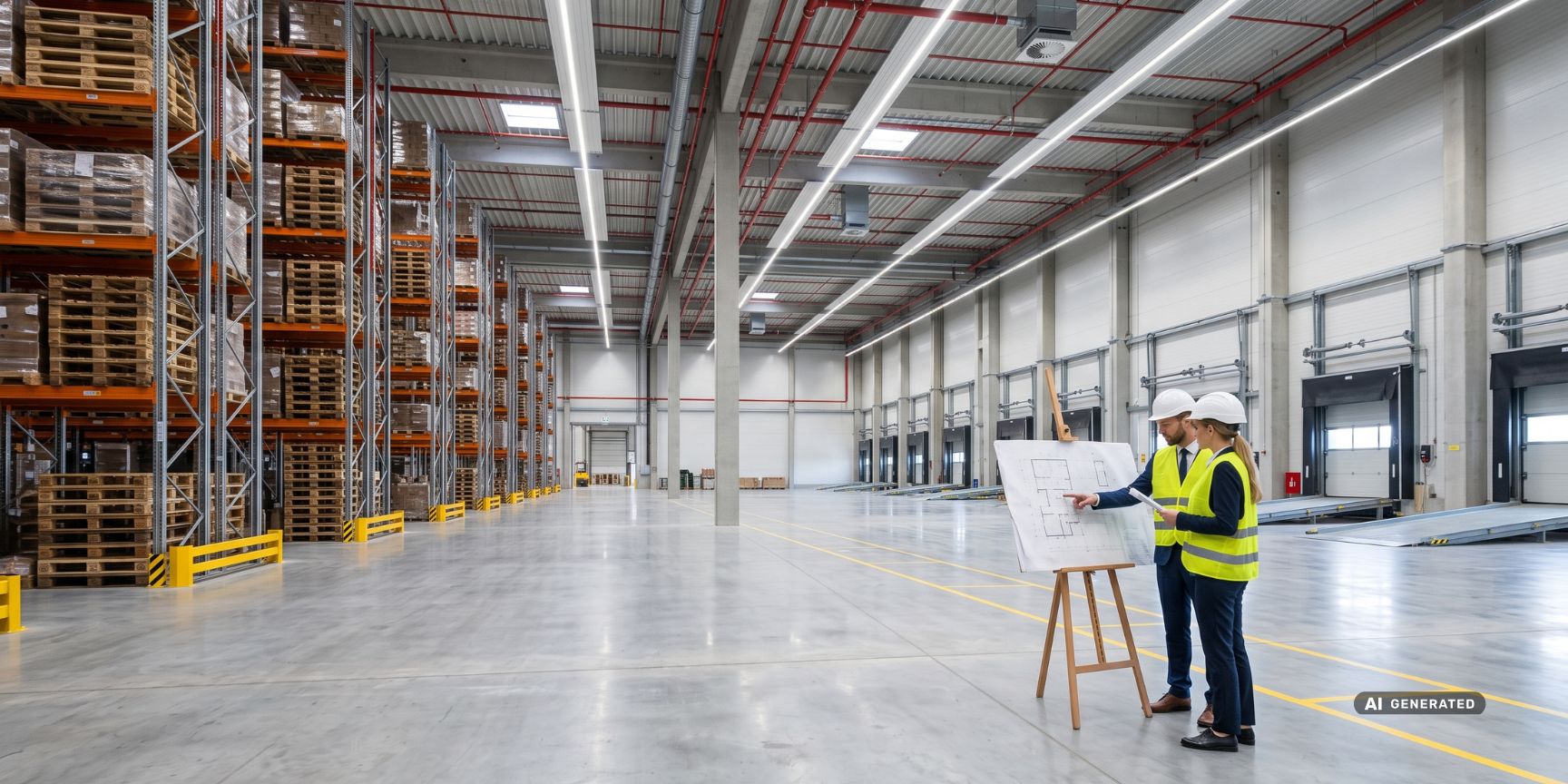
A rental agreement must never record the property only as a number of square meters on a land map. The exact structural condition must be anchored in the contract as a guaranteed property:
- Floor load capacity: For high-bay systems and heavy industrial trucks, industrial floors with a point and surface load of at least 50 kN/m² (approx. 5 t/m²) and strict flatness tolerances (e.g. according to DIN 18202) are indispensable.
- Clear hall height (UKB): The modern standard is between 10.00 and 12.20 metres lower edge of the truss. Every missing height difference reduces the vertical storage capacity and increases the effective costs per parking space.
- Door density and delivery: At least one truck dock leveller per 1,000 m² of hall space is the benchmark. For cross-dock concepts, the demand is significantly higher.
- Fire protection and media: ESFR sprinkler systems (VdS or FM Global standard) directly determine the maximum insurable fire loads and types of goods.
Special features of contract logistics: transit time mismatch & third-party usability
Contract logistics companies (3PL) are faced with a structural dilemma: service contracts with shipping customers usually run for 3 to 5 years. Landlords of modern logistics halls – especially for new buildings (built-to-suit), on the other hand, demand fixed terms of 7 to 10 years or longer.
To cushion this risk, special termination rights in the event of loss of mandate, subletting clauses (subleasing) and flexible extension options (e.g. 2x 3 years) must be anchored in the lease. In addition, the third-party usability of the property is key: standardised column grids (e.g. 12 × 24 m) and modular fire compartments make it possible to quickly convert space for other industries after a change of customer.

Facts, figures, data: rental prices, OPEX and value preservation
The economic conditions of the German logistics real estate market illustrate the financial implications:
- Prime rents: In Germany's top logistics regions (e.g. Munich, Frankfurt, Hamburg), rents for new buildings range from €7.50 to over €10.50 per m² / month. In secondary locations, existing space usually ranges between €4.50 and €6.50 per m².
- Ancillary costs (OPEX): The management costs (excluding process energy) are usually €1.20 to €2.50 per m² per month.
- Indexation (value retention clause): Almost all commercial leases are linked to the consumer price index (CPI). If the CPI rises by agreed thresholds (often 5% or 10%), the rent increases by the same percentage. In the event of high inflation rates, uncapped index clauses can unpredictably drive up the hall rent.
ESG and Green Leases: Data Transparency and Photovoltaics
Driven by European sustainability reporting (CSRD), the lease is transforming into a control instrument. So-called "green leases" replace rigid clauses with partnership obligations:
- Consumption data clauses: The landlord undertakes to provide automated smart metering data (Scope 1 and 2) so that the tenant can fully document his greenhouse gas balance.
- Roof use for photovoltaics (PV): Clear agreements on the installation of rooftop solar systems, tenant electricity models and feed-in tariffs.
- Split incentive solutions: Avoidance of the user-investor dilemma, in which the owner pays for structural efficiency measures, but the cost advantages go solely to the tenant.
Frequently Asked Questions (FAQ) about the Logistics Lease Agreement
What is the usual minimum term for logistics properties?
For existing properties, standard terms are usually between 3 and 5 years. For project developments and built-to-suit properties, investors usually demand 7 to 10 years to secure construction financing (CAPEX).
What is meant by dismantling and dismantling clauses?
These clauses regulate the condition in which the hall must be handed over at the end of the lease. If heavy-duty racks, mezzanine platforms or sprinkler adaptations have been installed, landlords often demand the complete restoration of the original condition. This entails considerable dismantling costs, unless a waiver of dismantling has been agreed.
How does a contract logistics provider protect itself from vacancy costs?
By negotiating subletting rights, break options or involving the shipping customer as a co-debtor or guarantor in the lease.
What is mandatory in an operating costs apportionment clause?
A precise, conclusive list of all apportionable items in accordance with the Operating Costs Ordinance (BetrKV) as well as transparent distribution keys. Blanket formulations such as "all incidental costs incurred" are legally risky.
Why is the official occupancy permit in the lease critical?
The agreed rental purpose (e.g. pure storage, cross-docking or handling of water-polluting substances according to WGK) must be approved under building and immission control law (BImSchG). If there is no permit for 24/7 operation or heavy goods traffic, the tenant may be liable for business interruptions without a corresponding contractual clause.
What does a maintenance cap regulate?
In order to cushion the unlimited cost risk for maintenance and repair (e.g. on gates, ramps and heating), tenants often agree on an annual cost cap, for example maximised to a fixed euro amount per square metre or a percentage of the annual net cold rent.
What happens in the event of structural defects in the floor slab?
Since settlements or cracks in the hall floor can paralyze narrow-aisle forklifts, it must be contractually defined that defects in the floor of the building are immediately remedied by the landlord at his own expense, flanked by clear rights to reduction and damages.
Conclusion: Forward-looking contract design ensures operational success
A lease agreement for a logistics property is not an interchangeable form, but the operational backbone of the entire supply chain. Whether it's floor statics, indexation, green lease requirements or exit strategies for contract logistics companies: those who harmonise structural parameters and operational risks before signing protect margins, ensure delivery capability and create the basis for profitable hall management.
Your Ideal Logistics Warehouse
Browse listings for warehouse space, logistics real estate, industrial land, and contract logistics solutions.
Browse Exposés
Maximize Exposure for Your Warehouse Space
Showcase your logistics properties and attract qualified inquiries.
Discover Products