




Triple-Net-Lease Agreement (NNN) for logistics properties
Table of contents
- What does Triple-Net Lease (NNN) mean?
- The Differentiation: Double Net (NN) vs. Triple Net (NNN)
- NNN in logistics real estate: Who bears which costs?
- Advantages for investors and portfolio holders
- Triple-Net in Contract Logistics: Risks for Tenants
- The ESG dilemma: Why NNN is being replaced by "green leases"
- Triple Net Lease FAQ
What does Triple-Net Lease (NNN) mean?
The term triple-net lease, often abbreviated as NNN Lease in the real estate industry, originally comes from the Anglo-American commercial real estate market. The "net" stands for the three major cost blocks that the tenant assumes in addition to the net rent:
- Net Property Tax
- Net Building Insurance
- Net Common Area Maintenance (Maintenance and Operating Costs)
In the practice of logistics real estate, this means that the tenant (e.g. a freight forwarder or contract logistics provider) not only pays for the rent of the hall, but also acts operationally like an owner and bears almost all building-related costs.
 für Logistikimmobilien_1.jpg)
The Differentiation: Double Net (NN) vs. Triple Net (NNN)
In order to correctly classify the NNN contract, you need to know the gradations in commercial tenancy law.
- Single Net (N): The tenant pays the basic rent plus the property tax.
- Double Net (NN): The tenant pays rent, property tax and building insurance. In Germany, this – combined with the classic apportionable operating costs – is by far the most common form of contract when renting out a warehouse.
- Triple Net (NNN): Here, the user also takes care of the complete maintenance and repair. The US market, for example, is strongly dominated by absolute "Triple Net Leases" (NNN), in which the tenant almost without exception assumes all costs, including roof, structure and taxes. Triple Net contracts are also often used for leases for open storage facilities and commercial properties.
NNN in logistics real estate: Who bears which costs?
The management of a modern logistics property entails considerable costs (OPEX). For standard logistics properties in Germany, ancillary costs of €1.20 to €2.50 per square metre per month are roughly expected. In a real triple-net contract, these are passed on in full to the tenant. The cost blocks are divided into:
- Apportionable operating costs: These include heating and electricity costs, water, waste collection as well as classic facility management (cleaning, winter service) and system maintenance.
- Non-apportionable operating costs: In a classic German commercial lease, the commercial property management and the repairs to the "roof and compartment" (the load-bearing building structure) remain with the owner. According to studies, these are currently at an average of 1.80 euros/m² per year. However, an absolute NNN contract based on the US model passes on even this repair of the roof and compartment to the hall user.
Advantages for investors and portfolio holders
For institutional investors, asset managers and investment companies, a triple-net lease is highly attractive. The landlord receives a highly predictable and stable cash flow, as the financial risk of fluctuating operating costs or exploding tradesmen's wages is completely outsourced. In practice, the classic triple-net contract is characterized by the fact that the tenant bears all operating costs and the landlord stays out of it completely. The administrative effort for the property thus tends to zero.
Triple-Net in Contract Logistics: Risks for Tenants
For service providers in contract logistics, an NNN contract poses considerable risks. Contract logistics companies calculate with extremely high margins (often in pay-per-pallet models) for their clients from trade and industry. If they rent a hall in the NNN model, they have to calculate the "Total Cost of Occupancy" (TCO) extremely precisely. If, for example, freight forwarders rent halls in lightweight construction (often with NNN leases in the USA), this can lead to gigantic and incalculable operational air conditioning costs for the user in climatically extreme zones. Sudden defects in sprinkler systems or industrial doors immediately add to the contract logistics company's balance sheet as unplanned expenses in an NNN contract and jeopardize the project margin.
 für Logistikimmobilien_2.jpg)
The ESG dilemma: Why NNN is being replaced by "green leases"
The real estate market is currently experiencing a massive upheaval. Classic "triple-net contracts" are increasingly considered outdated in modern supply chain management. The main reason is strict ESG regulations (Environmental, Social, Governance) and CSRD reporting obligations (Scope 3). A classic "split incentive" problem (user-investor dilemma) arises: Who pays for the conversion to LED or a heat pump? If the landlord invests in the hall (CAPEX), but the tenant benefits exclusively from falling energy costs (OPEX) through the NNN contract, the owner lacks the incentive to renovate in an energy-efficient manner. The solution is the "Green Lease". It replaces the strict NNN contract and regulates the cooperative partnership. Tenants and landlords agree on smart data exchange clauses and share the costs and financial savings for sustainable building upgrades.
Triple Net Lease FAQ
Question: What is the difference between OPEX and CAPEX in the NNN contract?
Answer: OPEX (Operational Expenditures) are the ongoing operating costs for the property such as energy, maintenance and administration, which are usually borne almost entirely by the tenant. CAPEX (Capital Expenditures) are one-off investments in fixed assets (e.g. the construction of the logistics property) that are borne by the owner in most constellations.
Question: Are genuine triple-net leases permissible in Germany?
Answer: In German commercial tenancy law, there is freedom of contract, but the contracts are subject to general terms and conditions control. A complete passing on of the maintenance and repair costs for "roof and compartment" (building structure) by means of a standardised standard contract is often classified by German courts as unreasonable disadvantage of the tenant and thus as ineffective. They usually have to be negotiated on a highly individual basis.
Question: For which users is a triple-net lease particularly suitable?
Answer: This model is ideal for large, financially strong industrial companies or e-commerce giants that lease so-called solitary locations (single-tenant halls) on a long-term basis for 10 to 15 years. The NNN contract gives them maximum operational freedom to automate and manage the hall in depth according to their own wishes, without having to constantly consult with the owner.
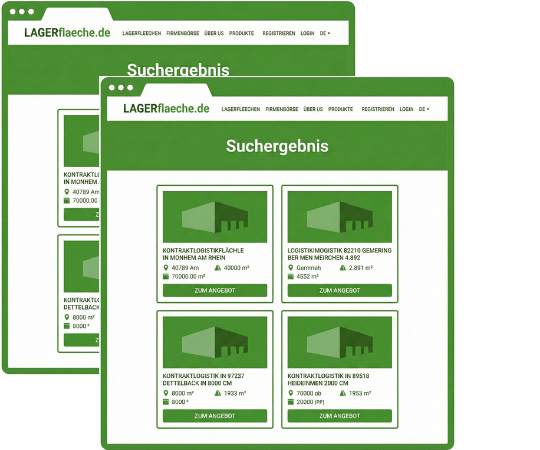
Your Ideal Logistics Warehouse
Browse listings for warehouse space, logistics real estate, industrial land, and contract logistics solutions.
Browse Exposés
Maximize Exposure for Your Warehouse Space
Showcase your logistics properties and attract qualified inquiries.
Discover Products