


Cyber Resilience in Logistics: Strategies to Counter Digital Attacks
Table of Contents
- The New Threat Situation: Facts, Figures and Facts on Cybercrime in Logistics
- When the digital engine sputters: Concrete problems after a cyber attack
- Legal pressure: The NIS2 Directive and the GDPR as a wake-up call
- Prevention is the best defense: What you need to do BEFORE an attack
- The Worst Is Here: What You Need to Do DURING and AFTER an Attack
- Looking at the Supply Chain as a Whole: Demanding Security from Partners
- Conclusion: Cyber resilience as a strategic necessity and competitive advantage
The digitalization of logistics is unstoppable. But with increasing networking, the attack surface for cybercriminals is also growing. Data loss, operational downtime and new legal requirements such as the NIS2 Directive pose immense challenges for logistics service providers. What are the specific problems, what can you do before and after an attack, and how do you navigate safely through the thicket of requirements? This article provides you with practical answers and a deep insight into IT security for the logistics industry.
Modern logistics is a highly complex, digitally networked ecosystem. Just-in-time deliveries, automated warehouses and global supply chain management systems are inconceivable without smooth IT. But it is precisely this dependence that makes the industry a lucrative target for cybercriminals. A successful attack can not only paralyze a single company, but send shock waves through entire supply chains.
But what does a cyber attack mean in concrete terms for a logistics service provider? Which vulnerabilities are exploited and how can you protect yourself effectively? And what if it's already too late?
The New Threat Situation: Facts, Figures and Facts on Cybercrime in Logistics
The threat is real and measurable. According to the Federal Situation Report Cybercrime 2024 of the Federal Criminal Police Office (BKA), the threat level from cybercrime in Germany remains high. In particular, ransomware attacks, in which data is encrypted and ransoms are demanded, pose one of the greatest dangers. The logistics industry has also been explicitly targeted by DDoS attacks, which aim to paralyze systems through a flood of requests.
A study by the German Insurance Association (GDV) revealed as early as 2023 that almost one in four companies (22%) in retail and logistics has already been the victim of a cyberattack. What is alarming is that three-quarters (73%) of those surveyed believed they were doing enough for their IT security – a misjudgement with potentially devastating consequences.
The most common attack vectors are:
- Phishing and social engineering: Targeted emails or messages that trick employees into revealing credentials or opening malicious attachments. The BKA reports that in phishing campaigns in 2024, shipping service providers were often misused as supposed senders - a direct point of attack for logistics.
- Exploitation of software vulnerabilities: Outdated software in transport management systems (TMS), warehouse management systems (WMS) or on office PCs serves as a gateway.
- Ransomware-as-a-Service (RaaS): Criminals "rent" malware and infrastructure, which enables attacks even for actors without in-depth technical knowledge and drives up the number of attacks.
When the digital engine sputters: Concrete problems after a cyber attack
A successful cyberattack is more than just an IT problem. It strikes at the operational heart of every logistics service provider. The consequences are complex and serious:
- Business shutdown: Tours cannot be planned, trucks cannot be loaded, goods cannot be tracked and invoices cannot be issued. The case of the logistics company Hellmann Worldwide Logistics at the end of 2021 is an example of this. After a ransomware attack, the company had to shut down its systems globally and switch to "robust manual processes" for days, which massively affected business operations.
- Data loss and tampering: The loss of sensitive customer data, freight information, or customs documents is catastrophic. Criminals can not only steal data, but also manipulate it to redirect deliveries or cause chaos.
- Financial damage: These are made up of several components: costs for IT forensic experts and recovery, any ransom paid, contractual penalties due to delivery delays and massive loss of sales. A study by PwC describes a case in which the restoration of the systems of a logistics service provider was only possible through a second data center. The costs for such emergency operations can quickly run into the millions.
- Loss of reputation: A successful attack shakes the trust of customers and partners. In an industry where reliability is everything, such damage to the company's image can be more damaging in the long term than the direct financial loss.
Legal pressure: The NIS2 Directive and the GDPR as a wake-up call
The times when IT security was a "can" topic are finally over. New legal requirements are increasing the pressure on logistics companies considerably.
The NIS2 Directive
The EU Directive on Measures for a High Common Level of Cybersecurity (NIS2) must be transposed into national law by October 2024 (in Germany through the NIS2UmsuCG). It massively expands the circle of companies affected. Parts of the traffic and transport sector are also classified as "essential" or "important" facilities. Companies with 50 or more employees or an annual turnover of 10 million euros are often affected.
What does this mean for you?
- Obligation to take risk management measures: You must demonstrably take appropriate technical and organizational measures (TOMs). This includes contingency plans, supply chain security, regular testing, and training.
- Strict reporting obligations: Security incidents must be reported to the Federal Office for Information Security (BSI) within 24 hours.
- Personal liability of the management: The management is liable for the implementation of cybersecurity measures and must train itself regularly. Violations can result in severe fines.
The General Data Protection Regulation (GDPR)
In the event of a data leak in which personal data (e.g. of customers or employees) is affected, the GDPR applies. This requires notification to the Data Protection Authority within 72 hours and can result in fines of up to 4% of annual global turnover.
Prevention is the best defense: What you need to do BEFORE an attack
Proactive action is key to cyber resilience. Don't wait until you become a target. How can you strengthen your lines of defense?
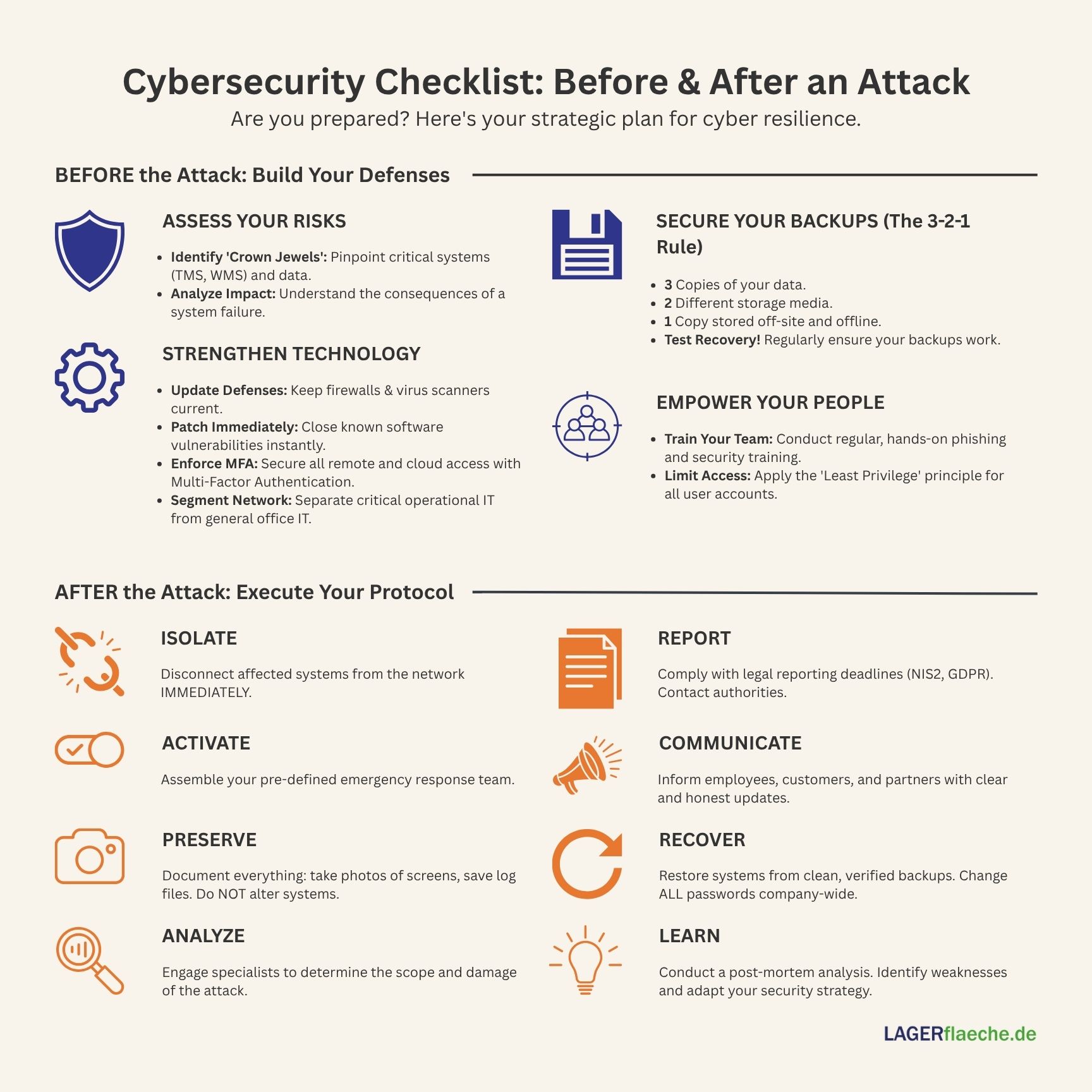
Checklist prevention:
Risk analysis & assessment of protection needs
Where are your "crown jewels"? Identify the most critical systems (TMS, WMS, financial accounting) and data. What would be the impact of a cancellation?
Technological foundation:
- Firewalls and virus scanners: Always keep them up to date.
- Patch management: Instantly close known vulnerabilities in operating systems and software.
- Multi-factor authentication (MFA): Secure all accesses, especially for remote workstations and cloud services, with a second factor (e.g. app, SMS code).
- Network segmentation: Separate critical systems (e.g. operational logistics IT) from normal office IT to prevent the spread of malware.
Secure backups (the 3-2-1 rule):
- 3 Copies of your data
- on 2 different media
- 1 copy of which is off-site (offline and/or in a secure cloud) to protect it from ransomware encryption. Test the recovery regularly!
The human factor:
- Employee awareness: Regular, hands-on training on phishing and social engineering is essential. Conduct simulated phishing attacks to increase learning.
- Authorization management: Assign access rights according to the "least privilege" principle. Every employee should only be able to access the systems and data that they absolutely need for their work.
The Worst Is Here: What You Need to Do DURING and AFTER an Attack
Despite the best preparation, an attack can be successful. What counts now is fast, structured and calm action. A good emergency plan is worth its weight in gold here.
Checklist reaction:
- Isolation: Immediately disconnect the affected systems from the network to prevent further spread. If necessary, shut down the server in a controlled manner.
- Activate emergency team: A predefined team of internal IT, management, external cybersecurity experts, and communications must take the lead. The contact lists must also be available without access to IT systems.
- Preservation of evidence: Document everything! Take photos of screen content (ransomware messages), back up log files, and create memory images of the affected systems for later forensic analysis. Change as little as possible.
- Analysis and evaluation: External specialists should analyze the extent of the attack. Which systems are affected? What data has been stolen or encrypted? Is the attacker still active on the network?
- Check reporting obligations: Is this a reportable incident under NIS2 or GDPR? Comply with the short deadlines (24 or 72 hours). Contact the BSI and the responsible data protection authority.
- Communication: Inform employees, customers, partners and, if necessary, the public transparently and honestly (depending on the situation). Communicate what happened, what actions are being taken, and when to expect normalization.
- Recovery: Restore systems from clean, audited backups to a secure, sanitized environment. Change all passwords.
- Postmortem analysis: Learn from the incident. What went well, what went badly? How was the attacker able to penetrate? Adjust your security strategy based on the insights.
Looking at the Supply Chain as a Whole: Demanding Security from Partners
Your own IT security is only as strong as the weakest link in your supply chain. An attack on a small transport partner or an IT service provider can affect your entire company (supply chain attack).
- Ask: What about the IT security of your partners? Request proof or self-disclosure.
- Contractual provisions: Integrate cybersecurity requirements and incident reporting requirements into your contracts with service providers.
- Secure interfaces: Secure all digital connections to partners (e.g. via EDI or API).
Conclusion: Cyber resilience as a strategic necessity and competitive advantage
Cyberattacks are a permanent and ever-evolving threat to the logistics industry. The question is not if, but when a company will be targeted. A purely reactive attitude is negligent and endangers the existence of the company.
Logistics service providers must understand IT security as a strategic, company-wide task that is supported by management. It is a matter of establishing a culture of security and cleverly combining technical and organizational measures. Investing in prevention, emergency planning and employee awareness is not just a cost factor, but a crucial investment in resilience, customer trust and thus in the future viability of your company. Companies that demonstrate their digital sovereignty will increasingly be able to use this as a clear competitive advantage.
Latest Blog Posts
Stay up to date with the newest trends, insights, and tips in warehouse and logistics. Our latest articles help you navigate the industry with confidence.

Data Centres vs. Logistics Facilities: The Race for Power and Land
Across Europe, logistics operators are competing for more than land and transport access. They increasingly need something much harder to secure: grid capacity. Data centres are intensifying that competition — and changing how logistics locations are evaluated....

Chinese companies discover Europe's logistics real estate
Chinese companies are becoming an increasingly visible user group in Europe's logistics real estate market. What does this mean for warehouse space, 3PL structures and the requirements for European logistics locations?...
AI Hallucinations in Logistics: When AI Plans the Wrong Delivery
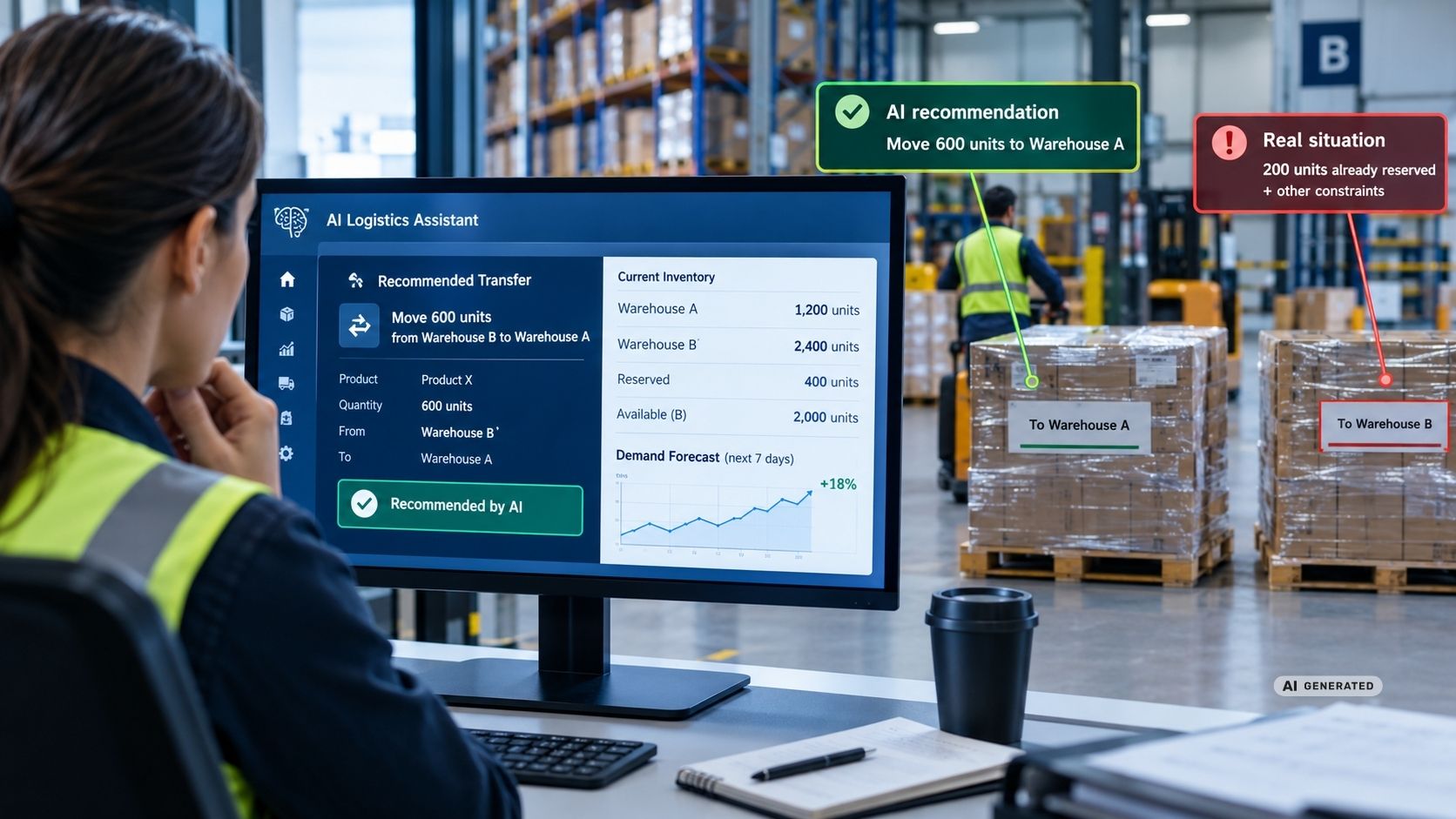
AI can analyze enormous amounts of logistics data — but it can also produce a convincing answer that is simply wrong. The critical question is not whether AI makes mistakes, but what happens when a wrong recommendation becomes an operational decision....

The Green Revolution on the Hall Roof: From Concrete Block to Ecological Power Plant?
Logistics roofs can do more than PV: greening, bees, urban farming and even sports areas turn unused roof space into multifunctional rooms....