


Live Cargo: Logistics, Collection Points and Value-added Services for Animal Transport
Table of Contents
- Is There a "Storage" of Animals? The Terminology of the Industry
- The Historical Development: From Cattle Drive to High-Tech Logistics
- Who are the Customers of Animal Logistics?
- Value Added Services (VAS) in Animal Logistics: Much More Than Just Feeding
- Animal Welfare and EU Regulation 1/2005: The Legal Guardrails
- The Infrastructure: What does a Logistics Center for Animals Look Like?
- Practical Example: The Procedure at an EU-approved Checkpoint
- International differences: Europe and the World in Comparison
- Conclusion: Animal Welfare and Logistics as a Common Challenge
Everyone is familiar with the transport of animals – the special trucks with ventilation slots are part of everyday life on European motorways. But what happens in between? Is there a kind of "storage" of animals in logistics?
Anyone who deals with the supply chain of farm animals, breeding animals or exotic species quickly comes across highly specialized logistics service providers. These companies do not store goods on pallets, but operate so-called collection points and control posts. In this article, we examine how this niche of logistics works, which strict animal welfare laws apply, which value-added services (VAS) are offered and how Europe differs from the rest of the world.
Is There a "Storage" of Animals? The Terminology of the Industry
From an ethical and legal point of view, live animals cannot be "stored". Logistics service providers, livestock dealers and freight forwarders instead use dedicated infrastructures for temporary accommodation:
- Assembly Centers: Places where animals from different farms are brought together. Here they are consolidated into larger transport units (similar to a hub-and-spoke system in general cargo). They usually only stay here for a few hours to two days.
- Staging points: Animals have to rest on long cross-border transports. Checkposts are officially approved "logistics service stations". Here the animals are unloaded, watered, fed and can rest.
- Quarantine stations: Before international export (especially to third countries), animals often have to be housed in isolation for several weeks in order to rule out the outbreak of animal diseases.
The Historical Development: From Cattle Drive to High-Tech Logistics
Animal logistics has undergone a massive transformation. In the 19th century, the classic cattle drive over hundreds of kilometers was the norm – a process that took weeks and was accompanied by enormous weight and loss rates for the animals.
With the expansion of the rail network in the late 19th and early 20th centuries, transport shifted to wagons. Nowadays, road transport dominates. The modern fleets of highly specialized logistics companies (such as VVG Münsterland or Schockemöhle in horse logistics) no longer have anything in common with the simple cattle trailers of the past. They have active ventilation systems, integrated drinking systems, temperature sensors and GPS-based routing. This physical progress is accompanied by the TRACES system (Trade Control and Expert System) – the digital, Europe-wide reporting system for animal transports.
Who are the Customers of Animal Logistics?
The players and clients in this logistics niche are extremely diverse:
- The farmer and breeder: A piglet producer sells his animals to a fattener. A breeding farm exports genetically valuable high-performance cattle to Asia.
- The meat industry and slaughterhouses: The procurement logistics of large slaughterhouses require just-in-time delivery of animals for slaughter in order to utilize the capacities of the facilities.
- Trade and equestrian sports: Specific transport companies take over the worldwide logistics of competition horses.
- Zoos and research institutions: An extremely complex field. The transport of zoo animals requires tailor-made transport boxes and logistics planning, some of which require months of lead time.
Value Added Services (VAS) in Animal Logistics: Much More Than Just Feeding
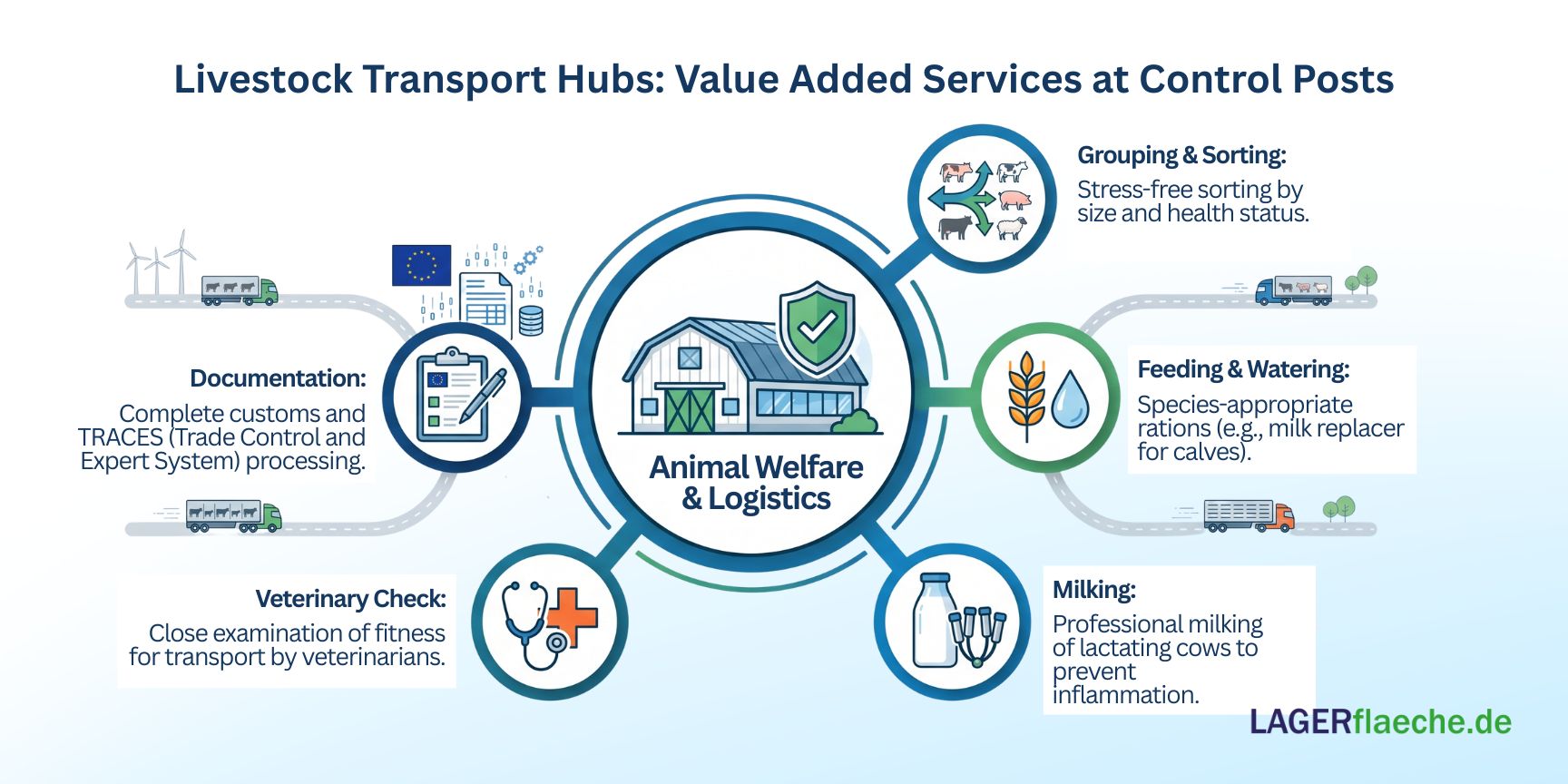
In traditional contract logistics, value-added services include activities such as labeling or repacking. At a checkpoint or a collection point for animals, VAS looks completely different. Service providers offer value-adding services that ensure animal welfare and relieve the customer of administrative burdens:
- Group formation and sorting: Animals are sorted by size, sex or health status to avoid injuries and stress on the truck.
- Species-appropriate feeding and watering: Depending on the species, there are strict ration plans. Calves need milk replacers, while cattle need to have access to roughage (hay/straw).
- Milking: Dairy cows that are in transit must be milked professionally at regular intervals at checkpoints to prevent painful udder inflammation.
- Veterinary checks: Close monitoring by veterinarians directly at the hub. Exhausted or sick animals are separated and are not allowed to continue their transport.
- Customs and document processing: The complete preparation of veterinary certificates, export documents and TRACES documentation is taken care of as a service.
Animal Welfare and EU Regulation 1/2005: The Legal Guardrails
This area of logistics is one of the most strictly regulated sectors of all. The EU Regulation (EC) No. 1/2005 on the protection of animals during transport forms the legal framework.
Some hard facts and regulations from European animal welfare law:
- Temperature requirements: The temperature must be strictly controlled in the means of transport and at the collection points. EU regulations often stipulate that the temperature in the animal sector must not fall below +5 °C and must not exceed +30 °C (with certain tolerances).
- Maximum transport times (example cattle/pigs): Adult cattle may be transported for a maximum of 14 hours, followed by a 1-hour rest period on the truck (for watering), followed by a further 14 hours.
- The 24-hour stop: After these sequences, the animals must be unloaded at an approved checkpoint. There must be a mandatory break of at least 24 hours during which the animals can rest, drink and eat.
- The logbook: For long journeys (over 8 hours), freight forwarders must submit a detailed logbook (route plan) that shows breaks, checkpoints and emergency plans.
The Infrastructure: What does a Logistics Center for Animals Look Like?
A hall for the "accommodation" of animals differs massively from a classic logistics property for e-commerce in terms of construction. The investment costs (CAPEX) for such special buildings are high.
- Hygiene and floor conditions: There are no smooth epoxy resin floors. Floors must be non-slip and have a steep slope (usually 2% to 4%) so that urine and washing water can drain immediately into special slurry tanks.
- Air conditioning: An extremely high air exchange rate is essential to remove ammonia gases, moisture and accumulated heat from the hall.
- Ramps and gates: The ramp angles are very limited by law (e.g. max. 20 degrees for pigs) to prevent slipping and panic during unloading.
- Biosecurity: Strict separation of pure and impure. Truck washes (to disinfect vehicles after unloading) are standard to prevent the spread of animal diseases (such as African swine fever).
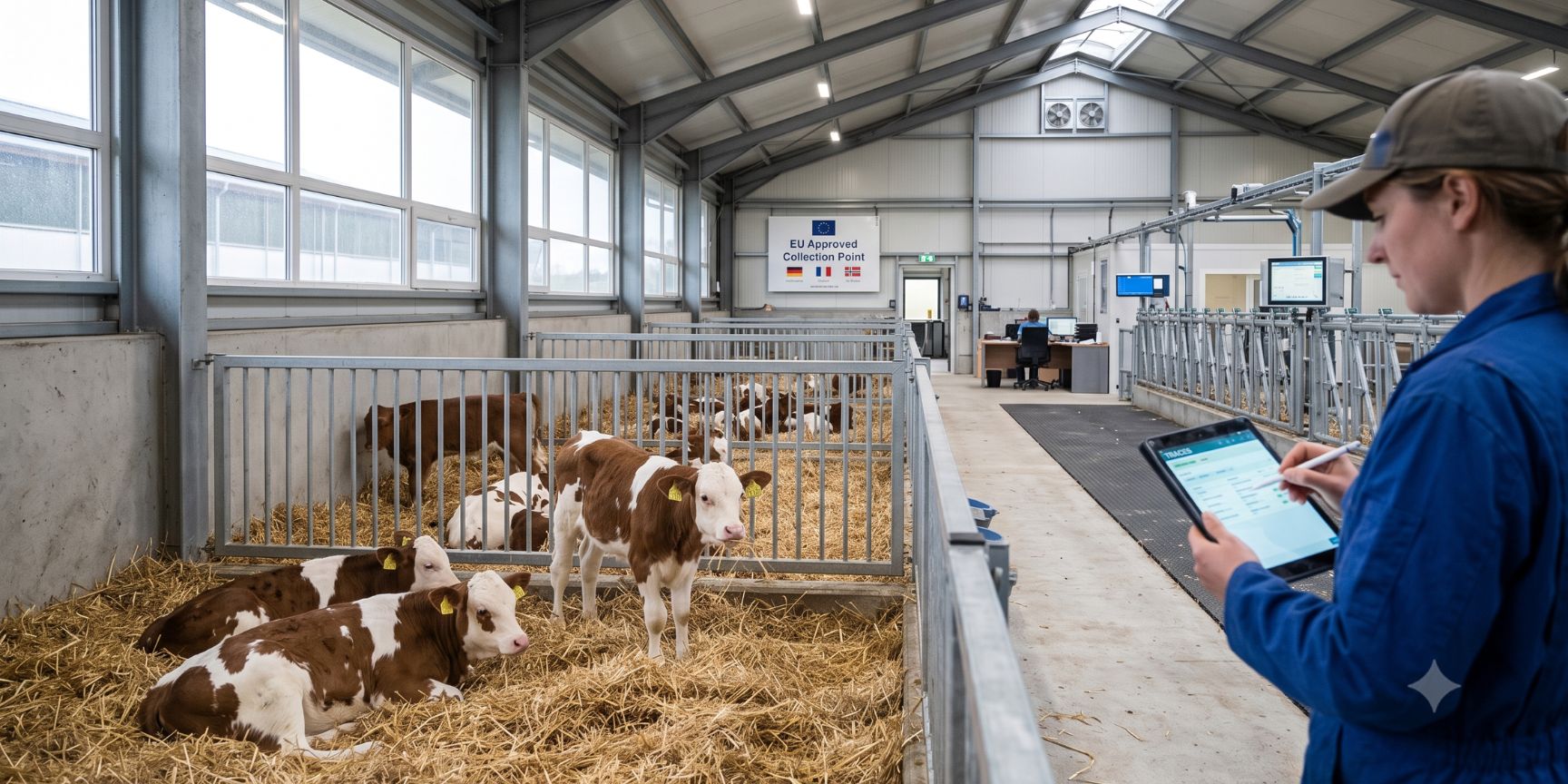
Practical Example: The Procedure at an EU-approved Checkpoint
To make the logistical process tangible, let's take a look at a fictitious, typical EU checkpoint near a European border:
Initial situation: A freight forwarder transports 600 calves from the Netherlands to southern Europe.
The stop: After 9 hours of driving (the legal maximum duration for unweaned calves), the truck reaches the checkpoint.
The Process (VAS):
- The animals are unloaded via flat, laterally bounded ramps.
- Employees sort the animals stress-free into groups of 10 animals each.
- Each group is placed in a box freshly strewn with straw.
- Automated drinking systems provide the calves with electrolytes and milk replacers.
- The facility can accommodate hundreds of animals at the same time. After the 24-hour period has expired, the official veterinarian checks the suitability for transport.
- The animals are gently loaded into the disinfected truck, the TRACES documents are digitally signed, and the transport continues.
Through this process-optimized intermediate station (logistics hub), the service provider ensures the well-being of the cargo and protects the freight forwarder from drastic fines or the withdrawal of the transport license.
International differences: Europe and the World in Comparison
The approach to animal logistics and collection points differs fundamentally globally. Geography, culture and political guidelines shape the networks:
Germany:
Compared to other countries, Germany has extremely strict requirements and interpretations. Political and social pressure is being exerted to avoid long animal transports and to limit the maximum transport time to 8 hours (so-called regionalization of value chains). The density of inspections by veterinary offices is particularly high here.
Southern Europe (e.g. Spain) & Eastern Europe (e.g. Romania):
These countries are massive exporters of live animals (especially sheep and cattle) to non-EU countries (e.g. North Africa, Middle East). Here, gigantic collection points and quarantine infrastructures are located directly at the seaports (such as Midia in Romania or Cartagena in Spain). The animals are consolidated there by truck from all over the country before they are loaded onto special animal transport ships.
Australia and New Zealand:
Once the world champions in the export of live animals over sea. The infrastructure at ports resembled huge, open "feedlots" (feeding grounds). However, a drastic political change is evident in New Zealand: For reasons of animal welfare, the export of live farm animals by sea was recently completely banned.
USA:
Here, gigantic distances shape the market. The road transport of cattle over thousands of kilometers in so-called "livestock trailers" on the highways is the order of the day. The "storage" often takes place in gigantic open feedlots. The European level of strict rest periods (such as the 24-hour rule after 14 hours of driving) is often non-existent in North America in this strictness; the animal welfare requirements for transport are much more relaxed there than in the EU.
Conclusion: Animal Welfare and Logistics as a Common Challenge
The term "storage" does not do justice to the complexity of the living supply chain. Modern animal logistics and the management of collection points and control posts require the highest level of logistical precision, veterinary expertise and ethical responsibility.
For logistics service providers, this means high investments (CAPEX) in special properties and specialist personnel. At the same time, the industry is showing how value-added services – from digital TRACES processing to professional animal care – can ensure that legal framework conditions are met and animal welfare is protected. In a future that increasingly demands regionality, these networks will have to evolve – towards even shorter distances, stricter digital surveillance and even higher standards for the most important "freight" of all.
Latest Blog Posts
Stay up to date with the newest trends, insights, and tips in warehouse and logistics. Our latest articles help you navigate the industry with confidence.
Data Centres vs. Logistics Facilities: The Race for Power and Land
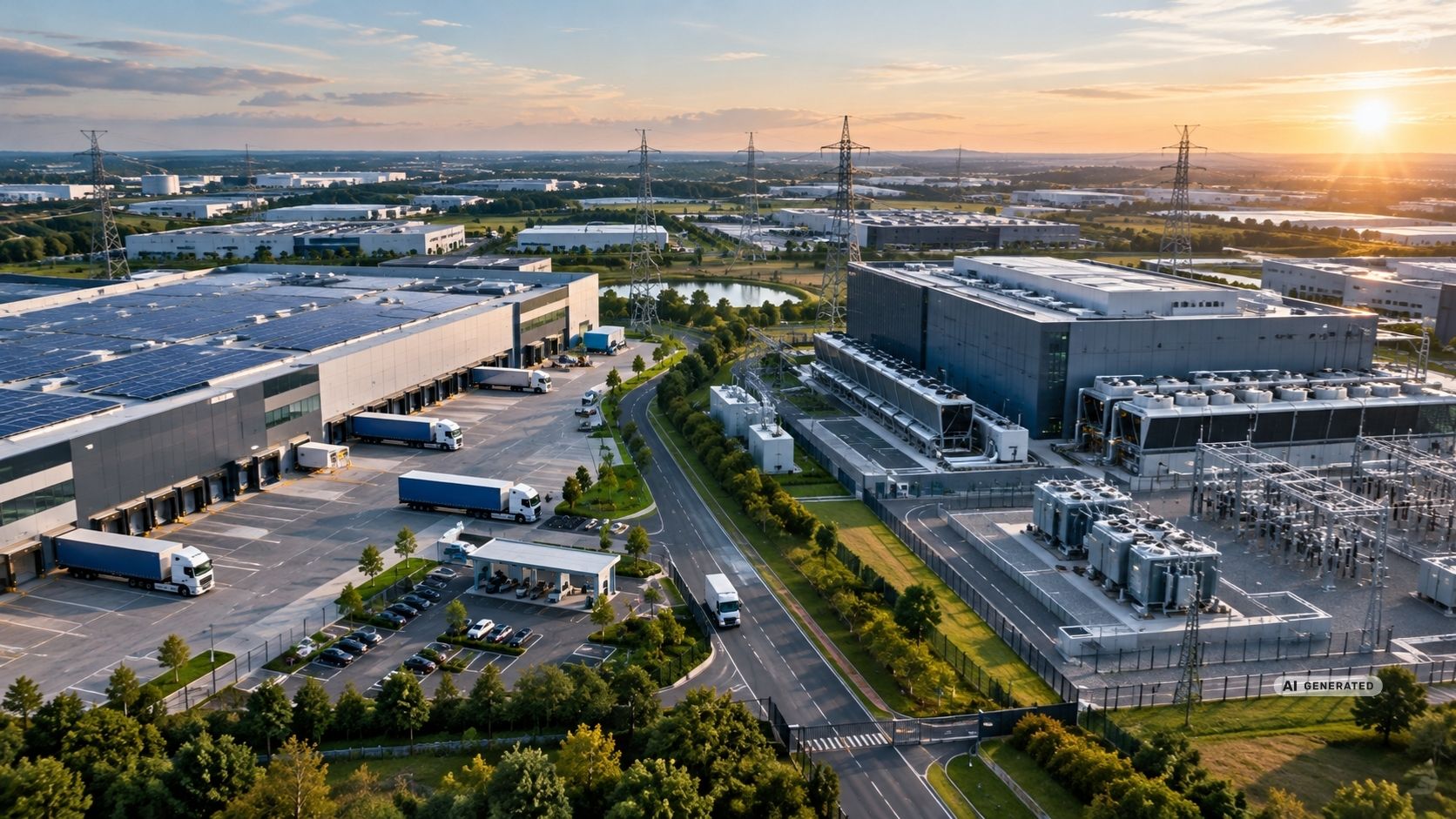
Across Europe, logistics operators are competing for more than land and transport access. They increasingly need something much harder to secure: grid capacity. Data centres are intensifying that competition — and changing how logistics locations are evaluated....
Chinese companies discover Europe's logistics real estate
Chinese companies are becoming an increasingly visible user group in Europe's logistics real estate market. What does this mean for warehouse space, 3PL structures and the requirements for European logistics locations?...
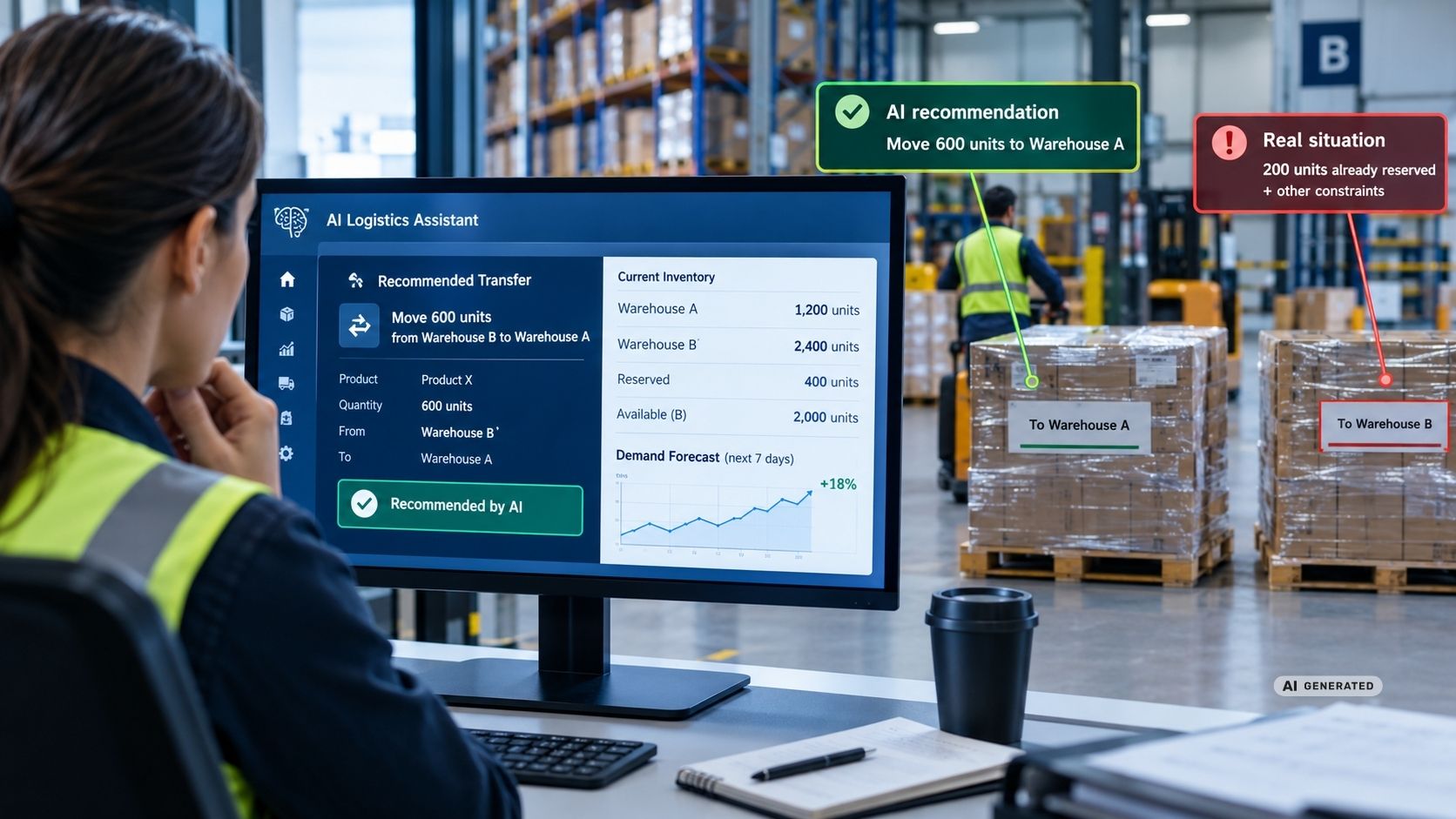
AI Hallucinations in Logistics: When AI Plans the Wrong Delivery
AI can analyze enormous amounts of logistics data — but it can also produce a convincing answer that is simply wrong. The critical question is not whether AI makes mistakes, but what happens when a wrong recommendation becomes an operational decision....
The Green Revolution on the Hall Roof: From Concrete Block to Ecological Power Plant?
Logistics roofs can do more than PV: greening, bees, urban farming and even sports areas turn unused roof space into multifunctional rooms....