




CSRD-compliant: What tenants (must) demand from their logistics property now
Table of Contents
- Why the CSRD is Changing the Rules of the Game in the Logistics Real Estate Industry
- Scope 1, 2 and 3: How the Hall Affects your Own ESG Balance
- Checklist for Tenants: You must Request this ESG Data from the Landlord
- Green Leases: A Guide to Successful Contract Negotiations
- International Differences: CSRD in the EU vs. Global ESG Regulations
- Practical Example: How an E-commerce Logistics Company saved 15% on Energy Costs through Data Transparency
- Conclusion: From Pure Space User to Active ESG Partner
- FAQ: Frequently Asked Questions about CSRD in Logistics Real Estate
The days when renting a logistics property were all about prices per square metre, ramp gates and floor load capacity are finally over. With the gradual introduction of the Corporate Sustainability Reporting Directive (CSRD) by the European Union, tenants of commercial space are facing a massive new challenge: they must prove the sustainability of their operational processes seamlessly and on a data-based basis.
But what happens when the rented warehouse becomes a black box? Who is liable for missing consumption data? And how do you negotiate contracts in such a way that your own ESG balance sheet is not sabotaged by an outdated property? This deep insight provides professionals and decision-makers with a practical guide for dealing with logistics real estate in the age of CSRD.
Why the CSRD is Changing the Rules of the Game in the Logistics Real Estate Industry
Around 50,000 companies in the EU will be required to report in the coming years. The CSRD requires not only warm words, but hard environmental, social and governance (ESG) metrics. For logistics service providers, e-commerce retailers and manufacturing companies, the property used represents one of the biggest levers – but also one of the biggest uncertainty factors – in the CO₂ balance.
Buildings are responsible for around 40% of energy consumption and 33% of greenhouse gas emissions worldwide (source: World Economic Forum / IEA). Tenants who do not receive reliable data from their landlord cannot meet their own reporting obligations. This is leading to a paradigm shift: the landlord is moving from being a pure space provider to an absolutely necessary data and ESG partner.
Scope 1, 2 and 3: How the Hall Affects your Own ESG Balance
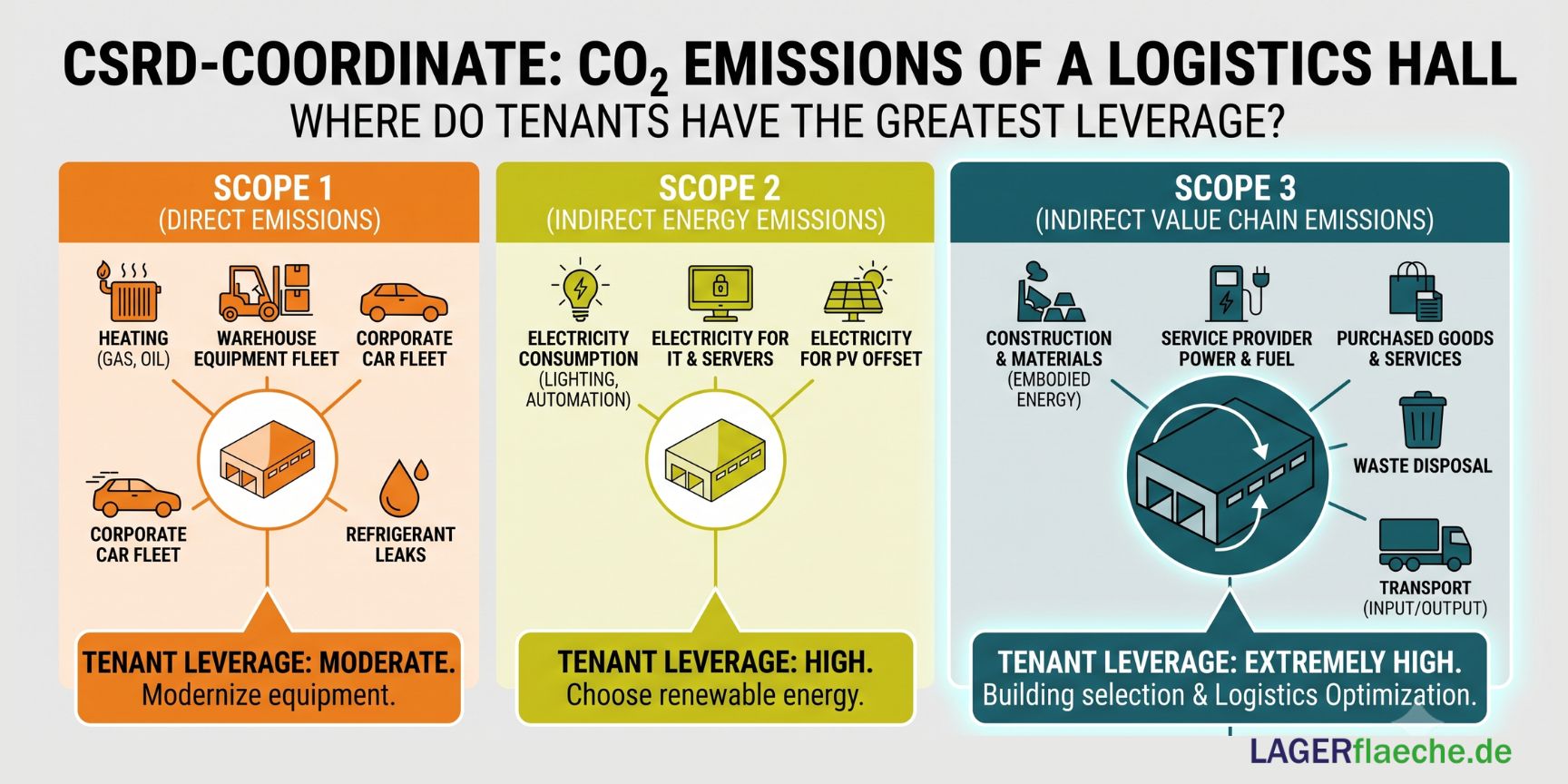
To request the right data, tenants must first understand how the logistics property fits into the Greenhouse Gas (GHG) Protocol. The classification depends heavily on who has operational control over the plant and who concludes the energy contracts.
- Scope 1 (Direct Emissions): If you as a tenant operate your own gas-powered radiant heaters in the hall or your own fleet of diesel-powered industrial trucks, these emissions fall directly into your Scope 1.
- Scope 2 (Indirect Emissions from Energy Purchase): If you purchase the electricity for lighting, automation technology (e.g. AutoStore) and cooling directly from the supplier, this counts as your Scope 2.
- Scope 3 (Upstream and Downstream Emissions): This is where things get complex. The "embodied carbon" generated during the construction of the logistics hall falls proportionately into the tenant's Scope 3 (category: leased assets). Without the life cycle analysis (LCA) of the landlord, you are in the dark here.
An energy-inefficient hall with poor insulation and outdated technology forces you as a tenant to consume a lot of energy. This massively worsens your own Scope 2 balance sheet and can lead to your customers (shippers) excluding you from their supply chains, as you in turn burden their Scope 3 balance sheet.
Checklist for Tenants: You must Request this ESG Data from the Landlord
Smooth reporting requires structured data transfer. Use the following overview table as a checklist for your requirements for the owner or asset manager.
| Data category | Specific key figure / documentation | Relevance to the tenant (CSRD) |
| Energy & Emissions | Monthly electricity and gas consumption (kWh/m²), share of renewable energies. | Mandatory for the calculation of Scope 1 and 2. |
| Resources & Water | Water consumption (m³), rainwater harvesting rate. | Necessary for ESRS E3 (Water and Marine Resources). |
| Waste management | Waste generation in tonnes, recycling quotas. | Necessary for ESRS E5 (Resource Use & Circular Economy). |
| Refrigerants (F-gases) | Maintenance logs and leakage rates of air conditioners/heat pumps. | Refrigerants have an extremely high global warming potential (GWP) and are Scope 1. |
| Building certificates | DGNB, BREEAM or LEED certificates, energy certificates (EPC). | Proof of basic building sustainability to stakeholders. |
| Embodied Carbon | Life cycle analysis (LCA) of the building materials used. | Important for in-depth Scope 3 calculations (leased assets). |
Green Leases: A Guide to Successful Contract Negotiations
The key to enforcing these demands is the "Green Lease". Classic "triple-net contracts", in which the tenant bears all operating costs and the landlord stays out of operation, are no longer up to date. A Green Lease regulates partnership cooperation to achieve environmental goals.
- Anchor data exchange clauses: Contractually agree that the landlord installs smart meters and provides you with the consumption data via a digital interface (API) on a monthly and automated basis.
- Investment allocation (split incentive): Who pays for the conversion to LED or the installation of a photovoltaic system? If the landlord invests (CAPEX) and you as a tenant benefit from lower ancillary costs (OPEX), a contractual arrangement must be found for cost sharing or a moderate "green" rent adjustment.
- Purchase of green electricity: Contractually stipulate that 100% certified green electricity is purchased for the entire building (including common areas).
- Sustainable usage obligations: The contract should also hold the tenant accountable, for example through requirements for waste separation, the ban on fossil fan heaters or the obligation to release the roof for a PV system of the landlord.
International Differences: CSRD in the EU vs. Global ESG Regulations
Logistics is global. Anyone who rents locations not only in Germany, but also in Europe or worldwide, encounters a highly fragmented regulatory environment. The standards for the sustainability of real estate sometimes differ greatly from each other.
Germany: GEG and certification focus
In Germany, the regulatory focus is strongly on the Building Energy Act (GEG), which sets technical standards for heating and insulation. However, the market here is strongly driven by investors who demand DGNB certificates (platinum or gold) for their portfolios. The CSRD now forces German tenants to translate this "hardware data" of the buildings into their corporate reporting.
France: The strict "Décret Tertiaire"
France has introduced one of the strictest regulations in the world with the Décret Tertiaire (Eco Énergie Tertiaire). It legally obliges owners and tenants of commercial buildings over 1,000 square metres to massively reduce energy consumption: by 40% by 2030, 50% by 2040 and 60% by 2050 (base year: 2010). In contrast to Germany, where responsibilities are often still disputed, the French law forces both parties to immediate, joint data collection on the state platform OPERAT.
Great Britain (UK): MEES as a hard cut-off
In the UK, the Minimum Energy Efficiency Standards (MEES) apply. Logistics properties may simply no longer be re-let if their Energy Performance Certificate (EPC) is worse than "E". By 2027, the limit is to be raised to "C" and by 2030 to "B". If you rent in the UK, the law guarantees you a certain energy efficiency in the medium term – otherwise the building is empty (stranded asset).
USA and global market: Investor-driven instead of state-regulated
In the USA or Asian markets, there is no counterpart to the EU-wide CSRD so far. The climate reporting rules of the US Securities and Exchange Commission (SEC) have been significantly weakened and often exclude Scope 3. Exceptions are states such as California (SB 253). Globally, data provision by landlords is forced less by governments than by international investors who want to report according to GRESB (Global Real Estate Sustainability Benchmark) or LEED.
Practical Example: How an E-commerce Logistics Company saved 15% on Energy Costs through Data Transparency
Initial situation:
The fictitious FastFulfill GmbH operates a 20,000-square-meter fulfillment center in a ten-year-old existing property in the Hanover area. In the course of preparations for the CSRD obligation in 2025, the logistics company requested granular energy data from the asset manager.
The problem:
The hall had only one main electricity meter. It was unclear how much energy was consumed for the high-bay lighting, the hall heating and the conveyor technology. The landlord initially refused to bear the high costs of retrofitting with smart meters (sub-metering).
The solution:
As part of a contract extension, both parties agreed on a green lease. The landlord installed an intelligent sub-metering system at his own expense. In return, FastFulfill GmbH agreed to a moderate rent increase (€0.15 / m²) and committed to sharing the collected data with the owner on a monthly basis so that the owner could improve its GRESB rating.
The utility value:
Thanks to the new data transparency, the tenant realized that the outdated lighting caused enormous costs in continuous operation at night. By immediately switching to an intelligent LED control system (investment by the tenant) and an optimized heating curve, annual energy costs were reduced by 15% and Scope 2 emissions were significantly reduced. A clear win-win for the ESG balance sheets of both parties.
Conclusion: From Pure Space User to Active ESG Partner
The CSRD no longer tolerates excuses. If you sign a new lease for a logistics property today, ESG data procurement and corresponding green lease clauses must be negotiated just as hard as the rent. Companies that do not proactively coordinate with their landlords now risk not only compliance violations and penalties, but also the loss of environmentally conscious clients in the medium term. Don't use transparency as a chore, but as a lever to reduce costs and increase the efficiency of your supply chain.
FAQ: Frequently Asked Questions about CSRD in Logistics Real Estate
As a tenant, can I legally force the landlord to hand over ESG data?
So far, there is no direct civil law obligation in standard tenancy law in Germany that forces the landlord to hand over detailed CO₂ data, unless this has been contractually agreed. The CSRD obliges you to report, not necessarily your landlord to deliver. This is precisely why green leases and clear additional contractual agreements are so vital for new or renewal contracts.
What happens if I, as a tenant, do not receive the data for the CSRD report?
If primary data (e.g. exact electricity consumption from sub-meters) is missing, the CSRD allows the use of plausible estimates (secondary data) or benchmarks from industry databases in exceptional cases. However, this usually leads to a "worst-case scenario" in the calculation, which artificially worsens your own sustainability record. In addition, you must justify in the report why there is no real data.
Are older halls (brownfields) generally a disadvantage under the CSRD?
Not necessarily. Although uninsulated existing buildings often cause more emissions during operation (Scope 1 and 2), the "grey energy" (Scope 3) has long since been written off due to the construction that took place years ago. If a brownfield is upgraded in terms of energy efficiency through a smart revitalization (e.g. new heating technology, PV roof, LED), the overall CO₂ balance over the life cycle can even be better than that of a completely new greenfield building on a greenfield site.
Latest Blog Posts
Stay up to date with the newest trends, insights, and tips in warehouse and logistics. Our latest articles help you navigate the industry with confidence.
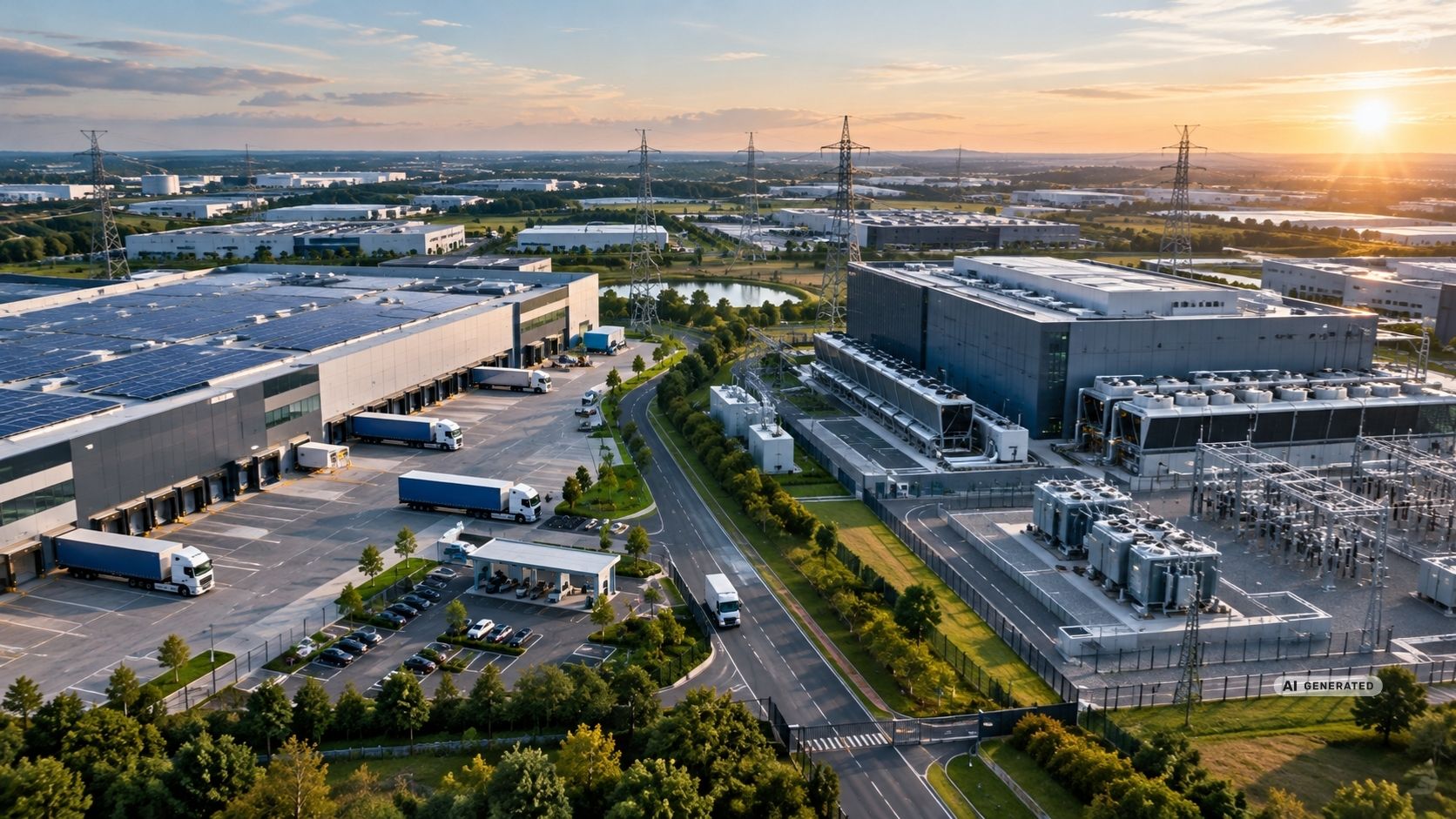
Data Centres vs. Logistics Facilities: The Race for Power and Land
Across Europe, logistics operators are competing for more than land and transport access. They increasingly need something much harder to secure: grid capacity. Data centres are intensifying that competition — and changing how logistics locations are evaluated....

Chinese companies discover Europe's logistics real estate
Chinese companies are becoming an increasingly visible user group in Europe's logistics real estate market. What does this mean for warehouse space, 3PL structures and the requirements for European logistics locations?...
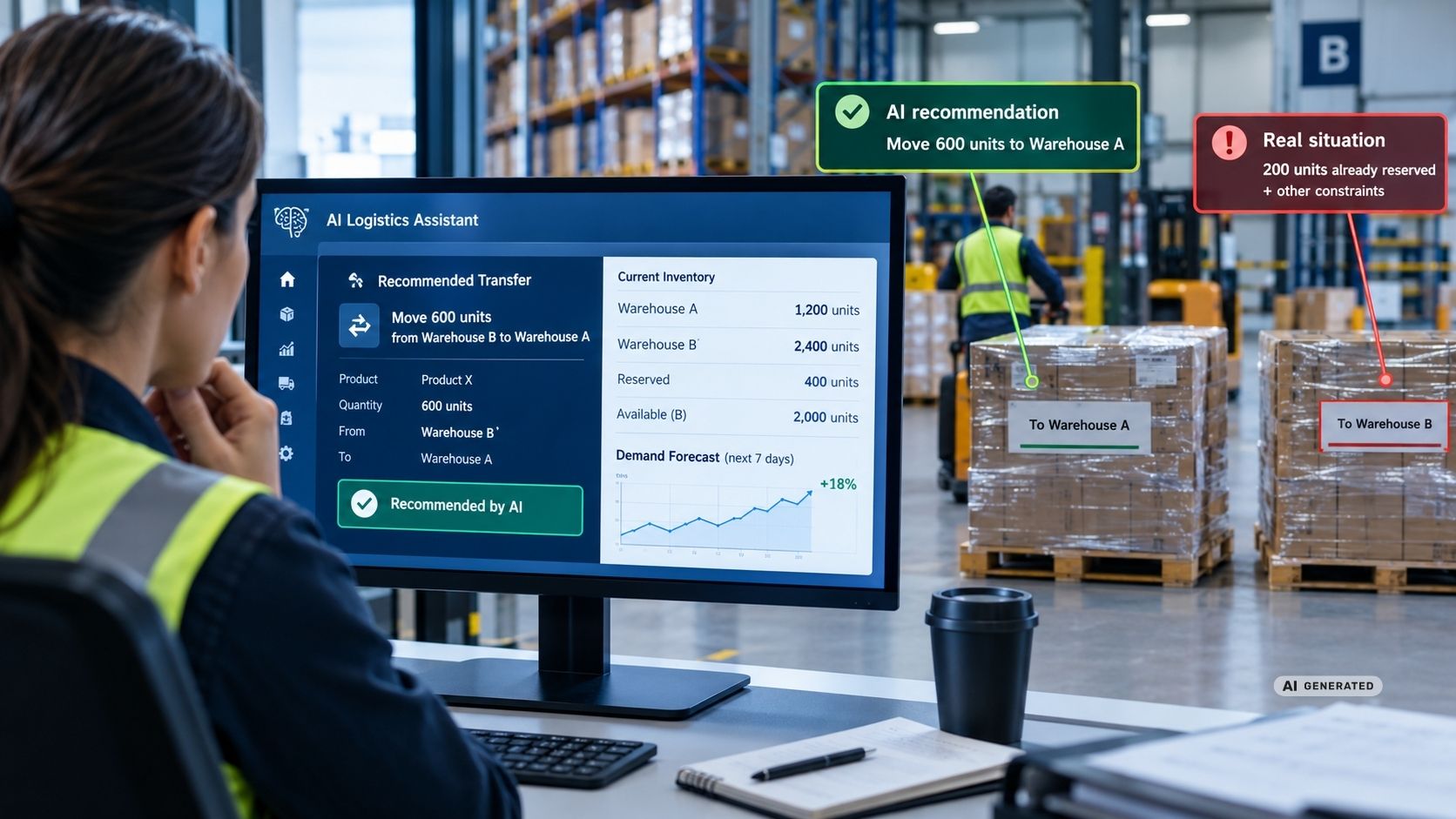
AI Hallucinations in Logistics: When AI Plans the Wrong Delivery
AI can analyze enormous amounts of logistics data — but it can also produce a convincing answer that is simply wrong. The critical question is not whether AI makes mistakes, but what happens when a wrong recommendation becomes an operational decision....
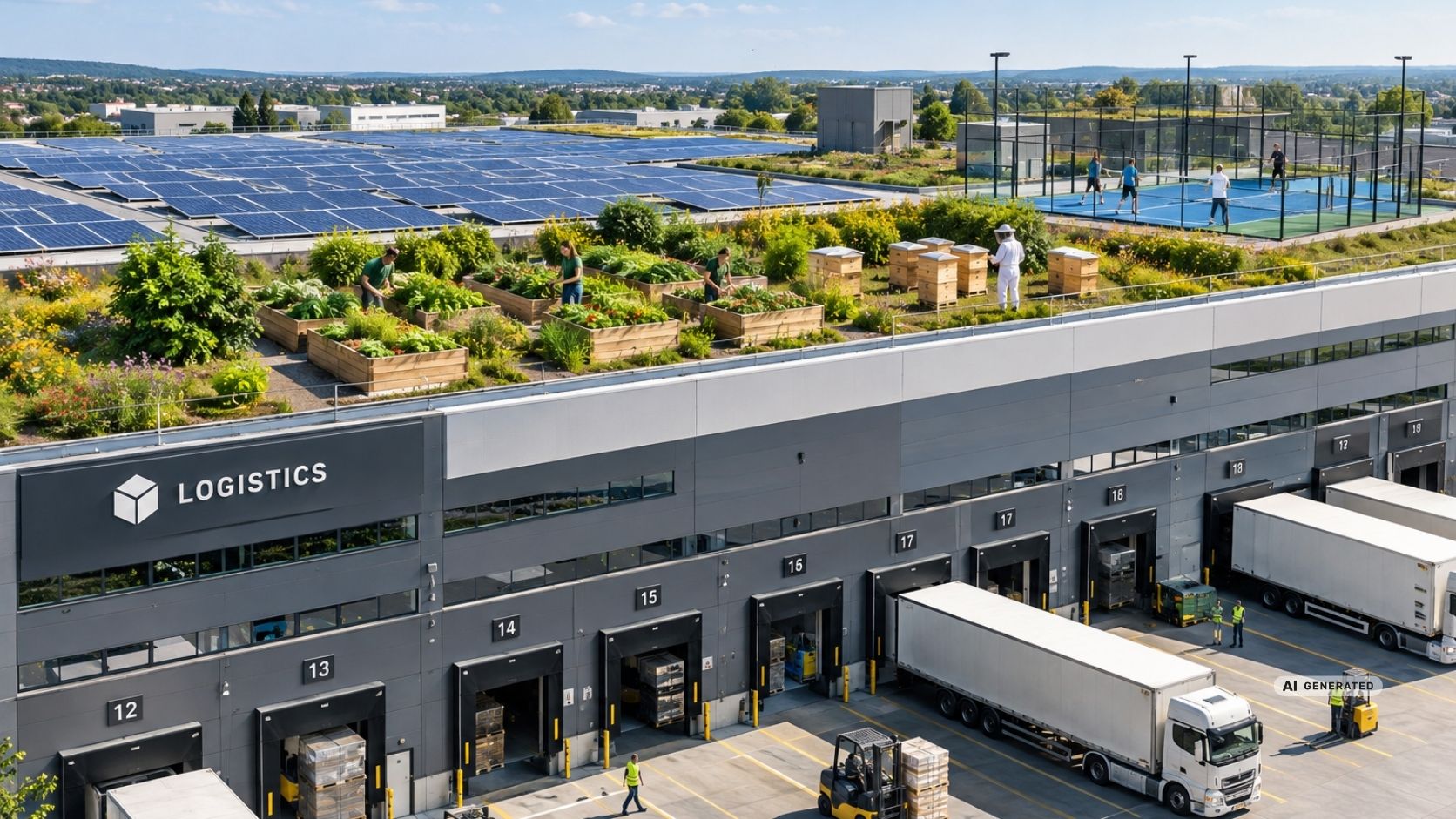
The Green Revolution on the Hall Roof: From Concrete Block to Ecological Power Plant?
Logistics roofs can do more than PV: greening, bees, urban farming and even sports areas turn unused roof space into multifunctional rooms....