



Open-air Storage in Transition: How Outdoor Logistics is Changing Modern Supply Chains
Table of Contents
- From Parking Space to Professional Outdoor Hub
- Why Outdoor Warehouses are becoming More Important for Modern Supply Chains
- Outdoor Warehouse or Logistics Property? The question of the Right Use
- The Open-air Warehouse of the Future will be Digital
- Drones, AI, and Autonomous Vehicles are Changing the Yard
- From Storage Yard to Logistics Service
- Open-air Warehouse as a Strategic Reserve Area
- Brownfields and Existing Industrial Sites are Gaining in Importance
- Open-air Storage International: Different Markets, Different Focal Points
- Practical Example: When Outdoor Space Creates Production Capacity
- Where is Outdoor Logistics Headed?
- Conclusion: The Open-air Warehouse will Become a Strategic Building Block
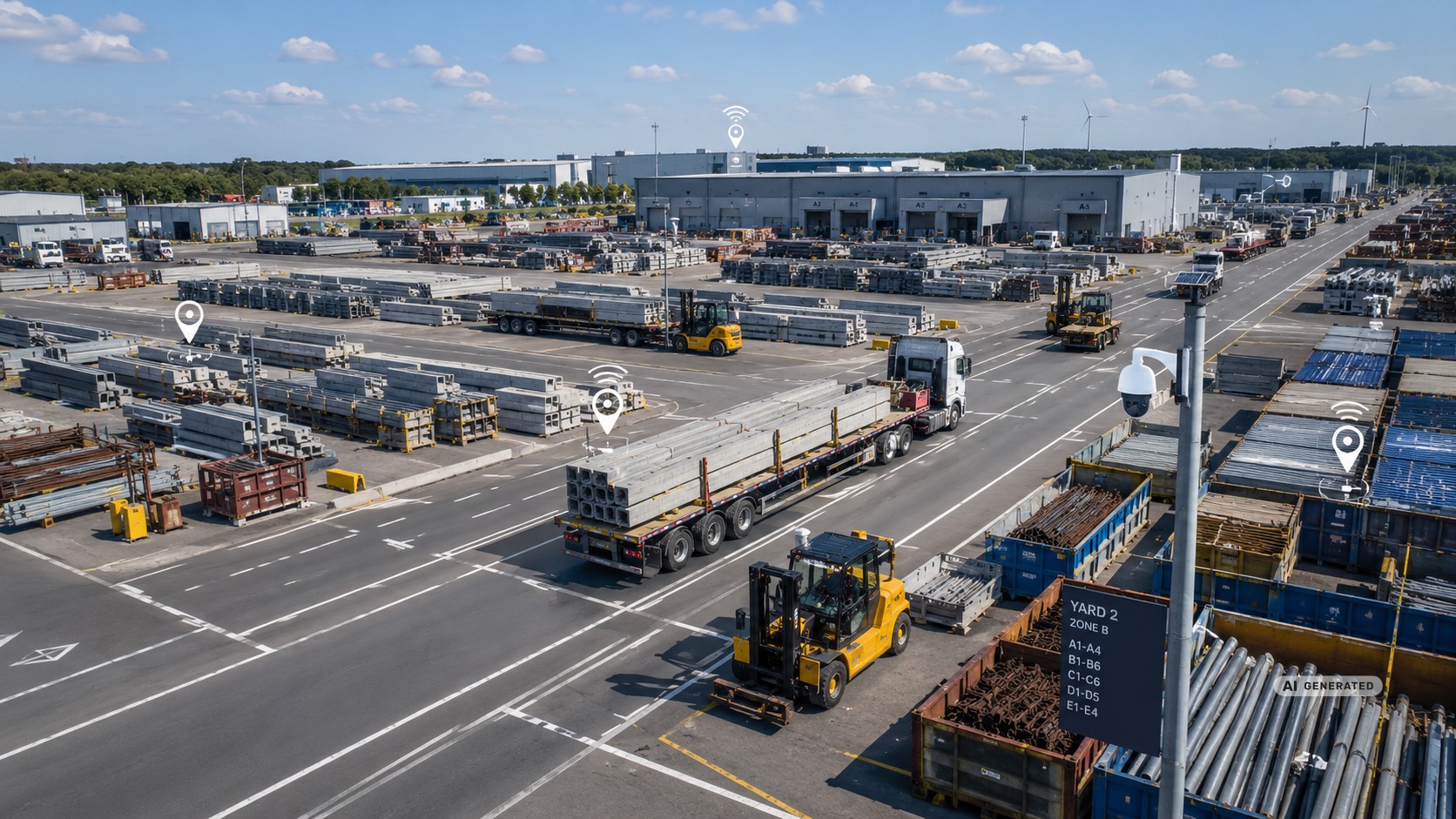
When talking about warehouse space in logistics, many people first think of large halls, high-bay warehouses and modern logistics properties. But not every product needs a roof over its head. For building materials, machines, vehicles, steel, containers, wood or particularly large project goods, the outdoor area can be the more economically and logistically sensible solution.
In the process, the classic outdoor warehouse has changed significantly. The simple parking space behind an industrial hall has increasingly become professionally managed outdoor logistics areas. Digital inventory management, sensor technology, automated access systems and modern yard management solutions make open space an independent part of the supply chain.
At the same time, the strategic value of such areas is increasing. Rising land prices, scarce hall capacities, fluctuating demand and ever larger goods are increasing the need for flexible outdoor space.
The question is therefore no longer just: Where can goods be stored outside?
Rather, it is about: What role can a professional outdoor warehouse play within a modern supply chain?
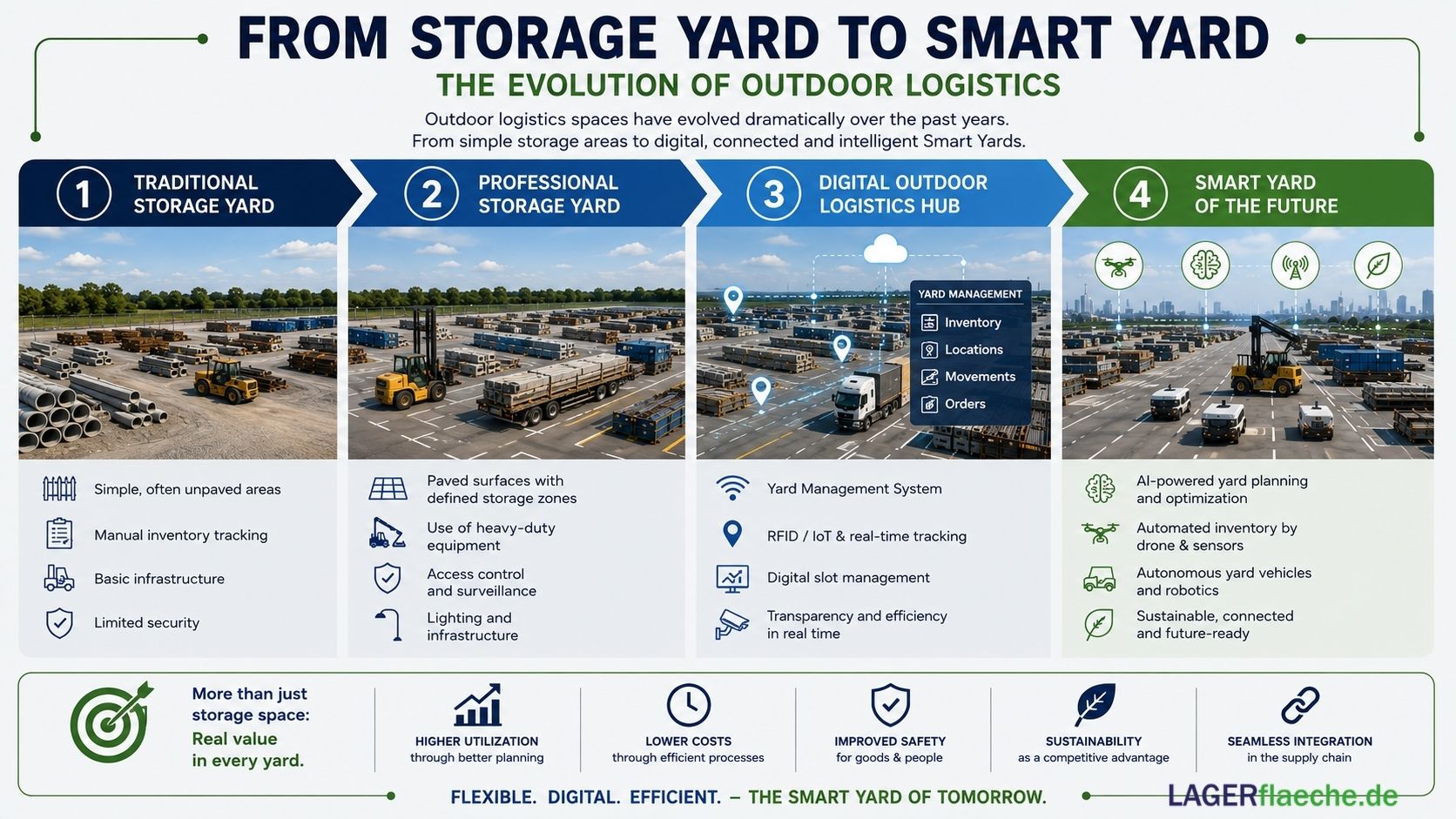
From Parking Space to Professional Outdoor Hub
The classic image of an open-air warehouse is quickly described: a fenced-in area, perhaps fortified, on which goods, machines, vehicles or materials are temporarily parked.
For many companies, this model still serves its purpose. However, the requirements for modern logistics spaces have increased significantly.
Today, a professional outdoor warehouse can be part of a complex logistical process. Goods are not only parked, but also accepted, identified, positioned, controlled, moved, protected and made available for onward transport.
This also shifts the importance of the area.
A pure storage area is becoming an outdoor logistics hub.
This development is particularly evident in goods that are difficult to store in classic halls due to their dimensions, weight or nature. These include, for example, large machines, precast concrete elements, steel structures, wind power components, vehicles, containers or building materials.
Professionally planned outdoor areas can be an important addition to the existing storage and production infrastructure.
Why Outdoor Warehouses are becoming More Important for Modern Supply Chains
There are several reasons for the increasing importance of open-air warehouses.
Space is becoming scarcer
In many logistics regions, suitable hall space is only available to a limited extent. At the same time, companies increasingly need additional capacity – for example, due to production growth, seasonal fluctuations or short-term projects.
In such situations, an outdoor area can create additional capacity without having to build a new logistics hall immediately.
Not every product needs a hall
The requirements of a product determine the appropriate bearing shape.
Sensitive goods such as food, pharmaceuticals or certain electronic products require controlled environmental conditions. Other goods, on the other hand, are largely insensitive to normal weather conditions or can be stored outdoors with suitable packaging and protective measures.
Especially in the case of large-volume or heavy goods, warehouse storage can even be unnecessarily expensive or technically unsuitable.
Production space must be used efficiently
An often underestimated use case is the relief of production sites.
Finished parts or machines can block the production hall even though they have already been manufactured and are just waiting to be called up. A suitable outdoor surface can serve as a buffer and thus make production and internal storage areas available again.
The open-air warehouse thus does not become a replacement for the entire storage infrastructure, but a strategic building block within the overall system.
Flexibility is becoming increasingly important
Supply chains increasingly have to react to fluctuations. Demand, production volumes, project durations and transport flows are changing.
An additional outdoor space can therefore be of particular interest to companies that need temporary or flexible storage capacity.
This is not necessarily about the largest possible area. The decisive factor is that the area, soil conditions, access, load-bearing capacity and logistical equipment fit the respective application.
Outdoor Warehouse or Logistics Property? The question of the Right Use
Outdoor warehouses and closed logistics properties fulfil different functions. The decision should therefore not be made solely on the price per square meter.
A hall area offers protection against precipitation, temperature fluctuations and other weather influences. It is therefore indispensable for sensitive goods and numerous classic warehouse processes.
An outdoor surface, on the other hand, shows its advantages especially for large, heavy or weather-resistant goods.
Among other things, the following are decisive:
- Characteristics and sensitivity of the goods
- Dimensions and weight
- Necessary floor load capacity
- Turnover frequency
- Required vehicles and equipment
- Duration of stay of goods
- Security and access requirements
- Necessary protective and packaging measures
- Available hall and outdoor space at the site
The most sensible solution can therefore also be a combination: sensitive or valuable goods are stored in the hall, while robust, large-volume or temporarily required goods are stored on a suitable outdoor area.
If you are looking for specific outdoor space for your logistics, you can directly compare suitable offers and outdoor warehouses:
The Open-air Warehouse of the Future will be Digital
One of the biggest changes is not necessarily on the ground, but in the information infrastructure.
On a large outdoor area, it is easy to lose track: Where is which container? Which component has already been stored? Which goods need to be loaded next? What space is free?
This is exactly where the digitization of so-called yard management comes in.
Digital systems can record warehouse positions and document goods movements. In addition, sensors, mobile data collection and tracking technologies are increasingly being used.
Digital parking space management
Instead of simply distributing goods on a physical site, digital information is assigned to each storage location or object.
This makes it possible, for example, to understand:
- which good is in which position
- when it was put into storage
- when it was moved
- what order is associated with it
- when it is scheduled for retrieval
This reduces search times and improves the predictability of daily processes.
RTLS and IoT
Real-time location systems can help to locate vehicles, containers or individual goods over larger areas.
IoT sensors can also provide additional information. Depending on the area of application, for example, movements, vibrations or certain environmental conditions can be monitored.
For large external warehouses, this creates a digital layer above the physical surface.
Drones, AI, and Autonomous Vehicles are Changing the Yard
Digitization goes one step further.
Automated inventory
On large areas, taking stock can be time-consuming. Camera systems and drones can help to record inventories and compare them with digital warehouse information.
This approach is particularly interesting for goods that are stored in large quantities or on large areas.
AI-powered space planning
Artificial intelligence can combine different pieces of information in the future:
- Planned deliveries
- Pick-up dates
- Current stock positions
- Available parking spaces
- Weather information
- Necessary transport routes
This can lead to suggestions for the optimal positioning of goods.
An open-air warehouse could thus increasingly not only document where something is located, but also calculate where something should be located.
Autonomous Yard Vehicles
Autonomous vehicles are also easier to use on enclosed company premises than on public roads.
For example, tractors, transport vehicles or other automated systems can be used on clearly defined routes.
The development still faces technical, economic and regulatory challenges. However, the basic principle is interesting: the closed yard offers controllable conditions for automation.
From Storage Yard to Logistics Service
A modern outdoor warehouse does not have to be limited to pure storage.
With increasing professionalization, additional services can take place directly on the outdoor area. This can include, for example, goods inspections, handling, packaging, preparation for onward transport or other logistical activities.
This also changes the business model.
The area is no longer valued exclusively according to the number of available square meters. Equally important are the logistical services that can be provided on these square meters.
This can be interesting for companies if they not only need floor space, but are looking for an external partner to take over certain parts of their logistics process.
This is particularly relevant for project logistics, heavy lift, vehicle logistics, building materials and other specialized goods.
Open-air Warehouse as a Strategic Reserve Area
A particularly interesting function of the open-air warehouse lies in its role as a buffer.
Companies do not always need additional storage capacity on a permanent basis. Often, the need arises from:
- seasonal peaks
- Production backlogs
- Project business
- delayed construction sites
- temporary supply chain issues
- additional import quantities
- Site conversions
- Production relocations
In such situations, an outdoor surface can serve as a temporary reserve.
This is strategically relevant because it means that companies do not have to respond to every capacity peak with a long-term real estate decision.
An outdoor warehouse can thus become part of a flexible capacity strategy.
Brownfields and Existing Industrial Sites are Gaining in Importance
Another development concerns the areas themselves.
Not every suitable outdoor logistics area has to be built on a completely newly developed site. Former industrial and commercial sites can be interesting for new logistical uses under certain conditions.
This can be particularly relevant where new space is difficult to access.
The subsequent use of existing commercial and industrial sites can also help to continue to use locations that have already been developed instead of developing additional space on the outskirts of the city.
Of course, the respective building law, water law, environmental and municipal requirements must be examined.
This makes land development more challenging – but at the same time can make existing locations more strategically valuable.
Open-air Storage International: Different Markets, Different Focal Points
The importance of outdoor logistics differs depending on the market.
Germany
In Germany, building materials logistics, automotive, mechanical engineering and project logistics, among others, play an important role.
At the same time, operators and users have to take into account numerous requirements with regard to land use, drainage, environmental and emission protection.
Netherlands
The proximity to major seaports and international logistics hubs makes outdoor areas particularly interesting for container and terminal processes.
Here, large logistics flows meet a high degree of automation and digitalization.
Scandinavia
In Scandinavia, climate and weather have a particularly strong influence on the design of external camps.
Wood, forestry, mining, and large industrial components are among the areas where outdoor storage can play an important role.
USA
In the USA, large-scale outdoor depots and so-called storage yards are common in various industries.
The available plot sizes and the regionally different regulatory framework conditions sometimes lead to completely different space concepts than in densely populated European logistics regions.
The international comparison therefore shows one thing above all: the open-air warehouse is not a uniform real estate product. Its function depends heavily on location, industry, goods and supply chain structure.
Practical Example: When Outdoor Space Creates Production Capacity
A typical scenario can be illustrated by the example of a manufacturer of large concrete or steel components.
Production runs continuously, while the finished components are sometimes not delivered to the respective construction site until weeks later. The products are large, heavy and unsuitable for classic high-bay storage.
If they remain in the production hall, they block valuable production space.
A suitable, paved outer surface near the production site can serve as an intermediate and buffer storage facility.
After production, the components are digitally recorded, positioned in defined storage locations and, if necessary, made available for further transport.
The economic advantage is not only due to the possibly lower cost of space.
Rather, the decisive factor is the additional production capacity that will be created when the previously blocked hall space can be used again for its actual purpose.
This shows the strategic value of an open-air warehouse particularly clearly:
The outer surface is not just a warehouse. It can help to make the entire production and logistics process more efficient.
Where is Outdoor Logistics Headed?
The open-air warehouse of the future is likely to be more connected to digital systems, automated processes and integrated logistics services.
Several developments are emerging.
- The physical surface is increasingly being mapped digitally. Storage positions, goods and movements are being linked with each other.
- Automation becomes interesting where there are large areas, recurring movements and clearly defined processes.
- Companies will view outdoor spaces more as flexible capacity instruments – not just as a low-cost alternative to the hall.
- The requirements for sustainable land use will increase. Existing commercial and industrial areas could gain strategic importance as a result.
- The boundaries between storage, transshipment and additional logistics services may become even more blurred.
This means that the outdoor warehouse is developing from a comparatively simple storage form into a component of modern outdoor logistics.
Conclusion: The Open-air Warehouse will Become a Strategic Building Block
The open-air warehouse has long been more than a paved area where goods are deposited in the open air.
For certain goods and processes, it can be an important addition to classic hall logistics. Its importance is growing in particular where companies move large or heavy goods, need temporary capacities or want to organize production and storage areas more flexibly.
At the same time, digitization is changing the role of the outdoor area. Yard management, tracking systems, sensor technology, automated inventory and, in the future, autonomous vehicles can turn a simple open space into an intelligent logistics area.
The decisive development is therefore:
From parking space to smart yard.
Companies that need additional outdoor capacity should not only pay attention to the available square footage. Soil, access, load-bearing capacity, safety, infrastructure, logistical services and strategic location within the supply chain are also crucial.
For the specific search for suitable space, companies can rent or compare suitable outdoor warehouses and external warehouses.
Latest Blog Posts
Stay up to date with the newest trends, insights, and tips in warehouse and logistics. Our latest articles help you navigate the industry with confidence.
Data Centres vs. Logistics Facilities: The Race for Power and Land
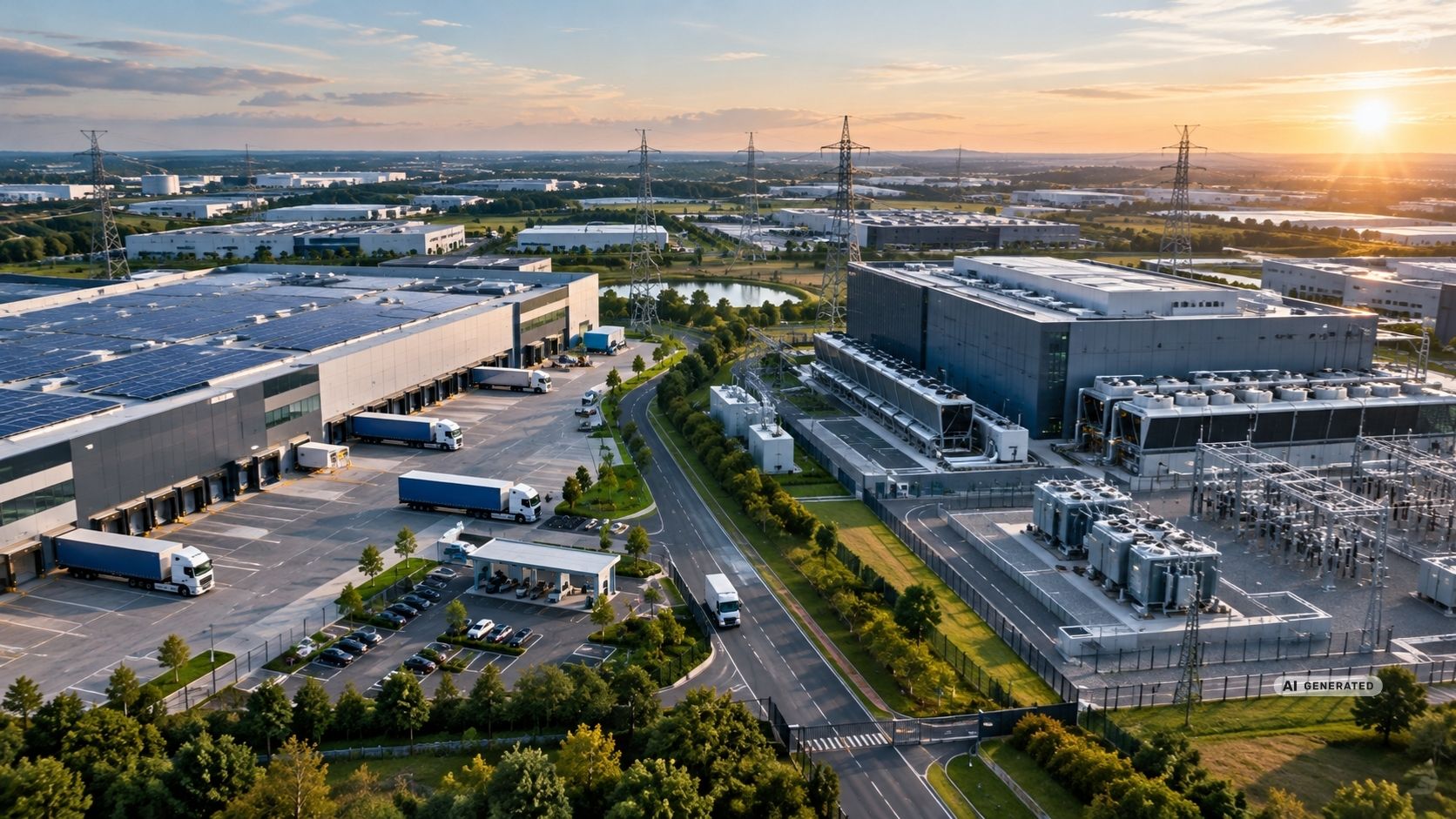
Across Europe, logistics operators are competing for more than land and transport access. They increasingly need something much harder to secure: grid capacity. Data centres are intensifying that competition — and changing how logistics locations are evaluated....

Chinese companies discover Europe's logistics real estate
Chinese companies are becoming an increasingly visible user group in Europe's logistics real estate market. What does this mean for warehouse space, 3PL structures and the requirements for European logistics locations?...
AI Hallucinations in Logistics: When AI Plans the Wrong Delivery
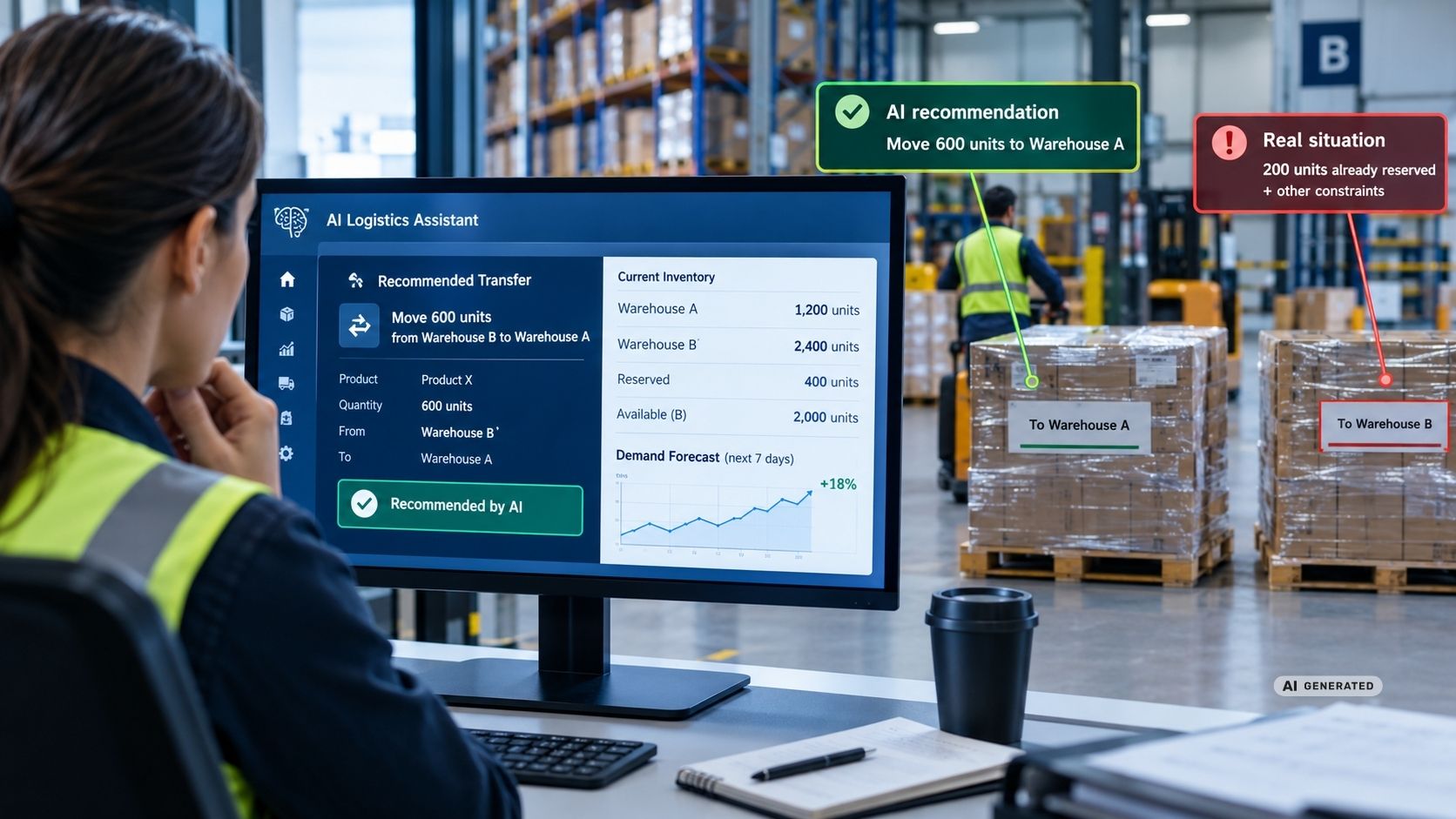
AI can analyze enormous amounts of logistics data — but it can also produce a convincing answer that is simply wrong. The critical question is not whether AI makes mistakes, but what happens when a wrong recommendation becomes an operational decision....
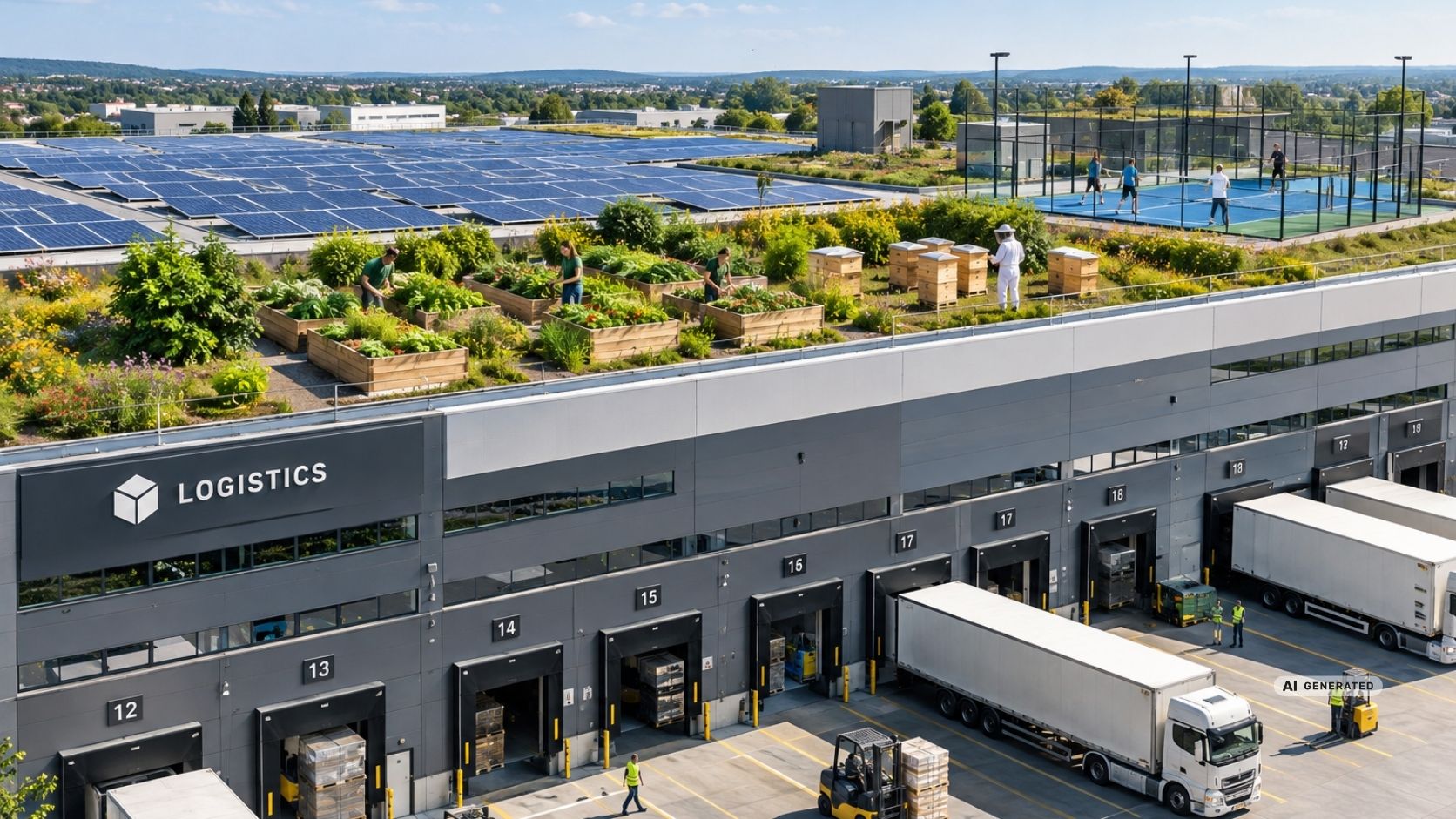
The Green Revolution on the Hall Roof: From Concrete Block to Ecological Power Plant?
Logistics roofs can do more than PV: greening, bees, urban farming and even sports areas turn unused roof space into multifunctional rooms....