


The Green Revolution on the Hall Roof: From Concrete Block to Ecological Power Plant?
Table of Contents
- Greenfield vs. Brownfield: Where does Sustainable Land Development Begin?
- Can a Green Roof Actually Replace Sealed Soil?
- Can Bees and Bumblebees Actually Fly that High?
- What Needs to be Considered with such a System? Statics, Safety and Technology
- Just Nice for the Press or a Real Ecological Benefit?
- Practical Example: Chilies, Bees and Entrepreneurial Spirit at Gebrüder Weiss
- Visions of the Future: Jungle, Lakes or a Sports Field on the Roof?
- Which Roof Use Suits Which Logistics Property?
- International Comparison: How Differently are Roofs Used?
- Conclusion: What Really Makes Sense on a Logistics Roof?
The logistics industry has a massive image and space problem. On the one hand, the need for modern warehouse and logistics space is growing, and on the other hand, the industry is under increasing pressure to reduce land consumption and the impact of new construction projects.
One possibility is the revitalization of industrial and commercial sites that are already in use. But what about the building itself?
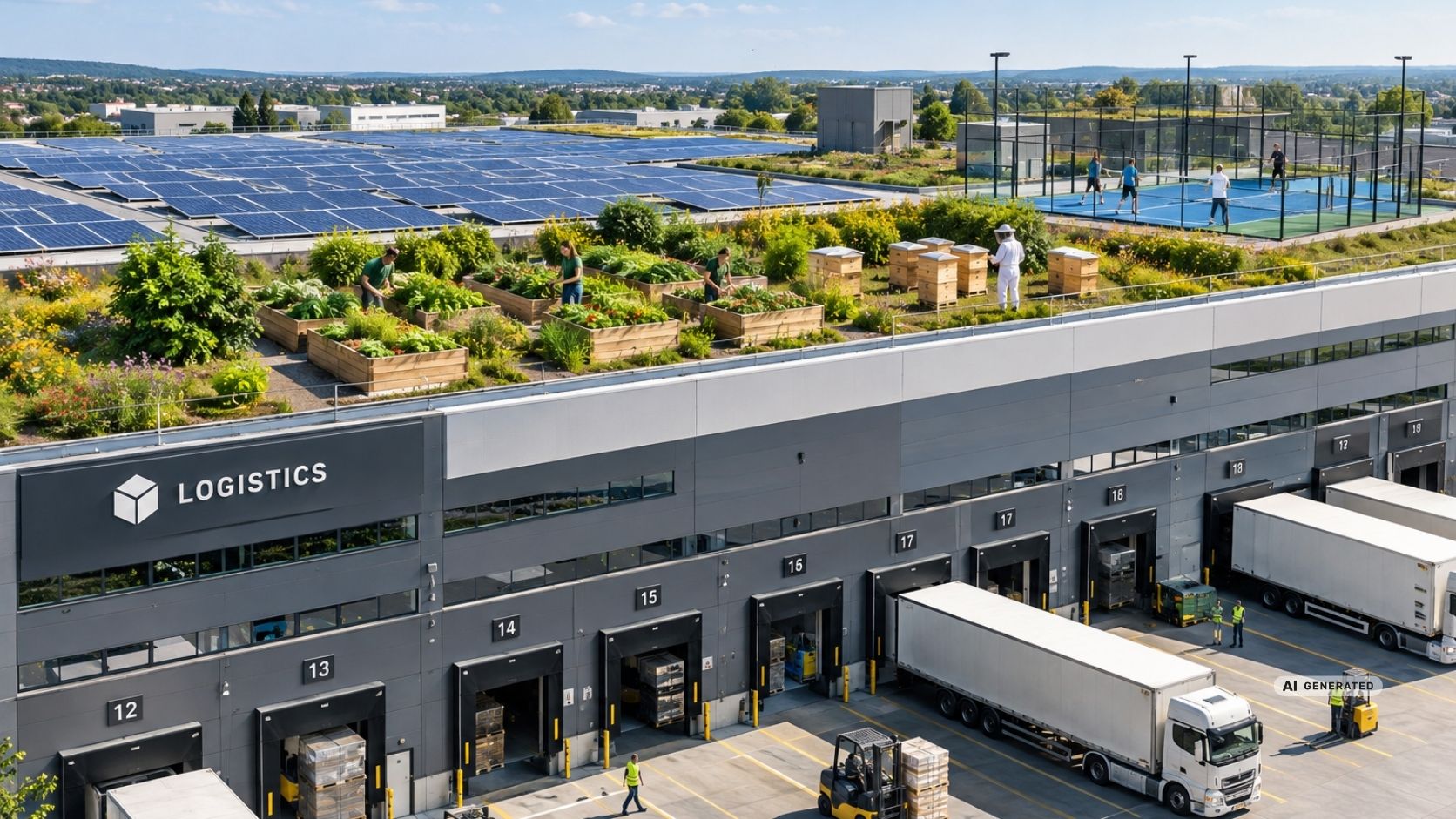
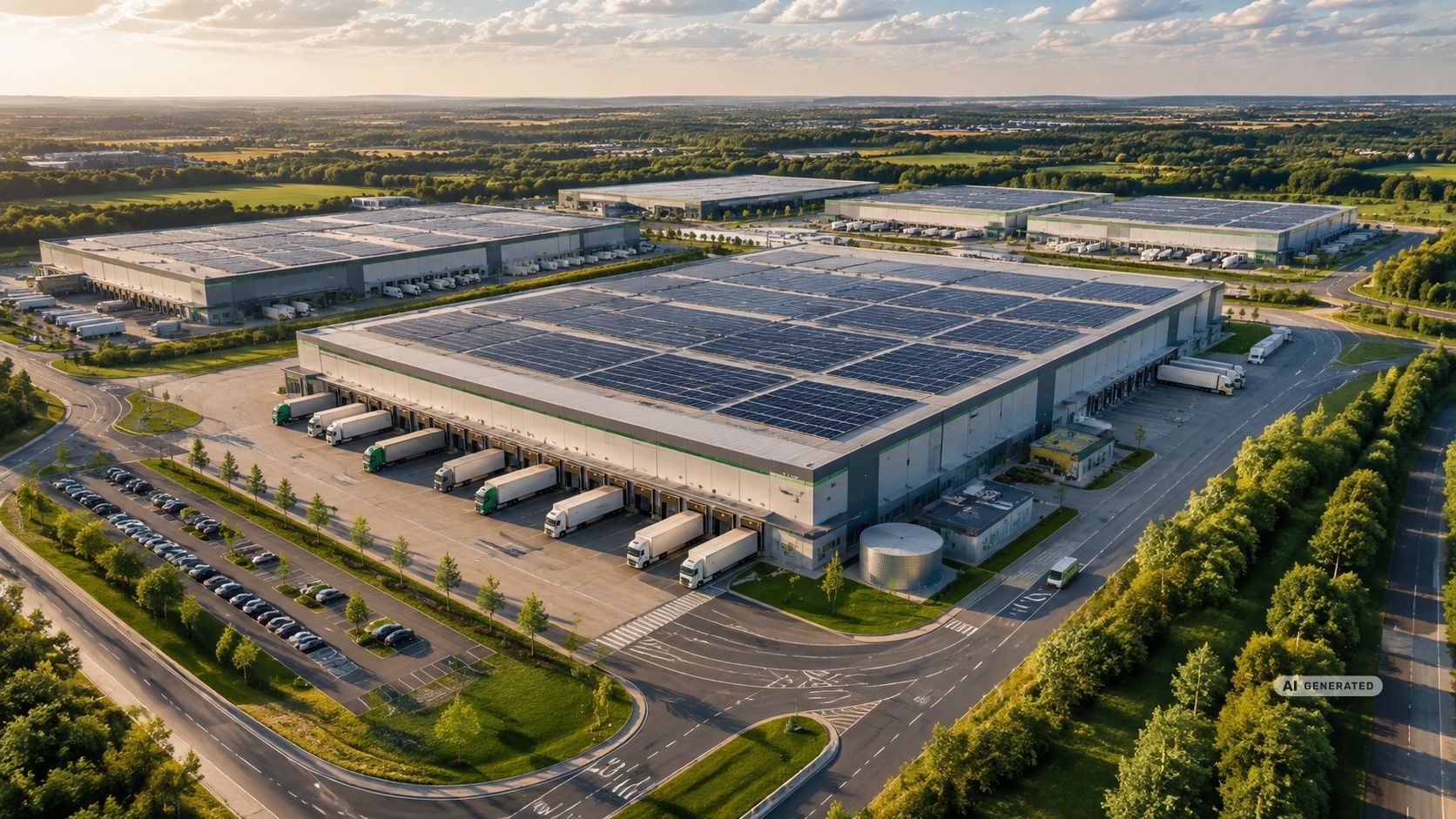
Large logistics halls sometimes have tens of thousands of square meters of roof space. A significant part of this today fulfils one function above all: it protects the building from the weather. At the same time, these areas could take on additional ecological, climatic and social functions.
So is it enough to put photovoltaics on the roof? Or can roofs become more – with greenery, rainwater retention, biodiversity areas, bees, raised beds or even recreational and sports areas?
The decisive question is not: Can you build a garden on a logistics hall? But: What additional use is technically, ecologically and economically sensible for the specific roof?
Greenfield vs. Brownfield: Where does Sustainable Land Development Begin?
The shortage of space is already forcing the industry to rethink. Project developers are therefore increasingly looking at brownfield sites – i.e. areas already used for industrial or commercial purposes – as an alternative to greenfield development.
The revitalization of such sites can avoid new land use and continue to use existing infrastructure. At the same time, brownfield projects are by no means automatically easy: contaminated sites, demolition, existing building fabric and complex site layouts can pose considerable challenges.
Even with sustainable brownfield development, however, one point remains: the land area is still largely sealed.
Rainwater can no longer seep away there as it would on natural soil. At the same time, heavily sealed surfaces can heat up significantly in the summer heat.
This raises a second question:
What can be done with the existing building area – especially with the large, often unused roof?
Read our blog "Brownfield instead of greenfield: Why the future of logistics lies on old industrial wastelands".
Can a Green Roof Actually Replace Sealed Soil?
The short answer is: No – not completely.
A green roof cannot replace the natural soil that has grown. A green roof has neither the same soil depth nor the same natural soil functions as a grown landscape. It is a technically constructed ecosystem that is separate from the natural soil.
However, this does not mean that green roofs are only symbolic politics.
The Federal Environment Agency cites positive effects on the microclimate, rainwater retention, air quality and biodiversity for green roofs, among other things. Depending on the structure, green roofs can store rainwater and release it again with a delay. In this way, they can make a contribution to climate adaptation, especially in heavily sealed areas.
Rainwater management also plays an important role: The Federal Environment Agency explicitly mentions green roofs as a way to temporarily store rainwater and return it to the water cycle via evaporation.
So a green roof does not undo sealed soil. However, it can expand a previously largely unused roof area with additional ecological and climatic functions.
It is precisely this combination that is interesting for logistics properties: space that is already built on can take on several functions at the same time.
Can Bees and Bumblebees Actually Fly that High?
A frequently asked question when planning beehives on building roofs is: Do the insects even find their way up?
The height of the building alone is not a fundamental obstacle. Bees and bumblebees can overcome building heights of several meters. Rather, the decisive factor is whether the roof offers suitable conditions.
These include, in particular:
- sufficient flowering plants and food sources,
- a suitable water supply,
- areas that are as protected as possible,
- suitable wind conditions,
- safe access for the care of the hives.
A roof with a few beehives is therefore not automatically a valuable biodiversity site. The overall concept is decisive.
If, on the other hand, a roof area is designed with suitable plants, different structures and retreat areas, it can create additional habitats for insects.
This is especially true for extensive greening: Compared to intensively cultivated roof gardens, they require less maintenance and can still take on ecological functions.
What Needs to be Considered with such a System? Statics, Safety and Technology
The greening of a 10,000 square meter warehouse is structurally challenging. It is not only the area that is decisive, but above all the planned structure and the resulting additional loads.
The statics
Water and wet substrates can put considerable additional loads on the roof structure. In the case of intensive greening, raised beds or roof gardens, it must therefore be checked at the planning stage to determine what load reserves are available.
One cubic meter of water, for example, weighs around one tone. In addition, there is substrate, plants, technical structures, people and, if necessary, other payloads.
Intensive roof use is therefore something completely different from light extensive greening.
Wind suction and fall protection
Different wind conditions have an effect on a logistics roof than at ground level. Plants, substrates, planters and technical elements must be secured accordingly.
If employees, external service providers or beekeepers regularly have to go to the roof, there are also requirements for access, fall protection, traffic routes and occupational safety.
Maintenance and irrigation
A distinction must also be made between the different roof concepts when it comes to water requirements.
Extensive greening is comparatively low-maintenance and can contain many plant species that can cope with intermittent dry periods. Intensive roof gardens and raised beds, on the other hand, require significantly more care and often additional watering during dry periods.
Rainwater storage and cisterns can be part of intelligent water management.
The Federal Environment Agency uses various retention roof projects to show that green roofs and rainwater management can be technically combined.
Just Nice for the Press or a Real Ecological Benefit?
The line between real ecological benefit and pure greenwashing is thin.
If there are only two beehives and a few planters on a huge logistics hall, the ecological effect is naturally limited.
A professionally planned roof concept, on the other hand, can combine several functions:
- rainwater retention,
- evaporation and microclimate regulation,
- biodiversity,
- photovoltaics,
- Quality of stay,
- Education and employee projects.
The combination of photovoltaics and green roofs is also interesting. The Federal Environment Agency, for example, describes retention roofs in which water retention, greening and PV are planned together.
This means that the roof area is not a single sustainability project, but a multifunctional building element.
Read our Blog "Logistics real estate with photovoltaics: The unused power banks of the energy transition".
The focus of this article is deliberately not on electricity generation itself. PV is only one of several possible uses of the roof.
Practical Example: Chilies, Bees and Entrepreneurial Spirit at Gebrüder Weiss
The fact that roof use does not have to be a pure vision of the future is shown by a current example from Austria.
The logistics service provider Gebrüder Weiss has implemented the "Chili-Chain" project on the roof terrace of its new Vorarlberg logistics and IT center in Wolfurt together with the HTL Dornbirn and the organic farm Vetterhof.
Around 50 raised beds have been created on the roof terrace. Chilies, pumpkins, watermelons and herbs grow there, among other things.
57 students and four teachers are currently participating in the multi-year project. Among other things, the students developed an automatic irrigation system and take responsibility for the ongoing care of the plants.
Since the end of July 2026, there have also been three bee colonies on the roof terrace.
The example is particularly interesting because it does not try to artificially turn a logistics property into a farm.
Instead, an existing roof area will be used as a place of learning, biodiversity area and social space.
The project thus shows one thing above all: a logistics roof can take on additional functions if the structural, organizational and operational conditions are right.
Visions of the Future: Jungle, Lakes or a Sports Field on the Roof?
What else is possible in this area?
Architectural visions allow for a lot – but the physics of a logistics property set clear limits.
Can lakes or a "primeval forest" be created on the roof?
Theoretically, water surfaces or intensive vegetation can also be implemented on roofs. For classic logistics properties, however, such concepts are associated with considerable additional requirements.
Water weighs around one ton per cubic meter. In addition, there are substrates, plants, technical structures and other payloads.
A roof with deep soil layers and large trees would therefore have to be designed accordingly. In many cases, this would not make sense technically and economically for a classic logistics hall.
This does not mean that intensive green roofs are fundamentally impossible. It simply means that structure, supporting structure and use must be coordinated as early as the planning stage.
A sports facility or a recreation area?
Under certain conditions, this is quite conceivable.
Easy recreational areas, running tracks or smaller sports facilities can be interesting for certain multi-level or inner-city properties. However, they also impose requirements on load-bearing capacity, access, fall protection, escape routes, noise, operation and permits.
For a classic single-story logistics hall, a sports facility is therefore not a standard component.
For densely populated urban locations, on the other hand, the idea can be much more interesting:
When land is scarce, the roof area itself becomes an additional usage dimension.
Which Roof Use Suits Which Logistics Property?
Not every roof needs a roof garden. In practice, it is important to find the right use for the respective property.
| Use of the roof | Typical requirements | Possible benefits |
| Extensive green roofs | Relatively small structure, suitable roof construction | Biodiversity, rainwater retention, microclimate |
| PV + Green Roof | Coordinated planning of statics, roof structure and technology | Energy generation + ecological functions |
| Biodiversity Areas / Bees | Suitable planting, safe access, care | Habitats, ESG, Environmental Education |
| Raised beds / urban farming | Higher loads, irrigation, regular maintenance | Education, employee retention, social use |
| Recreation areas | Safe access, fall protection, quality of stay | Employees, Social Functions |
| Sports Areas | Carrying capacity, safety, access, permits | Additional use in densely populated locations |
The most interesting development is therefore not likely to be to use every logistics roof as intensively as possible.
Rather, it is about intelligently combining several suitable functions.
International Comparison: How Differently are Roofs Used?
The use of roof areas depends heavily on the availability of space, climate, construction method and local conditions.
Germany and Europe
In Germany, the focus is increasingly on energy efficiency, rainwater management, climate adaptation and biodiversity. Green roofs are promoted by many municipalities or taken into account in certain building contexts.
The combination of PV and green roofs is gaining in importance.
France and Great Britain
In other European countries, too, roof areas are increasingly seen as part of energy, climate adaptation and urban farming concepts. However, the focus differs depending on the location and local planning.
Singapore and other densely populated metropolises
In cities with extreme space pressure, the vertical and multi-story use of buildings is of particular importance. There, a roof area can be much more valuable than in regions with plenty of available building land.
The international comparison therefore shows less of a single "best" roof concept.
Rather, it shows:
The scarcer the soil, the stronger the roof itself becomes part of the space strategy.
Conclusion: What Really Makes Sense on a Logistics Roof?
Does a fully managed roof garden on a logistics hall make economic sense?
If you only look at classic logistics KPIs, intensive roof farming is unlikely to pay off in many cases. Additional costs for statics, waterproofing, irrigation, access and maintenance must be taken into account.
However, the benefits can go beyond the classic return calculation.
A well-planned roof can at the same time:
- Retaining rainwater,
- Improve the microclimate,
- Creating living spaces,
- Generate solar power,
- Provide employees with additional opportunities to stay,
- Enabling educational projects
- and make the sustainability strategy of a property visible.
The example of Gebrüder Weiss shows that even raised beds and bees on a logistics roof do not have to be just a PR idea, but can become part of a concrete education and sustainability project.
A differentiated picture is therefore emerging for the coming years:
Extensive greening and photovoltaics can become an increasingly common component of modern roof concepts.
Biodiversity areas, bees, raised beds or recreation areas can take on additional functions.
Intensive uses such as urban farming or sports facilities, on the other hand, remain special solutions for buildings where statics, access, operation and economic efficiency speak in favor of this.
The pure "tin roof" does not have to disappear. It just doesn't have to be just a roof anymore.
The decisive question in the future will be:
What additional functions can the existing roof area take on – and which of them make technical, ecological and economic sense for precisely this logistics property?
Are you looking for innovative, ESG-compliant storage solutions or modern logistics properties? On LAGERflaeche.de you will find available warehouse and logistics space as well as further information about the future of modern logistics properties.
Source:
Federal Environment Agency, "Green roofs in large cities" and practical examples of intensive green roofs and retention.
Federal Environment Agency, monitoring report on the German Adaptation Strategy and information on rainwater management.
Gebrüder Weiss, August 17, 2026.
Latest Blog Posts
Stay up to date with the newest trends, insights, and tips in warehouse and logistics. Our latest articles help you navigate the industry with confidence.
The Green Revolution on the Hall Roof: From Concrete Block to Ecological Power Plant?
Logistics roofs can do more than PV: greening, bees, urban farming and even sports areas turn unused roof space into multifunctional rooms....
Automated Packaging in the Warehouse: Costs, ROI and Investment Decision
Automated packaging can reduce staff shortages, material consumption and shipping volume. However, it is not the technology alone that is decisive, but whether it is economically suitable for your own shipping process....
Location Consolidation in Logistics: When is it Worthwhile to Merge Several Warehouse Locations?
Multiple warehouse locations can grow for years without their structures growing with them. Find out when site consolidation becomes a strategic advantage – and when it creates new risks....
10 Logistics Myths that will no Longer be True in 2026
10 common assumptions about warehouses, logistics properties and supply chains will no longer stand up to scrutiny in 2026. This fact check shows which logistics myths are outdated – and what companies should consider instead....