


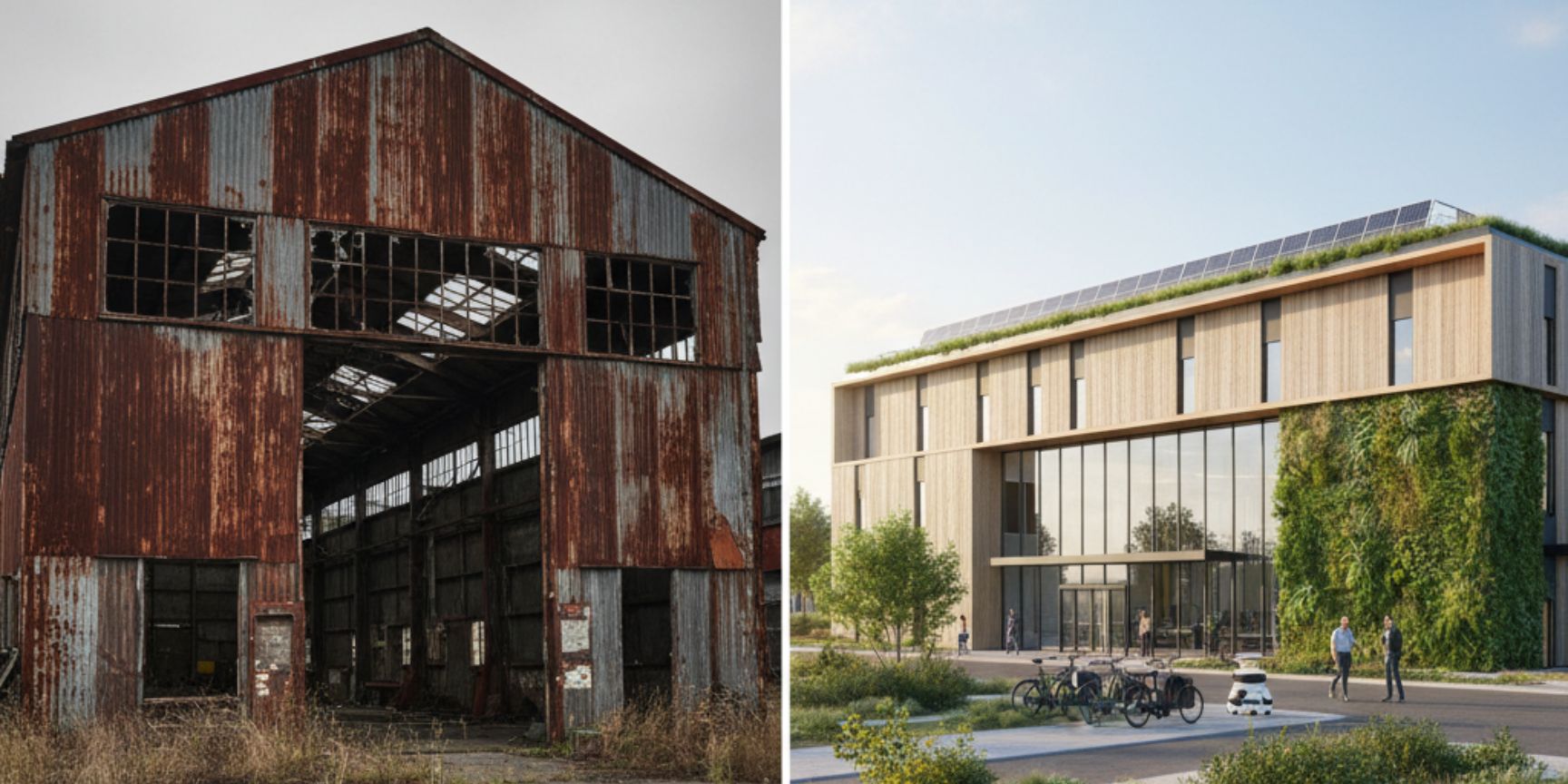
Brownfield Instead of Greenfield: Why the Future of Logistics Lies on Old Industrial Wastelands
Table of Contents
- Land Grabbing: A Problem with Hard Numbers
- Brownfield vs. Greenfield: A Clear Definition of Logistics Real Estate
- The Slumbering Gold: The Enormous Opportunities of Brownfield Development
- Reality Instead of Romance: The Challenges (Contaminated Sites and Building Fabric)
- Practical Example: Logport Duisburg – From Steelworks to the Logistics Heart of Europe
- The Alternative View: Cradle-to-Cradle (C2C) as a Sustainable New Construction Vision
- Brownfield Revitalization vs. C2C New Construction: What's the Right Way?
- The International View: Why Germany must be a Brownfield Country
- When Greenfield Remains Unavoidable: The Limits of Revitalization
- Conclusion: The Future of Logistics is Circular – and Often Brown
Logistics are booming. E-commerce, globalized supply chains and the call for "immediate availability" are driving up the need for storage and handling space. But this boom has a downside that is being discussed more and more loudly: "land grabbing". Every day, huge areas – often valuable farmland – are buried under concrete and asphalt in Germany. So, do we have to choose between economic prosperity, which requires strong logistics, and the protection of our environment and landscapes?
The clear answer is: No. There are alternatives that are smarter, more sustainable, and often even economically superior. Two concepts are coming into focus: the revitalization of brownfields (industrial wastelands) and the cradle-to-cradle (C2C) construction principle.
This article dives deep into the matter. We analyze why reaching for the "greenfield" is often the wrong way, what gigantic potential lies dormant in our old industrial sites and how the C2C model differs from it – or ideally complements it.
Land Grabbing: A Problem with Hard Numbers
To understand the urgency, we need to talk about the status quo. Germany has set itself the ambitious goal of reducing the daily use of new land for settlements and transport to "net zero" by 2050 (the so-called 30-hectare target by 2030 was already considered ambitious, but necessary).
The reality is different. In 2022, the daily increase was an average of 45 hectares per day, according to the Federal Statistical Office. This corresponds to an area of about 63 football pitches – every day. Logistics is a significant driver of this development. The construction of a new, large logistics hall on a greenfield site quickly seals 10 to 15 hectares in one fell swoop.
This sealing has drastic consequences:
- Loss of agricultural land for food production.
- loss of biodiversity and natural habitats.
- Increased risk of flooding, as rainwater can no longer seep away.
- Urban sprawl of the landscape and increase in traffic.
In view of these facts, the "greenfield" development – the simple new construction on a greenfield site – can hardly be justified morally and ecologically if alternatives exist.
Brownfield vs. Greenfield: A Clear Definition of Logistics Real Estate
Before we go into depth, the central terms must be clearly defined:
Greenfield (Grüne Wiese)
This refers to undeveloped land that was previously mostly used for agriculture or forestry. They are often located "outside" existing settlement structures, typically at motorway exits.
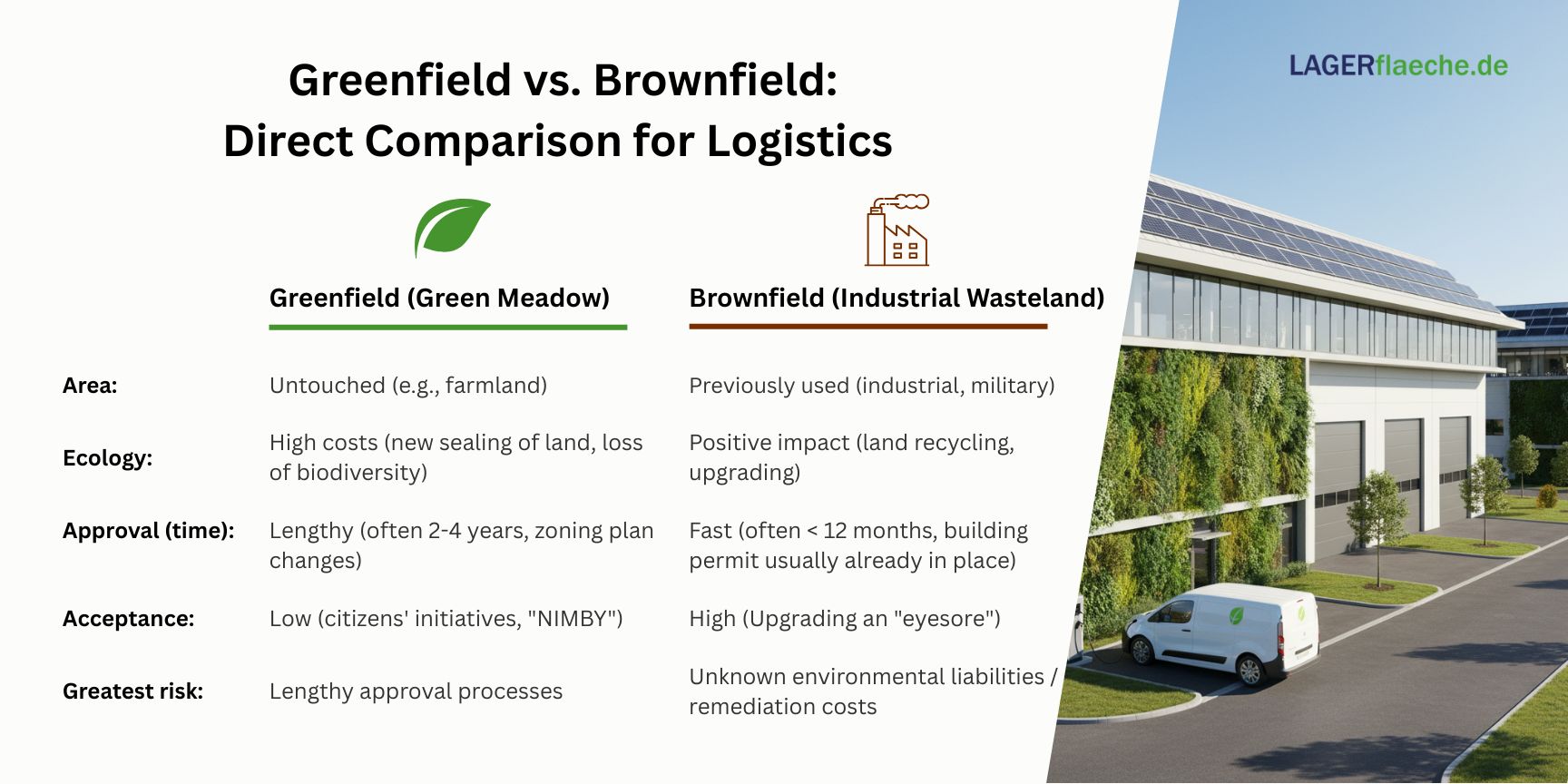
- Advantages: No contaminated sites, no demolition costs, often simple plot layouts for XXL halls, "free hand" in planning.
- Disadvantages: High ecological costs (sealing), long approval procedures (change of land use plans), often low acceptance among the population ("Not on my doorstep"), lack of infrastructure (public transport for employees).
Brownfield
These are plots of land that have already been used commercially, industrially or militarily and are now lying fallow. They can have vacant buildings, foundations or contamination.
- Advantages: No new land sealing, often already designated as a commercial or industrial area (building rights), existing infrastructure (roads, tracks, sewerage), higher local acceptance (upgrading of an "eyesore"), proximity to urban centers (important for "last mile" and personnel recruitment).
- Disadvantages: Potential contamination, high demolition and renovation costs, often complex plot layouts, poor building fabric of old buildings.
The Slumbering Gold: The Enormous Opportunities of Brownfield Development
The disadvantages of brownfields seem daunting at first glance. But for strategically thinking developers and logistics companies, the opportunities far outweigh the risks. The potential is enormous: estimates by the Federal Environment Agency and various research institutes (e.g. Aengevelt Research) put the usable brownfield potential in Germany at 150,000 to 200,000 hectares.
What are the concrete advantages in practice?
1. Time Factor: The "Approval Turbo"
Anyone who has ever developed a greenfield project knows the process: It often takes years for a land use plan to be changed and a development plan to be drawn up. In most cases, brownfields already have a valid building right (e.g. as a GE or GI area). Even if an adjustment is necessary, the process is often 12 to 24 months shorter than with a complete rezoning of arable land.
2. Acceptance Factor 2: From Eyesore to Showcase Project
The construction of a new logistics hall on a greenfield site almost always provokes resistance from citizens' initiatives and residents. The revitalization of an old industrial wasteland, on the other hand, is usually received positively. A dilapidated site, which may be contaminated and considered unsafe, is being renovated, upgraded and brings new jobs. This "goodwill" effect is an invaluable advantage in public perception.
3. Factor Personnel and Infrastructure
Most brownfield sites are located in established commercial areas or on the outskirts of cities. This means:
- Personnel: Access to labor is much easier than with an isolated location on the motorway.
- Infrastructure: Roads, sewerage, power and data lines are in place. Often there are even rail sidings – a huge advantage for the implementation of trimodal logistics concepts (road, rail, water).
Reality Instead of Romance: The Challenges (Contaminated Sites and Building Fabric)
A brownfield project is not a walk in the park. The challenges are real and require specialized knowledge and capital.
The Key Question is Almost Always: What is Slumbering in the Ground?
The remediation of contaminated sites (contamination by chemicals, oils, heavy metals or even ordnance from war) is the biggest factor of uncertainty. A soil survey is mandatory, but even this does not offer one hundred percent certainty.
Who Bears the Risk?
This is often the crux of the matter. The costs of remediation can explode and make a project uneconomical. Investors shy away from this risk. Successful brownfield developments are therefore often based on intelligent models between sellers, buyers and the public sector (e.g. through special funding programs or risk-sharing models).
The Building Fabric: Renovation or Demolition?
Sometimes there is still an old hall on the site. The romantic idea of "conversion" (e.g. a "loft warehouse") often fails in the face of reality:
- Statics: Old structures rarely meet the requirements for modern high-bay warehouses.
- Materials: Asbestos, PCBs and other pollutants in the building fabric drive up the renovation costs.
- Efficiency: Old layouts are often crooked and unsuitable for modern logistics processes.
In many cases, complete dismantling (demolition) and subsequent soil remediation is the economically more sensible way to build a new building on the "clean" property.
Practical Example: Logport Duisburg – From Steelworks to the Logistics Heart of Europe
Perhaps the most impressive example of successful brownfield revitalization in Germany is the Logport in Duisburg.
- Before: A 265-hectare site of a former Krupp steelworks. A huge, highly contaminated site that lay fallow after its closure in 1993.
- The process: In a massive effort (a joint venture between the city of Duisburg, the state of North Rhine-Westphalia and RAG), the site was renovated over a period of years. Millions of cubic meters of soil were moved and cleaned. At the same time, a perfect trimodal infrastructure (water, rail, road) was created.
- After: Today, Logport is one of the largest and most modern inland ports and logistics hubs in Europe. Over 50 companies (including global logistics giants) have settled here, creating thousands of jobs.
Logport proves that even the most complex and heavily polluted brownfields can be transformed into highly profitable, sustainable logistics hubs if the political will, capital and know-how are in place.
The Alternative View: Cradle-to-Cradle (C2C) as a Sustainable New Construction Vision
Now a second concept, often discussed in parallel, comes into play: Cradle-to-Cradle (C2C), to German "from cradle to cradle".
What is C2C? Developed by Prof. Dr. Michael Braungart and William McDonough, C2C is a design principle that goes beyond simple recycling. The aim is not to minimize waste (eco-efficiency), but to eliminate waste (eco-effectiveness).
C2C distinguishes between two cycles:
- The biological cycle: materials (e.g. organic building materials, textiles) that can safely return to the biosphere after use (compostable).
- The technical cycle: Materials (e.g. metals, certain plastics) that are designed to circulate infinitely in technical cycles without any loss of quality (no "downcycling").
What does this Mean for a Logistics Hall?
A C2C building is understood as a "material bank". Only materials are used that:
- Proven to be free of harmful substances (good for people and the environment).
- Modular and dismountable (e.g. screwed instead of glued).
- Have a "material passport" that documents exactly what is installed where.
At the end of its life, the building will not be demolished, but "dismantled". The materials are separated by type and returned to the technical or biological cycle.
Brownfield Revitalization vs. C2C New Construction: What's the Right Way?
This is the crucial point that is often misunderstood: Brownfield and C2C are not opposites – they are partners.
- Brownfield answers the question: WHERE do we build? (Answer: on recycled land).
- C2C answers the question: HOW do we build? (Answer: with recyclable materials).
The C2C idea can be applied on a greenfield site. This is better than a conventional new building, but does not solve the core problem of land sealing.
The absolute premier class of sustainable logistics real estate is therefore the combination of both:
A new C2C building on a redeveloped brownfield site.
This model stops surface sealing, upgrades an old area AND ensures that the new building itself does not represent future waste.
For whom is which alternative the right one?
- Conventional new greenfield construction: Actually, only for players for whom sustainability is not a factor, or for very specific XXL requirements (see below).
- New C2C greenfield construction: For companies with high ESG (Environmental, Social, Governance) standards that need to build on a site with no available brownfields.
- Brownfield revitalization (conventional): The pragmatic path for most logistics’ companies in urban areas. The focus is on land recycling, speed and infrastructure.
- Brownfield revitalization (with C2C): The gold standard. For future-oriented investors and owner-occupiers who want to implement their sustainability strategy (ESG) 100% credibly and look at the "total cost of ownership" (including dismantling value).
The International View: Why Germany must be a Brownfield Country
Attitudes towards brownfield vs. greenfield vary greatly internationally and are strongly driven by two factors: land availability and regulation.
Germany: High Pressure, Strong Regulation
Germany is densely populated, "land grabbing" is viewed extremely critically by society, and politicians (see "Net Zero Target 2050") are reacting with strict regulation. At the same time, the industrial history (e.g. Ruhr area, old GDR companies) is long, which creates a huge brownfield potential.
- Conclusion: Germany must rely on brownfield. The pressure is high enough to justify the higher renovation costs.
France: State-led Revitalisation
France is pursuing a similar goal to Germany ("Zéro Artificialisation Nette" - ZAN until 2050). However, the approach is often more centralized. The state actively identifies "friches industrielles" (industrial wastelands) and creates incentives through public development companies (EPF) or directly controls the redevelopment. The acceptance of brownfield projects is similarly high as in Germany.
USA: The Land of Unlimited Greenfields?
The US has a fundamentally different starting point: huge land availability. "Urban sprawl" is more culturally accepted. Greenfield developments are often the quick, cheap and preferred option.
- Exception: In dense metropolitan areas (e.g. New Jersey, Los Angeles) and through the Environmental Protection Agency's "Superfund" program, there are strong drivers for brownfield remediation. Superfund sites are highly contaminated sites where the EPA forces remediation (often at the expense of polluters), freeing up land for new development.
Poland & Eastern Europe: The Greenfield Boom
Countries such as Poland or the Czech Republic are the new logistics hotspots of Europe. The need for modern space is enormous ("pent-up demand"). Greenfield development clearly dominates here. Why?
- Speed: The market demands quick solutions.
- Costs: The land costs for Greenfields are (still) relatively low.
- Fewer contaminated sites: The industrial past is often less complex than, for example, in the Ruhr area or in the heavy industry of the USA.
- Size: Huge, modern distribution centers are being built for the whole of Europe, which often do not fit on brownfields.
When Greenfield Remains Unavoidable: The Limits of Revitalization
Despite all the advantages, we have to be honest. There are scenarios in which brownfield developments reach their limits and greenfield (ideally as a C2C project) remains the only option:
- XXL facilities: An e-commerce giant that needs a 150,000 m² fulfillment center in one go will hardly find a suitable brownfield. These surfaces are often fragmented or unsuitable in their geometry.
- Special logistics (dangerous goods/pharmaceuticals): Logistics with extremely high security requirements (e.g. Seveso III operations) often require large distances to residential areas, which are not available in inner-city brownfields.
- Completely new infrastructure nodes: If a completely new port or a freight transport center is built "on a greenfield site" (e.g. the JadeWeserPort), the logistics periphery must inevitably be developed as a greenfield, as there are no "old" areas.
Conclusion: The Future of Logistics is Circular – and Often Brown
The debate "brownfield vs. greenfield" has been decided at its core. In view of the climate targets and land consumption, the revitalization of brownfield sites is no longer a "nice option", but an ecological and social necessity.
The challenges – contaminated sites and costs – can be mastered through modern remediation technologies, intelligent risk management and funding programs. Examples of success such as Logport Duisburg impressively prove this.
Cradle-to-Cradle is not the opponent, but the logical partner. Brownfield recycles the land, C2C recycles the building. The smartest companies in the industry have realized that the combination of both is not only sustainable, but also economically superior in the long term: through faster approvals, better staff availability and a positive contribution to their own ESG balance. Reaching for greenfield sites is and remains a discontinued model.
Latest Blog Posts
Stay up to date with the newest trends, insights, and tips in warehouse and logistics. Our latest articles help you navigate the industry with confidence.
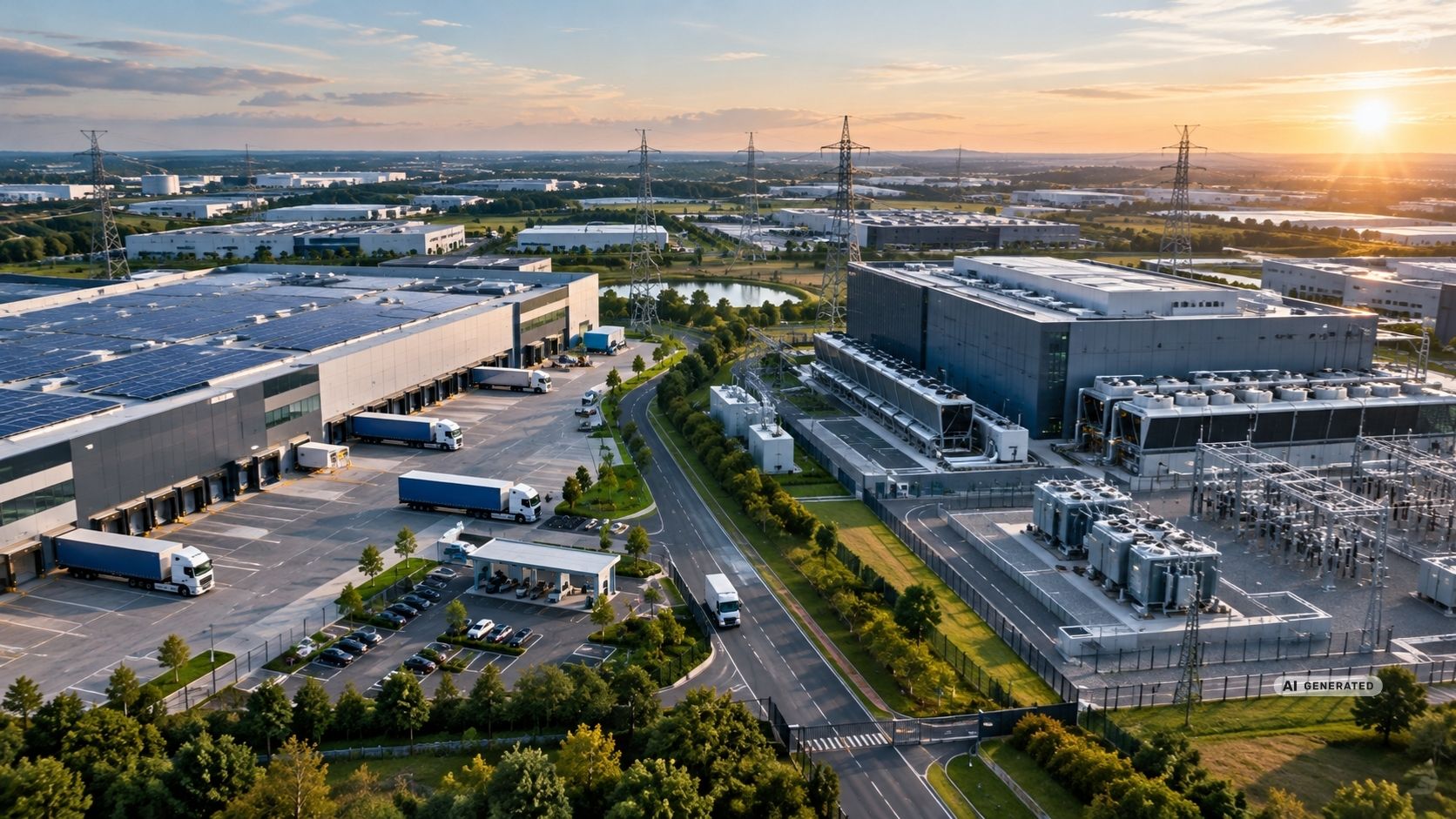
Data Centres vs. Logistics Facilities: The Race for Power and Land
Across Europe, logistics operators are competing for more than land and transport access. They increasingly need something much harder to secure: grid capacity. Data centres are intensifying that competition — and changing how logistics locations are evaluated....
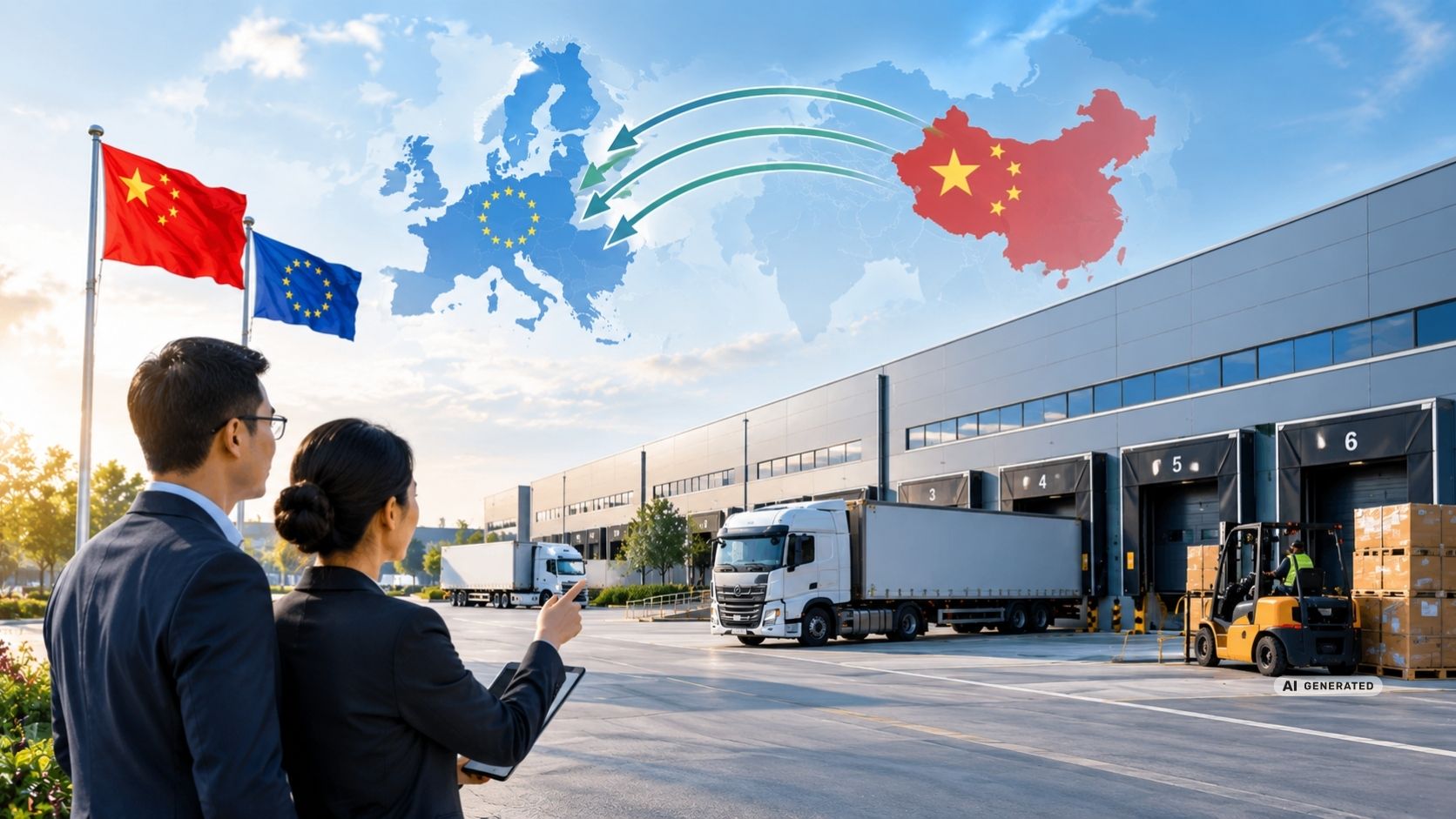
Chinese companies discover Europe's logistics real estate
Chinese companies are becoming an increasingly visible user group in Europe's logistics real estate market. What does this mean for warehouse space, 3PL structures and the requirements for European logistics locations?...
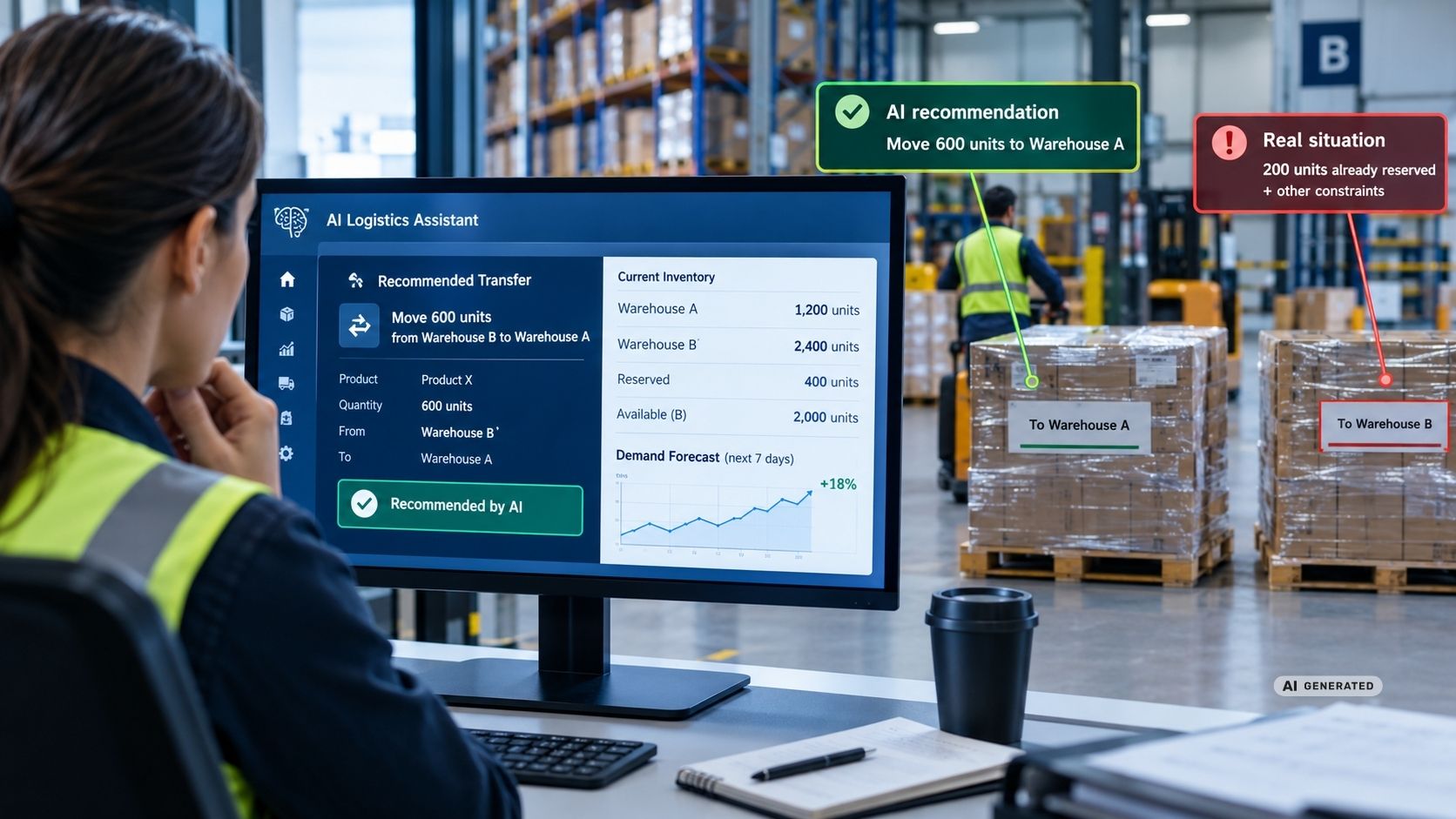
AI Hallucinations in Logistics: When AI Plans the Wrong Delivery
AI can analyze enormous amounts of logistics data — but it can also produce a convincing answer that is simply wrong. The critical question is not whether AI makes mistakes, but what happens when a wrong recommendation becomes an operational decision....
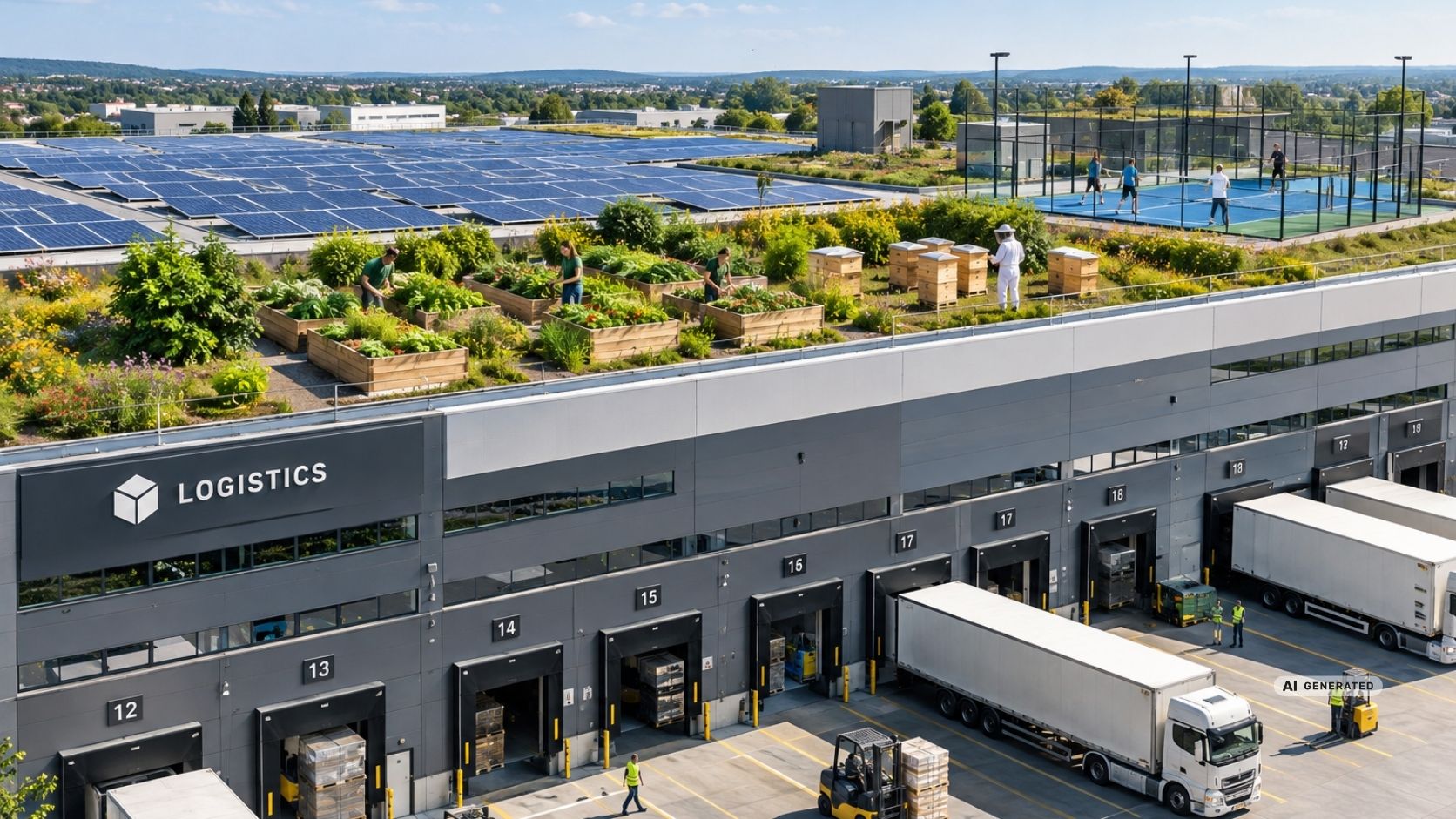
The Green Revolution on the Hall Roof: From Concrete Block to Ecological Power Plant?
Logistics roofs can do more than PV: greening, bees, urban farming and even sports areas turn unused roof space into multifunctional rooms....