



Poland, Czechia, Slovakia or Hungary: Which Location Best Fits Your Automotive Supply Chain?
Table of Contents
- Four countries, four different starting points
- How do the four automotive locations compare?
- Poland: A broad industrial base and flexible regional distribution
- Czechia: Established automotive manufacturing, supplier integration and engineering
- Slovakia: High production intensity and plant-oriented logistics
- Hungary: Vehicle manufacturing and the transition to electric mobility
- Direct comparison: Which country should companies investigate first?
- What does the country comparison mean for industrial property selection?
- Three practical business scenarios
- Conclusion: Choose the location that fits the supply chain
Four countries, four different starting points
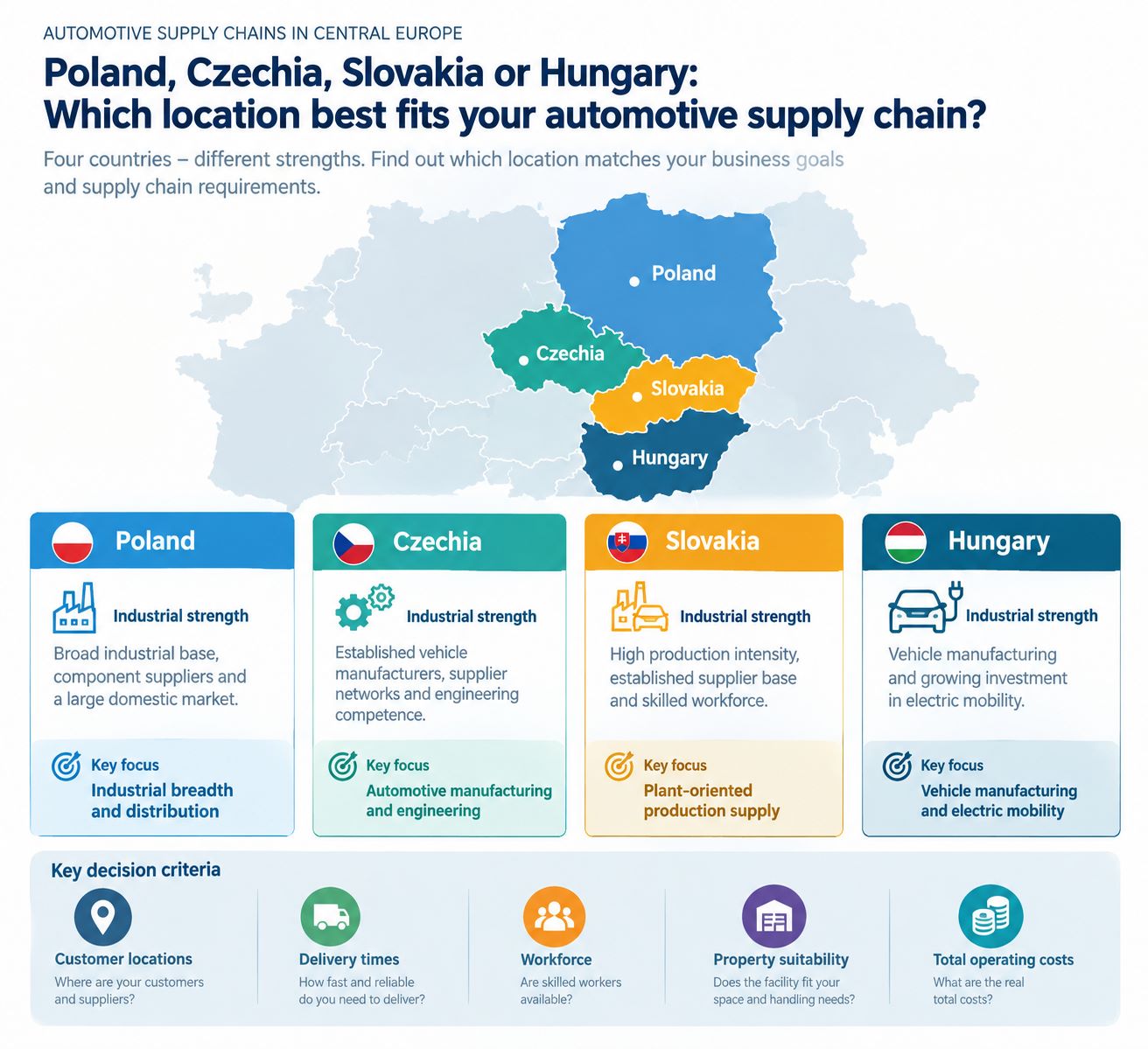
Poland, Czechia, Slovakia and Hungary form a closely interconnected manufacturing region within the European automotive industry. However, companies planning a new production facility, supplier operation or regional warehouse should not treat these four countries as interchangeable alternatives.
Czechia and Slovakia have particularly high passenger-car production volumes. Poland offers a broad industrial base and a large domestic market. Hungary is an established vehicle manufacturing location whose future role must also be assessed in the context of the transition to electric mobility.
The key question for businesses is therefore not which country is universally the best. It is which location best fits the requirements of a particular supply chain. Where are the customers and suppliers located? Which components need to be delivered? How time-critical are those deliveries? And will the facility support manufacturing, intermediate storage or distribution across several countries?
The wider geography of European industry also helps explain how these production networks fit together. Our article on the Blue Banana: Europe's industrial and logistics heart explores the concentration of economic activity and logistics infrastructure across Europe. In the automotive sector, these connections are particularly visible: components can cross several national borders before they are assembled into a vehicle.
How do the four automotive locations compare?
Passenger-car production in 2024 illustrates the differences in scale. According to the European Automobile Manufacturers' Association (ACEA), production reached 1,446,855 cars in Czechia, 993,750 in Slovakia, 435,541 in Hungary and 224,017 in Poland.[1]
These figures provide a useful starting point, but they are not a comprehensive ranking of the four automotive industries. They do not capture all components, commercial vehicles or the full value generated by the wider industrial ecosystem. Poland's automotive significance, in particular, should not be judged solely by its passenger-car assembly figures.
Employment data also highlight the sector's importance. In 2022, direct automotive employment accounted for 15.5% of manufacturing employment in Slovakia, 13.4% in Czechia and 12.4% in Hungary, according to ACEA.[2]
For site selection, companies should combine these indicators with specific information about suppliers, customer plants, workforce availability, infrastructure and operating costs.
Poland: A broad industrial base and flexible regional distribution
Poland is particularly worth considering for companies seeking a broad industrial supplier base or a distribution network serving multiple regions.
The country's automotive industry extends beyond passenger-car assembly. Component manufacturers and other industrial suppliers form part of its wider manufacturing base. This breadth can be valuable for procurement teams and suppliers looking to establish relationships with multiple industrial customers or consolidate flows from different suppliers.
Poland's size also creates a logistical challenge. A warehouse in the west of the country may be well positioned for customers in Germany, but less suitable for deliveries to eastern or southern Poland. Companies serving a national market should therefore evaluate actual delivery routes rather than simply select the cheapest available property.
Companies that should investigate Poland first include:
- Automotive suppliers serving several industrial customers or regions.
- Businesses considering a regional distribution centre for Poland and neighbouring markets.
- Procurement and logistics teams seeking to consolidate deliveries from multiple component suppliers.
When another country may be a better fit: If most deliveries are destined for a specific assembly plant in Czechia or Slovakia, a location closer to that customer may be more economical, even if its property costs are higher. Poland is not automatically the best choice for just-in-time production supply.
Czechia: Established automotive manufacturing, supplier integration and engineering
Czechia is a strong candidate for companies seeking close integration with established automotive manufacturing, supplier networks and technical development activities.
CzechInvest identifies the country's geographical position, infrastructure and skilled workforce as important location advantages. It also highlights established vehicle manufacturers, automotive suppliers and research and development activities in the mobility sector.[3]
This combination is relevant for suppliers that need to coordinate production processes, collaborate closely with customers on technical matters or integrate their operations into existing manufacturing networks. Logistics providers may also find opportunities in Czechia when managing component flows between suppliers and assembly plants.
However, suitability varies by region. Proximity to a specific customer plant may matter more than distance to the national border. Companies must also verify whether suitable workers, industrial space, road access and technical facilities are actually available at the proposed location.
Companies that should investigate Czechia first include:
- Component manufacturers seeking close cooperation with automotive manufacturers.
- Businesses with technical development and manufacturing operations.
- Logistics providers connecting multiple supplier and production locations within a regional network.
When another country may be a better fit: Poland may be more suitable for distribution serving a broad customer base across the Polish market. For supply to a specific Slovak assembly plant, the actual delivery route and required delivery windows should determine the choice.
Slovakia: High production intensity and plant-oriented logistics
Slovakia deserves particular attention when a business model depends closely on vehicle assembly and its associated supplier network.
The country is one of Europe's leading automotive manufacturing locations. The Slovak Investment and Trade Development Agency (SARIO) highlights its concentration of manufacturing capacity, established supplier base and skilled technical workforce. Its sector overview also identifies more than 360 Tier 1 and Tier 2 suppliers and several international vehicle manufacturers.[4]
This concentration is relevant for businesses supplying production plants directly. For time-critical components, dependable delivery routes, coordinated delivery slots and the ability to respond to production schedule changes are essential. A regional buffer warehouse can help consolidate deliveries or make materials available according to production requirements.
The automotive industry's economic importance also means that companies should assess their exposure to individual customers and production programmes. A location that works well for one plant today may become less attractive if production volumes or model programmes change.
Companies that should investigate Slovakia first include:
- Suppliers delivering regularly to specific Slovak assembly plants.
- Logistics providers specialising in plant-side warehousing, sequencing or production supply.
- Businesses whose service levels depend more on delivery reliability than on maximum geographic coverage.
When another country may be a better fit: Slovakia is not automatically the best base for a distribution network serving multiple national markets. Customer locations and total transport costs should determine the decision.
Hungary: Vehicle manufacturing and the transition to electric mobility
Hungary is particularly relevant for companies assessing vehicle manufacturing alongside changes in the automotive component landscape.
The country is an established passenger-car production location. Its future role should also be assessed in terms of investment in electric mobility, batteries and new vehicle components, and how these developments affect specific industrial regions.
The transition to electric vehicles is changing material flows and may introduce additional requirements for transport, storage and safety. Batteries and certain other components can have specific handling, packaging and safety requirements. Companies must verify these requirements early, since not every logistics facility is suitable for every product category.
Businesses should not, however, assume that announced investments automatically translate into a fully established local supplier base. They need to confirm which production facilities are operational, which suppliers are already present and which customer relationships are relevant to their own operations.
Companies that should investigate Hungary first include:
- Suppliers targeting specific vehicle or component manufacturing plants.
- Businesses involved in electric vehicles or emerging component technologies.
- Logistics providers able to meet specialised handling and storage requirements.
When another country may be a better fit: If a company is already closely integrated into a Czech or Slovak manufacturing network, locating closer to those customers may be more practical. An association with electric mobility alone does not justify relocating operations to Hungary.
Direct comparison: Which country should companies investigate first?
The following matrix is a shortlisting tool, not a universal ranking.
| Business priority | Countries to investigate first | Key consideration |
| Broad industrial sourcing and regional distribution | Poland | Supplier base, target regions and total transport costs |
| Integration with established automotive manufacturing and engineering | Czechia | Customer proximity, supplier capabilities and workforce |
| Plant-oriented, time-critical production supply | Slovakia; Czechia depending on the plant | Delivery windows, reliability and distance to the assembly plant |
| Electric mobility and emerging component supply chain | Hungary; also other countries depending on customers and suppliers | Confirmed production projects, suppliers and handling requirements |
| A central warehouse serving multiple countries | Compare all four | Total cost, transit-time reliability and inventory requirements |
The matrix indicates where an investigation could begin. It does not replace a site assessment. A company supplying a Slovak plant should not automatically select Poland simply because it has a broad industrial base. Conversely, a company serving customers across several countries does not necessarily need a warehouse next to an assembly plant.
These cross-border relationships also highlight the strategic importance of cooperation between companies. Our article on logistics networks as a strategic resource for SMEs examines how collaborative logistics networks can help businesses organise their operations. For automotive companies, the key question is whether cooperation improves supply reliability and efficiency or simply introduces additional interfaces.
What does the country comparison mean for industrial property selection?
Choosing the right country and choosing the right property are two separate decisions. Even if a country fits the business model, a particular region within it may still be unsuitable.
Companies evaluating a warehouse or distribution centre should assess at least five factors:
- Customer proximity: Where are assembly plants, suppliers and delivery destinations located? What delivery times are actually required?
- Transport costs and reliability: How do routes, border connections, traffic and potential disruptions affect supply?
- Workforce and operations: Are staff, road access, technical facilities and the required operating infrastructure available?
- Property suitability: Do clear height, floor loading, loading bays, fire protection and safety provisions match the goods and processes?
- Total operating costs: In addition to rent and service charges, include labour, transport, inventory, handling and the potential cost of supply disruptions.
A structured warehouse location assessment can help companies compare these factors. Where a location decision involves relocating sourcing or production, the nearshoring in logistics guide provides additional context.
Three practical business scenarios
Scenario A: A supplier wants to serve several industrial customers.
The company should first map its customers and potential suppliers. Poland may be attractive because of its broad industrial base and regional reach. Czechia may be a better fit if the main customers and technical partners are concentrated there.
Scenario B: A logistics provider must supply an assembly plant reliably.
The search should start with the plant's actual address and delivery requirements. Slovakia or Czechia may be suitable starting points if the relevant production and supplier relationships are located there. The lowest rent is not sufficient justification if delays could trigger substantial downstream costs.
Scenario C: A company is evaluating a supply chain for new electric-vehicle components.
Hungary belongs on the shortlist if specific projects, customers or suppliers support the business case. Depending on the material flows, however, locations in Poland, Czechia or Slovakia may also be appropriate. The decision should be based on confirmed business relationships and component-specific requirements, not investment announcements alone.
Conclusion: Choose the location that fits the supply chain
Poland, Czechia, Slovakia and Hungary offer different starting points for automotive businesses. Poland is particularly relevant for broad industrial sourcing and regional distribution. Czechia stands out for established vehicle manufacturing, supplier networks and technical capabilities. Slovakia is an important candidate for plant-oriented production supply, while Hungary merits closer investigation for specific vehicle manufacturing and electric-mobility opportunities.
These differences provide guidance, not a guarantee of lower costs or better delivery performance. The final decision must reflect actual customer relationships, transport routes, workforce and property availability, and total operating costs.
The practical recommendation is straightforward: define the supply chain first, shortlist the countries that fit it, and only then compare specific regions and industrial properties.
Sources
[1] ACEA, The Automobile Industry Pocket Guide 2025/2026. Passenger-car production data for 2024.
[2] ACEA, Share of direct automotive employment in the EU by country. Employment shares, reference year 2022.
[3] CzechInvest, Mobility. Information on vehicle manufacturers, suppliers, infrastructure and research.
[4] SARIO, Automotive Industry. Overview of Slovakia's automotive industry and supplier network.
Latest Blog Posts
Stay up to date with the newest trends, insights, and tips in warehouse and logistics. Our latest articles help you navigate the industry with confidence.
Poland, Czechia, Slovakia or Hungary: Which Location Best Fits Your Automotive Supply Chain?
Poland, Czechia, Slovakia and Hungary play different roles in Europe's automotive industry. This comparison explores which locations companies should consider for component sourcing, manufacturing, electric mobility and cross-border logistics....

Data Centres vs. Logistics Facilities: The Race for Power and Land
Across Europe, logistics operators are competing for more than land and transport access. They increasingly need something much harder to secure: grid capacity. Data centres are intensifying that competition — and changing how logistics locations are evaluated....

Chinese companies discover Europe's logistics real estate
Chinese companies are becoming an increasingly visible user group in Europe's logistics real estate market. What does this mean for warehouse space, 3PL structures and the requirements for European logistics locations?...
AI Hallucinations in Logistics: When AI Plans the Wrong Delivery
AI can analyze enormous amounts of logistics data — but it can also produce a convincing answer that is simply wrong. The critical question is not whether AI makes mistakes, but what happens when a wrong recommendation becomes an operational decision....