



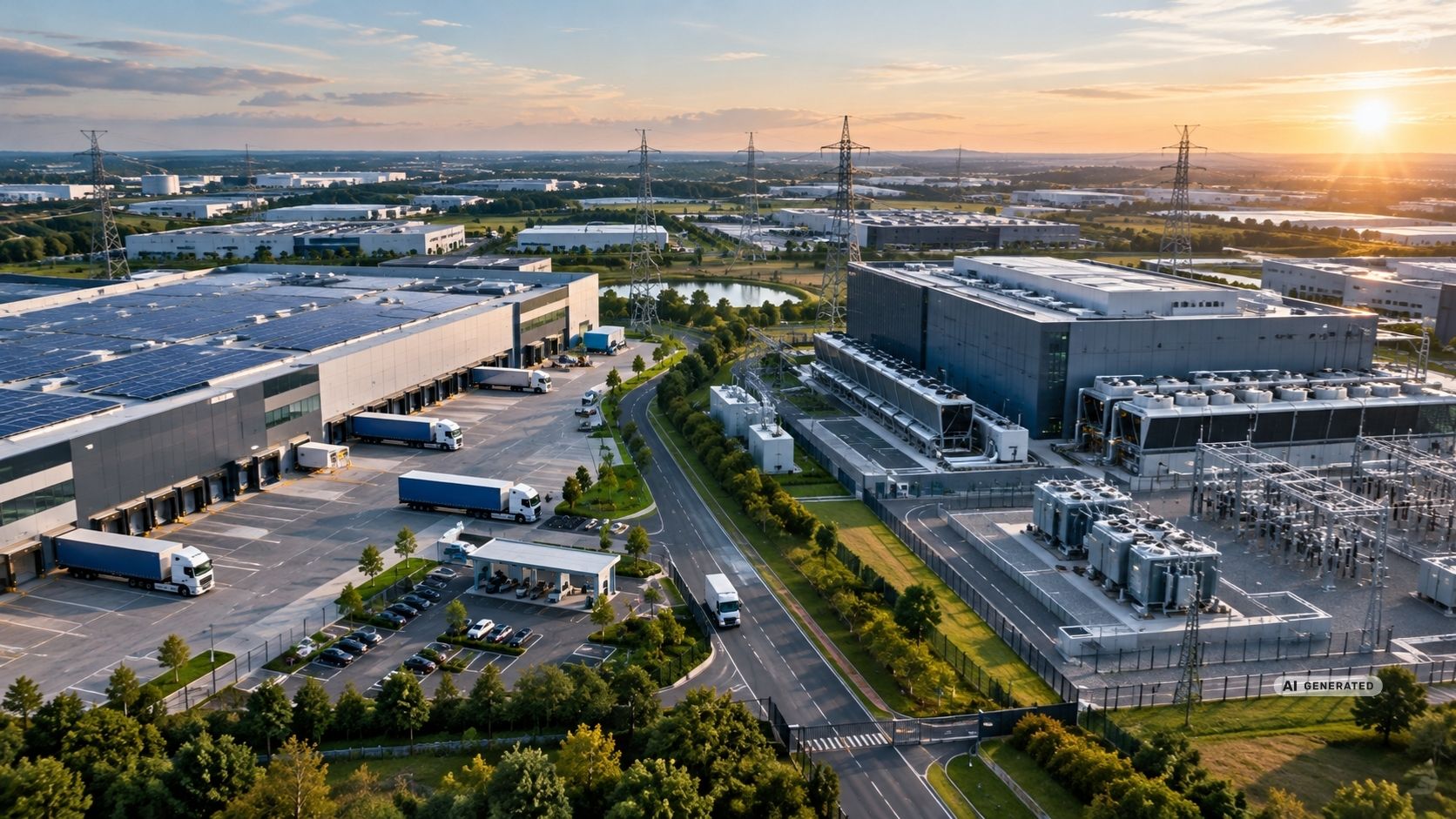
Data Centres vs. Logistics Facilities: The Race for Power and Land
Table of Contents
- When grid capacity becomes as important as motorway access
- Why data centres and logistics facilities want similar locations
- “Powered land” is becoming a new real-estate category
- Why data centres are increasing the pressure on logistics locations
- The Netherlands and the UK show where the problem is heading
- Does that mean data centres will always beat logistics?
- Amsterdam illustrates the changing development model
- What does this mean for logistics real estate?
- Will logistics move further away from major urban areas?
- Who will get Europe's best industrial sites?
- Conclusion: Europe's next location battle will be fought over power
When grid capacity becomes as important as motorway access
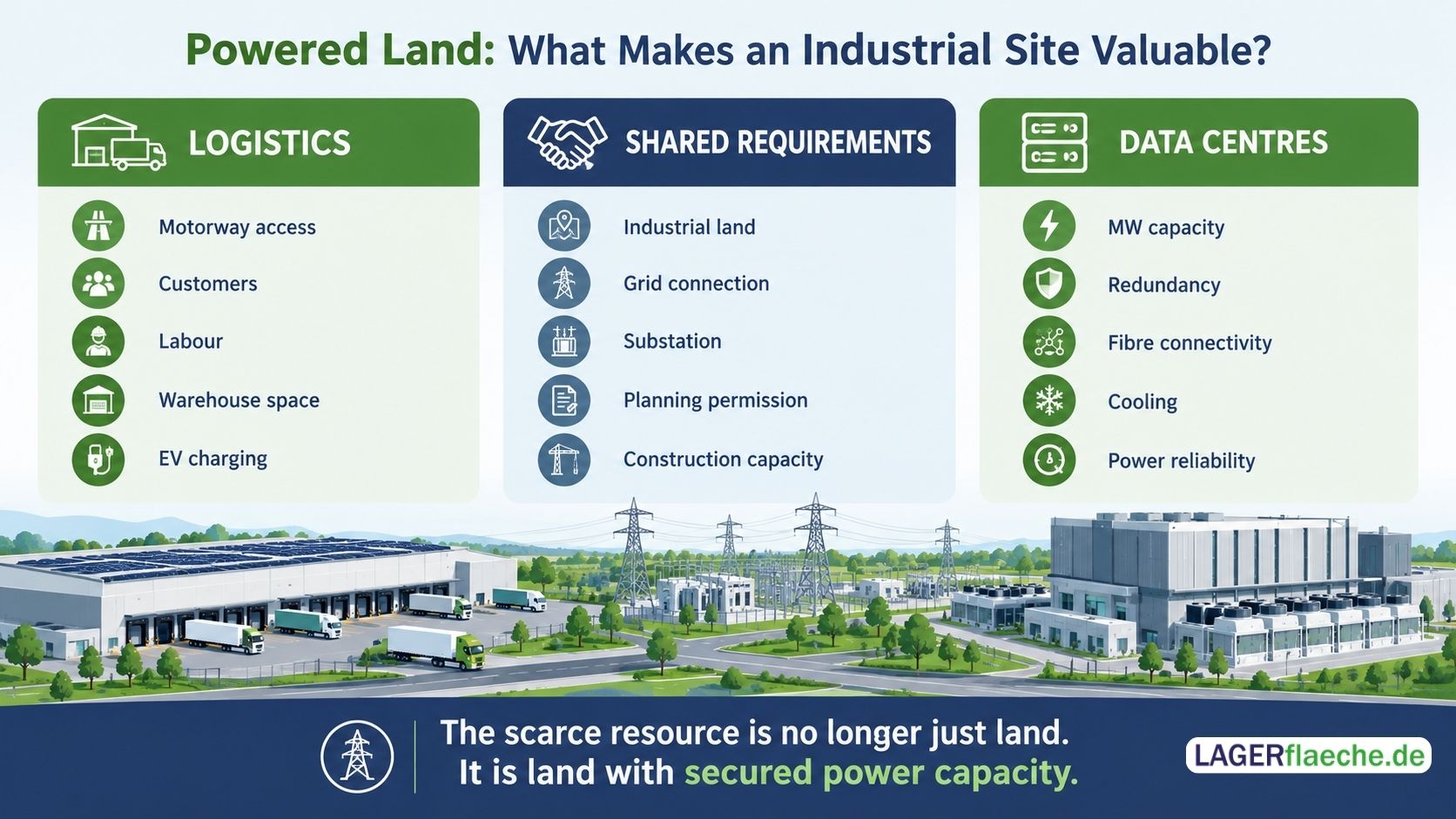
What makes an industrial site valuable?
For decades, the answer for logistics was relatively straightforward: proximity to motorways, ports, airports, labour markets and customers, combined with suitable land and a well-connected building.
These factors remain fundamental. But another location criterion is rapidly gaining importance: access to sufficient electrical power.
This creates an unusual form of competition.
On one side are logistics facilities whose electricity requirements are increasing through automation, conveyor systems, robotics, refrigeration, heat pumps, electric vehicles and charging infrastructure.
On the other are data centres — particularly hyperscale and AI facilities — whose entire business model depends on large quantities of reliable electricity.
The International Energy Agency (IEA) estimates that global data-centre electricity consumption could rise from around 460 TWh in 2024 to more than 1,000 TWh by 2030. In Europe, data-centre electricity demand is expected to increase by more than 45 TWh, or around 70%, between 2024 and 2030. [1]
This raises a question that is becoming increasingly relevant for industrial real estate:
Is electricity becoming the next major location factor for logistics property?
Increasingly, the answer is yes.
Why data centres and logistics facilities want similar locations
At first glance, a warehouse and a data centre have very little in common. One handles physical goods; the other processes and stores digital information.
Their location requirements, however, overlap more than might be expected.
Both can benefit from:
- large development sites,
- suitable industrial or commercial zoning,
- high-capacity electricity connections,
- substations and grid infrastructure,
- reliable telecommunications,
- suitable construction infrastructure,
- access to renewable energy,
- and sufficient capacity for future expansion.
The priorities are different.
For a logistics facility, electricity is an increasingly important operating input. For a large data centre, electricity is effectively part of the core production infrastructure.
That difference can significantly influence land economics.
A logistics operator may be able to move to another site if a particular property cannot provide the required power capacity.
A hyperscale operator planning a multi-megawatt or AI campus, by contrast, may accept a location further away from a major city if it offers access to sufficient power and fibre connectivity.
This is where the competition becomes interesting.
The question is no longer simply:
Who wants the best industrial land?
It is increasingly:
Who wants the best industrial land with access to power?
“Powered land” is becoming a new real-estate category
An industrial site with roads, water, sewage and planning permission is not necessarily a future-proof logistics location.
One additional question is becoming critical:
How much electrical capacity can actually be connected to the site — and when?
That distinction matters.
A site advertised as having a “power connection” does not necessarily have the capacity required for a highly automated warehouse, a large charging operation or a major expansion.
CBRE reported in 2026 that more than 80% of surveyed European logistics occupiers had concerns about the availability or reliability of electricity supply. At the same time, electricity availability had become an important building-selection criterion for more than 44% of logistics occupiers — more than twice the share recorded four years earlier. [2]
This changes how logistics property should be assessed. Rooftop photovoltaics can help reduce a facility’s dependence on purchased electricity, but on-site generation does not automatically guarantee sufficient grid connection capacity. Our article on logistics properties with photovoltaics explores the wider energy potential of warehouse roofs.
A warehouse with:
- sufficient electrical capacity,
- a high-capacity transformer,
- expansion potential,
- charging infrastructure,
- and a reliable grid connection
may be strategically more valuable than a larger building with limited power availability.
That leads to an important distinction:
The relevant metric is no longer simply how many square metres a site offers.
It is also:
How many square metres can be operated effectively with the available power capacity?
Why data centres are increasing the pressure on logistics locations
Data centres have a structural advantage in the competition for certain sites: their location can be less dependent on proximity to end consumers.
For a distribution centre, delivery times, customer density and road access are critical.
An AI or hyperscale data centre, on the other hand, primarily requires:
- substantial power capacity,
- grid access,
- cooling infrastructure,
- high-quality fibre connectivity,
- suitable land,
- and high levels of power reliability.
The data itself does not have to be physically transported by truck.
This allows data-centre developers to consider locations further away from established metropolitan hubs.
JLL has documented this trend in Europe. Hyperscale campuses planned for 2026–2028 are on average around 175 kilometres from major European hubs, compared with approximately 46 kilometres for projects completed between 2022 and 2025. At the same time, the share of greenfield projects in the European data-centre pipeline has increased from 8% to 39%. [3]
This matters for logistics real estate.
Some locations outside major metropolitan areas still offer larger development sites, industrial infrastructure and — in certain cases — better access to available grid capacity.
The result is a new form of competition:
not simply for industrial land, but for industrial land with power.
The Netherlands and the UK show where the problem is heading
The Netherlands provides one of Europe's clearest examples.
The country is facing significant grid congestion. Companies and new developments can face long waiting periods before additional electricity capacity becomes available. The Dutch government has described the overloaded electricity grid as a major obstacle to economic growth, new construction and electrification. [4]
At the same time, electricity demand from digital infrastructure continues to increase.
The situation has become particularly visible in areas around Utrecht, where grid constraints have affected the ability to provide new connections and additional capacity. The issue demonstrates that grid availability is no longer simply an energy-sector problem. It has become an industrial real-estate and economic-development issue. For logistics operators, this also raises the question of how to maintain reliable operations when energy supply becomes less predictable — a challenge explored in our article on energy blackouts and the drive for energy autonomy in logistics.
It has become an industrial real-estate and economic-development issue. [5]
The UK provides another example.
The British government has introduced reforms to the grid-connection process in response to the rapid growth in connection requests. At one point, approximately 60 GW of data-centre projects were reported to be sitting in the transmission connection queue. [6]
Ofgem subsequently reported that applications for new demand connections had increased from 41 GW to 125 GW in a year, with data centres accounting for at least 80 GW of that demand. [7]
This does not mean that data centres automatically receive priority over logistics.
It does mean that grid connections are becoming a strategically managed resource.
Does that mean data centres will always beat logistics?
No.
That would be far too simplistic.
Logistics properties have location requirements that data centres do not share to the same extent.
A large distribution centre needs to move physical goods efficiently. Motorway access, ports, airports, rail infrastructure, labour availability and proximity to customers therefore remain critical.
A data centre can potentially accept a location that would be unattractive for conventional logistics — provided that electricity and fibre connectivity are available.
The two sectors therefore operate according to different location models.
| Location factor | Logistics facility | Data centre |
| Motorway access | Very important | Secondary |
| Customer proximity | Very important | Often less important |
| Labour availability | Important | Important, but less labour-intensive |
| Site size | Important | Very important for hyperscale |
| Power availability | Increasingly critical | Fundamental |
| Grid connection | Important | Strategic core requirement |
| Fibre connectivity | Important | Essential |
| Cooling/water | Use-case dependent | Potentially critical |
| Expansion capacity | Important | Very important |
| Latency | Relevant in some operations | Critical for some applications |
This creates an important distinction:
A site can be ideal for a data centre but unsuitable for logistics — and vice versa.
The competition is therefore not occurring across every industrial plot in Europe.
It is concentrated around a specific category of high-quality, well-connected and power-capable sites.
Amsterdam illustrates the changing development model
Amsterdam provides a useful example of how large data-centre projects are responding to infrastructure constraints.
A planned hyperscale campus in the Amsterdam area was announced with an investment of approximately €1 billion and a planned capacity of around 78 MW, including its own substation. [8]
The example illustrates an important development trend.
When public grid capacity is difficult to obtain quickly, large data-centre developers can attempt to secure or develop parts of the required energy infrastructure themselves.
That changes the economics of site selection.
For a conventional logistics developer, a site without sufficient immediately available grid capacity may simply be rejected.
A well-capitalised data-centre developer may instead be able to use dedicated infrastructure, long-term power arrangements or other solutions to make a site viable.
That does not mean that every data centre will displace a logistics development.
It raises a more useful question:
Who can secure the required infrastructure faster and more economically?
What does this mean for logistics real estate?
For logistics developers and occupiers, the location assessment process is changing.
The traditional sequence was often:
Land → planning approval → building → power connection
Increasingly, these elements have to be assessed together:
Land + planning + grid capacity + connection date + power demand + expansion potential
CBRE is already observing increasing competition between logistics and data-centre developers for suitable land and construction resources. At the same time, electricity availability is becoming increasingly important for more energy-intensive logistics operations. This is part of a broader transformation in the sector, as explored in our analysis of logistics real estate in 2026: resilience and realignment. [9]
For logistics occupiers, several practical questions should therefore be addressed before committing to a location.
1. What will the actual power requirement be?
Do not assess only current consumption.
Automation, conveyor systems, robotics, refrigeration, heat pumps, electric trucks and charging infrastructure can substantially increase future demand.
2. What connection capacity is available?
Annual electricity consumption is only part of the equation.
The more important question for infrastructure planning is often:
What connection capacity is available at peak demand, and when?
3. Is the grid connection actually secured?
A property brochure stating “power available” is not sufficient for a major logistics project.
The relevant information includes connection capacity, voltage level, grid operator, available capacity, reinforcement requirements and the realistic connection timetable.
4. Can the site support future expansion?
A warehouse that works today may become electrically constrained as automation and vehicle electrification increase.
5. What are the alternatives?
If obtaining additional grid capacity could take several years, a slightly more distant site with existing capacity may ultimately offer the better business case.
Will logistics move further away from major urban areas?
Potentially — but not for exactly the same reasons as in previous logistics cycles.
Traditional logistics networks have concentrated around motorways, ports, airports and large population centres. The emerging power constraint could add another geographic layer.
Locations where the following factors coincide may become increasingly attractive:
- available electrical capacity,
- large development sites,
- nearby substations,
- realistic planning conditions,
- access to renewable electricity,
- and acceptable road or rail connectivity.
The same characteristics are attractive to data-centre developers.
JLL is already observing a shift of hyperscale and AI developments towards secondary locations where land and electricity can be secured more easily. [3]
For logistics, this could create both a threat and an opportunity.
Data-centre investment may accelerate the development of energy infrastructure in certain regions. If that additional infrastructure subsequently becomes available to other industrial users, logistics operators could benefit as well.
The critical question is whether the infrastructure is designed and regulated in a way that allows different industrial users to access it.
Who will get Europe's best industrial sites?
The answer is unlikely to be simply “the data centres”. Instead, the market is likely to become increasingly segmented.
Data centres will be particularly competitive in locations where electricity is the dominant constraint and large sites with high-capacity connections can be secured.
Logistics will remain highly competitive in locations where road access, customer proximity, labour and transport economics are more important than extreme power requirements.
The most interesting sites are those where these requirements overlap.
They represent a new category of industrial real estate: highly serviced, power-capable industrial land with expansion potential.
Such locations could become strategically valuable regardless of whether the eventual occupier is an automated distribution centre, a data centre, a manufacturing facility or another energy-intensive user.
For developers and landowners, this means that sites should no longer be evaluated purely by square metres.
For logistics occupiers, it means that a low rent can be a false economy if the property cannot provide enough electrical capacity for the intended operation over its full lifecycle.
Conclusion: Europe's next location battle will be fought over power
The European logistics property market is changing.
Land remains scarce. But increasingly, the constraint is not simply whether land exists. It is what can actually be powered on that land.
Data centres are intensifying this competition because AI, cloud computing and digital infrastructure require enormous quantities of reliable electricity. Their developers are increasingly willing to adapt their geographic footprint to locations where power and infrastructure can be secured.
This does not mean that logistics will be displaced on a broad scale.
Instead, logistics real estate is becoming more differentiated.
The future-proof logistics facility will not be defined only by clear height, floor loading, dock doors, motorway access or warehouse automation.
It will increasingly also depend on:
sufficient electrical capacity, reliable grid access, expansion potential and a realistic path to additional power.
Electricity is therefore becoming a real-estate factor.
And that leads to one of the most important questions for Europe's logistics locations in the years ahead:
Is an industrial site without secured grid capacity really “serviced” land anymore?
Sources
[1] International Energy Agency (IEA):Energy and AI (2025)
[2] CBRE:European Logistics Occupier Survey 2026 (22 July 2026)
[3] JLL:EMEA Data Centre Mid-Year 2026 Report
[4] JLL:AI boom redraws Europe's data centre map as power access overtakes location (6 August 2026)
[5] Ofgem:Ofgem acts to free up grid capacity by tackling speculative data centre projects (29 July 2026)
[6] UK Parliament:Written question: Electricity demand connection applications attributable to data centres (answer published 17 June 2026)
[7] Netherlands Enterprise Agency (RVO):What is grid congestion?
[8] Province of Utrecht:Netcongestie (Grid congestion)
Latest Blog Posts
Stay up to date with the newest trends, insights, and tips in warehouse and logistics. Our latest articles help you navigate the industry with confidence.
Data Centres vs. Logistics Facilities: The Race for Power and Land
Across Europe, logistics operators are competing for more than land and transport access. They increasingly need something much harder to secure: grid capacity. Data centres are intensifying that competition — and changing how logistics locations are evaluated....

Chinese companies discover Europe's logistics real estate
Chinese companies are becoming an increasingly visible user group in Europe's logistics real estate market. What does this mean for warehouse space, 3PL structures and the requirements for European logistics locations?...
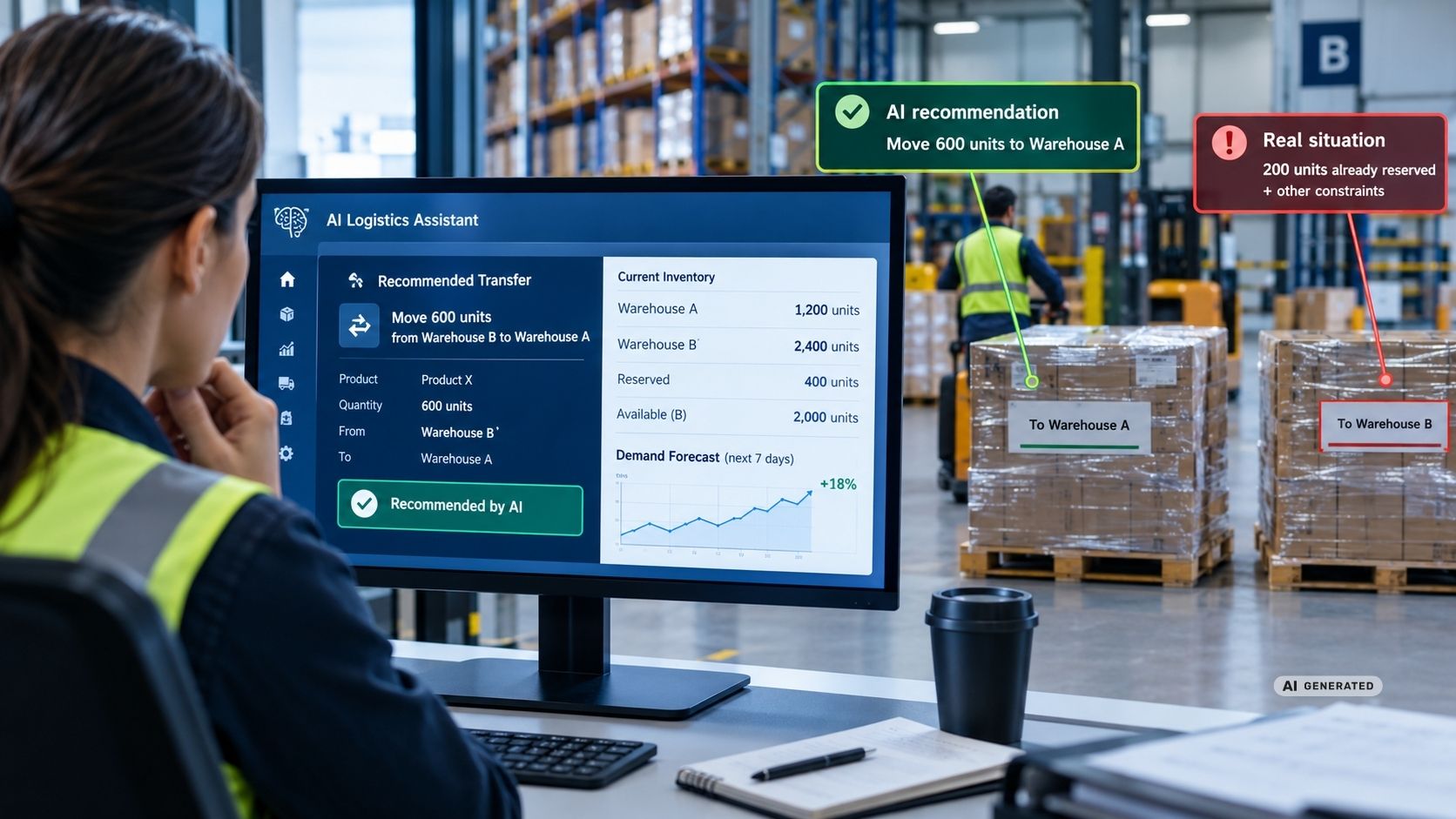
AI Hallucinations in Logistics: When AI Plans the Wrong Delivery
AI can analyze enormous amounts of logistics data — but it can also produce a convincing answer that is simply wrong. The critical question is not whether AI makes mistakes, but what happens when a wrong recommendation becomes an operational decision....
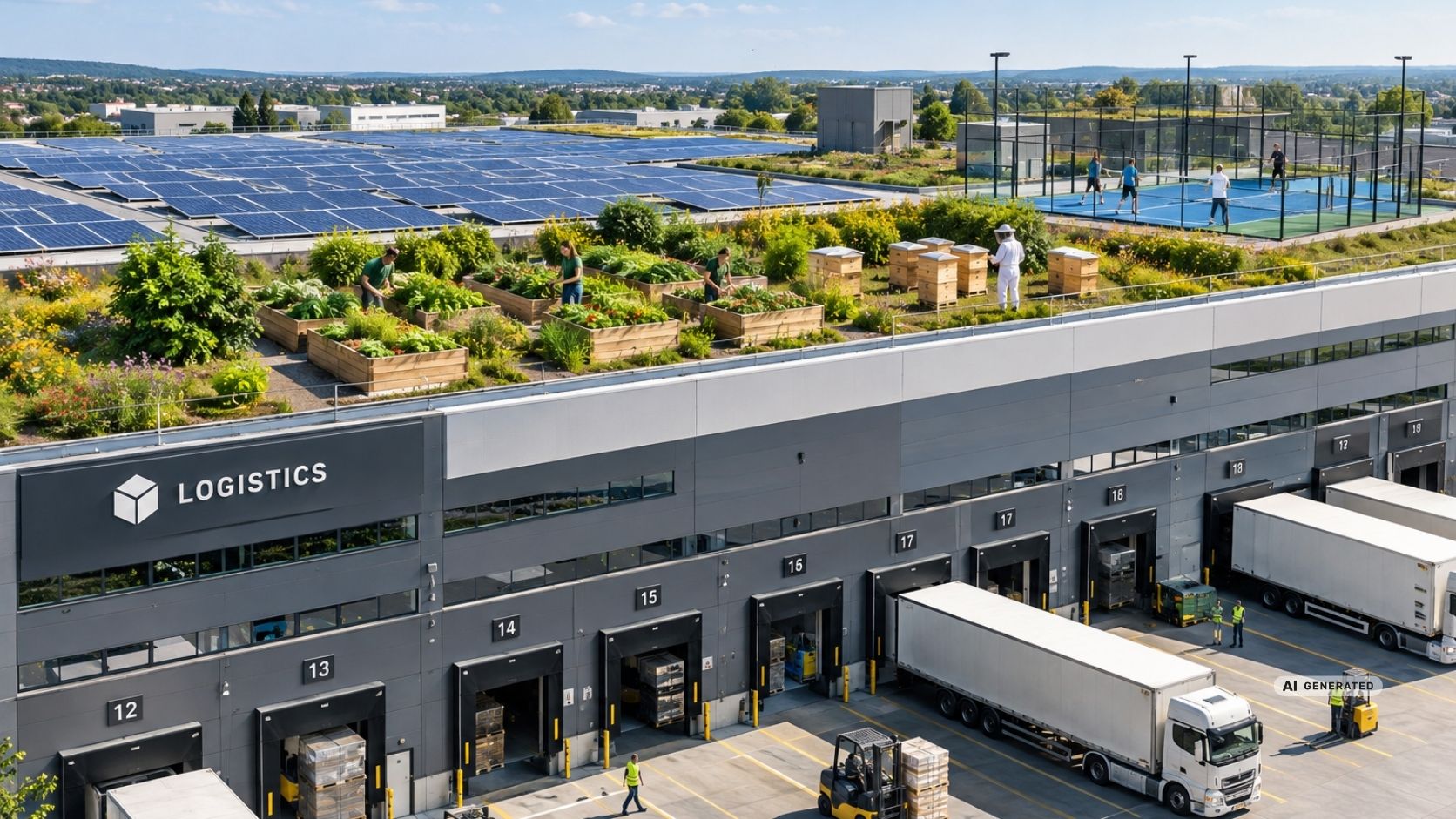
The Green Revolution on the Hall Roof: From Concrete Block to Ecological Power Plant?
Logistics roofs can do more than PV: greening, bees, urban farming and even sports areas turn unused roof space into multifunctional rooms....