


Chinese companies discover Europe's logistics real estate
Table of Contents
- Chinese companies need more than one sales market
- Automotive and batteries are changing demand
- E-commerce is only part of the development
- Rent directly or use 3PL?
- Which logistics properties are in demand?
- Germany remains important – but not automatically the best location
- Practical example: From production to the European supply chain
- What should companies check when looking for a location?
- What does this development mean for the logistics real estate market?
- Conclusion: Europe's logistics network is becoming more international
Chinese companies need more than one sales market
What happens to a company's logistics strategy when Europe no longer becomes just a sales market, but an operational location in its own right?
It is precisely this development that is gaining in importance. Chinese companies from the automotive, battery technology, e-commerce and industrial sectors are expanding their activities in Europe. This is also changing their logistical footprint: goods that previously reached European customers directly from China are increasingly becoming European inventories, regional distribution and local supply chains.
In its European Logistics Occupier Survey 2026, CBRE explicitly describes Chinese logistics users as an increasingly active group in Europe. The study is based on the information provided by 109 major logistics users with a total of around 90 to 100 million m² of logistics space. At the same time, modern, automatable and sufficiently energy-supplied space is becoming scarcer.
The decisive question is therefore no longer just: How many goods come from China to Europe? Rather: How much European logistics structure are Chinese companies building themselves – and what real estate do they need for this?
Automotive and batteries are changing demand
The development is particularly evident in the automotive industry. According to ACEA, a total of 1,105,806 new vehicles were imported from China to the EU in 2025. Chinese-made vehicles thus accounted for around 7% of EU new car sales and even about 20% of battery electric vehicle sales. Source: ACEA, Fact sheet: EU-China vehicle trade, 2026.
For logistics, this means more than additional vehicle transports. As soon as manufacturers in Europe set up production, sales and after-sales structures, additional material flows arise: components have to be provided, spare parts stored and vehicles and accessories distributed regionally.
The battery industry also shows how closely production and logistics are now linked. CATL started test production of battery cells at its new plant in Debrecen on September 22, 2026. Once fully expanded, the site is expected to reach a capacity of 100 GWh and supply European car manufacturers. Source: CATL, 22.09.2026.
This does not simply create "more warehouses". Different logistical functions are created: production supply, intermediate storage, component logistics, spare parts supply and regional distribution.
E-commerce is only part of the development
Chinese companies in Europe are often first associated with platforms such as Temu and Shein. This topic is important for logistics, but it only describes part of the development.
Our article "The Logistics Flood from the Far East: How Temu, Shein & Co. Are Challenging the European Ecosystem" already deals with the impact of Chinese e-commerce parcel flows on Europe's infrastructure.
The change under consideration here goes one step further: What happens when Chinese companies no longer just send goods to Europe, but need European warehousing and distribution structures?
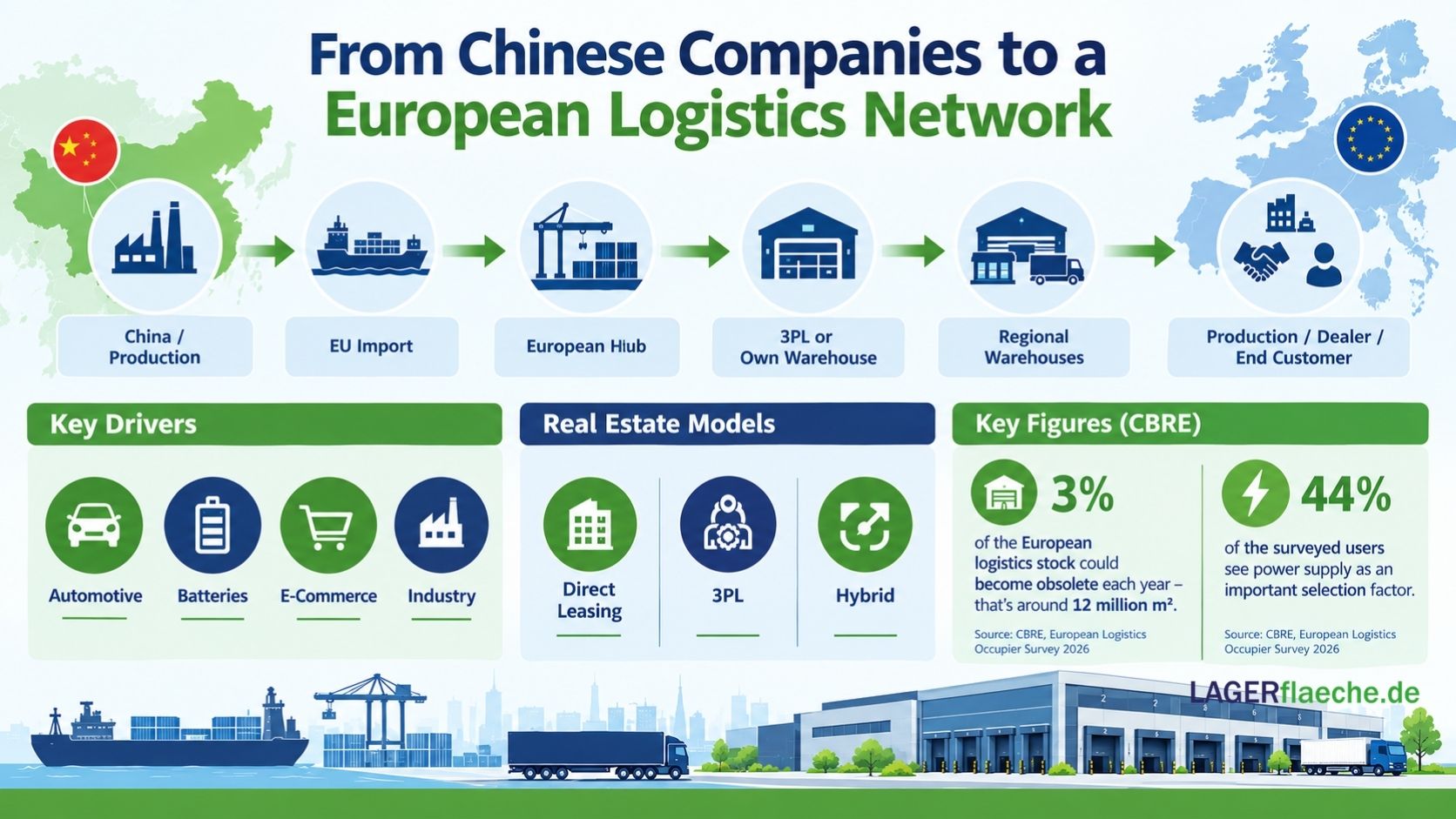
Off China → customer in Europe
can then, for example,
China → European hub → fulfillment → customer.
The structure becomes even more complex when regional warehouses, returns processing, spare parts or European production sites are added. This makes the location of the inventory a strategic factor.
Rent directly or use 3PL?
An important question for the real estate market is: Who actually signs the lease?
This is because a Chinese company can need European storage capacity without renting a hall itself.
In the first model, the company rents directly. It controls warehouses, IT, processes and inventories itself. This offers a high level of operational control, but also requires personnel, technology and corresponding know-how.
In the second model, a 3PL service provider takes over storage and fulfillment. This can be particularly attractive when entering the European market, because existing infrastructure and personnel can be used.
A third model is hybrid: For example, a company operates a European core site itself and supplements it with 3PL capacities or regional warehouses.
This development is also relevant for the real estate market. CBRE expects stronger demand from Chinese users in Europe in 2026 and cites automotive and e-commerce in particular as active areas. In e-commerce, space is often used indirectly via 3PLs, but increasingly also via direct leases.
Which logistics properties are in demand?
Not every Chinese company needs the same type of warehouse. An e-commerce company is looking for different properties than a battery manufacturer or an automotive supplier.
| Users | Typical function | Important factors |
| E-commerce | Fulfillment, Returns, Inventory | Customer proximity, CEP network, automation |
| Automotive | Parts, Spare Parts, Distribution | Proximity to production, transport connections |
| Battery | Production supply, interim storage | Energy, Safety, Permits |
| Industry | Components, spare parts | Traffic, hall technology, flexibility |
| 3PL | Multi-Client Fulfillment | Divisible, ramps, expandability |
The technical quality of the property is becoming increasingly important. According to CBRE, around 44% of the users surveyed see the power supply as an important factor in the selection of buildings – more than twice as many as four years earlier. At the same time, without major investments, around 3% of Europe's occupied logistics stock, or around 12 million m², could become obsolete every year.
The problem is therefore not simply "too little storage space". What is needed above all is the right storage space: modern, automatable, energy-efficient and in the right location.
Germany remains important – but not automatically the best location
Germany offers Chinese companies several advantages: a large sales market, a central location in Europe, a dense transport network and a strong automotive and industrial infrastructure.
Nevertheless, a European logistics network does not necessarily have to be concentrated in Germany. Depending on the flow of goods, Poland, the Czech Republic, Hungary, the Netherlands or Belgium can also play an important role.
The decisive question is therefore not:
Where is the company based?
But:
Where does the goods have to be for the European supply chain to work?
Our existing article "Logistics Market Germany: Who Rents the Large Logistics Spaces?" already examines the industry and user structure of the German market. The new article complements this perspective with a specific international user group.
For Chinese companies, for example, this can result in a multi-level network:
European gateway → central warehouse → regional distribution → customer or production site
Practical example: From production to the European supply chain
CATL is a particularly clear example of how a Chinese manufacturer can become part of Europe's industrial infrastructure.
The plant in Debrecen is not only a production facility. The battery cells manufactured there are to supply European car manufacturers. CATL has been producing battery modules in Debrecen since 2024; test production of battery cells also began in September 2026.
This also changes the logistical task. Material has to get to production, finished components have to be transported on and inventories have to be coordinated along the European automotive supply chain.
A similar pattern can be seen among Chinese car manufacturers: production, sales, spare parts and service generate different flows of goods that do not necessarily pass through the same warehouse.
This shows an important point: European expansion does not automatically mean a single large central warehouse. It can create a network of different warehouse and logistics functions.
What should companies check when looking for a location?
For Chinese companies that are setting up a European warehouse structure for the first time, the search for space should only begin after the supply chain has been defined.
Important questions are:
Where do the goods come from? From China, a European production facility or from several suppliers?
Where is the customer located? In Germany, the DACH region or several European markets?
How long do the goods stay in the warehouse? Hours, days or several weeks?
Who operates the warehouse? In-house operation, 3PL or hybrid model?
What products are stored? Standard goods, vehicle parts, batteries, dangerous goods or high-value goods?
What technical equipment is required? Power capacity, floor load capacity, hall height, ramps, automation or safety infrastructure?
Can the area grow? Especially when entering the European market, an initially small warehouse can require significantly more capacity within a few years.
It is also worth taking a look at existing sourcing strategies. Our article "Offshoring to Friendshoring: The Ultimate Guide to Strategic Warehouse Logistics" shows how changes in production and procurement structures have a direct impact on inventories, location selection and logistics space.
What does this development mean for the logistics real estate market?
Chinese companies are creating an additional source of demand – but not necessarily exclusively through new space.
Part of the demand is handled by 3PLs. Another part is generated by production sites, regional warehouses or the relocation to more modern real estate.
This is precisely where an important development of the European market lies: According to CBRE, a large part of the current leasing activity consists of relocations to better properties, not just an increase in the total space stock.
Properties that meet international user requirements can therefore be of interest to owners and operators: high energy availability, modern building technology, good transport connections, automation suitability, sufficient maneuvering space and flexible usage options.
Conclusion: Europe's logistics network is becoming more international
Chinese companies are becoming more visible in Europe's logistics real estate market. Automotive, batteries and e-commerce in particular are driving this development. At the same time, it is becoming clear that "Chinese demand" is not a uniform model.
An e-commerce company may start by using a 3PL. An automaker may need production supply and spare parts inventory. A battery manufacturer, on the other hand, integrates logistics directly into a European manufacturing site.
The decisive change is therefore not simply "more trade between China and Europe". It is about the emergence of European farm structures:
Import → European stock → distribution → production → spare parts → after sales
The more these structures are localized, the more important suitable logistics properties become. It is not the origin of the company that determines the space requirements, but the function that the warehouse is to take on within the European network.
Sources:
CBRE, European Logistics Occupier Survey 2026;
CBRE, European Real Estate Market Outlook Midyear Review 2026;
ACEA, Fact sheet: EU-China vehicle trade, 2026;
CATL, announcement of the start of test production in Debrecen, 22.09.2026.
Latest Blog Posts
Stay up to date with the newest trends, insights, and tips in warehouse and logistics. Our latest articles help you navigate the industry with confidence.
Data Centres vs. Logistics Facilities: The Race for Power and Land
Across Europe, logistics operators are competing for more than land and transport access. They increasingly need something much harder to secure: grid capacity. Data centres are intensifying that competition — and changing how logistics locations are evaluated....
Chinese companies discover Europe's logistics real estate
Chinese companies are becoming an increasingly visible user group in Europe's logistics real estate market. What does this mean for warehouse space, 3PL structures and the requirements for European logistics locations?...
AI Hallucinations in Logistics: When AI Plans the Wrong Delivery
AI can analyze enormous amounts of logistics data — but it can also produce a convincing answer that is simply wrong. The critical question is not whether AI makes mistakes, but what happens when a wrong recommendation becomes an operational decision....
The Green Revolution on the Hall Roof: From Concrete Block to Ecological Power Plant?
Logistics roofs can do more than PV: greening, bees, urban farming and even sports areas turn unused roof space into multifunctional rooms....