



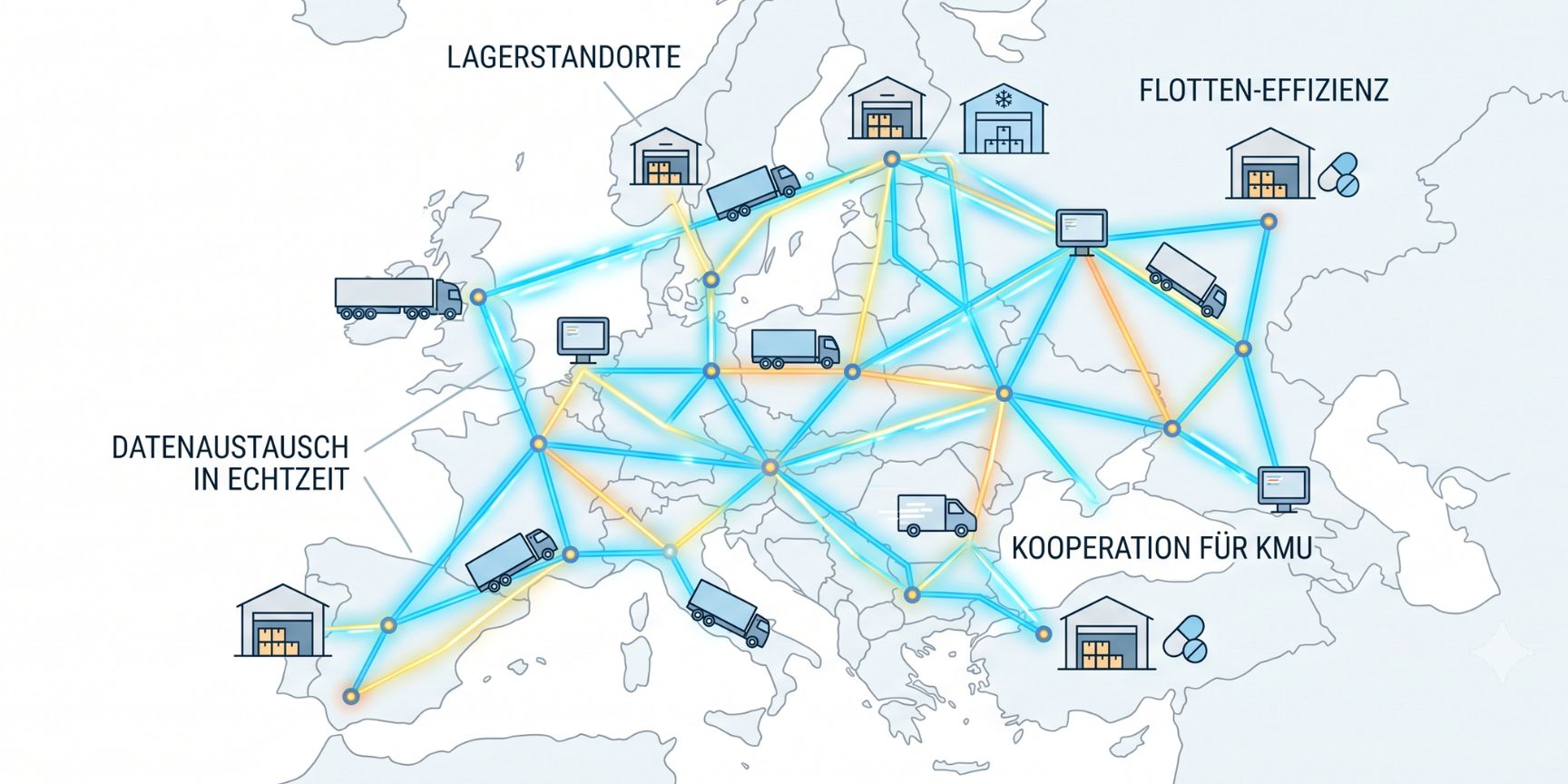
Logistics Networks: Lifeline for SMEs or Real Competition for the Industry Giants?
Table of Contents
- Why do Logistics Networks Exist at all?
- In which Areas of Logistics do They Make Sense?
- What Types of Logistics Networks are There?
- Are the Networks Directed Against the Large Logistics Companies such as Dachser, Kuehne+Nagel & Co.?
- Who is Allowed into the Network and What are the Advantages?
- Where do the Networks Differ? (Focus on the Most Important Players)
- What are the Differences in Europe and Worldwide?
- Practical example: How a medium-sized freight forwarder grows through cooperation
- Conclusion: The Future Belongs to Cooperation
Logistics is a business of economies of scale. If you transport and store more, you can do so more cheaply per unit. But what does a medium-sized freight forwarder do when the customer suddenly demands nationwide Europe-wide distribution or additional storage space in another federal state? He is reaching his limits. This is where logistics networks come into play.
In this in-depth article, we examine why logistics networks exist, where they make sense, how they differ from the closed systems of the "big players" and which specific networks (such as ELVIS, CTL or Logcoop) dominate the market.
Why do Logistics Networks Exist at all?
Imagine the following industry-common challenges:
- The problem of empty runs: According to estimates by the EU Commission and Eurostat, around 20% to 25% of all truck journeys on European roads are empty runs. A massive economic and ecological loss.
- Geographical limitation: A freight forwarder with 50 trucks can never cover the whole of Germany economically in 24-hour intervals (next-day delivery).
- Lack of bargaining power: When purchasing trucks, tires, toll services or insurance, the small freight forwarder pays far higher prices than a large corporation.
Logistics networks have been established to solve precisely these problems. They are strategic alliances of legally and economically independent logistics service providers. Their goal: to achieve economies of scale through cooperation that are otherwise only reserved for large corporations. They enable the exchange of freight (avoidance of empty runs), the sharing of storage capacities and joint purchasing.
In which Areas of Logistics do They Make Sense?
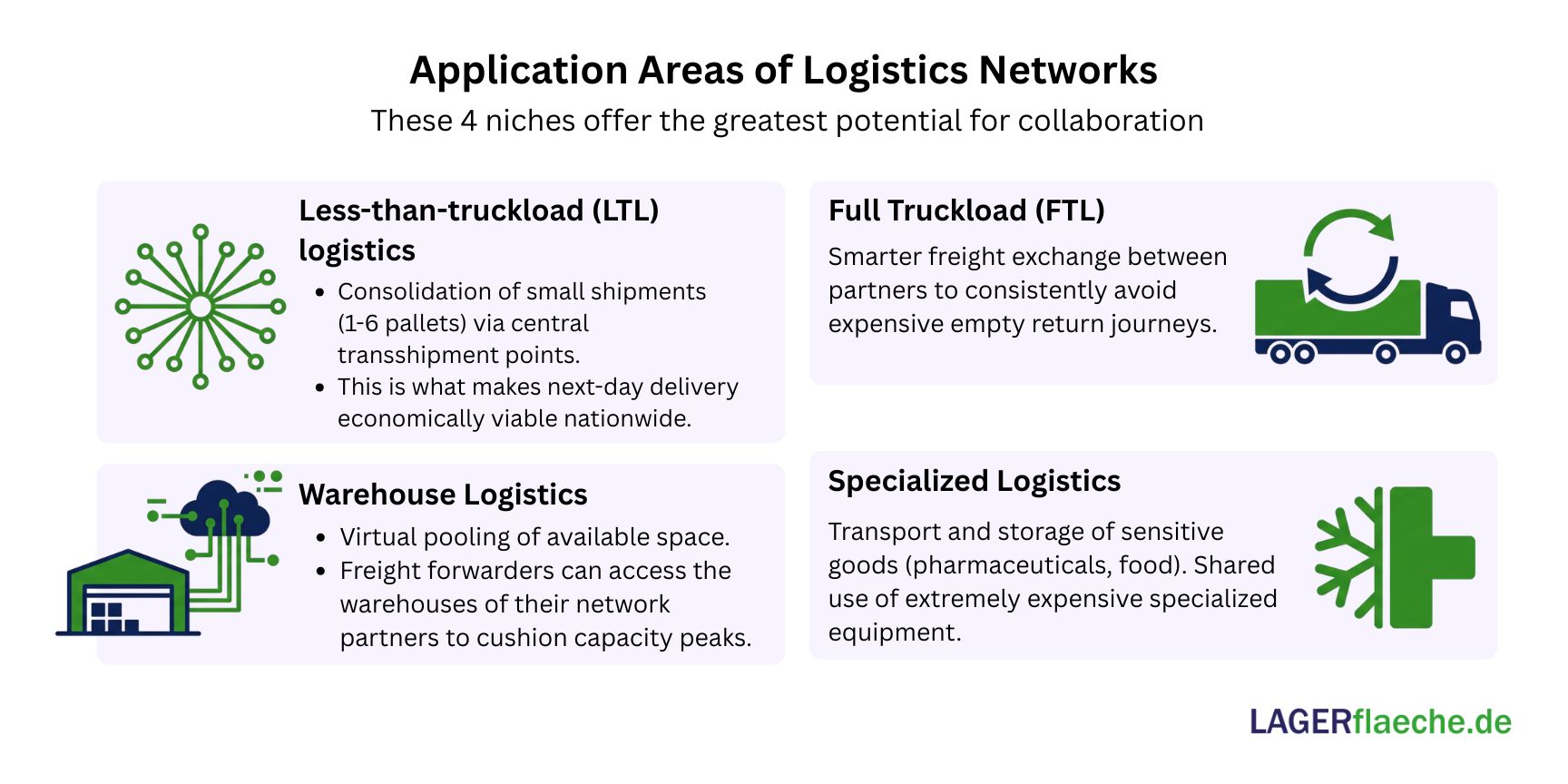
Networks are not equally strong in every logistics niche. They make sense above all where high frequency, area coverage and consolidation are absolutely necessary:
- General cargo logistics (LTL - Less-than-Truckload): The absolute classic. If a customer only wants to send two pallets from Munich to Hamburg, direct transport is not worthwhile. The pallets must be consolidated with other shipments in a hub (transshipment center).
- Full Truckload (FTL): To avoid empty runs on the way back.
- Warehouse logistics & warehousing: When the company's own halls are full, warehouse networks arrange temporary space with partners.
- Special logistics: Temperature-controlled transports (pharmaceuticals, food) or hazardous goods, where extremely expensive special equipment is better shared than purchased twice.
What Types of Logistics Networks are There?
Not every network works the same. In general, the mergers can be divided into the following main categories:
| Network Type | Description | Target group / participants |
| General cargo cooperations | Hub-and-spoke systems (hub and spoke). Partners feed shipments into a central hub and take shipments back for their destination region. | Classic freight forwarders with a focus on shipments from 1 to 6 pallets. |
| Charge networks | Focus on part loads and full loads. Often combined with freight exchanges in order to make optimal use of trucks. | Transport company with a large fleet of its own vehicles. |
| Purchasing groups | No operational freight exchange, but bundling of purchasing volumes (vehicles, diesel, insurance). | Small to medium-sized logistics companies. |
| Warehouse networks | Virtual consolidation of storage capacities. One partner stores for the customer of another partner. | Contract logistics companies and real estate operators. |
| Special industry networks | Highly specialized networks with strict requirements (e.g. GDP guidelines for pharmaceuticals). | Niche logistics company. |
Are the Networks Directed Against the Large Logistics Companies such as Dachser, Kuehne+Nagel & Co.?
One of the most exciting questions in the market: Is a network like CTL or ELVIS a direct attack on industry giants such as Dachser, Kuehne+Nagel, Rhenus or DSV?
The honest answer is that it is not so much an aggressive attack as a necessary survival strategy (defensive).
The industry giants mentioned operate so-called closed networks. Dachser, for example, has its own branches throughout Europe, its own IT system and its own hubs. When a customer goes to Dachser, they get everything from a single source. Medium-sized freight forwarders can never offer this level of service and coverage on their own.
By bringing together hundreds of medium-sized companies in an open network, they simulate the strength of a corporation. They can suddenly offer nationwide 24-hour deliveries and thus compete against the "Goliaths" of the industry in tenders. Networks protect medium-sized companies from being completely pushed out of the market by the big companies or degraded to pure subcontractors (carriers without direct customer contact).
Who is Allowed into the Network and What are the Advantages?
Who is allowed in?
Networks are primarily aimed at small and medium-sized enterprises (SMEs) in freight forwarding and contract logistics. However, the admission requirements are often strict. Candidates must:
- Prove financial stability.
- Have certifications (ISO 9001, etc.).
- Meet guaranteed transit times and quality quotas (often over 98% punctuality).
- Contractually commit to territorial protection (partners do not poach in the postcode areas of other partners).
The advantages at a glance:
- Competitiveness: Participation in large-scale tenders becomes possible.
- Cost reduction: Reduction of empty runs and more favorable purchasing conditions.
- Scalability without CAPEX: Expansion of the portfolio (e.g. storage abroad) without own investments in new logistics properties.
- Knowledge transfer: Exchange of best practices among managing directors at eye level.
Where do the Networks Differ? (Focus on the Most Important Players)
To understand the landscape, we need to look at the specializations of the most well-known networks:
ELVIS AG (European Cargo Association of International Freight Forwarders)
- Focus: Full truck loads (FTL), part loads (LTL) and massive joint purchasing.
- Difference: ELVIS is Europe's largest network for full truck loads. It functions less as a classic general cargo hub, but has strong tools such as the "Part Load Network" and bundles gigantic purchasing volumes for its partners (e.g. tolls, diesel, vehicles).
CTL (Cargo Trans Logistik AG)
- Focus: Classic general cargo.
- Difference: CTL operates huge central handling operations (hubs), e.g. in Homberg (Efze). Medium-sized freight forwarders drive to these hubs at night, exchange pallets and return with shipments for their own region. Direct competitor to networks such as VTL or CargoLine.
Logcoop GmbH & Logcoop Lagernetzwerk GmbH & Co. KG
- Focus: warehouse logistics, transport and purchasing.
- Difference: While most networks "only" move trucks, the Logcoop warehouse network connects independent logistics properties. If a freight forwarder in the Ruhr area has a customer who urgently needs 5,000 m² of warehouse space in Bavaria, the system looks for a partner in Bavaria. The customer remains with the original freight forwarder, the operational work is carried out by the partner. An ingenious solution to the current shortage of space.
Palletways
- Focus: Express pallet transport.
- Difference: Originally from the UK, Palletways is extremely standardized. It is not about loose boxes, but purely about palletized freight. The system is highly IT-driven and designed for maximum speed in the B2B and B2C sectors (e.g. heavy garden tools for end customers).
PharmaXnet
- Focus: Temperature-controlled pharmaceutical logistics (GDP).
- Difference: An absolute niche network. Only haulage companies that meet extremely high quality and hygiene requirements for transporting medicines are allowed in here. It shows that networks work perfectly even in highly sensitive niches.
What are the Differences in Europe and Worldwide?
Logistics networks are highly dependent on the geography and economic structure of a country. Specifically:
Germany:
Germany is the "motherland" of general cargo networks. Why? Because the German economy is extremely decentralized. We have strong industrial centers in the Ruhr area, in Bavaria, Baden-Württemberg and around Hamburg. This requires a complex, multi-center hub-and-spoke system. Nowhere else in the world are there as many functioning medium-sized business cooperations as here.
United Kingdom (UK):
The UK is the home of pallet networks (such as Palletways or Palletforce). Due to the island location and a strongly retail-oriented economy, almost everything here is moved on standard pallets. The networks are extremely dense and often centrally bundled in the Midlands (the "Golden Triangle" of British logistics).
France & Spain:
These countries are monocentric (everything is concentrated in Paris and Madrid, respectively). There are fewer cooperative networks of medium-sized companies here. Often one or two large national players dominate, or the networks function purely via a massive central hub in the capital, which extends the transit times for cross-connections (e.g. from Marseille to Bordeaux).
USA:
In the USA, you will look in vain for German-style cooperations (many small freight forwarders joining forces). The distances are too gigantic. The market is dominated by huge LTL carriers (such as Old Dominion or XPO) and a gigantic army of freight brokers who auction loads digitally to independent owner-operators.
Practical example: How a medium-sized freight forwarder grows through cooperation
The initial situation: The (fictitious) medium-sized "Spedition Huber" from Stuttgart has a loyal major customer from the mechanical engineering sector. This customer now wants to conquer northern Germany and urgently needs 3,000 pallet spaces including picking near Bremen.
The problem: Huber does not have its own logistics property in Bremen. A new building or the rental of its own hall there would be an enormous financial risk (high CAPEX) for Huber and would take months. The danger: The customer migrates to a large corporation like Kuehne+Nagel, which has locations throughout Germany.
The solution via the network: Spedition Huber is a member of the Logcoop warehouse network. Huber uses the intranet to find "Logistik GmbH Nord" in Bremen, also a Logcoop partner, which currently has 4,000 m² vacancy.
Huber rents the space virtually. The customer in Stuttgart retains Huber as the only contact person and signs the contract. Huber's trucks drive the machines to Bremen, where the staff of "Logistik GmbH Nord" stores and picks the goods.
The result: Huber has retained the customer, generated sales and expanded its portfolio – without having to invest a single euro in its own hall construction in Bremen.
Conclusion: The Future Belongs to Cooperation
Logistics networks are no longer a "nice-to-have" for small and medium-sized logistics service providers, but an essential basis for survival. In a market characterized by massive price pressure, a shortage of space and the expansion drive of large global corporations, platforms such as ELVIS, CTL or Logcoop offer the only way to keep up technologically and geographically.
Logistics companies that still resist partnerships today and try to cover a modern, data-driven supply chain as a lone wolf will lose out to the "big players" in the long run. The principle of the future is clear: competition on the road, cooperation in the system.
Latest Blog Posts
Stay up to date with the newest trends, insights, and tips in warehouse and logistics. Our latest articles help you navigate the industry with confidence.

Data Centres vs. Logistics Facilities: The Race for Power and Land
Across Europe, logistics operators are competing for more than land and transport access. They increasingly need something much harder to secure: grid capacity. Data centres are intensifying that competition — and changing how logistics locations are evaluated....
Chinese companies discover Europe's logistics real estate
Chinese companies are becoming an increasingly visible user group in Europe's logistics real estate market. What does this mean for warehouse space, 3PL structures and the requirements for European logistics locations?...
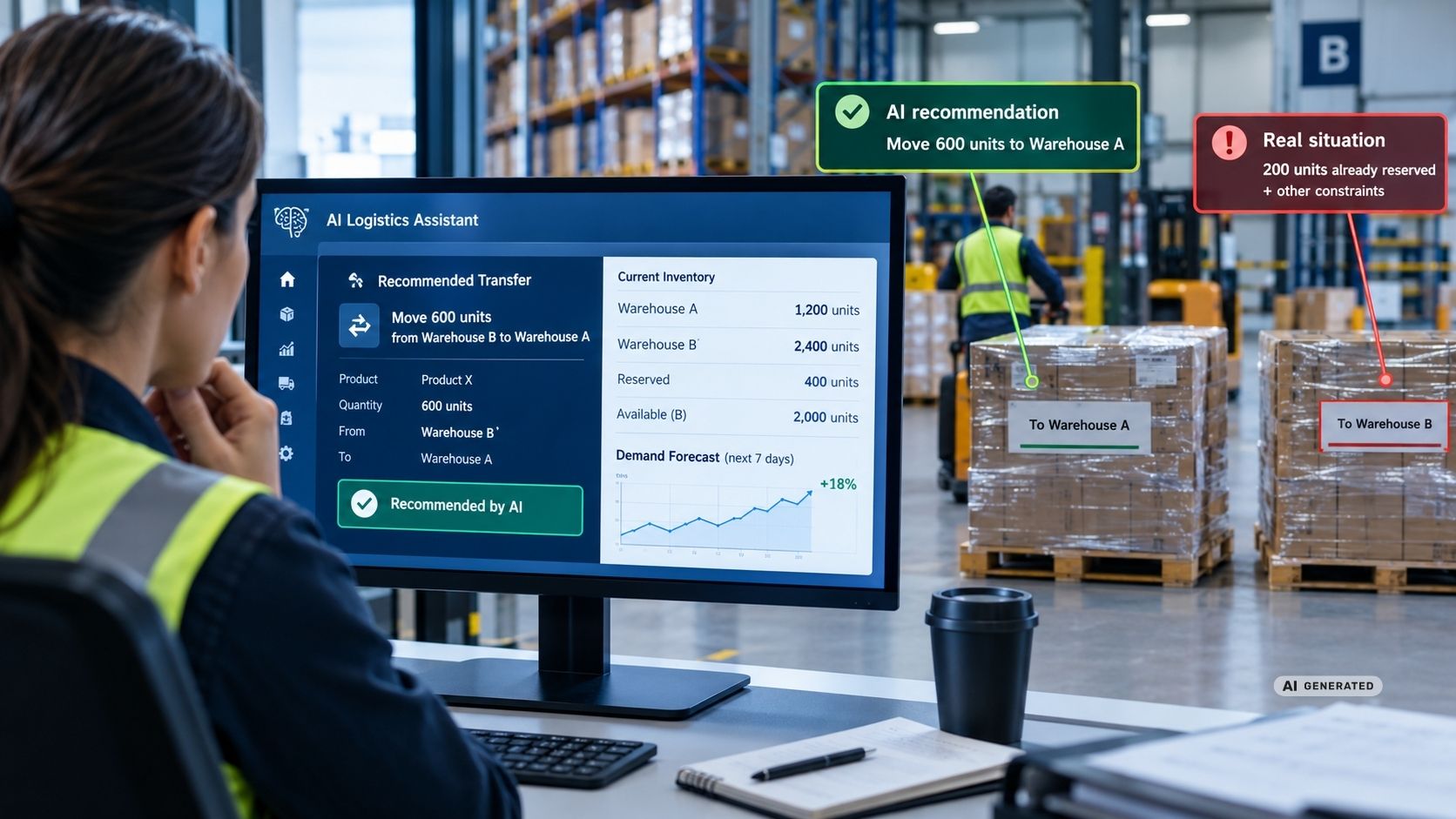
AI Hallucinations in Logistics: When AI Plans the Wrong Delivery
AI can analyze enormous amounts of logistics data — but it can also produce a convincing answer that is simply wrong. The critical question is not whether AI makes mistakes, but what happens when a wrong recommendation becomes an operational decision....
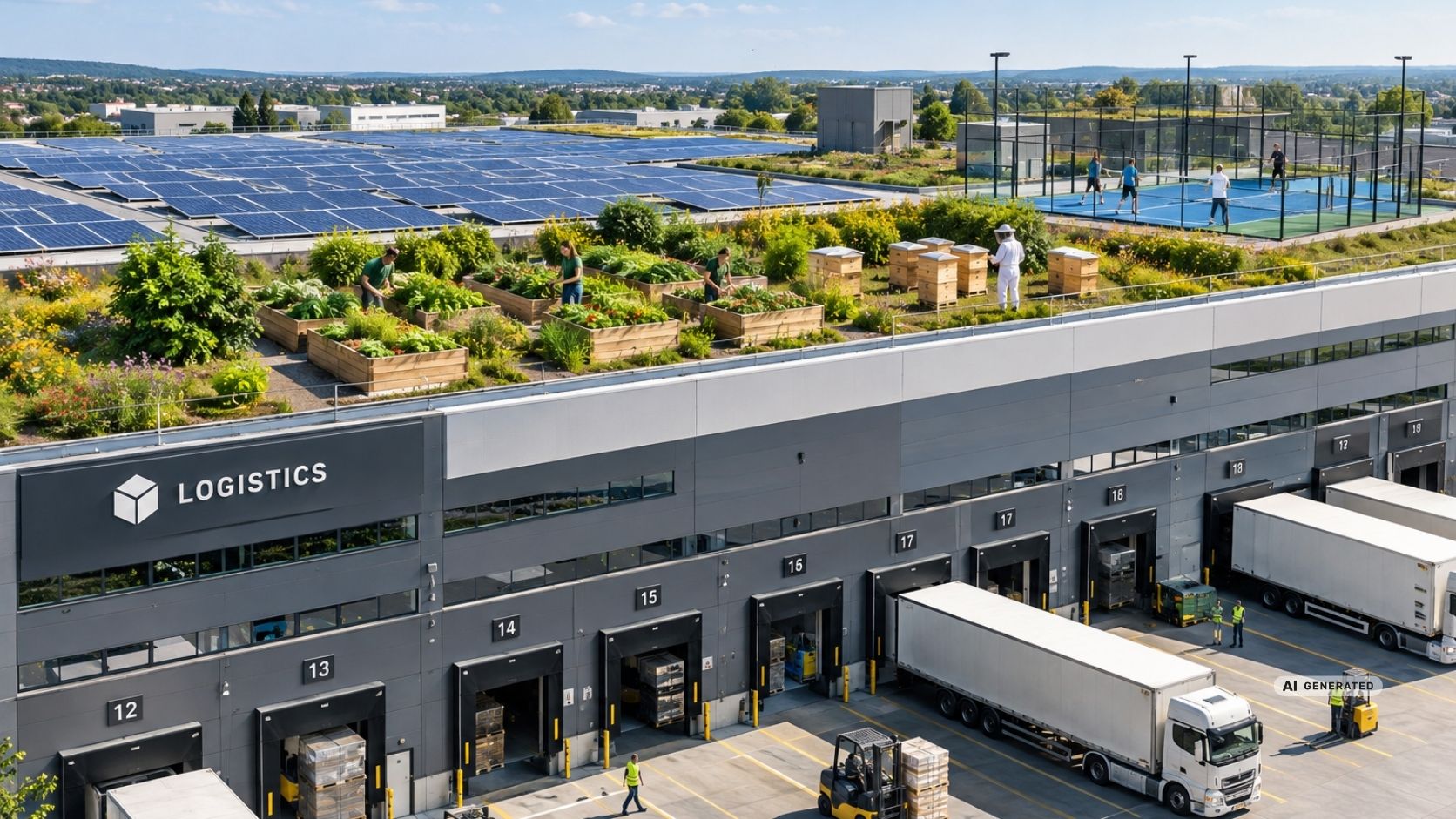
The Green Revolution on the Hall Roof: From Concrete Block to Ecological Power Plant?
Logistics roofs can do more than PV: greening, bees, urban farming and even sports areas turn unused roof space into multifunctional rooms....