



Switching contract logistics provider: why the exit from vendor lock-in starts in the contract
Table of contents
- How does vendor lock-in arise? Three shackles: people, IT, building
- What if your contract logistics provider underperforms? The four-step escalation ladder
- Dedicated warehouse: what if the building no longer fits the business?
- What does switching contract logistics provider cost?
- Which exit strategies work before dependency and after lock-in?
- Why is exiting particularly hard in Germany?
- Example: how AuraCare Cosmetics gets out
- Where we could be wrong
- Checklist: is your exit prepared?
- Conclusion: the exit starts when you sign
Your contract logistics provider is no longer delivering, errors are piling up and your margin is shrinking. Yet nothing changes, because switching provider sounds like standstill. That is what vendor lock-in looks like in practice: the shipper could switch, but not at an acceptable cost and not without putting its own ability to deliver at risk.
Our view: lock-in in logistics is above all a contract problem, not a technology problem. Whether an exit is possible is usually decided years earlier, at signature. Anyone who does not build an exit strategy into the contract logistics agreement will later negotiate from the weaker position. We show how shippers prepare a switch, escalate within a running contract and what a switch costs.
How does vendor lock-in arise? Three shackles: people, IT, building
In short: vendor lock-in arises when know-how, data and the building are tied so closely to one provider that switching costs more than carrying on. It usually creeps in on three levels that reinforce one another.
- People and process knowledge: The more value-added services the provider takes on, such as kitting, quality control or returns, the more knowledge about products and special cases sits only within its team. Much of it is documented nowhere.
- IT and data: The shipper's ERP and the provider's warehouse management system (WMS) are often linked by bespoke point-to-point interfaces. Stock and movement data sit in the provider's system, frequently in proprietary formats.
- Building and equipment: A provider that installs conveyor technology for one customer or leases a building long term wants to recover that investment over the contract term. That binds both sides.
Each level on its own is manageable; the combination is what makes it dangerous. The provider then holds the stronger hand, not because it is better, but because switching costs more.
What if your contract logistics provider underperforms? The four-step escalation ladder
Rising pick errors, missed cut-off times, stock discrepancies: we have already described how to spot the hidden costs of poor contract logistics. But what should you do when immediate termination is not possible or not wise? We recommend four steps that are already set out in the contract.
Step 1: facts in the Quarterly Business Review (QBR). The quarterly performance meeting needs hard KPIs rather than impressions: pick error rate, same-day dispatch rate for orders received before cut-off, inventory accuracy. For context: research regards one error per 1,000 order lines (0.1 %) as a desirable target.
Step 2: apply service credits. A good service level agreement (SLA) links missed KPIs to contractual penalties or credits that are offset against current invoices. That moves the issue up to management level at the provider.
Step 3: remediation plan with a deadline. The contract should provide for a formal remediation plan. In it, the provider demonstrates concrete countermeasures within a fixed period, we recommend 30 to 60 days, such as training, additional staff or buffer capacity at its own expense. This step also has a legal function: under section 314 of the German Civil Code (BGB), termination for breach of duty generally requires that a deadline for remedy has expired without success or that a formal warning has been issued.
Step 4: extraordinary termination with a transition period. If there is no improvement, the contractual right of extraordinary termination applies. What matters is that the provider remains obliged to an orderly transition period after termination, on the same terms and SLAs. For migrating interfaces and data, practitioners recommend 90 to 180 days. Without this clause the termination right is worth little.
Dedicated warehouse: what if the building no longer fits the business?
When an exclusive warehouse pays off is covered in our comparison shared warehouse vs. dedicated warehouse. For the exit, the term is what counts. Contract logistics agreements usually run for three to five years, and in our market experience leases for existing buildings often run for a similar period. For new builds and built-to-suit warehouses, meaning buildings tailored to a single occupier, investors and developers usually require fixed terms of seven to 15 years. If the business model changes, for example from pallet deliveries to retailers towards single items shipped direct to consumers, the racking and layout no longer fit, but the contract runs on.
Then there is alternative use. A building with customer-specific conveyors, special sprinkler systems or ceiling openings is hard to sublet. And at the end come reinstatement obligations.
What does switching contract logistics provider cost?
In short: for a mid-sized site, the bill quickly reaches around €1.5m, and the biggest block is the physical move. We have modelled a typical case: a site with 10,000 m² of warehouse space and around 8,000 pallet locations. The figures are benchmarks and assumptions, not quotes.
| Cost block | Benchmark / assumption | Model value | Basis |
| Physical relocation | around €50 to €125 per pallet location (retrieval and put-away, truck transport, racking relocation, project management) | approx. €720,000 (€90 × 8,000) | own derivation from handling rates, TIMOCOM freight rates and racking benchmarks |
| IT migration (WMS, interfaces) | €120,000 to €400,000 total cost over five years for a mid-sized warehouse | approx. €250,000 | Find Your WMS 2026 |
| Parallel operation, 1 to 2 months | double rent and service charges plus staff in both warehouses | approx. €220,000 | Model assumption |
| Reinstatement | depends on the contract; UK comparison case around €65/m² including repairs | approx. €300,000 (€30/m²) | Model assumption, comparison value Picton 2025 |
| Performance dip after go-live | often 10 to 20 % lower productivity in the first two weeks | not included | JIT Transportation 2026 |
| Total | excluding performance dip | approx. €1.49m | own model calculation |
Our derivation per location: retrieval and put-away €3 to €6 each, truck transport around €20 (33 pallets per full load, 300 km, €2.10 per km according to TIMOCOM, Q2 2026), racking relocation at 30 to 50 % of the new price, roughly €20 to €70, plus labelling, stocktaking and project management. Conveyors or special goods make the move considerably more expensive.
For parallel operation we assume two months of double rent at €8 to €9 per m², the prime rent range in most top markets (BNP Paribas Real Estate, Q3 2026), plus service charges and overlapping staff. For operating costs alone, BAUAKADEMIE (NEO Logistics Impact Report) forecast €11.97 per m² of gross floor area per year for investor-owned buildings in 2025.
There is no reliable German flat rate for reinstatement. A UK comparison: when the occupier of the Rushden 300 distribution warehouse (around 29,000 m²) left early in 2025, it paid £1.7m for reinstatement and repairs, roughly €65 per m². As roof and structure usually remain with the landlord in Germany, we assume €30 per m².
Which exit strategies work before dependency and after lock-in?
There are two moments for an exit strategy: before the contract is signed and once lock-in already exists. The first is considerably cheaper.
Before dependency: at tender and contract stage
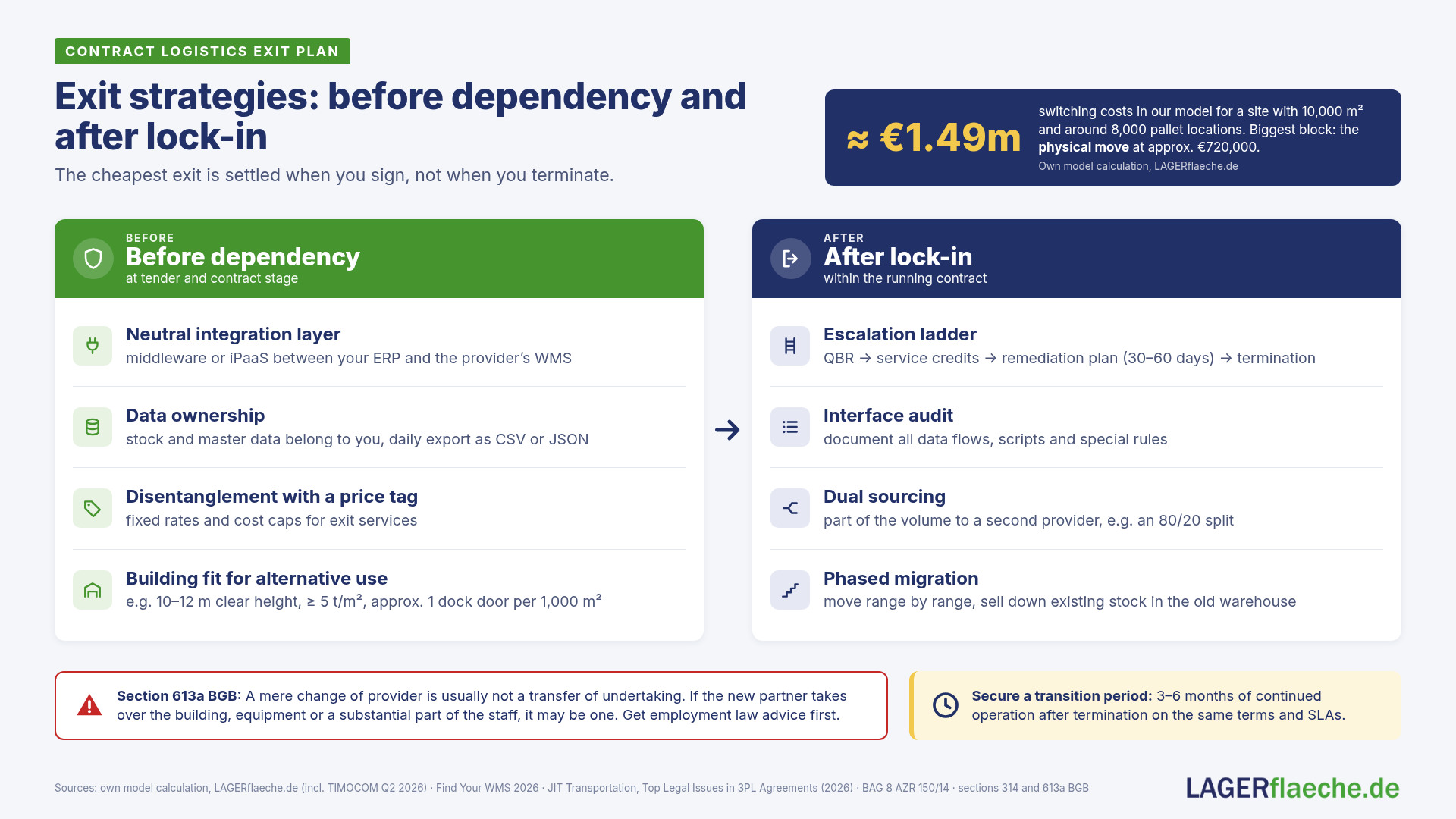
- Neutral integration layer: Instead of direct interfaces between ERP and the provider's WMS, put middleware or an integration platform (iPaaS) in between. When switching, only the endpoint needs reconnecting and your own ERP stays untouched.
- Data ownership: Stipulate in the contract that stock, movement and master data belong to the shipper, with a regular, ideally daily, export in open formats such as CSV or JSON.
- Disentanglement services with a price tag: Agree fixed hourly rates and cost caps for support during the exit, including fixed rates for retrieving stock per pallet.
- A building fit for alternative use: Lease buildings close to market standard, for example 10 to 12 m clear height, at least 5 t/m² floor loading and roughly one dock door per 1,000 m². That keeps it attractive to future tenants.
After lock-in: within the running contract
- Dual sourcing: Part of the volume, such as one product group, returns or a region, goes to a second provider, for example on an 80/20 split. That creates a fallback and benchmark data.
- Tendering with the exit in mind: Choose the new provider not just on price, but on references in your segment, a robust start-up plan, open interfaces and a willingness to agree exit clauses. The best test is a trial run with part of the volume, for example through dual sourcing.
- Interface audit: Document all data flows, scripts and special rules before announcing the switch.
- Phased migration instead of a big bang: Move range by range. New stock already goes to the new warehouse while existing stock is sold down in the old one. That reduces the most expensive cost block, the physical move. We have described separately how to plan such a logistics relocation.
The move itself: stocktake, insurance, bonded warehouse
Stocktake and data reconciliation: Before the last transport, stock is frozen and counted in the old warehouse. After put-away, the figures are reconciled with the new WMS. Discrepancies must be resolved before go-live, otherwise it remains unclear who bears the shrinkage.
Insurance: In road transport, the carrier's liability under section 431 of the German Commercial Code (HGB) is capped at 8.33 special drawing rights per kilogram. High-value goods therefore need cargo or goods-in-transit insurance that also covers handling and interim storage.
Customs and tax warehouses: If goods are held duty-suspended in a customs warehouse or excise-suspended in a tax warehouse, such as perfumes containing alcohol, the new site must also be authorised, under the Union Customs Code or as a tax warehouse. The transport then runs under official supervision. The authorisation belongs early in the project plan.
Why is exiting particularly hard in Germany?
Employment law: section 613a BGB. Many shippers fear that switching means taking over the outgoing provider's staff. Under the case law of the Federal Labour Court (BAG) and the CJEU, a mere change of provider is generally not a transfer of undertaking but a so-called succession of function. It can be different if the new provider takes over essential assets, such as the building, conveyor technology and WMS, or a substantial part of the workforce in terms of numbers and expertise. Employment contracts may then transfer to it. That is precisely the risk in the apparently simplest route: the building and equipment stay and only the operator changes. Whether a transfer of undertaking applies is always a case-by-case question and should go to a specialist employment lawyer before the tender.
Works council and customers. Co-determination usually concerns not the shipper but the outgoing provider. If the end of the contract leads to job cuts or a site closure there, this can be an operational change under section 111 of the Works Constitution Act (BetrVG), and in companies with more than 20 employees entitled to vote, its works council must then be involved. That takes time and can strain the transition period. Customers and trading partners should know the move date, new delivery address and any delivery pauses early.
Building and fire safety. Alterations to existing buildings are complex, because workplace rules (ASR), the industrial building guideline and insurers' sprinkler requirements (VdS CEA 4001) all have a say.
Space market. According to CBRE, big-box vacancy in Germany stood at 4.6 % in mid-2026, and at zero in Munich. In sought-after locations, little space is available at short notice (BNP Paribas Real Estate). Anyone planning a switch needs lead time.
Example: how AuraCare Cosmetics gets out
A fictional but realistic example shows what an exit within a running contract can look like. The company and figures are invented, but based on published case studies and industry benchmarks.
The starting point: AuraCare Cosmetics, a manufacturer of premium care products selling direct and through retail (annual revenue around €42m), signs a five-year contract with a large contract logistics provider in Hesse in 2022: an 8,000 m² dedicated warehouse, a customer-specific pick-by-light system and a proprietary WMS, linked to Shopify Plus and the Navision ERP via a script.
The problem: In 2025, pick performance collapses due to high staff turnover. On Black Friday, 18 % of orders are left unshipped and the complaint rate peaks at 4.2 %. When AuraCare threatens termination, the provider points to the term running until the end of 2027 and demands €850,000 in compensation plus €120,000 for removing the pick-by-light system.
The way out:
- KPI evidence: According to the WMS logs, the provider has missed the agreed same-day dispatch rate of 98 % by more than 7 percentage points for five months. AuraCare issues a formal warning and sets a 30-day remedy period. Only when this passes without success does termination for cause become a serious option.
- Middleware: Before announcing the switch, AuraCare introduces an integration platform. Shop and ERP data then run through standard interfaces.
- Split model: AuraCare needs a multi-user warehouse in North Rhine-Westphalia at short notice. For such cases, available space at logistics providers can be found and enquired about directly on LAGERflaeche.de. Direct-to-consumer business moves immediately, while the pallet business with retailers stays with the previous provider for six months.
- Settlement: In view of the documented SLA breaches, both sides agree a termination agreement. AuraCare pays no exit fee but takes over racking at a residual value of €50,000.
The result: Within four months, the complaint rate at the new warehouse falls from 4.2 % to 0.4 %. After twelve months, the cost per pick is 14 % lower despite the migration costs.
How realistic is this? Case studies from the providers involved report similar figures: 40 % fewer errors at eyewear brand LOOK Optic, 98.9 % same-day dispatch at beauty brand Yen Aura, 15.5 % lower fulfilment costs at Atoms. Early termination fees of two to six months of minimum charges are common in 3PL contracts.
Where we could be wrong
Dual sourcing costs economies of scale and often does not pay off for small volumes. And not every lock-in is bad: heavy automation needs long terms for the investment to pay off. Our point is not to avoid commitment, but to settle the exit in advance.
Checklist: is your exit prepared?
Contract
Data & IT
Building & network
Conclusion: the exit starts when you sign
Vendor lock-in in contract logistics is not fate, but usually the result of a contract that did not think about the exit. Shippers who settle escalation, transition period, data ownership and reinstatement in advance negotiate as equals. Those already stuck can get out with documentation, a second partner and a phased migration. Our recommendation: write the exit strategy into the contract before you need it.
Sources
- CBRE: German industrial and logistics real estate market H1 2026 (incl. Munich, as reported by DEAL Magazin, 31.07.2026)
- BNP Paribas Real Estate: Logistics Market Germany Q3 2026
- BAUAKADEMIE: NEO Logistics Impact Report 2025/26
- Find Your WMS: WMS costs 2026 (as of October 2026)
- TIMOCOM Transport Barometer Q2 2026, cited in Wochenzeitung Verkehr (15 July 2026)
- Handling and racking costs: Industrie Fachwissen, Lagerplatzkosten berechnen (05/2026); RackCity and Hammerhead Industrial (2026)
- Picton Property Income: announcement on Rushden 300 (October 2025)
- 3PL contracts and SLAs: JIT Transportation, Top Legal Issues in 3PL Agreements and Automation Change Management (2026); WarehousingCosts.com (2026)
- Günthner, Rammelmeier (Technical University of Munich) for BVL: research report on avoiding picking errors with pick-by-vision
- Federal Labour Court (BAG): judgments of 22.08.2013 (8 AZR 521/12) and 19.03.2015 (8 AZR 150/14)
- Sections 314 and 613a of the German Civil Code (BGB)
Latest Blog Posts
Stay up to date with the newest trends, insights, and tips in warehouse and logistics. Our latest articles help you navigate the industry with confidence.
Hidden Vacancy: How Unused Industrial and Logistics Space Comes Back to the Market
Logistics space is scarce – yet some buildings stand half empty without ever being listed. We explain what lies behind hidden vacancy, how space holders can measure it and reactivate it on a sound legal footing, and what this means for companies looking for space....
Switching contract logistics provider: why the exit from vendor lock-in starts in the contract
When your contract logistics provider stops delivering, switching often looks impossible. We show why the exit starts in the contract: with an escalation ladder, a switching-cost model, German employment law and a fictional but realistic example....
Logistics Real Estate 2027: It's Not the Rent That Holds You Back, It's the Building
In 2027, the search for warehouse space will rarely fail on rent. It will fail on the building itself: not enough power, a floor that can't carry the automation, a network full of dead spots. Why power, floor and network are becoming deal-breakers, and what occupiers, owners and developers should check now....

Poland, Czechia, Slovakia or Hungary: Which Location Best Fits Your Automotive Supply Chain?
Poland, Czechia, Slovakia and Hungary play different roles in Europe's automotive industry. This comparison explores which locations companies should consider for component sourcing, manufacturing, electric mobility and cross-border logistics....