


Master Plan for Logistics Relocation – Between High Technology, Time Pressure & Global Hurdles
Table of Contents
- Why Move? The Drivers Behind the Relocation
- Planning Horizons: From the Vision to the "Go-live"
- The Customer Perspective: Transparency Beats Speed
- Difficulties and Stumbling Blocks: Where Projects Fail
- Avoid Downtime: Strategies for Zero-defect Migration
- Can AI Help? The Digital Twin of the Move
- International Comparison: Germany vs. the World
- Practical example: The "Smart-Move" case study
- Conclusion for Decision-makers
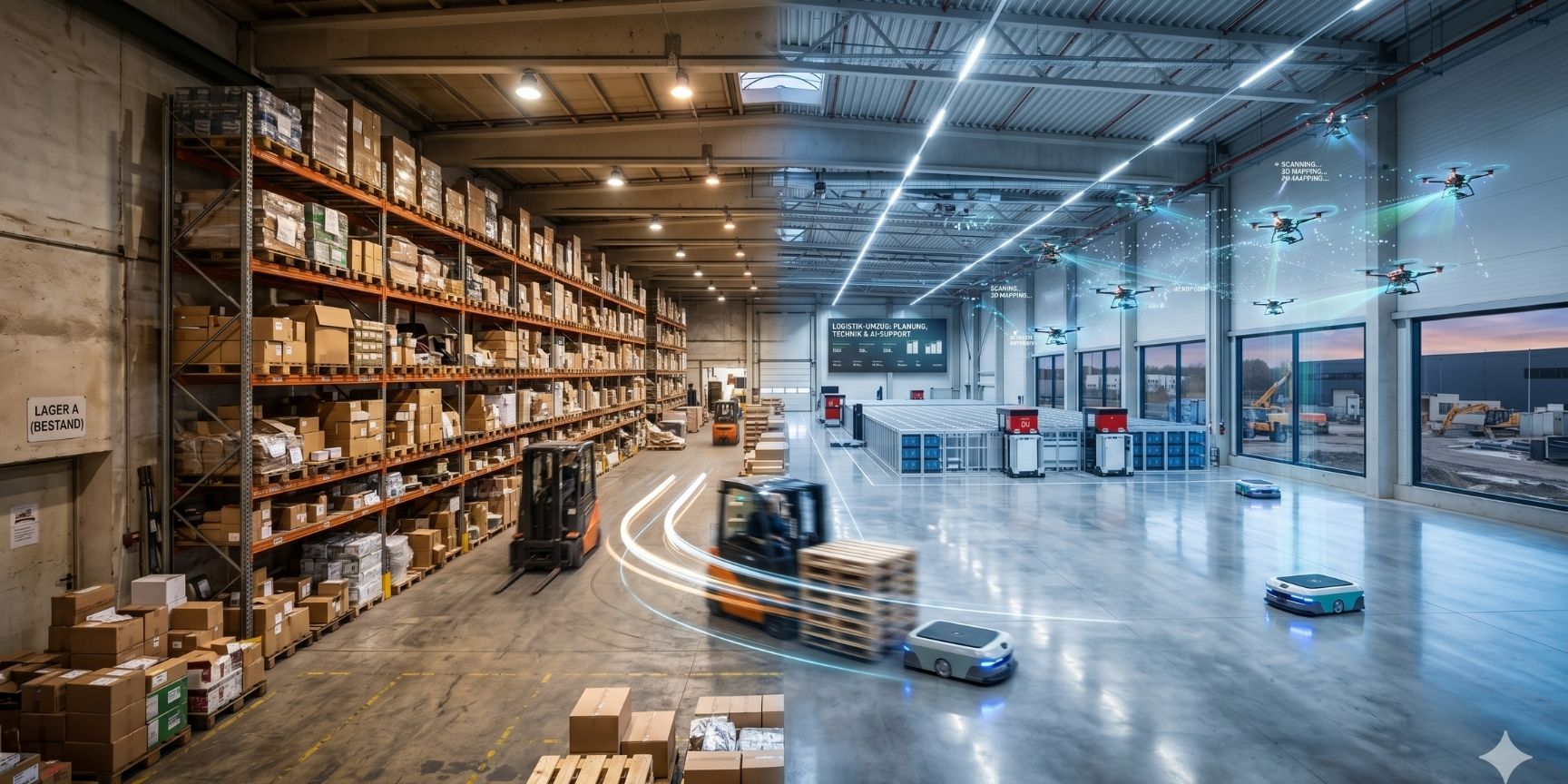
Moving a logistics site is much more than just transporting shelves and pallets from A to B. It is an "open-heart operation" of the supply chain. Whether it's capacity limits at the service provider, the desire for automation (Industry 4.0) or the completion of your own property – the reasons are manifold, but the risks are identically high for each project.
How can such a feat of strength be achieved without extensive delivery interruptions? What role does artificial intelligence play in layout optimization? And why is a move in Poland or the USA fundamentally different from Germany? In this deep dive, we shed light on all facets of warehouse migration.
Why Move? The Drivers Behind the Relocation
Before the first truck rolls, the strategic decision is made. In practice, we see three main drivers:
- The pain of scaling: The logistics service provider (3PL) is growing faster than its space. According to a study by Fraunhofer IML, a space utilization of over 85% already leads to massive efficiency losses in the picking processes.
- Technological disruption: Older existing properties often do not have the floor load capacity (point load) or ceiling heights necessary for modern AutoStore systems or narrow-aisle warehouses.
- In-house management vs. outsourcing: Many companies are switching from the rental model to self-construction in order to stabilize costs in the long term and to be able to better control ESG criteria (sustainable construction).
The central question is: Is the new location just a larger shell or a technological upgrade?
Planning Horizons: From the Vision to the "Go-live"
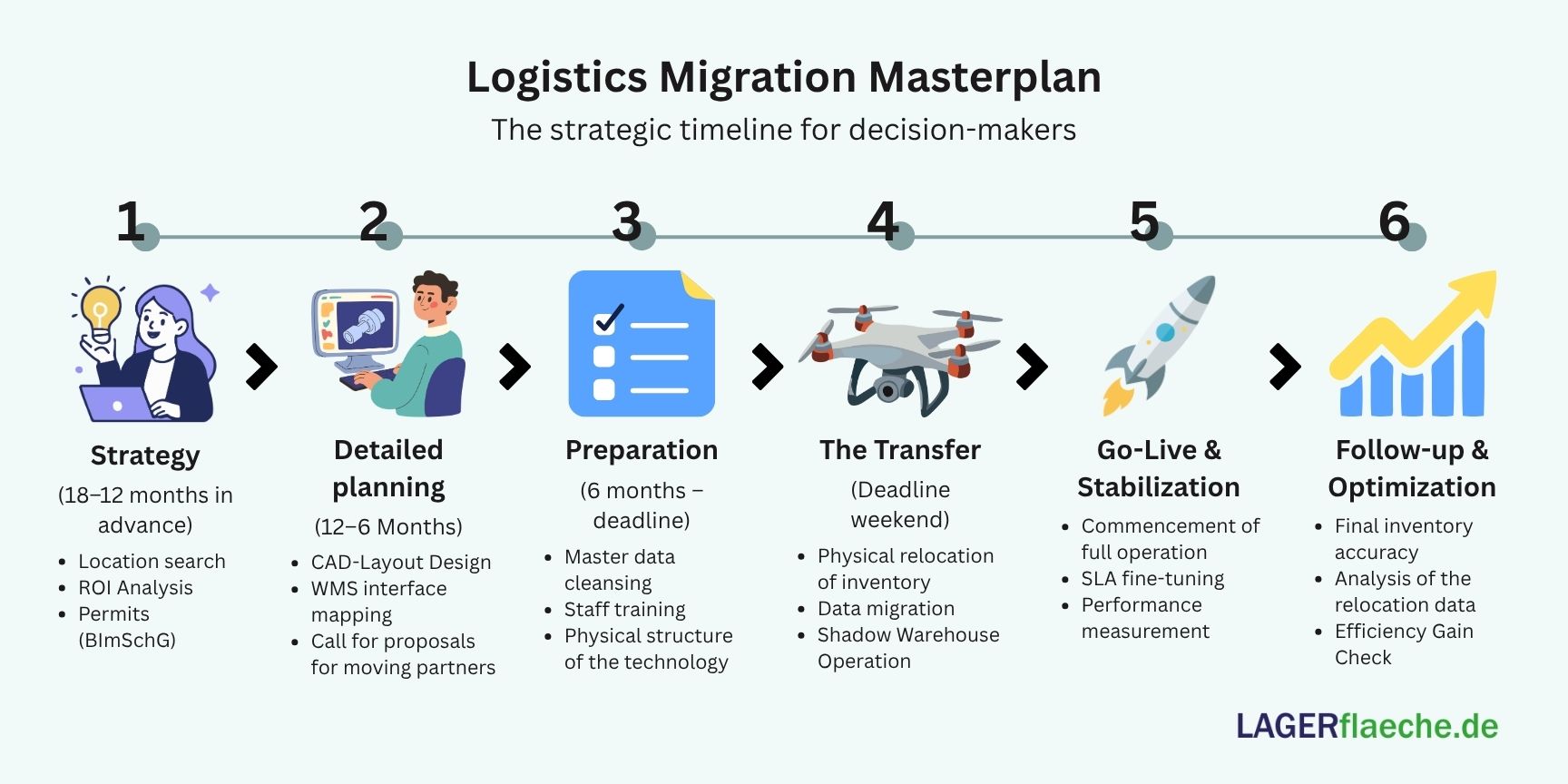
A fatal mistake in practice is underestimating the lead time. A professional logistics move is divided into three phases:
- Strategic phase (18-12 months before relocation): site search, network analysis, approval process.
- Detailed planning (6-12 months before the move): Layout design (CAD), tendering of the relocation service providers, IT infrastructure planning.
- Implementation (6 months until the deadline): Physical setup of the technology, data migration, staff training.
Practical figure: According to the BVL (German Logistics Association), large logistics projects (over 20,000 m²) require a minimum lead time of 14 to 18 months to ensure building permits and fire protection requirements (e.g. sprinkler systems according to VdS standard).
| Phase | Focus | Critical path |
| Concept | ROI-Analysis | Permits (BImSchG) |
| IT Setup | WMS-Mapping | Interface Testing |
| Transfer | Inventory relocation | Physical Inventory Accuracy |
The Customer Perspective: Transparency Beats Speed
What do customers have to consider when their service provider moves? For the customer, a move is primarily a risk to his own ability to deliver.
- SLA adjustments: During the hot phase, service level agreements (SLAs) often have to be adjusted temporarily.
- Inventory build-up: Customers should proactively build up a safety stock to bridge a 1- to 2-week "dark phase" of the warehouse.
- IT interfaces: A new location often means a new warehouse management system (WMS) or at least new IP ranges and routing tables.
Important: Agreements must be contractually fixed. Who is liable in the event of delays? Are there penalties? Open communication is the best risk management here.
Difficulties and Stumbling Blocks: Where Projects Fail
Despite the best planning, unforeseeable problems often arise:
- Shortage of skilled workers: Moving to a location just 30 km away can mean the loss of 20-30% of the permanent workforce if the commute becomes too long.
- Building permits & fire protection: In Germany, the requirements are extremely strict. A lack of acceptance of the fire dampers can stop a 50-million-euro project on the day it moves in.
- Data garbage: "Garbage in, garbage out." If uncleaned master data is transferred to the new system in the new warehouse, picking collapses in the first week.
Avoid Downtime: Strategies for Zero-defect Migration
How do you prevent shipping from coming to a standstill?
- The "Shadow Warehouse" concept: For a transitional period, both locations will be operated in parallel. Incoming goods are already going into the new hall, outgoing goods are being served from the old stock until it is sold out.
- Big bang vs. phased rollout: While the "big bang" (moving over the weekend) is risky, it minimizes the time of double costs. A physically phased move (by product groups) is safer, but logistically more complex (split orders).
- Buffer logistics: Use of external capacities for 4 weeks to take the pressure off the main project.
Can AI Help? The Digital Twin of the Move
Today, artificial intelligence (AI) is no longer a gimmick, but an efficiency driver:
- Layout optimization: AI algorithms calculate the ideal slotting in the new warehouse based on historical order data. Where do fast-moving vehicles have to be located to minimize the travel distances of the AGVs (Automated Guided Vehicles)?
- Predictive planning: AI can analyze weather data, traffic conditions, and port delays to determine the optimal time for physical goods transfer between halls.
- Digital twin: Before the move, the hall is digitally simulated. In this way, bottlenecks at the loading gates (docks) can be identified before the first truck arrives.
Source for AI trends: Gartner Magic Quadrant for WMS 2024.
International Comparison: Germany vs. the World
A move in Germany follows different rules than in the USA or Eastern Europe.
Germany
- Strengths: Central location, high legal certainty, excellent rail connections.
- Weaknesses: Extremely slow approval procedures (up to 24 months for new buildings), high energy costs, rigid working time models.
Poland & Czech Republic
- By comparison, the "speed-to-market" is significantly higher here. Permits for logistics hubs (e.g. Wroclaw or Prague) are often issued in half the time. According to Eurostat (2023), wage costs are still about 40-50% below German levels, while at the same time having state-of-the-art infrastructure.
USA
- Difference: In the USA, the "design-build" principle prevails. Halls are often erected in record time, but with lower energy standards than in the EU. The focus here is massively on the connection to the major carrier hubs (FedEx, UPS).
China
- The difference: Here, government control is decisive. Logistics clusters are artificially created and equipped with high-speed infrastructure. The automation rate here is often higher than in Europe, driven by massive e-commerce pressure (Alibaba/JD.com).
Practical example: The "Smart-Move" case study
Scenario:
A medium-sized electronics distributor moves from a 5,000 m² existing hall to a 12,000 m² new building with an integrated AutoStore system.
Solution:
- Data cleanup: 6 months in advance, all "slow sellers" (dead stock) were identified and sold off or scrapped.
- IT-Sim: The new WMS was operated in parallel to the old one and fed via API.
- The move: Over three weekends, specific product groups were relocated. The AI optimized the truck loading in such a way that the unloading time at the destination was reduced by 30%.
Result
Not a single delivery delay for end customers. Pick performance increased by 45% after 4 weeks at the new location.
Conclusion for Decision-makers
A move is the opportunity for an operational restart. If you only see it as a transport task, you will fail. If you use it as a transformation project that includes AI, a clean IT strategy and transparent customer communication, you will create the basis for the next decade of growth.
Checklist for your success
Questions you Should Ask Yourself Now:
- Do we have the capacity to manage the move in parallel to day-to-day business, or do we need external project managers?
- How do our top 10 customers react to a potential 48-hour unavailability?
- Does the new hall offer enough flexibility for the logistics trends of 2030 (e.g. hydrogen infrastructure or drone ports)?
References:
- Fraunhofer Institute for Material Flow and Logistics (IML) – Annual Report 2024/2025.
- BVL Magazine: "Logistics real estate in transition", issue 02/2024.
- Eurostat: Labour Cost Levels 2023.
- Gartner: Magic Quadrant for Warehouse Management Systems.
Latest Blog Posts
Stay up to date with the newest trends, insights, and tips in warehouse and logistics. Our latest articles help you navigate the industry with confidence.
Data Centres vs. Logistics Facilities: The Race for Power and Land
Across Europe, logistics operators are competing for more than land and transport access. They increasingly need something much harder to secure: grid capacity. Data centres are intensifying that competition — and changing how logistics locations are evaluated....

Chinese companies discover Europe's logistics real estate
Chinese companies are becoming an increasingly visible user group in Europe's logistics real estate market. What does this mean for warehouse space, 3PL structures and the requirements for European logistics locations?...
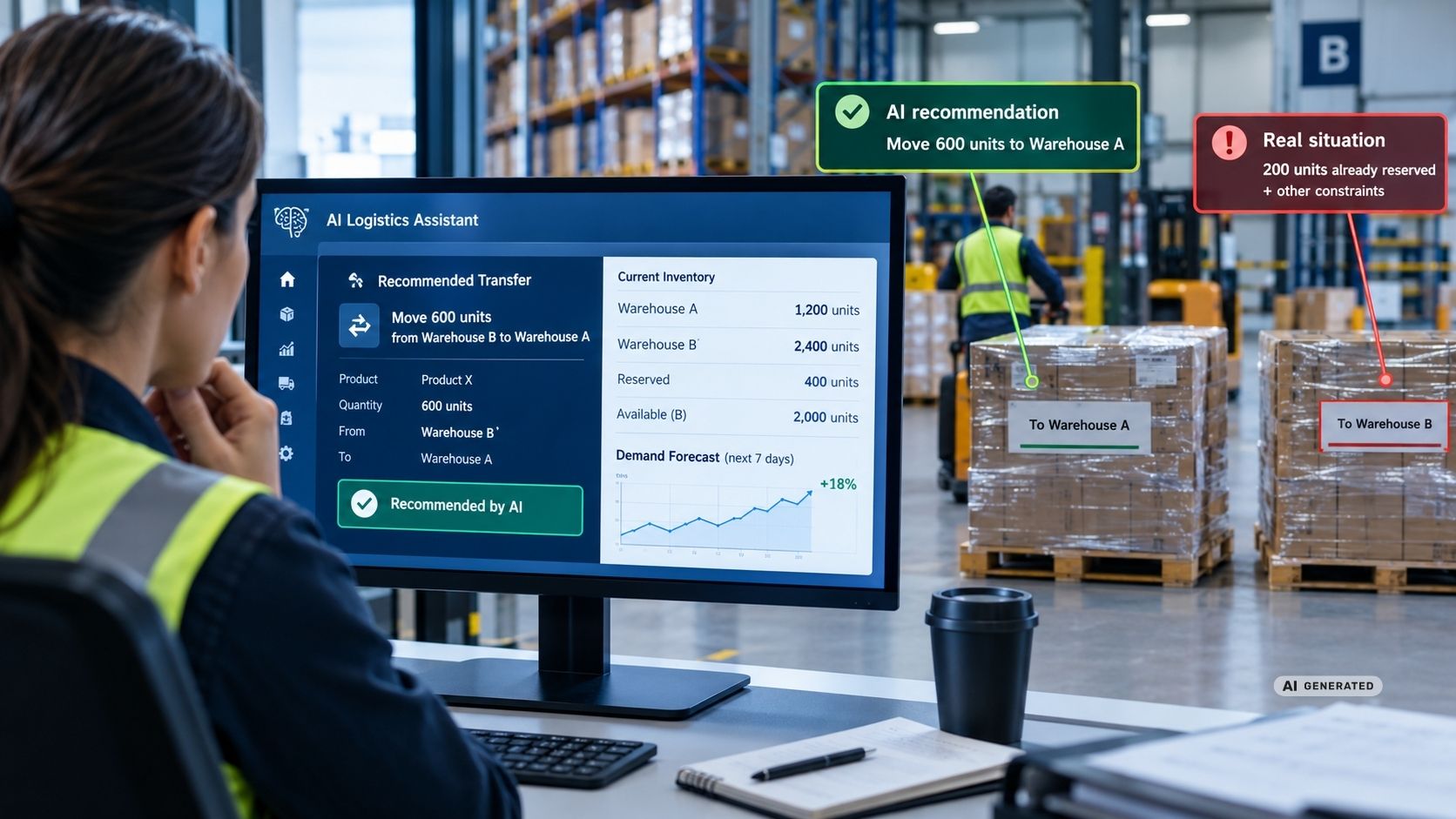
AI Hallucinations in Logistics: When AI Plans the Wrong Delivery
AI can analyze enormous amounts of logistics data — but it can also produce a convincing answer that is simply wrong. The critical question is not whether AI makes mistakes, but what happens when a wrong recommendation becomes an operational decision....
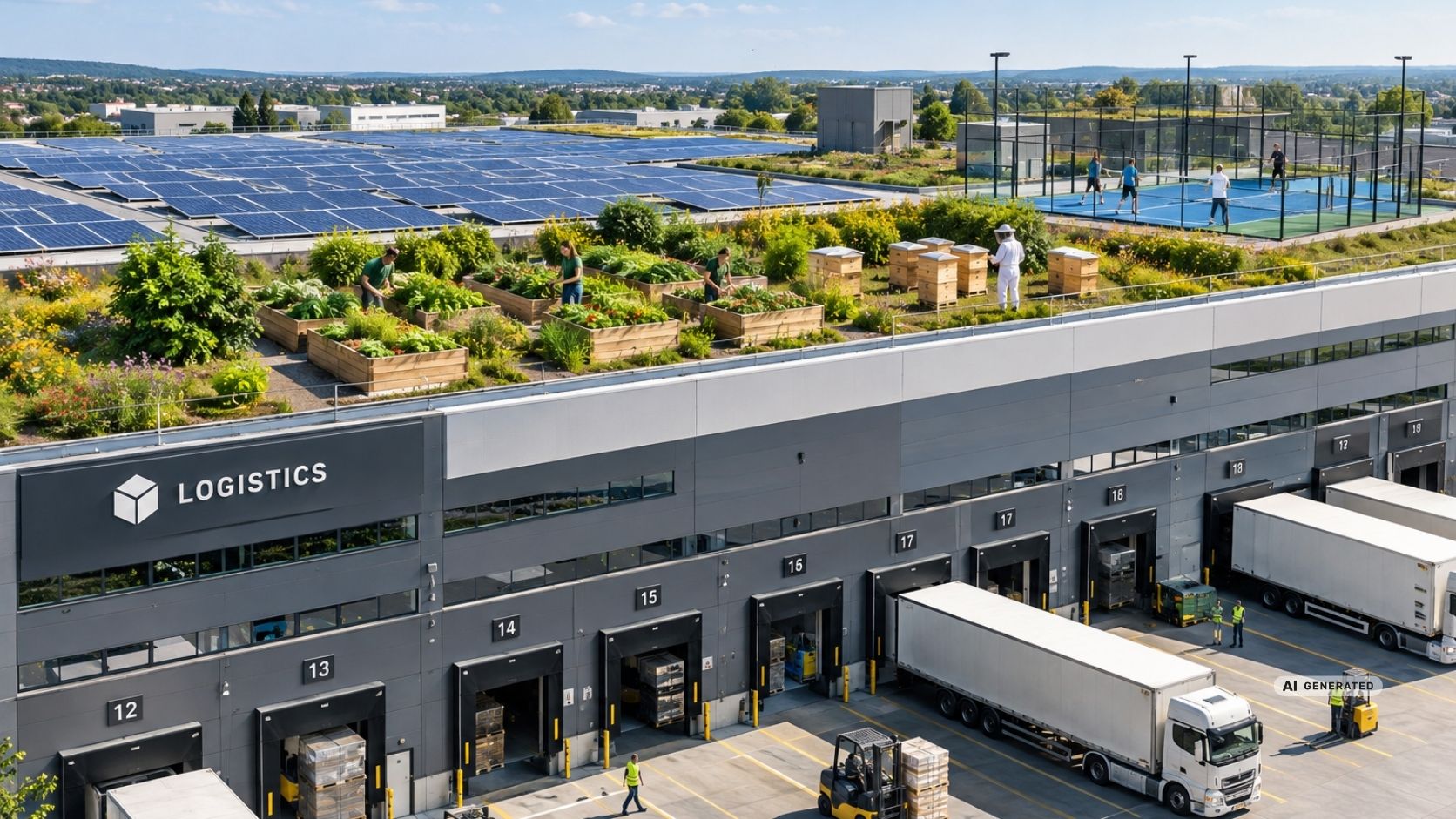
The Green Revolution on the Hall Roof: From Concrete Block to Ecological Power Plant?
Logistics roofs can do more than PV: greening, bees, urban farming and even sports areas turn unused roof space into multifunctional rooms....