



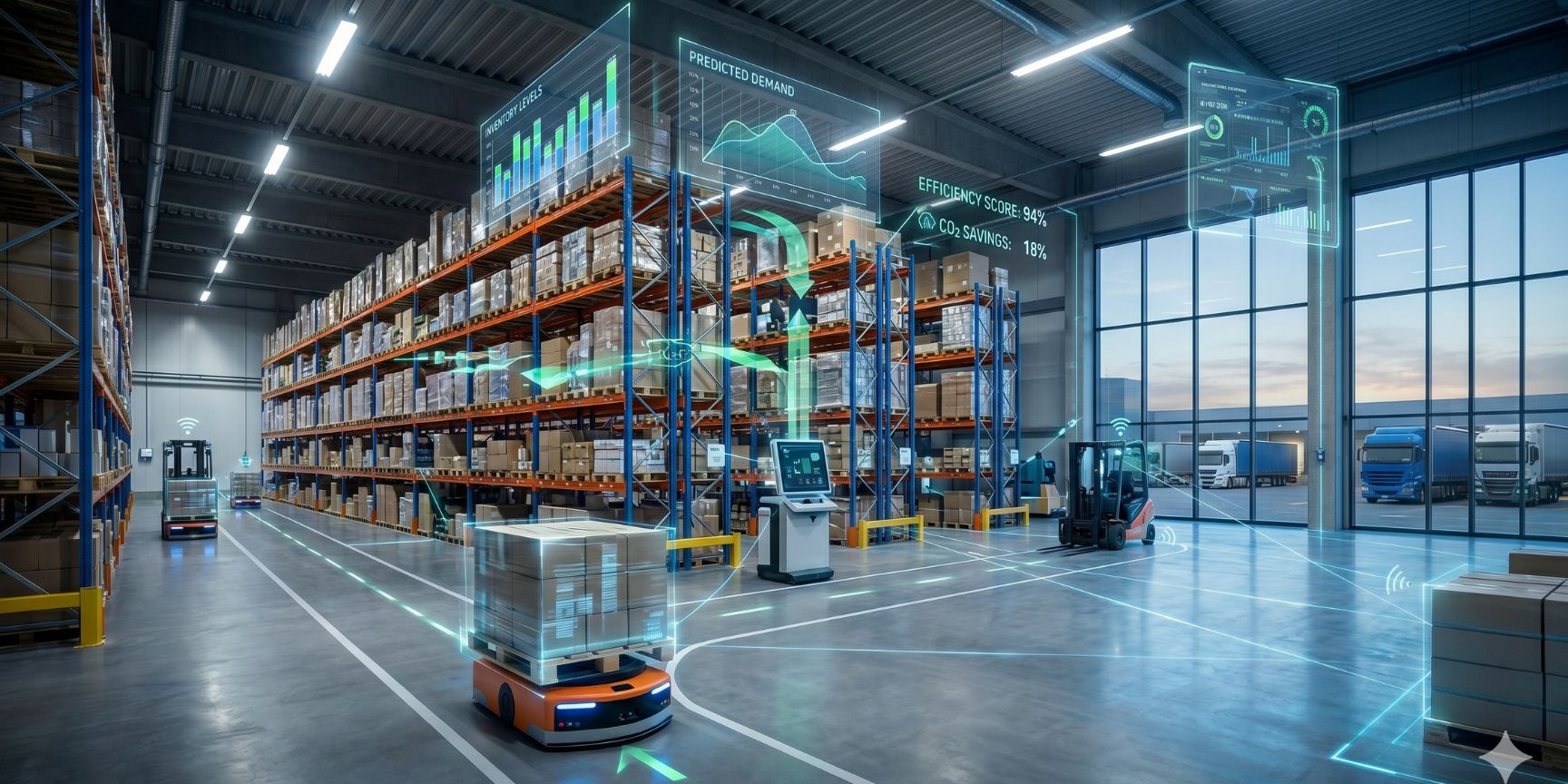
Predictive Logistics: How AI and Smart Warehousing are Revolutionizing the Global Supply Chain
Table of Contents
- Sustainability and CO2 Savings: Increase Effectiveness Through Data
- New IT Infrastructure: Do We Need the Wheel Anew?
- Only for Large Halls? The Scalability of Intelligence
- The Brain of the Warehouse: Machine Learning and Data Access
- Forecast Quality: What Does Success Depend on?
- Global Comparison: Where does Germany Stand?
- Prerequisites for Modern Logistics Halls
- Practical Example: Increased Efficiency at a Medium-sized e-Commerce Logistics Company
- Conclusion: Logistics is Becoming a Tech Sector
In a world in which "just-in-time" is being replaced by "predictive everything", logistics companies are facing a turning point. It is no longer just a matter of moving goods from A to B, but of knowing that goods B are needed even before the order has been placed. Predictive logistics and smart warehousing are the buzzwords that will determine future competitiveness. But what is behind the hype? Is the new IT infrastructure a hurdle or a stepping stone? And how does Germany fare in an international comparison?
In this article, we shed light on the depth of data-driven logistics and answer the critical questions of the industry.
The key questions: What you need to know today about tomorrow's logistics
Before we dive into the technical details, we need to ask ourselves the questions that keep decision-makers awake at night today:
- Can AI really reduce operational costs without increasing complexity immeasurably?
- Is the transformation to a smart warehouse only feasible for billion-dollar corporations with huge halls?
- How "green" is digital logistics actually – is CO2 savings measurable?
- Why is Germany lagging behind the Netherlands or Singapore in terms of digital infrastructure?
Reduce Costs, Increase Margins: The Economic Lever of Prediction
The primary driver for investments in predictive logistics is the bare economy. In traditional logistics, empty capacities, inefficient routing and excess inventory are the biggest "margin eaters".
According to a study by Gartner (2024), companies can reduce their inventory and inventory costs by up to 15% to 25% by using AI-powered forecasting models.
Where does the saving come from?
- Avoidance of out-of-stock situations: AI recognizes seasonal patterns and local trends faster than any dispatcher.
- Optimized workforce planning: By predicting peak times, the deployment of personnel can be precisely controlled, which minimizes expensive overtime.
- Predictive maintenance: IoT sensors on conveyor systems and autonomous industrial trucks report wear and tear before it comes to an expensive standstill.
Sustainability and CO2 Savings: Increase Effectiveness Through Data
Sustainability is no longer a "nice-to-have", but a bitter necessity due to regulations such as the Supply Chain Due Diligence Act (LkSG) and the EU's CSRD Directive.
Smart warehousing contributes directly to CO2 reduction:
- Energy efficiency: Intelligent lighting and climate controls based on movement data and weather forecasts reduce energy consumption by up to 30%.
- Route optimization in the warehouse: Shorter distances for forklifts and robots mean less power consumption.
- Packaging optimization: AI calculates the ideal carton size to avoid air transport, which improves truck utilization and saves CO2 on the road.
Fact: The Fraunhofer Institute for Material Flow and Logistics (IML) estimates that a fully digitalized supply chain could reduce transport emissions globally by approx. 10–15%.
New IT Infrastructure: Do We Need the Wheel Anew?
The fear of a complete redesign of the IT infrastructure is widespread. The answer is a clear one: "It depends."
The basic building blocks:
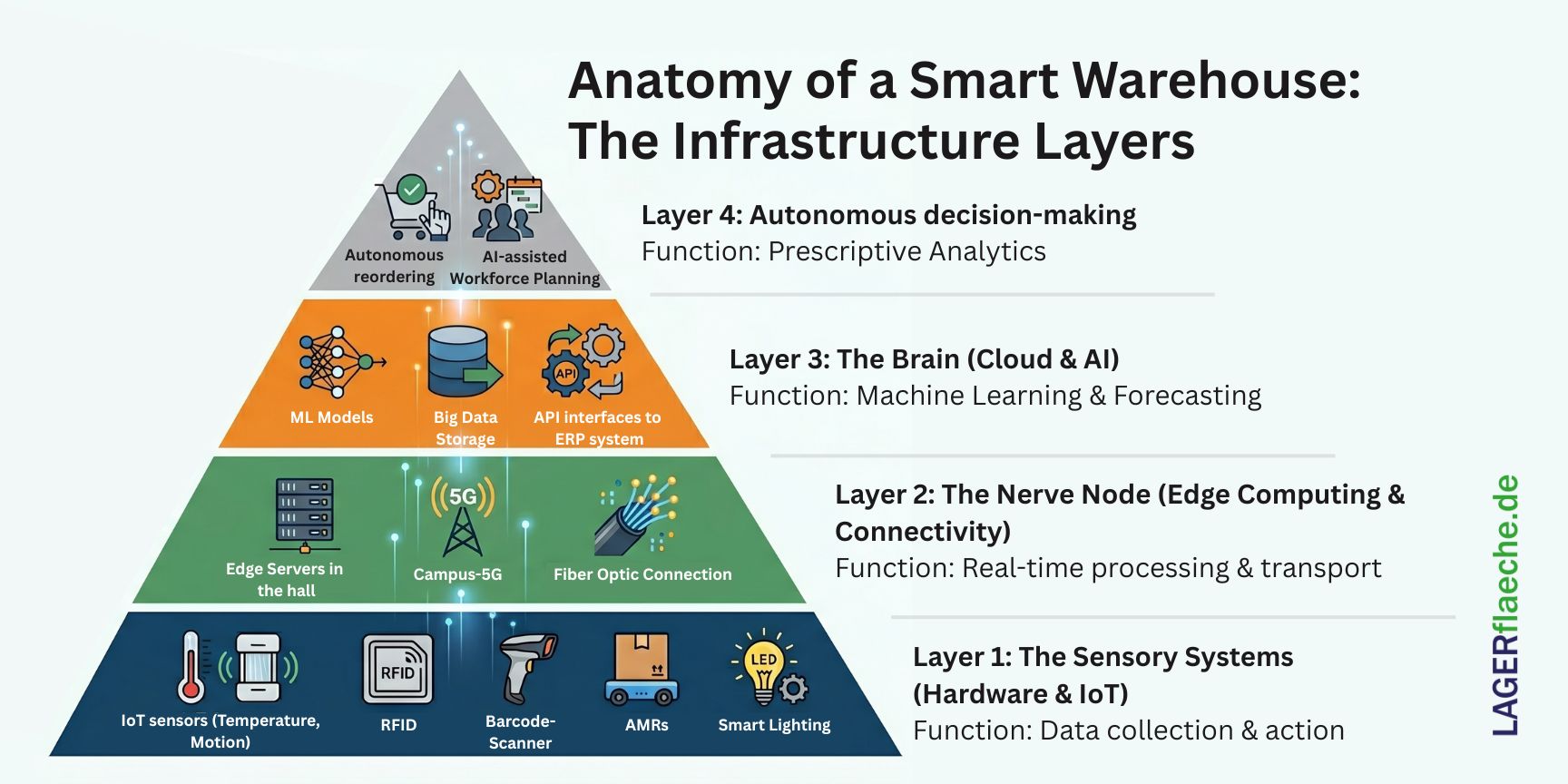
- Data node (edge computing): Data must be processed where it is generated (e.g. directly at the sensor) to avoid latencies.
- Fiber optics & 5G: Without a high-performance connection, data exchange in real time is impossible. 5G in particular makes it possible to network thousands of IoT devices in a very small space.
- Cybersecurity: As networking increases, the attack surface increases. A modern infrastructure needs a "Zero Trust" model.
Important: It is often not necessary to replace the existing ERP system (such as SAP). Modern AI solutions build on the existing structure as "layers" and pull data via APIs (interfaces).
Only for Large Halls? The Scalability of Intelligence
A common misconception is that predictive logistics only makes sense in 50,000 m² logistics centers.
Small halls and existing buildings (brownfield)
In fact, the potential is often even higher in existing halls (brownfield), as the inefficiencies are greater here.
- Retrofitting: Existing racking systems and conveyor belts can be retrofitted with low-cost IoT sensors (LoRaWAN standard).
- Space utilization: In small halls, every square meter counts. AI-powered slotting algorithms optimize storage space occupancy so dynamically that capacity can increase by up to 20% without adding.
The Brain of the Warehouse: Machine Learning and Data Access
How does AI access information? The magic word is data aggregation.
The Machine Learning (ML) Process
- Data ingestion: The AI uses historical data (order history of the last 5-10 years), current weather data, traffic data, and even social media trends.
- Pattern recognition: Algorithms identify correlations. Example: "When it rains in the north of Germany, the order of rubber boots increases by 40%."
- Future forecast: Statistics become probability. The system learns with every mistake (reinforcement learning).
What will happen to the data in the future? We are moving away from pure forecasts to prescriptive analytics. The system not only says what will happen, but also makes decisions autonomously (e.g. independent reordering of goods).
Forecast Quality: What Does Success Depend on?
Not every AI forecast is spot on. The quality depends on three factors:
- Data Cleanliness: "Garbage in, garbage out." If master data (weights, measurements, delivery times) is stored incorrectly, the AI fails.
- Granularity: The more finely detailed the data (e.g. hourly instead of daily updates), the more precise the forecast.
- External factors: A pandemic or a blocked Suez Canal are "black swan" events that briefly overwhelm any AI. However, modern systems use "stress tests" to simulate such scenarios.
Global Comparison: Where does Germany Stand?
The world map of logistics innovation is unevenly drawn.
| Country | Strength | Why? |
| Netherlands | Digital infrastructure | Enormously high proportion of fiber optics, gateway function through Rotterdam, state funding for smart hubs. |
| USA | Software & Cloud | Dominance of platform economies (Amazon, Google Cloud), venture capital for log-tech startups. |
| China | Degree of automation | Massive investments in robotics and fully autonomous warehouses (JD.com, Alibaba) due to economies of scale. |
| Germany | Engineering knowledge | World market leader in intralogistics hardware (Linde, Still, Jungheinrich), but often slowed down by slow internet connections and data protection concerns. |
Germany has the advantage of its central location in Europe, but is struggling with an outdated digital infrastructure in rural regions. While 5G is standard in warehouses in Singapore, German logistics companies often still struggle with dead spots on the company premises.
Prerequisites for Modern Logistics Halls
Anyone who builds or renovates a hall today must understand it as a data hub.
- Connectivity: Comprehensive Wi-Fi 6 or Campus 5G.
- Sensor technology: Wherever there is movement (gates, ramps, forklifts).
- Digital twin: A virtual image of the hall in which processes can be simulated before they are implemented in real life.
- Open-interface: No closed, proprietary systems, but open-source approaches for connection to the global digital supply chain.
Practical Example: Increased Efficiency at a Medium-sized e-Commerce Logistics Company
A German medium-sized company with a 5,000 m² hall (existing building) converted to predictive logistics in 2024.
- Problem: 30% overtime during the Christmas season, high error rate in picking.
- Solution: Implementation of AI-supported pick path optimization and connection of weather and seasonal data.
- Result: Within 6 months, the error rate fell by 45%, and personnel costs were reduced by 12% through better pre-planning. The payback period (ROI) was only 14 months.
Conclusion: Logistics is Becoming a Tech Sector
Predictive logistics is no longer a luxury good, but the operating system of the modern economy. The path to the smart warehouse leads through data quality and the courage to use a digital infrastructure. Whether it's a large hall or a small inventory, those who don't use their data today will be overtaken tomorrow by those who calculated their future yesterday.
Sources:
- Gartner Supply Chain Research 2024.
- Fraunhofer IML: Logistik-Trend-Report.
- World Bank: Logistics Performance Index (LPI) 2023.
- Statista: Global Smart Warehousing Market Forecast 2025-2030.
Latest Blog Posts
Stay up to date with the newest trends, insights, and tips in warehouse and logistics. Our latest articles help you navigate the industry with confidence.
Data Centres vs. Logistics Facilities: The Race for Power and Land
Across Europe, logistics operators are competing for more than land and transport access. They increasingly need something much harder to secure: grid capacity. Data centres are intensifying that competition — and changing how logistics locations are evaluated....
Chinese companies discover Europe's logistics real estate
Chinese companies are becoming an increasingly visible user group in Europe's logistics real estate market. What does this mean for warehouse space, 3PL structures and the requirements for European logistics locations?...
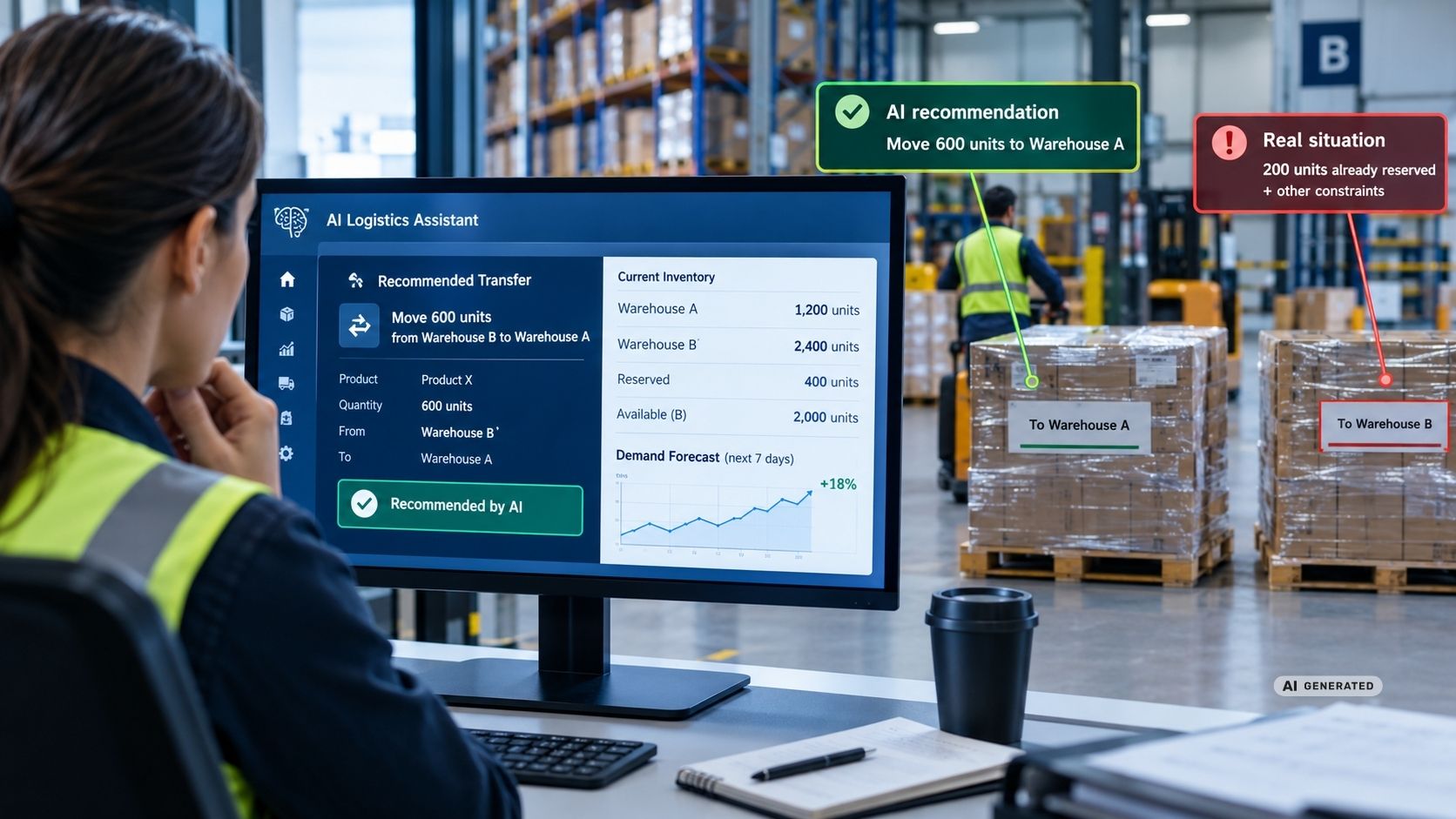
AI Hallucinations in Logistics: When AI Plans the Wrong Delivery
AI can analyze enormous amounts of logistics data — but it can also produce a convincing answer that is simply wrong. The critical question is not whether AI makes mistakes, but what happens when a wrong recommendation becomes an operational decision....
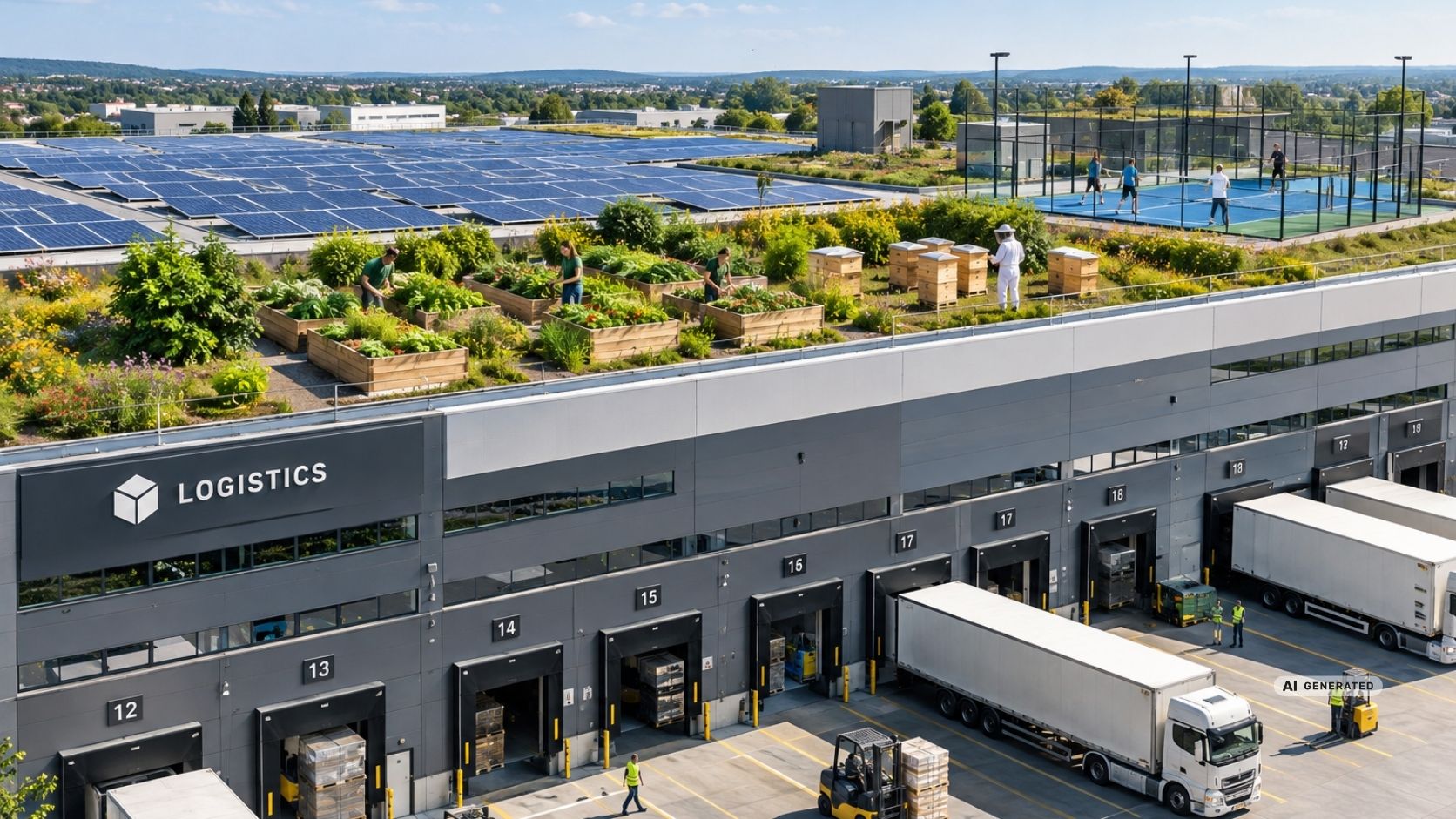
The Green Revolution on the Hall Roof: From Concrete Block to Ecological Power Plant?
Logistics roofs can do more than PV: greening, bees, urban farming and even sports areas turn unused roof space into multifunctional rooms....