



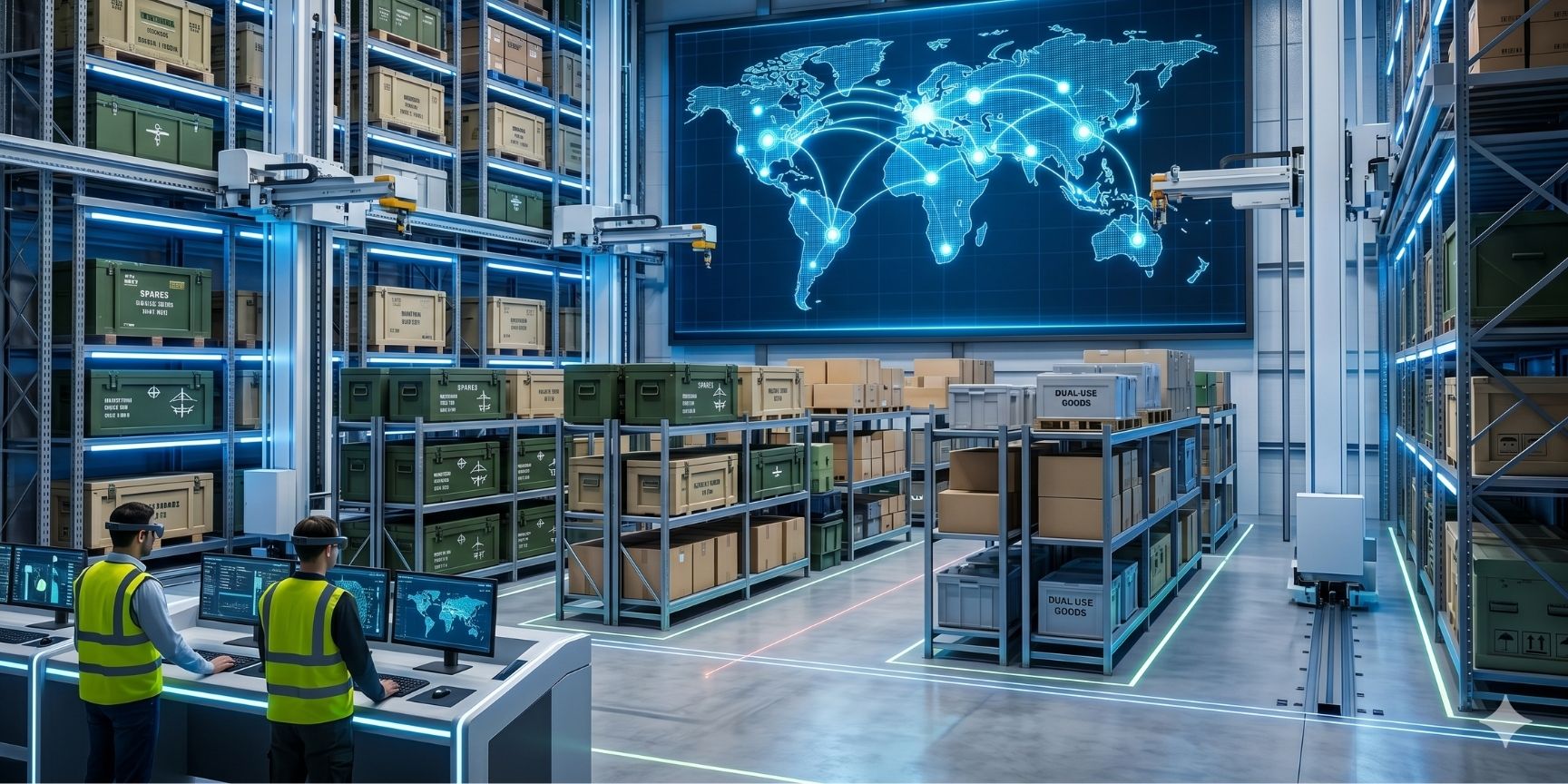
Defense Logistics: Resilient Supply Chains as Critical Infrastructure
Table of Contents
- Paradigm Shift: The Supply Chain as Safety-Critical Infrastructure
- European Partnerships vs. National Solo Efforts
- Country Comparison: Germany in the Focus of the World
- The Role of Logistics Service Providers: More than just Transport
- Decision Criterion: Security of Supply Before Costs
- Communication and Standards: The Digital Ammunition
- Practical Example: The "Leopard 2" Spare Parts Hub
- Recommendations for Action for Decision-makers in Politics and Business
- Conclusion: Logistics is the Basis of Deterrence
In the public debate on national defense, the spotlight is usually on the "big systems": battle tanks, frigates or next-generation fighter jets. But a weapon system is only as good as its availability. Without resilient warehouse logistics and highly specialized logistics service providers, these platforms will remain immovable monuments in the event of an emergency.
The current geopolitical situation forces us to no longer see logistics as a pure cost factor, but as a strategic asset. Based on our recent white paper, in this article we shed light on why the supply chain is the actual center of gravity in modern defense architectures.
Central questions that we answer:
- Why do supply chains have to be classified as safety-critical infrastructure (KRITIS) today?
- How does the German logistics philosophy differ from that of Polish, French or US approaches?
- What role do private logistics service providers play in the context of civil-military cooperation?
- How do we transform "Just-in-Time" back into a robust "Just-in-Case"?
Paradigm Shift: The Supply Chain as Safety-Critical Infrastructure
For decades, logistics in the defense industry was designed to maximize efficiency and minimize inventory. The result was a highly optimized but extremely fragile chain. In a world of "systemic competition", this fragility is a security risk.
When we talk about security of supply, we mean the ability to remain able to deliver over long periods of time at high intensity. This means:
- Redundancy instead of efficiency: Storage capacities must be physically available, even if they represent "dead capital" in peacetime.
- Cyber resilience: Logistics data (inventories, routes, capacities) are primary targets for hybrid warfare.
Data fact: According to a study by the Kiel Institute for the World Economy (IfW), an interruption of maritime supply routes in the North Sea and Baltic Sea would cost Germany billions of euros every day – not only economically, but also in the defense capability of the NATO spearhead.
European Partnerships vs. National Solo Efforts
The small-scale nature of European arms logistics is one of the biggest obstacles to operational capability. While the US relies on standardized large-scale production, Europe affords over 30 different main weapon systems.
The advantage of local production and European standards: To strengthen independence, we have to decentralize logistics, but centralize standards. A Polish repairer must be able to repair a German system with spare parts from a Dutch logistics hub without bureaucratic or technical hurdles delaying the process by weeks.
Country Comparison: Germany in the Focus of the World
Approaches to defense logistics vary widely. A look at the map shows clear strategic differences:
| Country | Focus of the logistics strategy | Special feature |
| Germany | Centralization & Bureaucracy | High quality, but slow processes by the Federal Office of Bundeswehr Equipment, Information Technology and In-Service Support (BAAINBw). |
| USA | Global projection capability | Use of the Defense Production Act to immediately convert private supply chains to military priority. |
| Poland | Logistical hub of the eastern flank | Massive investments in warehouse infrastructure and cross-border rail logistics. |
| France | Sovereignty & "War Economy" | Strong state control of supply chains (Économie de guerre). |
| Israel | Highly adaptive real-time logistics | Full integration of AI-driven needs analysis due to permanent threat situation. |
Why Germany needs to catch up
For years, Germany has relied on the "dividend of peace" model. This meant selling warehouse space and outsourcing without strategic control. In comparison, Poland has recognized that it is the logistical "dry port" for NATO's eastern flank. Poland is currently building up capacities that can support the relocation of entire divisions within 48 hours – a figure that German rail and warehouse logistics can currently only dream of.
The Role of Logistics Service Providers: More than just Transport
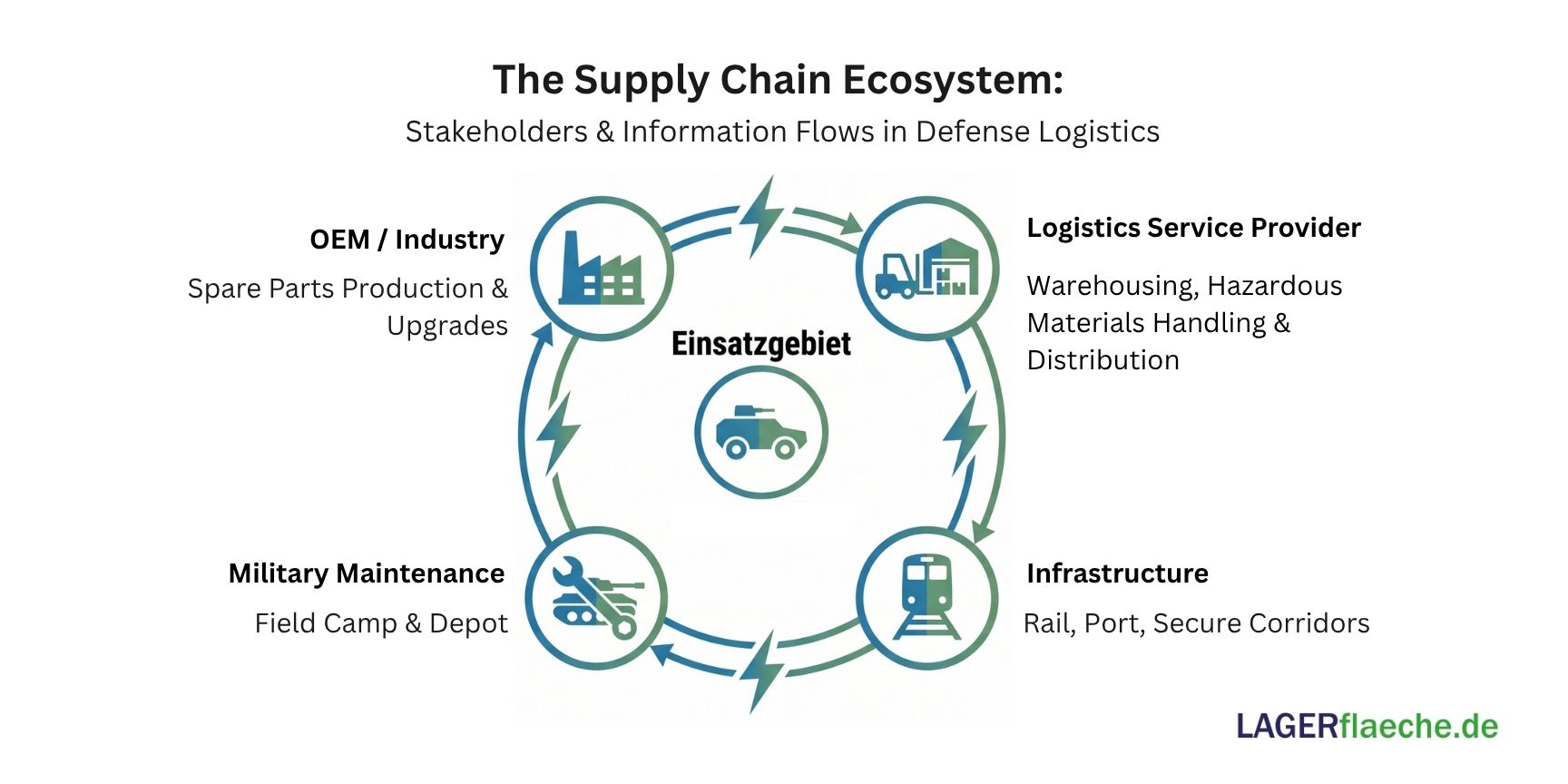
In modern conflicts, the boundaries between civilian and military logistics are blurred. Today, logistics service providers (LSPs) are partners of the armed forces. You will be responsible for:
- Dangerous goods logistics: Storage and transport of ammunition in compliance with the highest safety standards.
- Repair logistics: Return of damaged systems to industrial repair centers.
- Obsolescence management: Ensuring that spare parts for 30-year-old systems are still available or reproducible.
Decision Criterion: Security of Supply Before Costs
The most important finding from our white paper is that if you buy cheap, you pay with time and human lives in an emergency. In classical business administration, the "lowest landed cost" approach is pursued. In defense, the "Highest Assurance of Supply" approach must apply. In concrete terms, this means:
- Dual-sourcing: Critical components must be sourced from at least two independent sources, ideally in different geographic regions.
- Buffer stocks: Inventory turnover rate is a measure of success in the civilian sector; in defense, a high safety stock is a measure of survival.
Communication and Standards: The Digital Ammunition
A tank without radio is a metal box; a logistics chain without data interoperability is a traffic jam. The basis of any stability is trust, which is created by clear standards. NATO standardization (STANAG) plays a key role here. But the digital implementation is lagging behind.
Why standards fail: Communication often fails due to proprietary systems of the manufacturers. Here we demand: Open source interfaces for logistics data while preserving sovereignty. Only if the logistics service provider knows in real time which sensor is failing at which front passage can the chain react proactively (predictive maintenance).
Practical Example: The "Leopard 2" Spare Parts Hub
Let's imagine a scenario: A multinational brigade deploys Leopard 2 tanks on NATO's eastern flank.
- The problem: Parts come from Germany, maintenance is done in Poland, the user is a Spanish unit.
- The solution: A dedicated logistics service provider operates a Forward Logic Center (FLC). It uses AI-powered analytics to maintain inventory based on the region's wear profile (sand, mud, cold).
- The utility value: Local stockpiling and on-site repair reduce the Mean Time To Repair (MTTR) from 14 days to 48 hours.
This example shows that it is not the tank that wins the battle, but the availability of the spare engine at the right moment in the right place.
Recommendations for Action for Decision-makers in Politics and Business
What specifically needs to change? We have defined four central pillars:
- Recognition as KRITIS: Logistics centers of the defense industry must legally receive the same protection status as power plants.
- Move away from JIT: Introduction of minimum stocking quotas for strategic components (e.g. semiconductors for target optics).
- Investment in multimodality: Expansion of rail sidings for private logistics parks in order to be able to move heavy loads regardless of the road situation.
- Transparency offensive: Establishment of a common data space for industry and the military (similar to the "Catena-X" model of the automotive industry) in order to detect supply bottlenecks months in advance.
Conclusion: Logistics is the Basis of Deterrence
Deterrence only works if the adversary knows that the systems are not only available, but can also be used sustainably. Warehouse logistics and its service providers are the silent guarantors of this credibility. It's time to bring the supply chain out of the shadow of procurement offices and treat it for what it is: the lifeline of our freedom.
Question to our readers: How do you assess the current dependence on non-European suppliers in your supply chain? Discuss with us in the comments or download our full whitepaper for detailed metrics.
Sources and data:
- SIPRI Yearbook 2025: Trends in World Military Expenditure.
- NATO Support and Procurement Agency (NSPA): Operational Logistics Support Partnership Report.
- Federal Ministry of Defence (BMVg): Report on material readiness.
- McKinsey & Company: The future of defense supply chains (2024).
Practical checklist for logistics managers in the defense sector
Latest Blog Posts
Stay up to date with the newest trends, insights, and tips in warehouse and logistics. Our latest articles help you navigate the industry with confidence.

Data Centres vs. Logistics Facilities: The Race for Power and Land
Across Europe, logistics operators are competing for more than land and transport access. They increasingly need something much harder to secure: grid capacity. Data centres are intensifying that competition — and changing how logistics locations are evaluated....

Chinese companies discover Europe's logistics real estate
Chinese companies are becoming an increasingly visible user group in Europe's logistics real estate market. What does this mean for warehouse space, 3PL structures and the requirements for European logistics locations?...
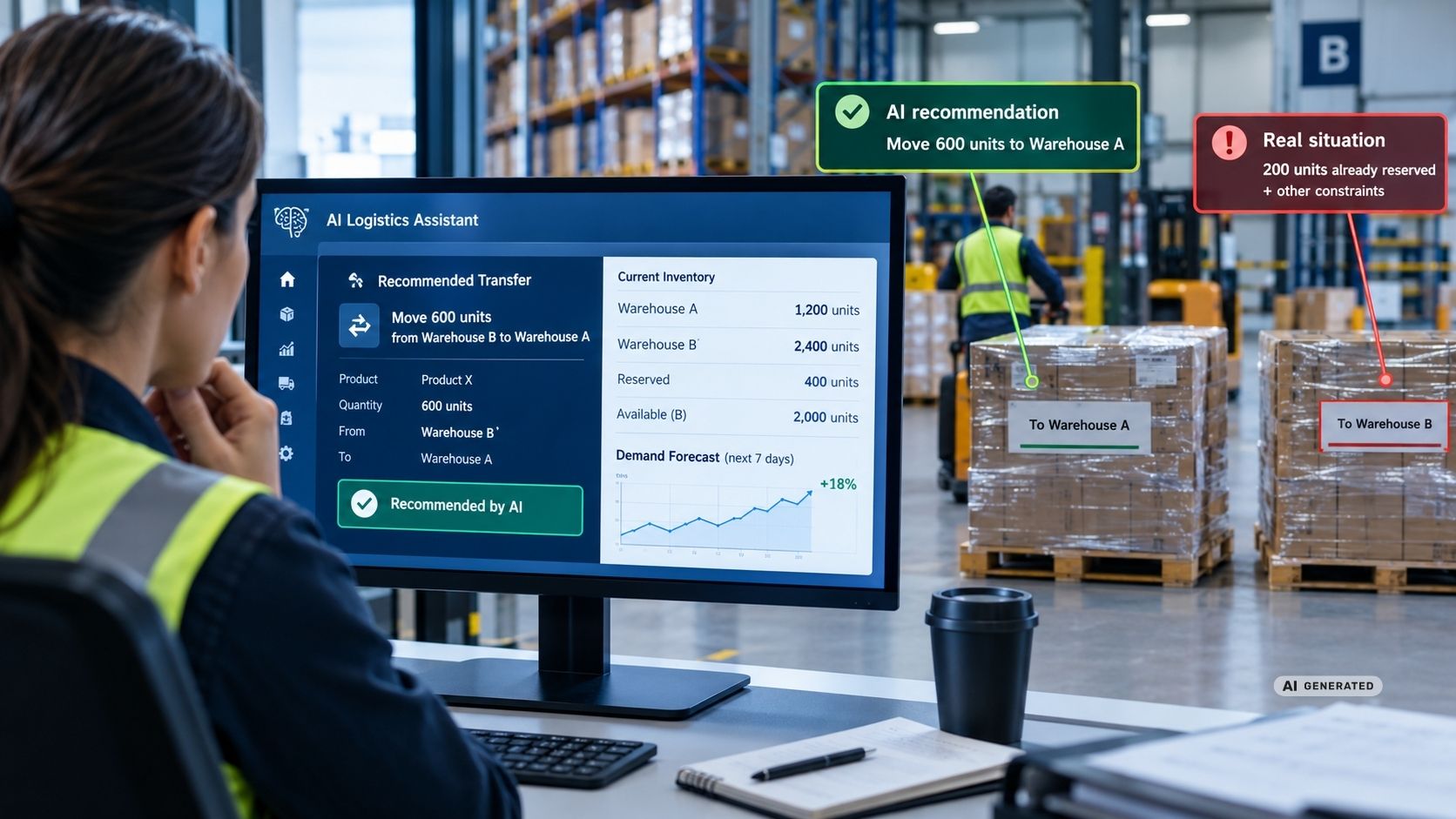
AI Hallucinations in Logistics: When AI Plans the Wrong Delivery
AI can analyze enormous amounts of logistics data — but it can also produce a convincing answer that is simply wrong. The critical question is not whether AI makes mistakes, but what happens when a wrong recommendation becomes an operational decision....
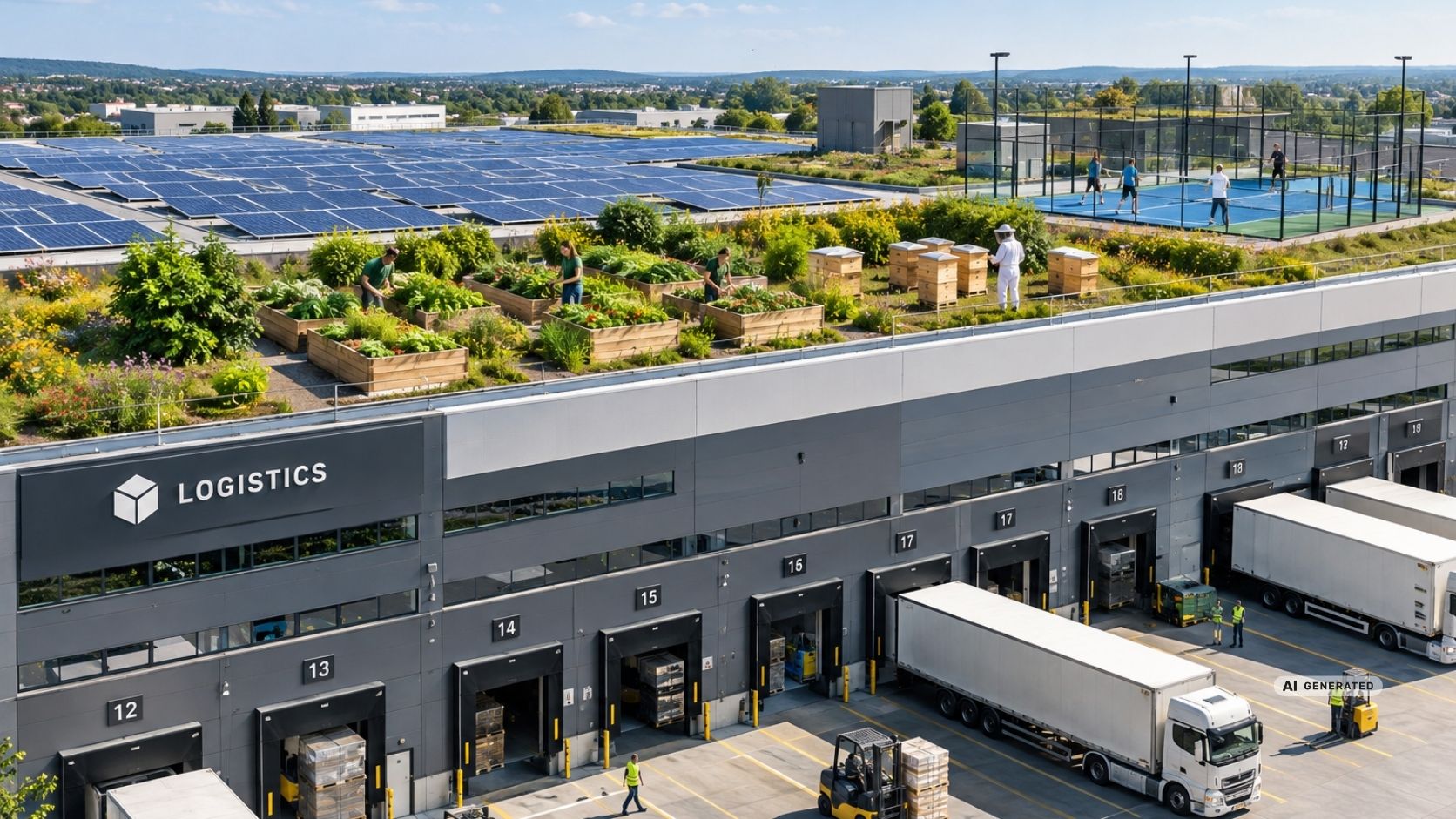
The Green Revolution on the Hall Roof: From Concrete Block to Ecological Power Plant?
Logistics roofs can do more than PV: greening, bees, urban farming and even sports areas turn unused roof space into multifunctional rooms....