



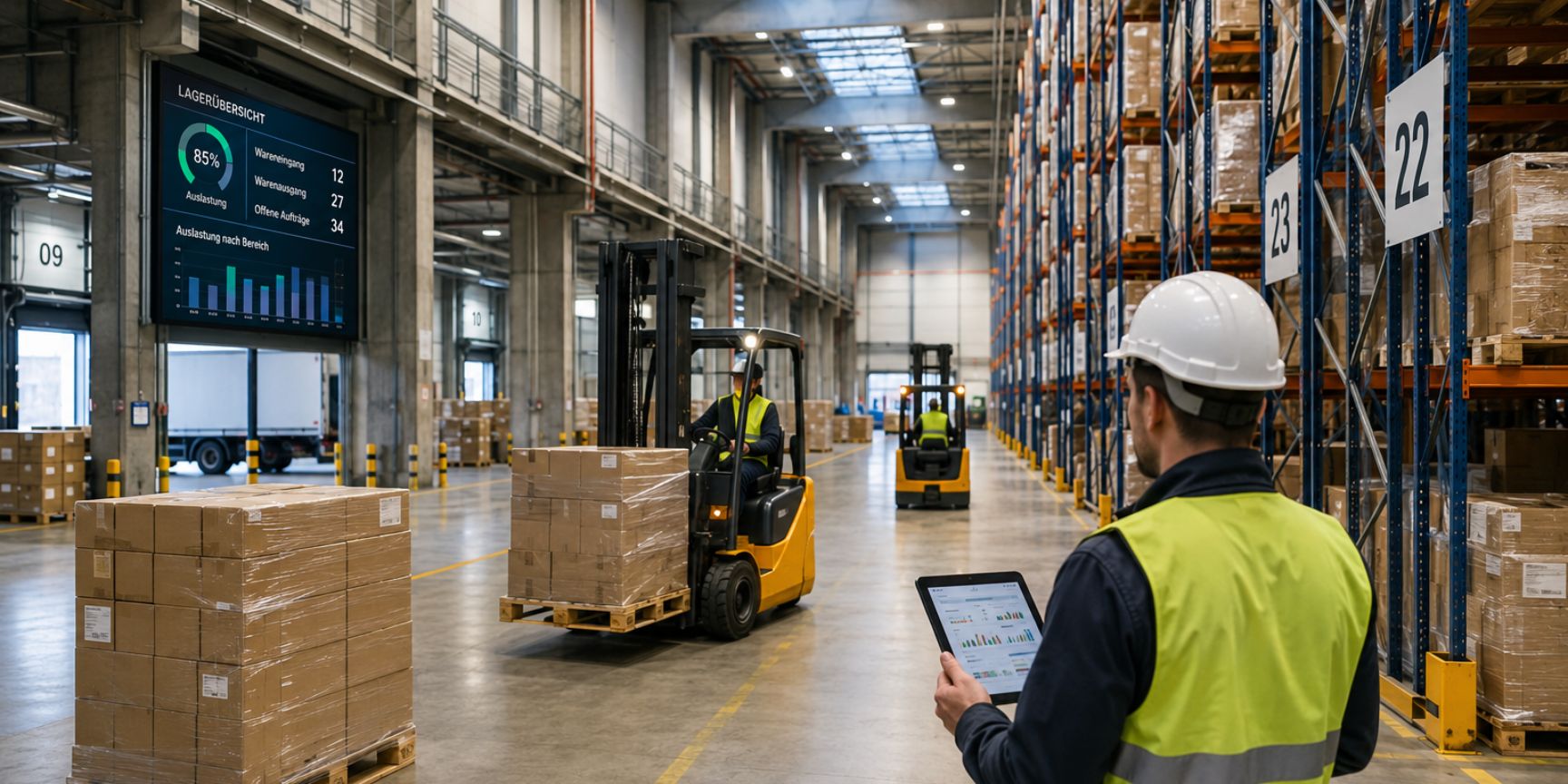
Why Many Warehouse Searches Fail – And How Companies Create Better Enquiries
Table of Contents
- Why the Quality of a Warehouse Application Today Determines the Success of a Project
- The Market has Changed: Warehouse Space is no Longer a Standard Product
- Missing Data in RFQs: The Most Common Inventory Request Error
- Which Data Should Not be Missing in Any Warehouse Application
- Incorrect Pallet Calculations Cause Massive Planning Errors
- Practical Example: When the Pallet Logic Does Not Match Reality
- Lack of Technical Requirements Leads to Unsuitable Offers
- Scheduling Mistakes: Why Unrealistic Timelines Jeopardize Projects
- Typical Frustrations of Warehouse Operators and Logistics Service Providers
- How Companies Create Better Stock Searches
- Why professional warehouse searches create competitive advantages
- Conclusion: Good warehouse searches save time, costs and risks
Why the Quality of a Warehouse Application Today Determines the Success of a Project
The market for warehouse and logistics space has changed fundamentally in recent years. Increasing scarcity of space, volatile supply chains, higher construction costs and increasing automation mean that providers of warehouse space are now working much more selectively than they did just a few years ago.
Many companies are therefore experiencing the same situation: The stock request is sent to several providers – but there is no feedback, offers are hardly comparable or the project is delayed for months.
The cause is often not only the market, but the quality of the request itself.
According to analyses by CBRE and Prologis, incomplete technical information, incorrect capacity calculations and unrealistic schedules are among the most common reasons for inefficient tendering processes in the European warehouse real estate market.
The crucial question is therefore:
How must a modern warehouse application be structured so that owners, warehouse operators and logistics service providers can react quickly and precisely?
This article shows the most common mistakes – and explains in a practical way how companies create professional warehouse inquiries that actually lead to reliable offers.
The Market has Changed: Warehouse Space is no Longer a Standard Product
Just a few years ago, many companies were able to find storage space at relatively short notice. Today, the situation is much more complex.
According to data from Statista and the German Logistics Association, the demand for modern warehouse space in Europe has risen continuously in recent years. At the same time, there is a lack of suitable new construction space in many regions.
Particularly in demand today are:
- Multi-User-Warehouses
- E-Commerce-Lager
- temperature-controlled storage areas
- Dangerous goods warehouse
- Urban logistics areas
- ESG-compliant real estate
- Automation-capable halls
This means that owners and operators now check requests much more closely. An imprecise warehouse request is often not processed further.
Especially in economically strong regions such as Frankfurt, Hamburg, Munich, Rotterdam, Vienna or Zurich, companies are increasingly competing for modern logistics space with a high level of technical equipment.
Missing Data in RFQs: The Most Common Inventory Request Error
Many companies underestimate how detailed a professional warehouse RFQ needs to be today.
A typical problem: The request only contains information such as:
"We are looking for a storage area in the Frankfurt area with approx. 5,000 m²."
For operators or owners, this is no longer enough.
Because behind every warehouse request there are operational questions:
- What goods are stored?
- How high is the turnover frequency?
- How many truck movements occur every day?
- What shelf heights are needed?
- Are there seasonal fluctuations?
- Which IT systems need to be connected?
- Are additional value-added services needed?
If this information is missing, providers can neither seriously calculate capacities nor costs.
According to Fraunhofer IML, incomplete requirement profiles regularly lead to incorrect planning in warehouse projects and make it much more difficult to compare offers.
Which Data Should Not be Missing in Any Warehouse Application
A professional warehouse application should contain at least the following information:
Basic operational data
- Number of pallets
- SKU Count
- Product groups
- Turnover frequency
- Incoming and outgoing quantities
- seasonal fluctuations
- Volume of returns
Technical requirements
- Hall height
- Floor load
- Number of ramps
- Temperature Requirements
- Fire protection classes
- Sprinkler
- Dangerous goods classification
- Power supply
Process Information
- Picking
- Packaging
- Returns handling
- Value Added Services
- Handling without intermediate storage
- Degree of automation
- WMS Requirements
The more specific the information, the higher the probability of reliable offers.
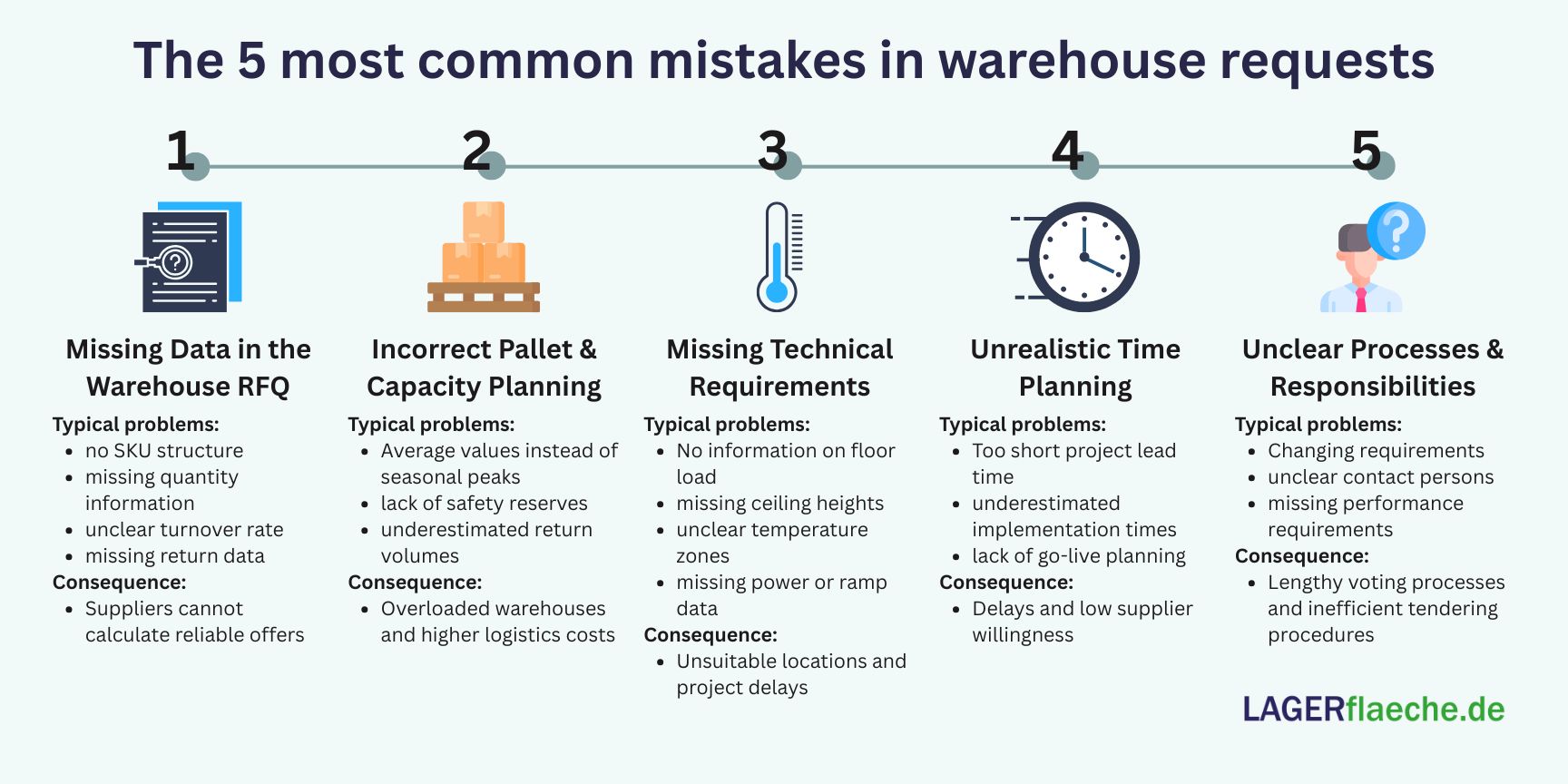
Incorrect Pallet Calculations Cause Massive Planning Errors
One of the most common mistakes in warehouse applications concerns pallet calculation.
Many companies only calculate with average values. In practice, however, this results in considerable deviations.
An example:
A trader calculates with 4,000 Euro pallets. In the Christmas business, however, demand increases to 7,500 pallet spaces at short notice.
The consequences:
- Warehouse overload
- Additional interim storage facilities
- Higher transport costs
- inefficient processes
- Delays in shipping
- Contractual conflicts
Why averages are dangerous
Warehouse operators do not calculate on the basis of idealized average values, but on the basis of maximum loads.
The decisive factors are:
- Load peaks / seasonal peaks
- Safety reserves
- Replenishment frequencies
- ABC Structures
- Volume of returns
- Promotional business
Seasonal fluctuations can have an enormous impact, especially in e-commerce.
According to data from DHL, shipping volumes in European online retail increase by more than 40 percent compared to the annual average during seasonal peak periods.
Practical Example: When the Pallet Logic Does Not Match Reality
A consumer goods company from southern Germany was looking for 8,000 m² of warehouse space at short notice.
The original request was based on:
- 5,000 pallets
- Low turnover rate
- Standard shelving
However, after a detailed analysis, it became clear:
- High proportion of promotional goods
- strong seasonal peaks
- Additional return areas
- Increased need for picking
- Higher SKU complexity
In the end, the real space requirement was around 35 percent higher than originally assumed.
Without a more precise needs analysis, the project would have caused operational problems after just a few months.
Lack of Technical Requirements Leads to Unsuitable Offers
Many warehouse applications fail not because of the space itself, but because of technical details.
Today, a warehouse is a highly specialized infrastructure. Even small deviations can make projects economically unusable.
Typical examples:
- Insufficient floor load
- lack of WGK approval
- Incorrect sprinkler standards
- Hall heights that are too low
- Lack of charging infrastructure
- unsuitable temperature zones
- Insufficient electricity capacities
Why Technical Specifications Need to Be Defined Early
Automated or semi-automated warehouse processes in particular require precise framework conditions.
Modern high-bay warehouses require, for example:
- High flatness tolerances
- Precise soil qualities
- Defined ceiling heights
- Sufficient power supply
- High-performance data connections
If this information is missing from the warehouse application, the following often arise:
- Bad investments
- Time-consuming renegotiations
- Project cancellations
- Go-live delays
Especially in contract logistics projects, providers therefore check technical risks very carefully even in the early phase.
Scheduling Mistakes: Why Unrealistic Timelines Jeopardize Projects
Another core problem of many warehouse applications is unrealistic schedules.
Many companies assume that storage space is available at short notice. In fact, complex projects often require several months of lead time.
How long modern warehouse projects realistically take
Depending on the scope of the project, companies typically need to plan for:
| Project phase | Typical period |
| Requirements definition | 2–6 weeks |
| Market approach | 2–4 weeks |
| Offer phase | 4–8 weeks |
| Contract negotiations | 4–12 weeks |
| Implementation | 2–6 months |
Especially for:
- Automation
- WMS-Integration
- Dangerous goods
- temperature-controlled bearings
- individual conversions
project durations are significantly extended.
Why short-term storage requests are problematic
Many operators prioritize requests with realistic planning security.
An inquiry with:
"Needed in four weeks"
often signals:
- Lack of internal planning
- High project risk
- operational uncertainty
- Unclear decision-making structures
Professional providers often evaluate such projects cautiously.
Typical Frustrations of Warehouse Operators and Logistics Service Providers
Many owners and logistics service providers report similar problems with tenders.
Some of the most common frustrations include:
Unclear responsibilities
It is often unclear:
- who decides,
- who is technically responsible,
- or how budgets are released.
As a result, projects drag on unnecessarily.
Constantly changing requirements
It is not uncommon for the following to change during the process:
- Space requirements
- Durations
- Temperature Requirements
- Performance requirements
- Process Scopes
This significantly increases planning effort and risk.
Lack of data quality
Particularly problematic:
- Incomplete Excel files
- Lack of quantity structures
- Unclear article master data
- incorrect season assumptions
Many providers therefore only selectively invest resources in new RFQs.
How Companies Create Better Stock Searches
Today, the quality of a warehouse application is decisive for speed, depth of offer and project quality.
Successful warehouse inquiries follow five basic principles
- Think data before area: It is not the square meters that are at the beginning, but processes, product structure and volumes.
- Calculate load peaks realistically: It is not average values, but maximum loads that define the reality in the warehouse.
- Specify technical requirements at an early stage: The more precise technical data is available, the more reliable offers become.
- Plan realistic timelines Professional warehouse projects require sufficient lead time.
- Clearly define contact persons Clear responsibilities speed up the entire process.
Create a Professional Warehouse Request: Checklist for Companies
Company and Project Data
Area and Warehouse Data
Technical Requirements
Process Requirements
Contract and Time Planning
Why professional warehouse searches create competitive advantages
In a tense market environment, structured warehouse requests are increasingly becoming a competitive advantage.
Companies benefit from:
- faster responses
- more precise offers
- Fewer planning errors
- shorter project durations
- Greater planning security
At the same time, the cooperation between clients, owners and logistics service providers improves considerably.
A professional warehouse request is therefore no longer just a space request – but the basis for successful supply chain projects.
Conclusion: Good warehouse searches save time, costs and risks
Many warehouse applications do not fail because of the market, but because of incomplete or imprecise requirements.
Anyone who is successfully looking for warehouse space or logistics partners today must:
- Prepare operational data cleanly,
- Precisely define technical requirements,
- create realistic schedules,
- Consider seasonal load peaks
- and providers in a structured way at an early stage.
Especially in a dynamic European logistics market, professional RFQs are increasingly decisive for project success or project delay.
Companies that strategically prepare their warehouse requests not only receive better offers – but also create the basis for long-term stable logistics processes.
Find the right warehouse space and logistics partners faster
Post your warehouse listing on LAGERflaeche.de and reach property owners, warehouse operators, and logistics service providers in Germany and Europe directly.
Post a warehouse listing now
Promote your warehouse project professionally and receive suitable offers.
Post a warehouse requestFor companies, retailers, and logistics service providersLatest Blog Posts
Stay up to date with the newest trends, insights, and tips in warehouse and logistics. Our latest articles help you navigate the industry with confidence.
Data Centres vs. Logistics Facilities: The Race for Power and Land
Across Europe, logistics operators are competing for more than land and transport access. They increasingly need something much harder to secure: grid capacity. Data centres are intensifying that competition — and changing how logistics locations are evaluated....

Chinese companies discover Europe's logistics real estate
Chinese companies are becoming an increasingly visible user group in Europe's logistics real estate market. What does this mean for warehouse space, 3PL structures and the requirements for European logistics locations?...
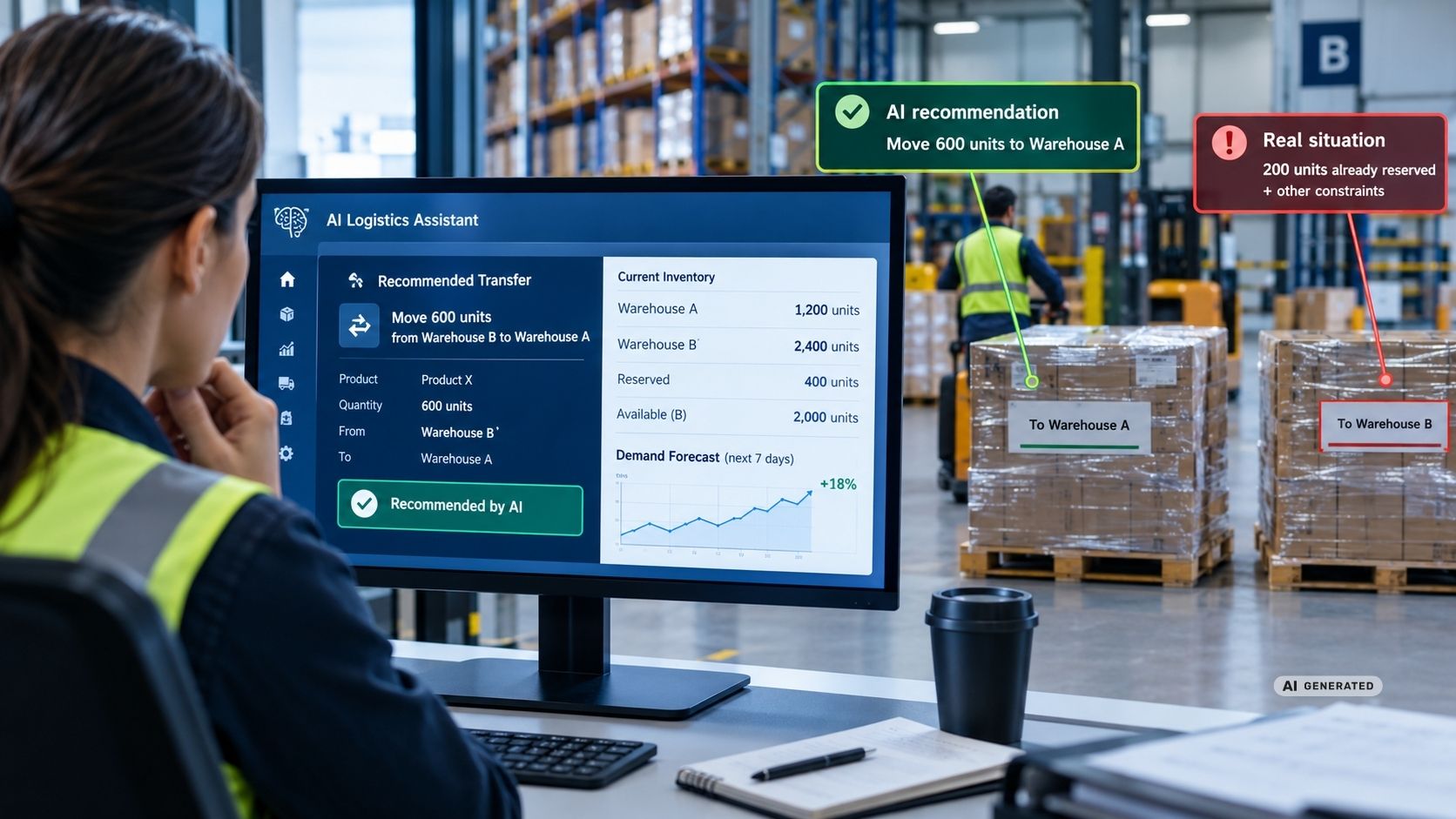
AI Hallucinations in Logistics: When AI Plans the Wrong Delivery
AI can analyze enormous amounts of logistics data — but it can also produce a convincing answer that is simply wrong. The critical question is not whether AI makes mistakes, but what happens when a wrong recommendation becomes an operational decision....
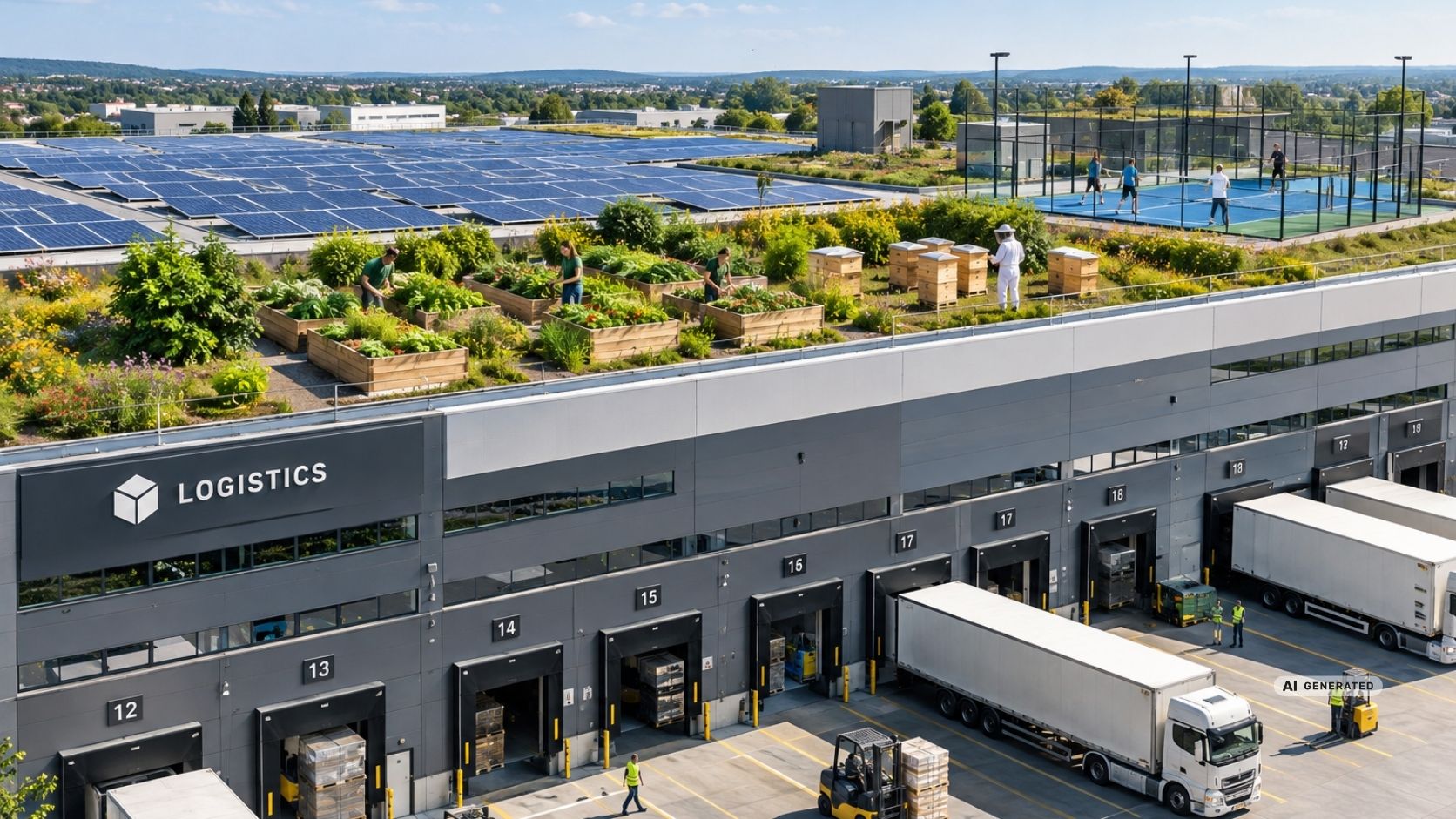
The Green Revolution on the Hall Roof: From Concrete Block to Ecological Power Plant?
Logistics roofs can do more than PV: greening, bees, urban farming and even sports areas turn unused roof space into multifunctional rooms....