


New Horizons: How Free Trade Agreements are Redrawing the Global Logistics Landscape
Table of Contents
- Status Quo: The New Geography of Free Trade
- Impact on Warehouse Logistics: From "Just-in-time" to "Just-in-case"
- Focus on Germany: What does the Logistics Location need to Consider Now?
- Profiteers: Which Logistics Sectors will Win?
- Market Specifics: What EU Logistics Companies Need to Know
- Opportunities vs. Risks: A Calculated Analysis
- Country Comparison: Logistics Performance in Contrast
- Practical Example: The "SME move" to India
- Conclusion: Logistics as an Enabler of Free Trade
The world map of retail is currently being redrawn. While traditional supply routes are suffering from geopolitical tensions, the European Union is opening strategic doors to the growth markets of the future. India, the Mercosur bloc (Brazil, Argentina, Paraguay, Uruguay), Mexico and New Zealand are in the focus of a new era of free trade.
But what does the elimination of tariffs and trade barriers mean in concrete terms for the ramps in Germany? Are we facing a warehouse boom or logistical overload? In this deep dive, we analyze the impact on (warehousing) logistics and show why Germany needs to act now.
The core questions of this article
- What impact do the agreements have on the global shipment volume?
- How are the requirements for warehouse logistics changing due to longer transit times?
- Which specific logistics sectors will benefit the most?
- What are the "blind spots" when entering the market in regions such as Mercosur or India?
Status Quo: The New Geography of Free Trade
The EU is pursuing a diversification strategy ("de-risking") to reduce dependencies – especially on China.
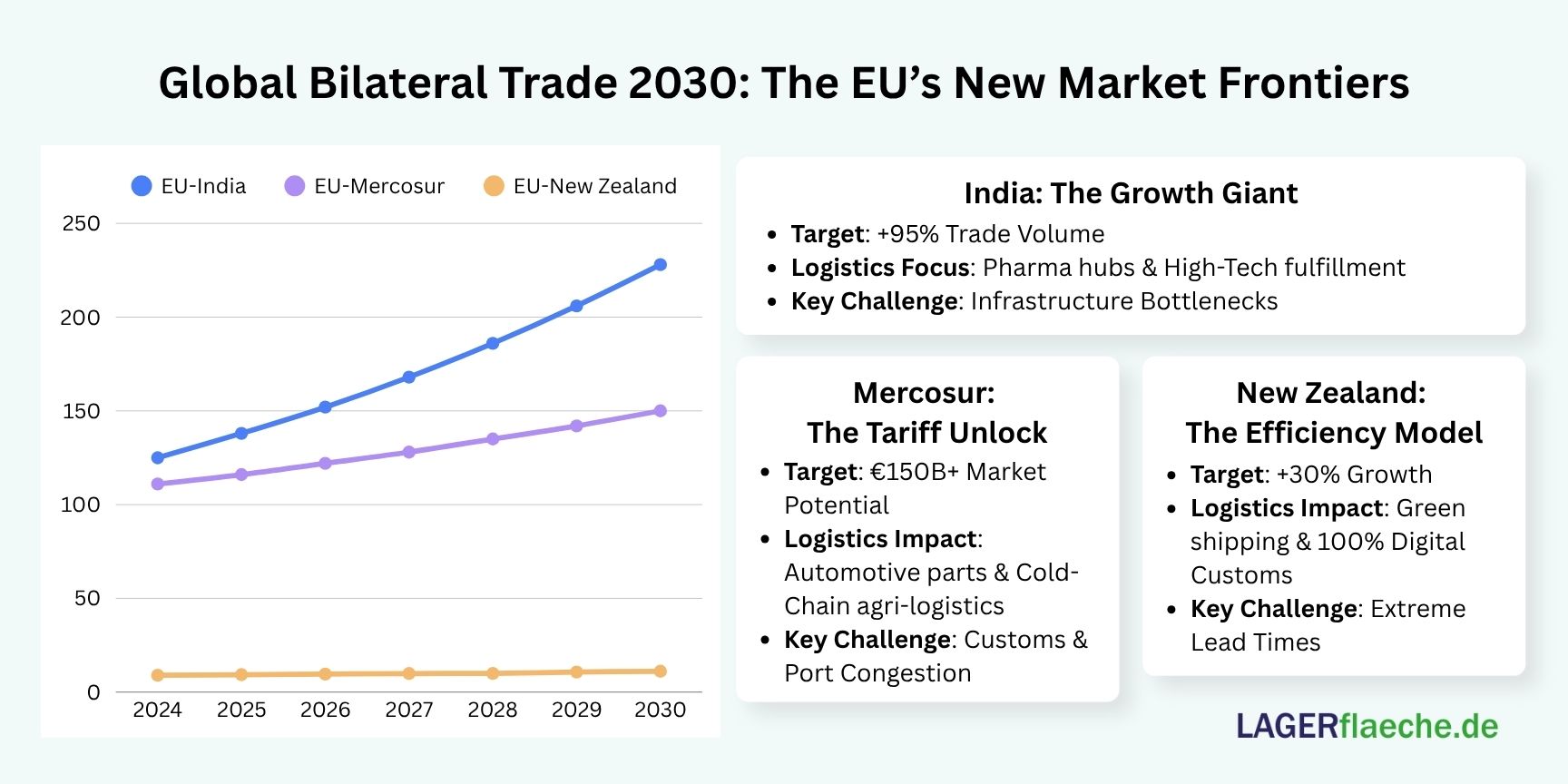
- India: The planned free trade agreement (EFTA/EU-India) will open up a market of 1.4 billion people. India aims to become an exporting nation worth USD 1 trillion by 2030.
- Mercosur: An agreement would create the largest economic area in the world (over 700 million people).
- New Zealand: The agreement, which has been in force since May 2024, eliminates 91% of tariffs on EU exports from day one.
- Mexico: The modernized agreement ("Global Agreement") facilitates access to one of the most important manufacturing hubs for the North American market.
Fact check: According to the EU Commission, the agreement with New Zealand alone could increase bilateral trade by up to 30%. In India, trade volume is expected to double within a decade.
Impact on Warehouse Logistics: From "Just-in-time" to "Just-in-case"
The opening of these markets is changing the DNA of warehousing. While trade with EU neighbors means short distances, agreements with India or Brazil lead to transit times of 30 to 50 days in the sea freight sector.
The change in the size of the warehouse
- Safety stocks: Due to geographical distance and potential disruptions (e.g. Red Sea, Panama Canal), German companies need to increase their buffer stocks.
- Central warehouse strategy: We will see an increase in regional hubs. Germany acts as a gateway for Indian goods to Eastern Europe.
- Specialization: India is increasingly exporting pharmaceuticals and textiles. This requires highly specialized GDP-certified (Good Distribution Practice) cold storage and automated hanging garment warehouses.
Interesting question: Will these agreements make Germany a pure transit country or a value-adding logistics hub? Answer: The opportunity lies in the "Logistics Plus" strategy – i.e. finishing, picking and quality control directly in the German warehouse before the goods go to the EU internal market.*
Focus on Germany: What does the Logistics Location need to Consider Now?
Germany is the logistics world champion, but the lead is melting. With the new agreements, the demands on infrastructure are increasing.
- Digitization of customs processes: The complexity is increasing. Service providers must have a perfect command of the ATLAS system and the rules of origin of the new agreements. An error in the preferential calculation can cancel out the tariff advantages.
- Shortage of skilled workers: More volume means more personnel requirements in processing. Automation in the warehouse (AGVs, picking robots) is going from being a "nice-to-have" to a question of survival.
- ESG compliance: The Supply Chain Due Diligence Act (LkSG) also applies to imports from Mercosur or India. Logistics service providers must be able to offer transparency across the entire chain.
Profiteers: Which Logistics Sectors will Win?
Not every service provider will benefit equally. Here are the winning segments:
| Industry | Reason for the growth |
| Refrigeration & Pharmaceutical Logistics | India is the "pharmacy of the world". Enormous need for uninterrupted cold chains. |
| Contract logistics | Companies outsource complex import processes and warehousing to specialists. |
| Customs agencies | High demand for advice on new free trade rules and certificates of origin. |
| E-Commerce Fulfillment | Direct imports from India and Mexico for the European retail market are increasing. |
Market Specifics: What EU Logistics Companies Need to Know
A free trade agreement is not a free pass. The operational hurdles in the partner countries are sometimes massive.
India: The Logistics Cost Challenge
India's logistics costs are around 13-14% of GDP (compared to around 8% in Germany).
- Knowledge: The Indian government has launched the "National Logistics Policy" and the "Gati Shakti" program to modernize the infrastructure.
- Note: Multimodal transport (rail/road) is often still inefficient. "Last Mile" in India is highly complex.
Mercosur: Protectionism and bureaucracy
Brazil is notorious for the "Custo Brasil" – the high cost of doing business in the country.
- Knowledge: Despite free trade, tax peculiarities (ICMS, IPI in Brazil) remain.
- Note: The port capacities in Santos or Buenos Aires are often overloaded. A local partner with ground handling expertise is essential here.
Opportunities vs. Risks: A Calculated Analysis
Opportunities
- Market diversification: Reduction of dependence on China (China + 1 strategy).
- Growth: Tapping into the growing middle class in India and Brazil.
- Innovation: German logistics technology (warehouse software, robotics) can be exported to these countries.
Risks
- Currency risks: Volatility of real (Brazil) or rupee (India) affects freight rates and margins.
- Infrastructure gap: Free trade is of little use if the goods are stuck in the port.
- Legal uncertainty: Political upheavals (especially in Mercosur) can delay or torpedo agreements.
Country Comparison: Logistics Performance in Contrast
To understand the depth of the topic, it helps to take a look at the World Bank's Logistics Performance Index (LPI).
| Country | LPI Ranking (Exemplary) | Strengths | Weaknesses |
| Germany | Top 3 | Infrastructure, reliability | Digital bureaucracy |
| India | 38th place | IT services, workforce | Road network, logistics costs |
| Brazil | 51st place | Agricultural logistics | Customs bureaucracy, security |
| Mexico | 66th place | Border Proximity USA, Manufacturing | Crime (transport theft) |
| New Zealand | Top 20 | Digital administration | Extreme distance (island location) |
Why this difference? While Germany has a highly densely populated network, large countries such as Brazil or India are struggling with the sheer distance and a historically grown investment backlog.
Practical Example: The "SME move" to India
Scenario: A German machine manufacturer from Baden-Württemberg has been importing components from China so far. Due to the new agreement with India and the geopolitical risks, he switches to a supplier in Pune (India).
The logistical implementation:
- Shipping: From Mumbai (Nhava Sheva) to Hamburg. Transit: 28 days.
- Warehouse strategy: As the delivery time fluctuates, the company increases its safety stock in the warehouse in Germany from 4 to 8 weeks.
- Digital chain: The logistics service provider implements real-time tracking to monitor the sea freight containers.
- Customs: The free trade agreement saves the company 5% import duty, which more than compensates for the higher storage costs.
The result: the supply chain is more resilient, costs are stable despite higher inventories, and the company is ESG-compliant.
Conclusion: Logistics as an Enabler of Free Trade
The opening of the markets in India, Mercosur, Mexico and New Zealand is a double-edged sword with enormous potential for the German logistics industry.
Warehouse logistics will change massively: away from pure transshipment points to strategic buffer centers with a high level of digital competence. Germany must do its homework – especially in the digitalization of infrastructure and the relief of customs bureaucracy – in order to maintain its role as a leading logistics hub.
What is your opinion? Are our warehouses in Germany ready for the flow of goods from India and South America, or are we threatened with a collapse at the ports? Discuss with us in the comments!
Latest Blog Posts
Stay up to date with the newest trends, insights, and tips in warehouse and logistics. Our latest articles help you navigate the industry with confidence.
Data Centres vs. Logistics Facilities: The Race for Power and Land
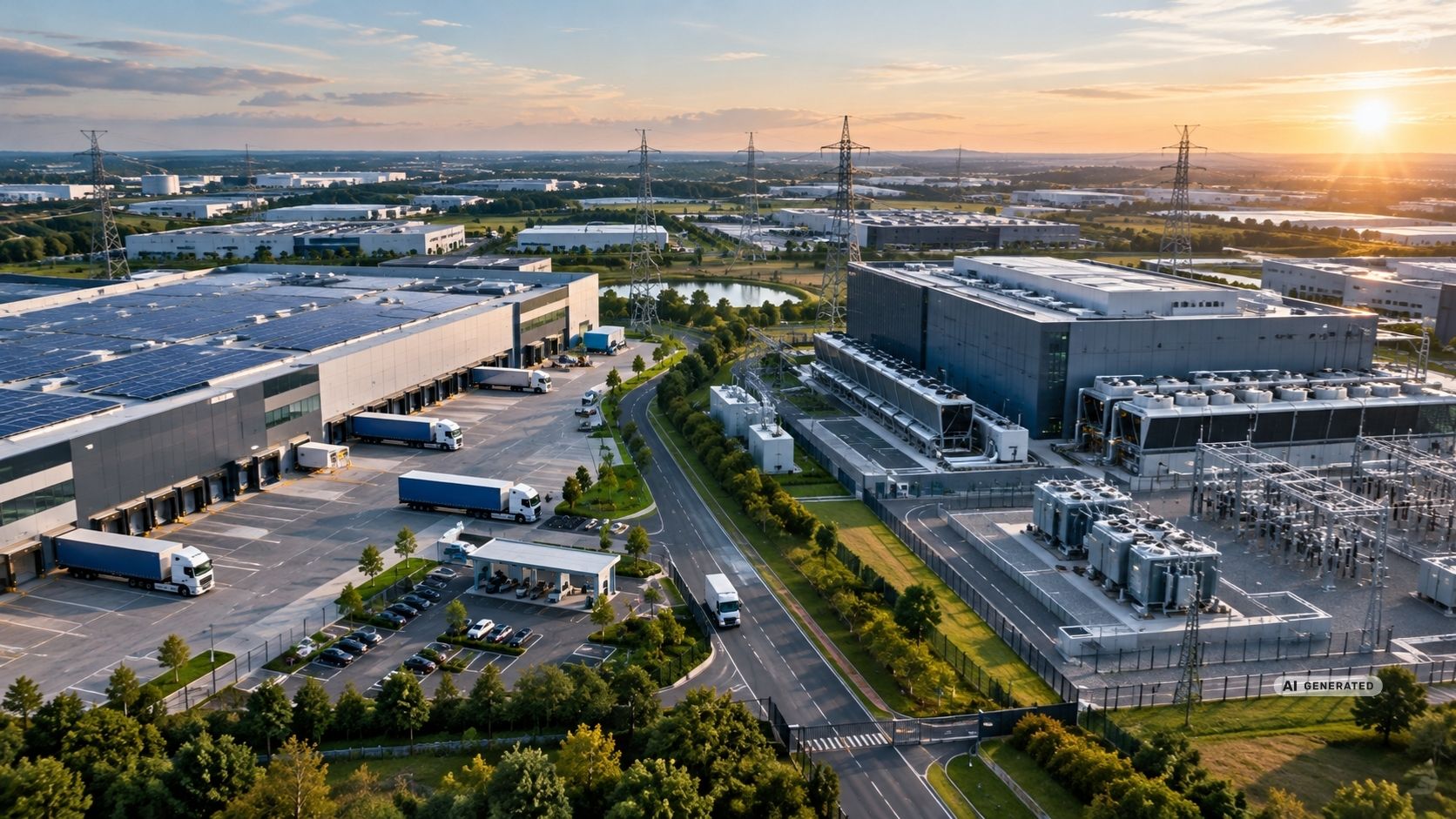
Across Europe, logistics operators are competing for more than land and transport access. They increasingly need something much harder to secure: grid capacity. Data centres are intensifying that competition — and changing how logistics locations are evaluated....
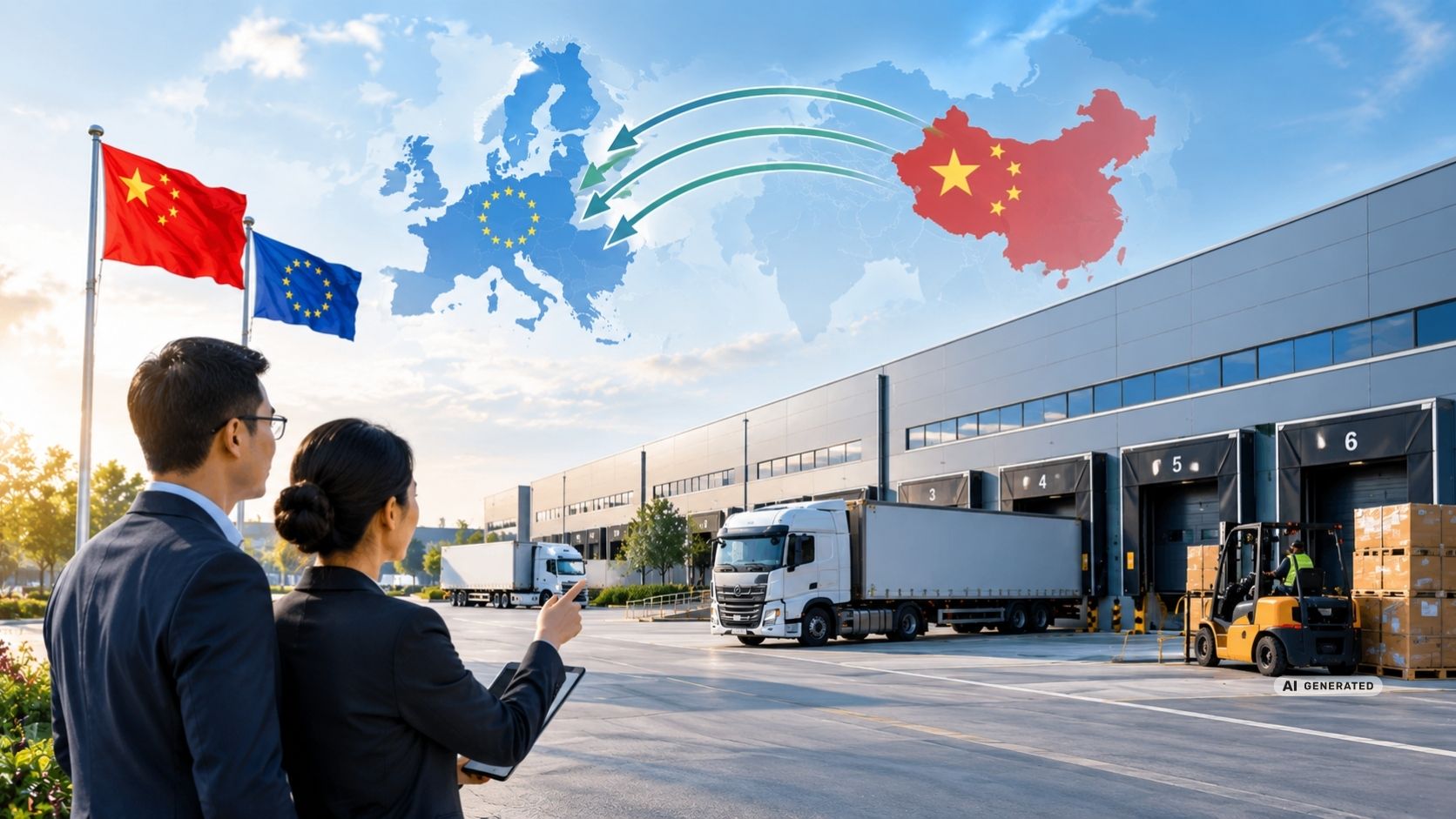
Chinese companies discover Europe's logistics real estate
Chinese companies are becoming an increasingly visible user group in Europe's logistics real estate market. What does this mean for warehouse space, 3PL structures and the requirements for European logistics locations?...
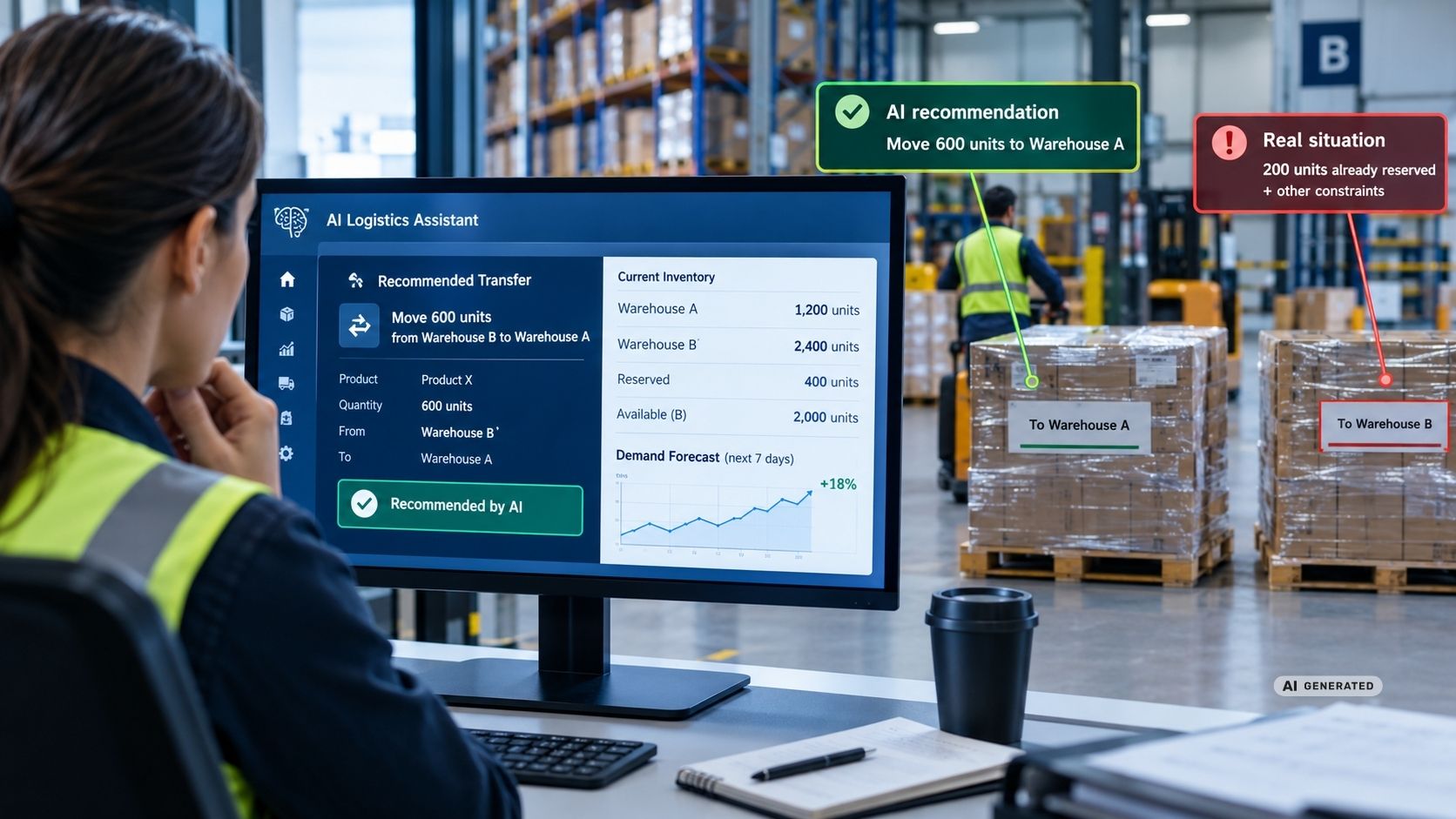
AI Hallucinations in Logistics: When AI Plans the Wrong Delivery
AI can analyze enormous amounts of logistics data — but it can also produce a convincing answer that is simply wrong. The critical question is not whether AI makes mistakes, but what happens when a wrong recommendation becomes an operational decision....
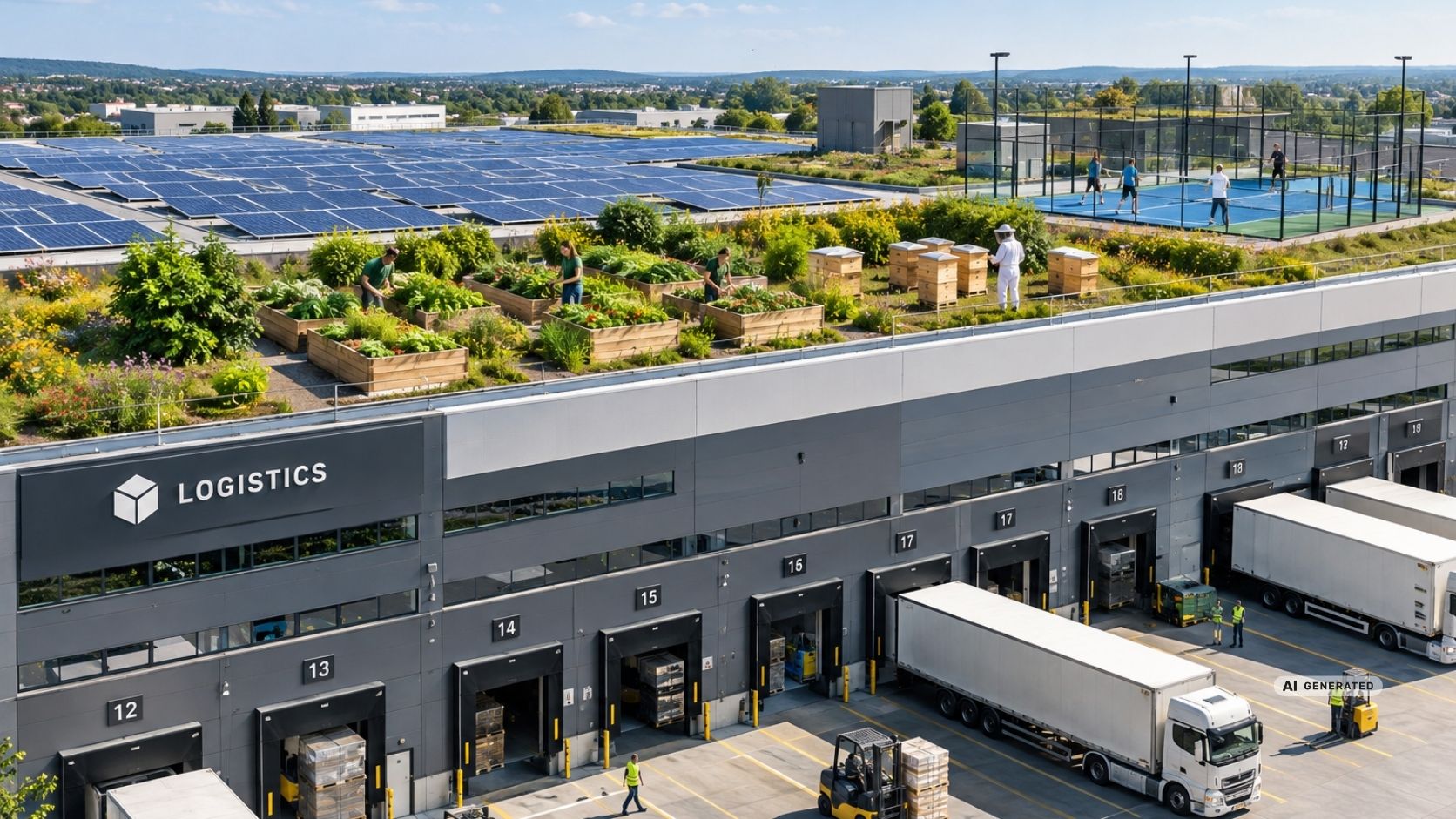
The Green Revolution on the Hall Roof: From Concrete Block to Ecological Power Plant?
Logistics roofs can do more than PV: greening, bees, urban farming and even sports areas turn unused roof space into multifunctional rooms....