



Hidden Vacancy: How Unused Industrial and Logistics Space Comes Back to the Market
Logistics space is scarce – yet some buildings stand half empty without ever being listed. We explain what lies behind hidden vacancy, how space holders can measure it and reactivate it on a sound legal footing, and what this means for companies looking for space....
Switching contract logistics provider: why the exit from vendor lock-in starts in the contract
When your contract logistics provider stops delivering, switching often looks impossible. We show why the exit starts in the contract: with an escalation ladder, a switching-cost model, German employment law and a fictional but realistic example....
Hidden Vacancy: How Unused Industrial and Logistics Space Comes Back to the Market
Table of contents
- What hidden vacancy is – and what it isn't
- Why space stays out of sight
- How big the potential is: the numbers behind the shortage
- How to spot and measure hidden vacancy in your own portfolio
- Technical suitability: when reactivation pays off
- The legal framework: subletting, change of use, fire safety
- Off-market: how hidden space finds its user
- A look abroad: England, the US, the Netherlands and Poland
- Illustrative example: how reactivating 14,000 m² can add up
- Checklist for space holders and space seekers
- Frequently asked questions (FAQ) about hidden vacancy
- Conclusion: know the stock, find the space
Industrial and logistics space is scarce in Germany, and building on greenfield sites is getting harder. Yet some buildings stand half empty or serve as overflow storage – without ever appearing on a listings portal or in a broker report. In German this is called „grauer Leerstand“: grey or hidden vacancy. We think it is one of the most underrated reserves of space in the market. Our argument: the next building you need often already exists. It just isn't on the market.
This article is written for space holders who want to put unused capacity to work and for companies looking for space.
What hidden vacancy is – and what it isn't
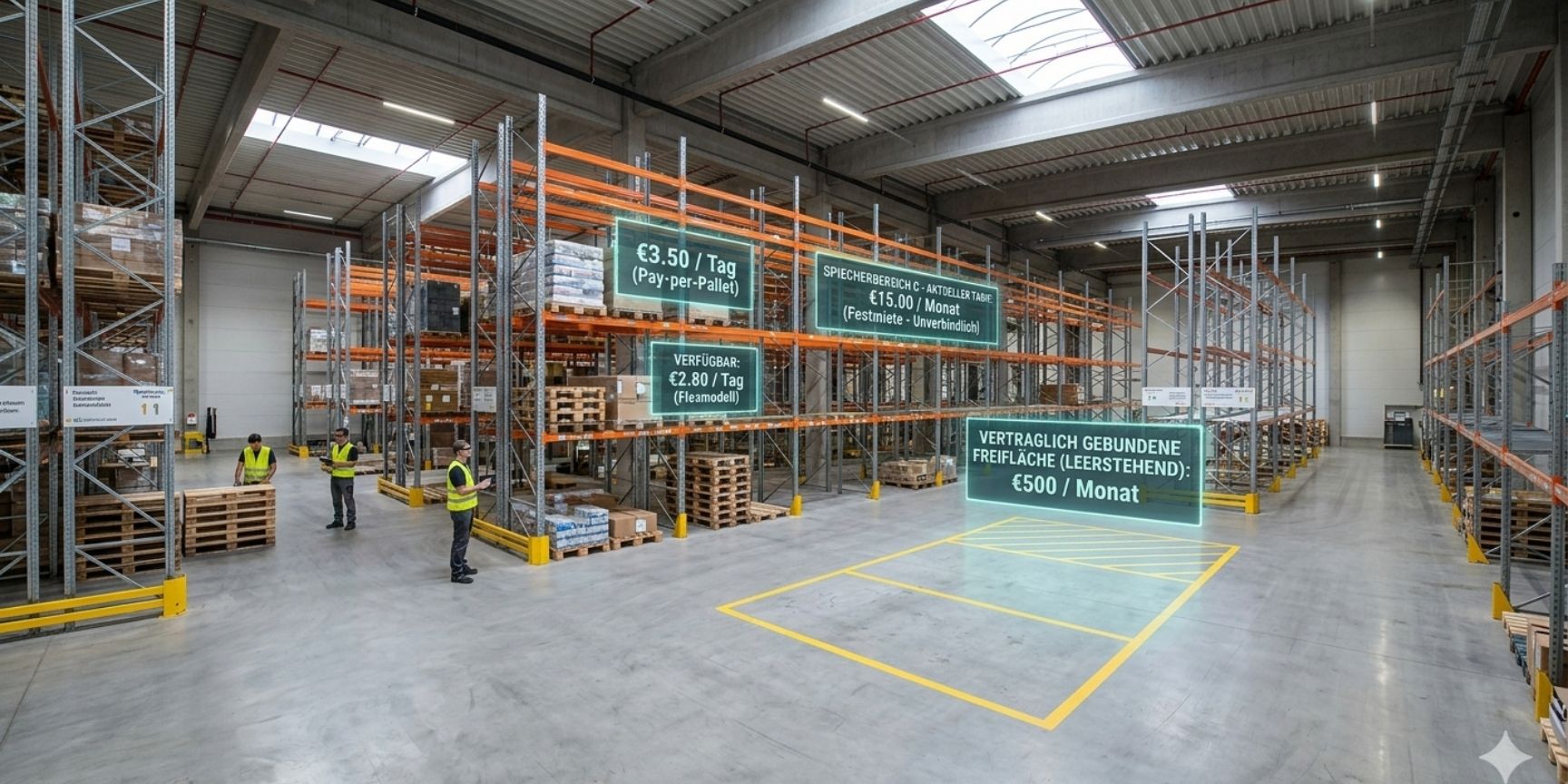
Hidden vacancy describes space that is leased or owner-occupied but no longer fully used. It isn't marketed, so it is missing from official vacancy rates. There are three forms:
| Form | Characteristics | In market reports? |
| Visible vacancy | Actively marketed via portals and agents, available immediately or at short notice | Yes |
| Hidden vacancy | Off-market, lease still running; partial use, buffer storage or gradual run-down; owner still weighing the next use | No |
| Structural vacancy | Permanently unlettable („stranded asset“), major structural or regulatory shortcomings, usable only after a deep retrofit or demolition | Partly |
It should not be confused with a greyfield, which is disused land that has already been built on (see the FAQ).
Why space stays out of sight
There are usually business reasons behind it:
- Reserve space: companies hold space for expected orders. If a production ramp-up slips, the building sits idle.
- Structural change: when production moves, mixed space made up of hall, ancillary rooms and workshops is left with no internal use.
- Effort and remaining term: with 12 to 24 months left on the lease, tenants shy away from the legal and operational effort of subletting – especially if third parties would have to drive across their own site.
- Reputation: a „to let“ sign at the factory gate can be misread as a sign of weakness.
- No strategy: many owner-occupiers simply don't know how to position their buildings for third-party users.
How big the potential is: the numbers behind the shortage
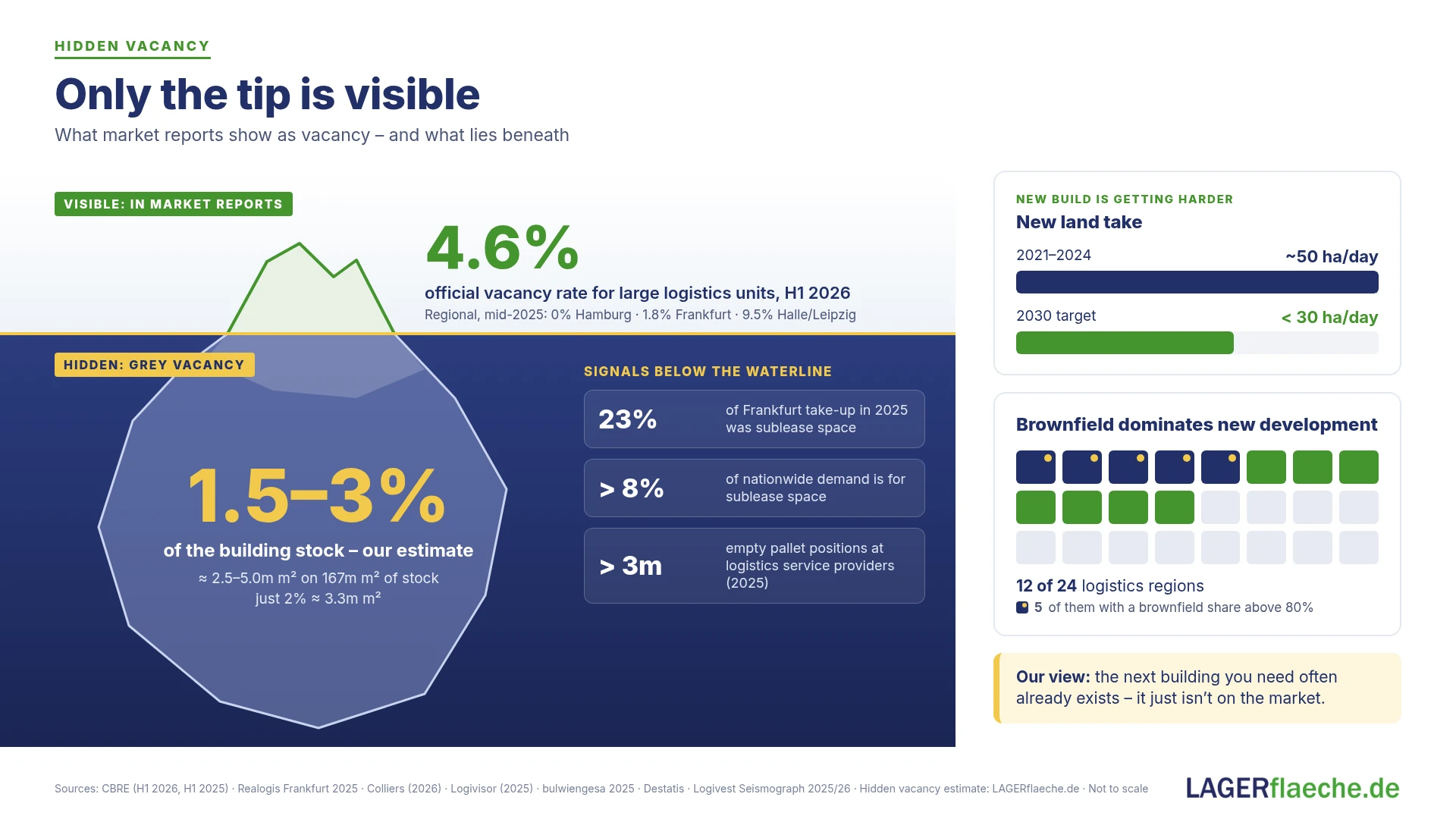
According to CBRE, the official vacancy rate for large logistics units in Germany stood at 4.6% in the first half of 2026, after peaking at 5.0% at the end of 2025. Regional differences are wide: in mid-2025 the rate ranged from 0% in Hamburg and 1.8% in Frankfurt to 9.5% in Halle/Leipzig. We put this in context in our in-depth 2026 market analysis.
Subletting shows how much space lies below these rates: according to Realogis, subleases accounted for around 23% of Frankfurt take-up in 2025, about 101,200 m², up from 17% in 2024. Nationwide, Colliers puts the share at a good 8% of demand. In summer 2025, CBRE also noted that many logistics companies were holding “significant under-used space” because of the weak economy – what it called hidden vacancy. Anyone seeking available space in Frankfurt is therefore also competing for space that was never officially vacant.
There are no official statistics on hidden vacancy. Our estimate is 1.5% to 3% of the building stock. We base it on the sublease shares above and on the warehousing platform Logivisor, which in 2025 put the number of empty pallet positions at logistics service providers alone at more than three million. With a functional logistics stock of around 167 million m² (bulwiengesa, 2025), just 2% would equal about 3.3 million m² – space that is already built, serviced and permitted.
At the same time, new development is getting harder. The German government aims to cut new land take for settlements and transport to under 30 hectares a day by 2030; between 2021 and 2024 it averaged around 50 hectares (Destatis). According to Logivest, brownfield already dominates new development in 12 of 24 logistics regions, and exceeds 80% in five of them. We have explained why the future lies on old industrial sites. Hidden vacancy is the faster route: the building is already there.
How to spot and measure hidden vacancy in your own portfolio
Hidden vacancy rarely starts with an empty building, but with creeping under-use. Three metrics make it measurable:
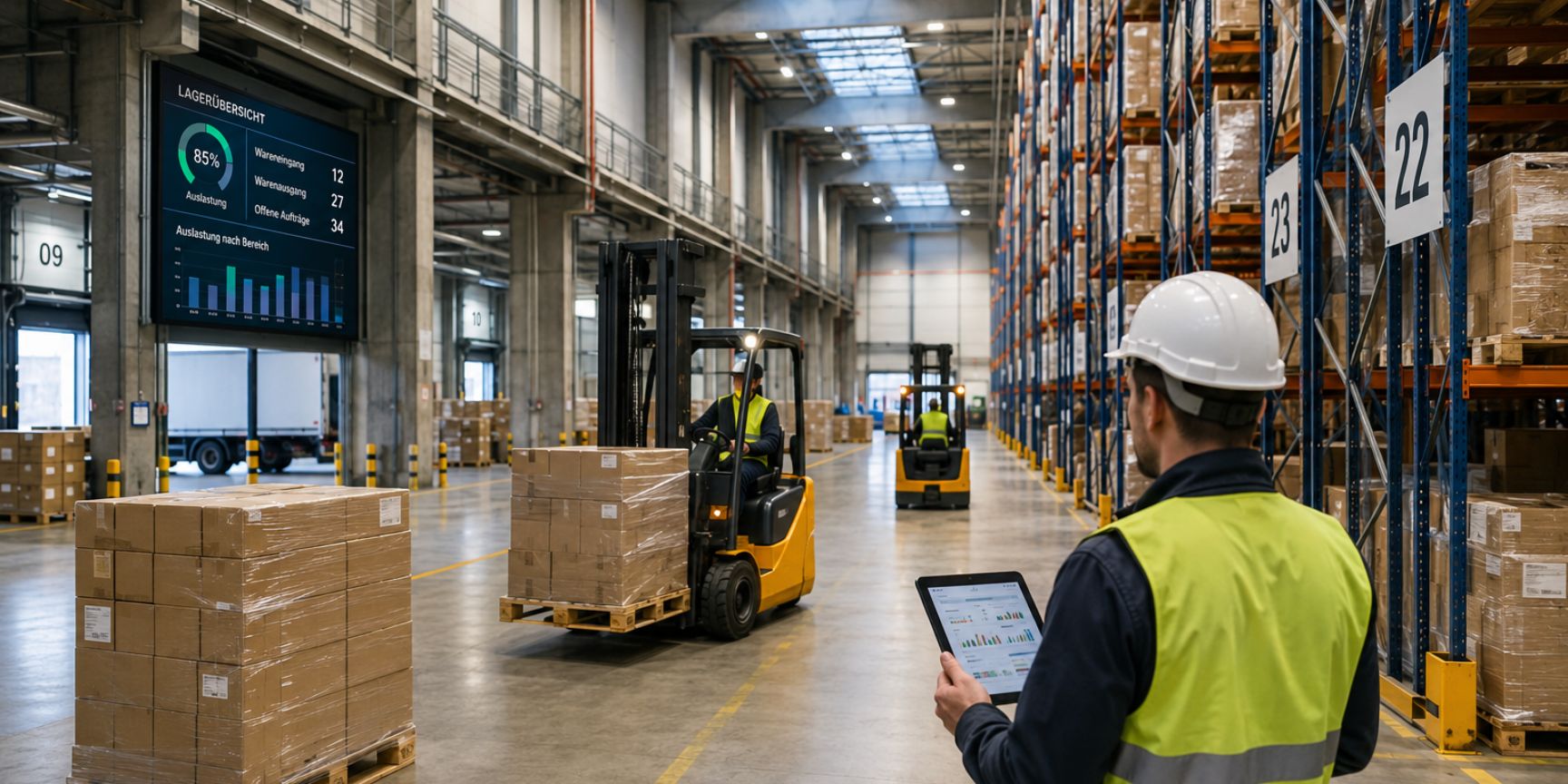
- Space utilisation in %: space actually used divided by available usable space.
- Occupied pallet positions: the share of occupied positions over several months, not just on a reporting date.
- Cost per unused m² per month: rent, service charges, energy and property tax, allocated to the unused space.
An example: of 8,000 m², only 2,000 m² are needed on a lasting basis. Utilisation is 25%, and 6,000 m² are hidden vacancy. Multiply that by the full cost per m² and you get what the company pays monthly for nothing. Our recommendation: if utilisation stays well below plan for six months, the space belongs on the agenda – not just before the lease expires.
Technical suitability: when reactivation pays off
What matters is suitability for third-party use: location, condition and capex must support an economic next use.
| Criterion | Modern logistics requirement | Often found in older stock |
| Clear height | 10.00 to 12.20 m | 6.00 to 8.50 m |
| Floor load | at least 50 kN/m² (5 t/m²) | 30 to 40 kN/m² |
| Floor flatness | DIN 18202 row 4 or FM2 | cracks, falls, thresholds |
| Loading | approx. 1 dock door per 1,000 m² | level-access sectional doors |
| Fire safety | ESFR roof sprinklers | outdated fire alarm system, hydrants |
| Energy | rooftop PV, certification (e.g. DGNB) | gas radiant heaters, retrofit needs under the GEG (German Buildings Energy Act) |
Then there is the column grid – wide grids such as 12 x 24 m allow flexible racking and production layouts – and the surroundings: in an established mixed-use area, noise rules under the TA Lärm can rule out three-shift operation and night-time HGV traffic. How grid connection, slab and data network affect lettability is covered in our article on power, floor and network.
The legal framework: subletting, change of use, fire safety
Most hidden space is reactivated by subletting the warehouse. Under German law (Section 540 of the Civil Code, BGB), the head tenant needs the landlord's consent, in practice for each individual subtenant. If the landlord refuses, the tenant may terminate early with the statutory notice period – unless there is good cause relating to the subtenant or the lease validly excludes this right. The head tenant remains liable to the landlord for the subtenant's fault, even where consent has been given.
Before signing, the following should also be settled:
- Permitted use and change of use: does the agreed use cover the new one? If production turns into storage, a planning change of use with fire safety evidence and a new operating description may be needed.
- Written form: leases of more than one year must be in writing (Section 550 in conjunction with Section 578 BGB). Otherwise the lease is treated as open-ended and can be terminated early with ordinary notice.
- VAT: opting to charge VAT on a sublease (Section 9 of the VAT Act) is only possible if the subtenant uses the space exclusively for transactions that do not exclude input VAT deduction.
- Insurance and access: liability cover, site security, shared infrastructure and cost allocation belong in the contract.
For subtenants: their lease is tied to the remaining term of the head lease. When it ends, the owner can also reclaim the space from the subtenant (Section 546(2) BGB), and subtenants usually have no direct claims against the owner. This section is not legal advice.
Off-market: how hidden space finds its user
By definition, hidden vacancy isn't advertised. But vacancies often show early, for example when product lines are phased out or sites are merged.
For space holders, the route from surplus space to new user usually has four steps: an internal needs analysis, a technical pre-check, matching with specific requirements and, finally, the right contract model. Options include a sublease, a lease assignment with a replacement tenant, a partial letting, multi-user operation billed per pallet, or a sale and leaseback. The current occupier is relieved of fixed costs; the new user gets space that is available straight away.
For seekers: if you define your requirements precisely, you can be offered space that isn't on the market yet. We will show step by step how to search beyond the portals in a separate article.
A look abroad: England, the US, the Netherlands and Poland
In England, the tax system makes hiding space expensive: business rates are due on empty property after a relief period of three months, or six months for industrial property such as warehouses. Combined with FRI leases, which make the tenant fully responsible for repairs and insurance, this is a strong incentive to sublet surplus space quickly.
In the US, triple-net leases and a liquid sublease market create transparency. According to Savills, available sublease space stood at 214.5 million sq ft in the first quarter of 2026 – the first fall since 2021. In the Netherlands, older warehouses are being refurbished and re-let: in Venlo, a renovated logistics building of just over 11,300 m² was fully let in April 2026 (JLL). In Poland, far more space is visibly on the market: according to BNP Paribas Real Estate, vacancy stood at 7.3% in the first quarter of 2026, with prime rents at €5.25/m² a month. We think hidden vacancy plays a smaller role there.
Our view: Germany has the most secure contractual framework but the least transparency. Part of the space problem here is an information problem.
Illustrative example: how reactivating 14,000 m² can add up
Please note: this example is fictitious and does not describe a real client or project. It uses typical assumptions to show how a reactivation can work.
Suppose a supplier to the metalworking industry reduces its production space through automation. A 14,000 m² unit – built in 2008, 9.50 m clear height, 50 kN/m² floor load – has stood largely empty for more than a year, used only for shunting and scrap storage. The lease still has 3.5 years to run.
After a survey and technical review, the fire compartments are separated and dedicated access roads created so that site traffic and the new user do not cross; LED lighting and separate meters are added. A regional contract logistics provider takes the space. Assuming total occupancy costs of €4.10/m² a month (rent and service charges), this relieves the outgoing tenant of around €690,000 a year. The new user moves into a ready building without waiting for the planning, permitting and construction of a new build, and no additional land is sealed.
Checklist for space holders and space seekers
Space holders and owner-occupiers
Space seekers
Frequently asked questions (FAQ) about hidden vacancy
Question: Is hidden vacancy included in official vacancy rates?
Answer: No. Market reports count space that is actively marketed. Hidden vacancy is leased or owner-occupied and not on offer.
Question: Can I sublet a leased warehouse without consent?
Answer: In Germany, usually not. Under Section 540 BGB the tenant needs the landlord's consent. If it is refused without good cause relating to the subtenant, the tenant gains a special right to terminate, unless the lease validly excludes it.
Question: What is the difference between hidden vacancy and a greyfield?
Answer: A greyfield is disused land that has already been built on. Hidden vacancy sits in buildings that are formally occupied but not fully used.
Question: How long can a sublease run?
Answer: No longer than the head lease. When the head lease ends, the owner can also reclaim the space from the subtenant. Anyone planning longer term should consider a lease assignment or a three-party agreement with the owner.
Conclusion: know the stock, find the space
Hidden vacancy doesn't end the shortage of space, but it makes it easier to live with. The harder new development becomes, the more valuable every square metre of existing stock that today only generates costs. Space holders should measure utilisation and tackle surpluses early instead of carrying them until the lease ends. Seekers should define their requirements clearly enough for a match to be possible before the space reaches the market.
Have unused warehouse space?List your property on LAGERflaeche.de – including space to sublet or partial units. Looking for space?Post a search request so that space holders know what you need before they put their building on the market.
Sources
- CBRE: German industrial and logistics market H1 2026 (vacancy rate)
- CBRE: German industrial and logistics market H1 2025 (regional vacancy rates, hidden vacancy)
- Realogis: Frankfurt/Rhine-Main logistics market 2025 (sublease share)
- Colliers, cited at the RUECKERCONSULT press conference on the logistics rental market (May 2026): nationwide sublease share
- Logivisor: Leerstand bei Logistikdienstleistern – der graue Markt als Chance? (materialfluss, 4 Sept 2025)
- bulwiengesa: Logistik und Immobilien 2025 (logistics stock)
- Destatis: Growth in settlement and transport area 2021–2024; 30-hectare target of the German Sustainable Development Strategy
- Logivest: Logistikimmobilien Seismograph 2025/2026
- Savills: State of the U.S. Industrial Market Q1 2026
- JLL Netherlands: press release Sunrise Real Estate, Venlo (14 April 2026)
- BNP Paribas Real Estate Poland: Industrial and Logistics Market in Poland Q1 2026
- GOV.UK: Business rates – empty property relief
- German Civil Code (Sections 540, 546, 550, 578 BGB), VAT Act (Section 9 UStG)