



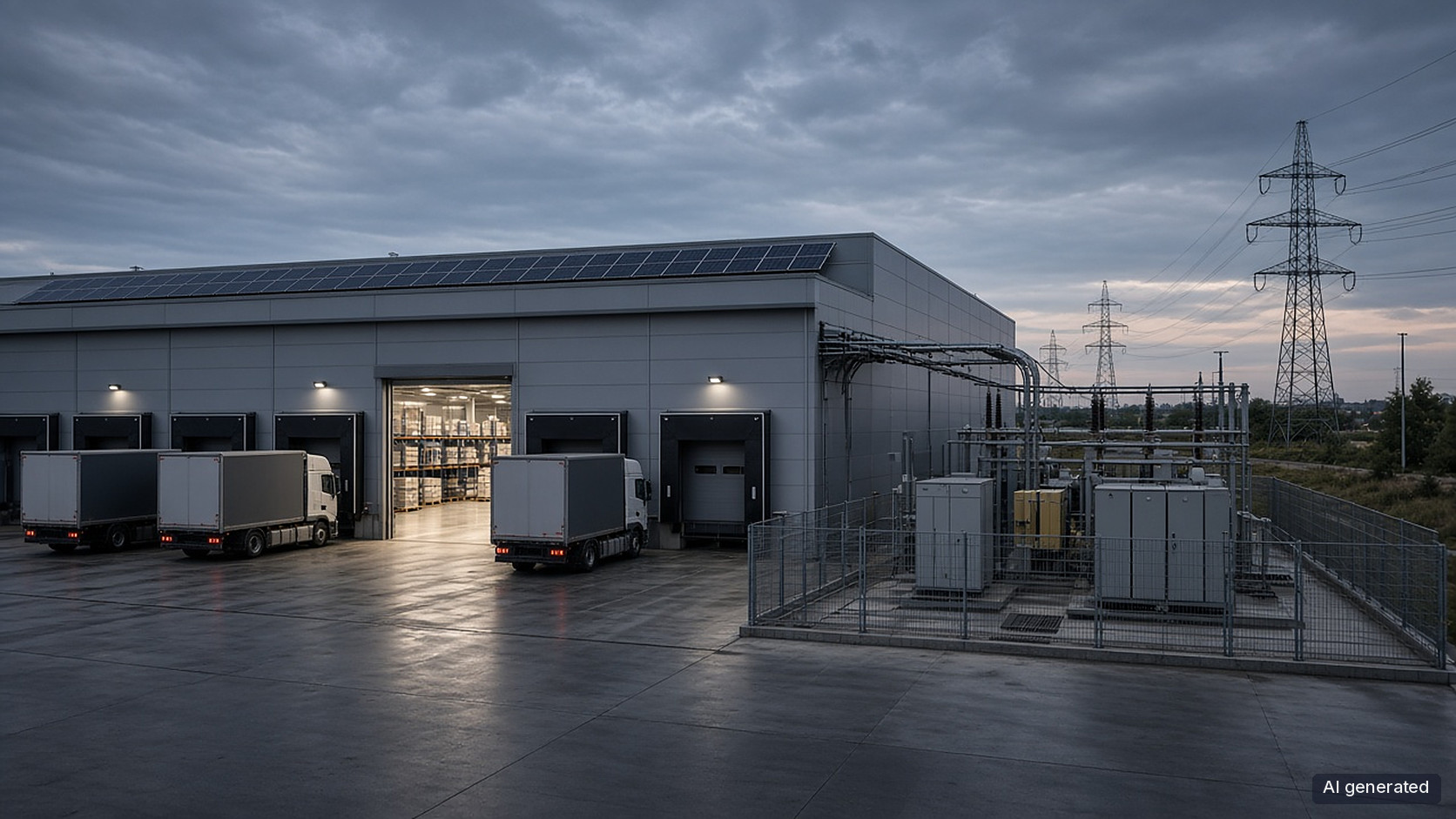
Logistics Real Estate 2027: It's Not the Rent That Holds You Back, It's the Building
Table of contents
- Looking back: what happened to our 2026 forecast
- Power, floor, network: the three deal-breakers for warehouses in 2027
- The second rent: why operating costs will matter more than base rent in 2027
- Automation yes, humanoids not yet
- Land is running out: brownfields and going vertical
- Urban logistics space: what the end of doorstep delivery means for buildings
- Where we could be wrong
- Checklist for 2027: what occupiers, owners and developers should check now
- Conclusion: spec first, rent second
Anyone looking for logistics space in 2027 will negotiate on rent. But that's often not where the search falls apart. Our argument: the real bottleneck in logistics real estate in 2027 isn't the price per square metre. It's the building. Can it get enough power? Can its floor carry the automation you're planning? Can its network run operations without dropouts? If you keep comparing warehouses mainly on euros per square metre, there's a good chance you'll lease the wrong one.
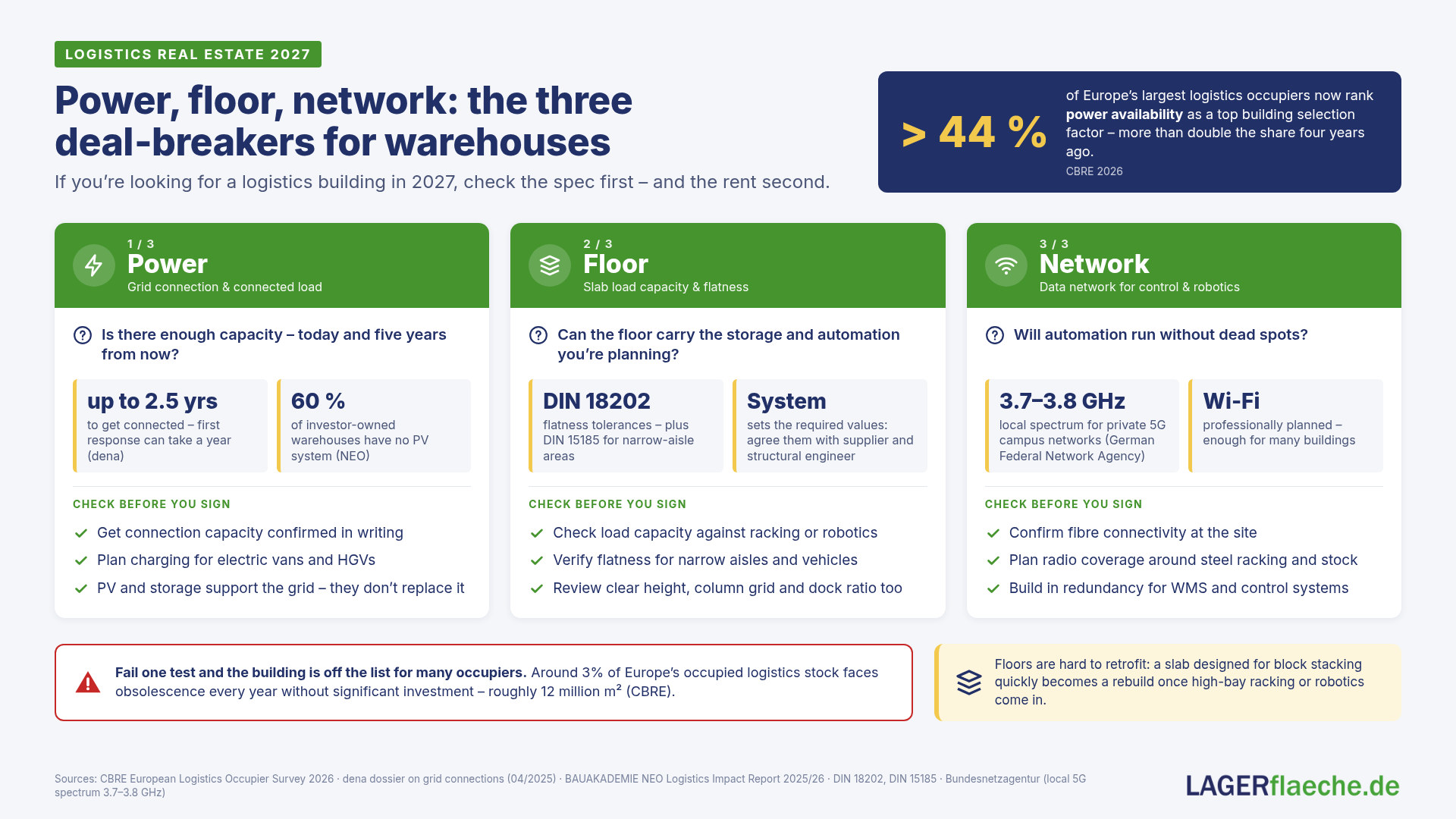
The 2026 data backs this up. In CBRE's latest European occupier survey, more than 44% of the largest logistics occupiers now rank power availability as a top building selection factor – more than double the share four years ago. 83% say they are very or somewhat concerned about power availability and grid stability. And most leasing deals aren't expansions at all. They're moves into better buildings.
Looking back: what happened to our 2026 forecast
In our in-depth analysis of logistics real estate in 2026, published in January, we wrote that rising rents from mid-2027 were all but certain. We got the direction right and the timing wrong – we were too cautious. Rents are already climbing in 2026. According to CBRE, prime rents across the top five German markets were 3.2% higher by mid-2026, and 5.5% higher in secondary hubs. BNP Paribas Real Estate puts the year-on-year increase across the top markets at just over 4%, to around €8.50/m². Munich leads at €11.25/m², while Leipzig is far cheaper at €5.70/m² (all figures: prime rent, net, per m² per month).
Vacancy has turned as well. CBRE says big-box vacancy peaked at 5.0% at the end of 2025 and stood at 4.6% by mid-2026. Take-up in the first half of 2026 came to around 3.0 million m² (CBRE) to just over 3.3 million m² (BNP Paribas Real Estate), depending on how deals are counted.
Our view for 2027: rents will keep rising, but moderately – nothing like the jump of 2021/2022. The more interesting question is where the pressure builds. Not in the average, but in modern, well-powered buildings in established locations. CBRE notes that the rent gap between new builds and older stock remains clearly visible. We expect that gap to widen in 2027, not narrow.
Power, floor, network: the three deal-breakers for warehouses in 2027
CBRE sums it up neatly: occupiers aren't worried about warehouse availability in general, but about modern, automatable, efficiently powered buildings in the locations they actually need. That gives us three tests every building will face in 2027.
Power: the grid connection comes before the lease
Automated conveyors, refrigeration, charging points for electric vans and HGVs: logistics sites need far more power than they used to. Grid connections often can't keep up. In a dena dossier from April 2025, logistics companies reported waiting up to a year just for a first response from the grid operator, and up to 2.5 years for the actual connection. A March 2026 study by FfE for the Bavarian business association vbw puts the planning lead time for grid expansion at 2 to 10 years depending on the voltage level – while logistics businesses typically work with payback periods of under five years.
For occupiers, that means available connection capacity belongs in the listing and in the lease, not in a query after you've moved in. Solar helps, but it doesn't replace a grid connection. And it's far from standard: according to BAUAKADEMIE's NEO Logistics Impact Report 2025/26, 60% of the investor-owned warehouses surveyed have no PV system at all – only around 40% do.
Floor: automation decides what the slab has to do
High-bay racking, very narrow aisle trucks, autonomous mobile robots and shuttle or cube storage systems all place their own demands on load capacity and flatness. In Germany, DIN 18202 sets the flatness tolerances, and narrow-aisle areas also have to meet the stricter requirements of DIN 15185. CBRE lists floor loading, clear height, dock door ratio and column grid among the features occupiers increasingly care about.
The catch: you can't simply retrofit a floor. A slab designed for block stacking can quickly turn into an expensive rebuild once you want high-bay racking or robotics. The exact specification depends on the system and needs to be agreed early with the system supplier and the structural engineer.
Network: no reliable data network, no automation
Robots, scanners, warehouse management and control systems need wireless coverage that doesn't drop out. Steel racking and tall stacks of goods create dead zones. Private 5G campus networks – in Germany, companies can apply to the Federal Network Agency for local spectrum in the 3.7–3.8 GHz band – are one option. For many buildings, professionally planned Wi-Fi is enough. What matters is checking fibre connectivity, radio planning and redundancy before you sign.
Our conclusion: in 2027, a building that fails any one of these three tests is no longer something many occupiers will negotiate over. It's off the list. CBRE estimates that around 3% of Europe's occupied logistics stock faces obsolescence every year without significant investment – roughly 12 million m².
The second rent: why operating costs will matter more than base rent in 2027
According to BAUAKADEMIE's NEO Logistics Impact Report, operating costs for investor-owned warehouses averaged €11.50 per m² of gross floor area (GFA) per year in 2024, with €11.97/m² forecast for 2025. The biggest drivers are maintenance and repairs (+9%) and insurance (+8%). On average, €1.80/m² GFA per year hits investor returns directly. One thing to watch when comparing: rents are quoted per m² per month, operating costs per m² GFA per year. Mixing the two is comparing apples with oranges.
For occupiers, the takeaway is simple: an energy-efficient building with its own power supply can work out cheaper overall, even at a higher base rent. We look at what's behind these numbers in How exploding operating costs threaten returns on logistics real estate.
Automation yes, humanoids not yet
Rising rents increase the pressure to automate, especially in low-margin contract logistics. But CBRE points to a conflict: automation mainly pays off with longer lease terms, while many occupiers still prefer short leases. If you want to automate, negotiate lease term and payback together.
Humanoid robots won't change much of this in 2027. In our view they are still at the pilot stage and aren't a separate design criterion for buildings. A warehouse designed for autonomous mobile robots and conveyor technology will also be ready for humanoids. We've assessed where the technology stands in our reality check on humanoid systems in contract logistics.
Land is running out: brownfields and going vertical
The German government wants to cut new land take for housing and transport to under 30 hectares a day by 2030. Between 2021 and 2024, the actual figure averaged 50 hectares a day (Destatis). Greenfield sites won't get any easier to permit. At the same time, competition for land is growing: CBRE names data centres and defence companies as new rivals for sites. Occupiers are moving elsewhere – according to BNP Paribas Real Estate, take-up outside the major logistics hubs rose by 42% to 2.3 million m² in the first half of 2026.
That makes brownfields the most important land reserve in metropolitan areas. Their advantage can be existing infrastructure, potentially including a grid connection – but that has to be verified site by site, not assumed. Multi-storey warehouses will remain a niche in Germany in 2027, limited to very expensive urban locations. They make all three tests harder: higher demands on floor slabs, ramps or goods lifts, and power supply across several levels.
Urban logistics space: what the end of doorstep delivery means for buildings
Doorstep delivery isn't disappearing, but it's no longer the default. Deutsche Post plans around 50,000 parcel lockers in Germany by 2030, at least half of them open to all carriers (press release, 1 October 2026). DPD and GLS aim to run 3,000 shared lockers by 2027. Parcels are being consolidated into fewer stops.
For logistics real estate, this isn't a consumer question. It's a question of flows. Urban depots need less deep storage and more throughput: more doors and parking for vans, cross-dock layouts, charging for electric vehicles. The big box by the motorway junction stays. What changes is the smaller, city-edge building – and there, too, power supply ends up being decisive.
Where we could be wrong
- Between comparable buildings, rent still decides. According to CBRE's survey, rent remains the most important factor when occupiers choose between similar, neighbouring buildings. Our argument applies where buildings differ technically – which is increasingly the case.
- Grid connections could get faster. JLL describes phased power provision and local solutions that can shorten connection times in individual cases. Storage and load management can soften bottlenecks.
- Demand could weaken. BNP Paribas Real Estate cites geopolitical risks and US tariff policy as sources of uncertainty. If demand cools, the market eases and occupiers regain negotiating power.
- ESG pressure could be weaker than expected. CBRE reports that willingness to pay a premium for net-zero-ready space has fallen, and decarbonisation timelines have been pushed back.
Checklist for 2027: what occupiers, owners and developers should check now
Occupiers and 3PLs
Owners and investors
Developers
Conclusion: spec first, rent second
The logistics real estate market in 2027 won't be decided by the price per square metre, but by whether a building can support its occupier's operations at all. Power, floor and network are no longer nice-to-have features. They're entry requirements. If you're searching, check them first. If you own, invest in them first. And if you're building, secure them first – before you break ground.
Sources
- CBRE / Analytiqa: European Logistics Occupier Survey 2026
- CBRE Germany: press release on the industrial and logistics market H1 2026 (17 July 2026, in German)
- BNP Paribas Real Estate: Logistics Market Germany Q2 2026 (in German)
- BAUAKADEMIE: NEO Logistics Impact Report 2025/26
- dena dossier (April 2025), as cited by energiefahrer.de (in German)
- FfE for vbw: Netzanschlüsse als Schlüsselfaktor (March 2026, in German)
- JLL: Power availability becomes a key value driver for real estate (in German)
- German Environment Agency / Destatis: land take for housing and transport
- DHL Group: press release "DeinFach und myflexbox schließen sich zusammen" (1 October 2026)
- DER SPIEGEL: DHL plans to expand its parcel locker network (incl. DPD/GLS 2027 target)
Latest Blog Posts
Stay up to date with the newest trends, insights, and tips in warehouse and logistics. Our latest articles help you navigate the industry with confidence.
Logistics Real Estate 2027: It's Not the Rent That Holds You Back, It's the Building
In 2027, the search for warehouse space will rarely fail on rent. It will fail on the building itself: not enough power, a floor that can't carry the automation, a network full of dead spots. Why power, floor and network are becoming deal-breakers, and what occupiers, owners and developers should check now....
Poland, Czechia, Slovakia or Hungary: Which Location Best Fits Your Automotive Supply Chain?
Poland, Czechia, Slovakia and Hungary play different roles in Europe's automotive industry. This comparison explores which locations companies should consider for component sourcing, manufacturing, electric mobility and cross-border logistics....
Data Centres vs. Logistics Facilities: The Race for Power and Land
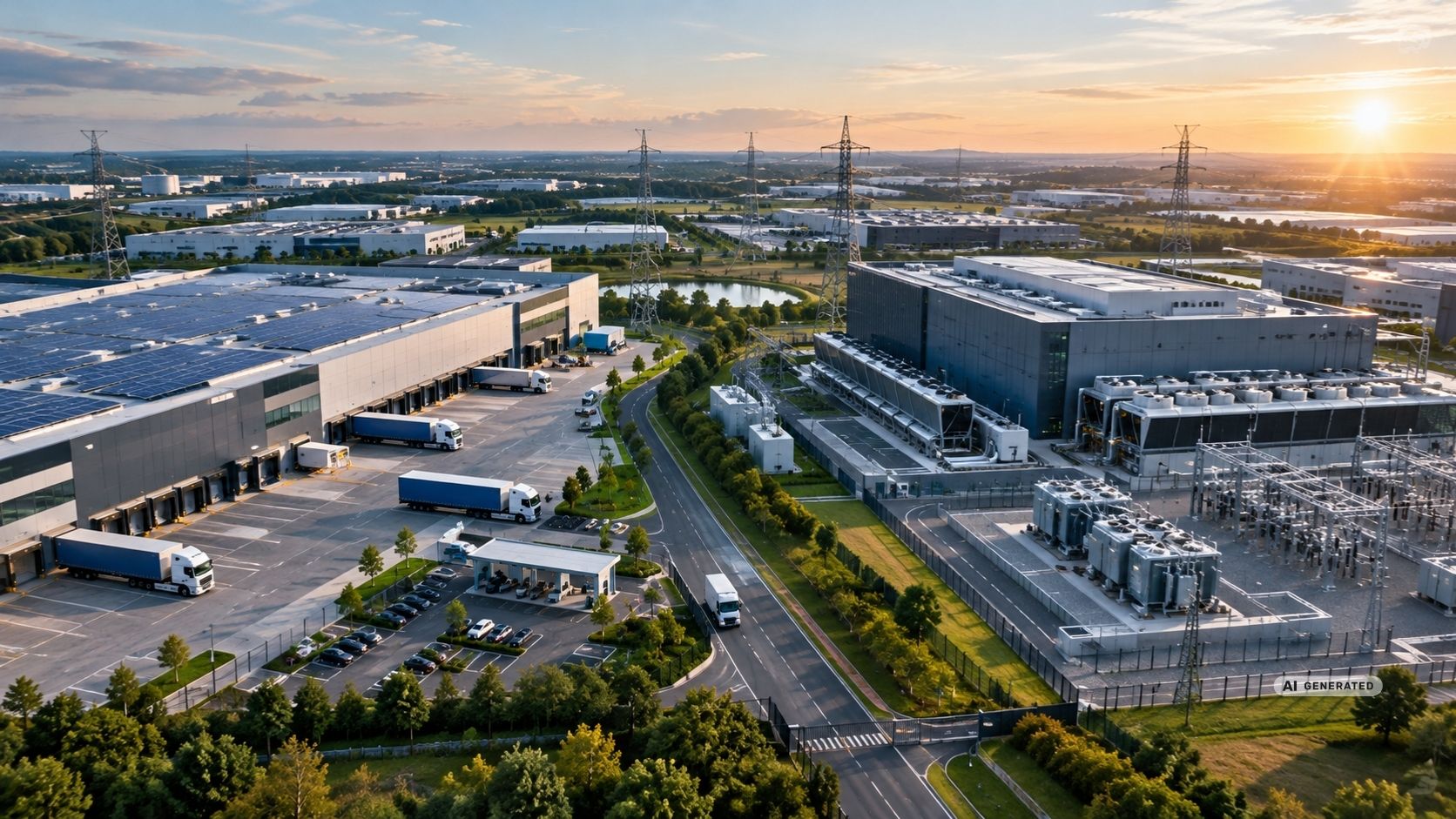
Across Europe, logistics operators are competing for more than land and transport access. They increasingly need something much harder to secure: grid capacity. Data centres are intensifying that competition — and changing how logistics locations are evaluated....

Chinese companies discover Europe's logistics real estate
Chinese companies are becoming an increasingly visible user group in Europe's logistics real estate market. What does this mean for warehouse space, 3PL structures and the requirements for European logistics locations?...