



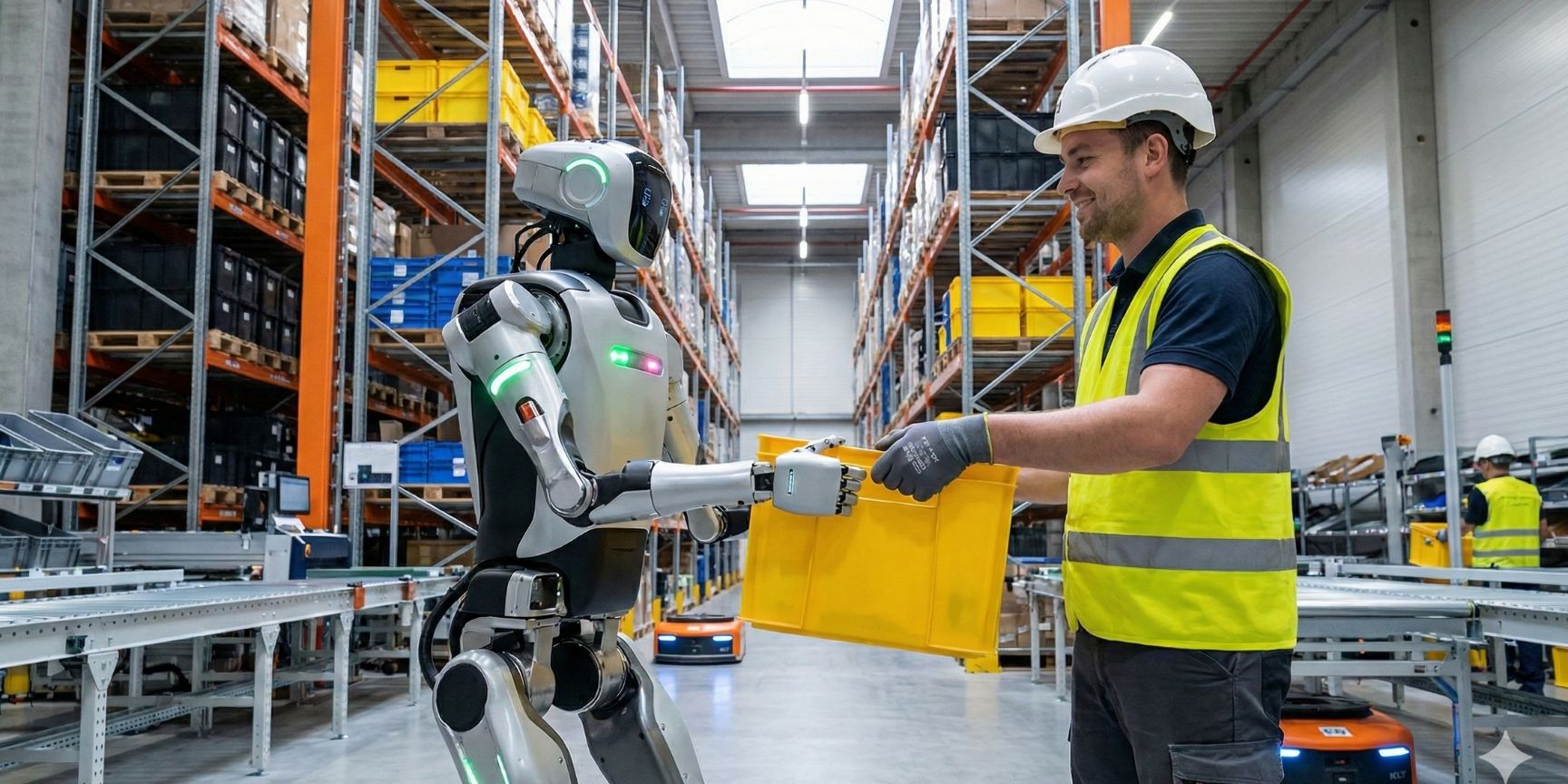
Colleague Robots - Humanoid Systems in Contract Logistics – The Reality Check
Table of Contents
- Colleague Robots: Humanoid Systems in Contract Logistics – The Reality Check
- Status Quo: Dreams of the Future or Hard Reality in Warehouse Logistics?
- Forms and types: Which humanoids are relevant?
- Useful areas of application: Where does the robot beat humans (and where not)?
- Competing systems: Will AMRs and AutoStore be displaced?
- Labor Market and Ethics: Curse or Blessing for Workers?
- Global comparison: Why Germany is hesitating and the US is rushing
- Case study: BMW and Figure AI – A look into practice
- Future Outlook: AI Brains in Robotic Bodies
- Conclusion
Will the "Terminator" soon be our new warehouse clerk? It's not quite as dramatic, but logistics is facing a turning point that is as far-reaching as the introduction of the forklift truck. For years, humanoid robots were expensive toys of research or science fiction cinema. But 2024 and 2025 mark the turning point: the systems leave the laboratories and enter the rough floor of the warehouses. But is the effort really worth it? Where do we stand compared to the USA or China? And what does this mean for the workforce? We shed light on the topic completely.
Status Quo: Dreams of the Future or Hard Reality in Warehouse Logistics?
For a long time, the dogma in logistics was: "Wheels are better than legs". A wheel is more energy-efficient and easier to control. So why imitate the complexity of the human gait?
The answer lies in the brownfield problem. The majority of the world's warehouses are built for people – with stairs, narrow aisles, uneven floors and shelves designed for human grasping heights. While classic AGVs (Automated Guided Vehicles) or AMRs (Autonomous Mobile Robots) often require an adaptation of the infrastructure (flat floors, wide paths, special markings), humanoid robots promise a "drop-in" solution. They should work where people work, without having to rebuild the warehouse.
Fact check: According to a forecast by Goldman Sachs, the humanoid robot market could reach a value of $38 billion by 2035 , with logistics being one of the main drivers. We are currently in the "Advanced Pilots" phase. Companies such as GXO Logistics, Amazon and DHL are no longer just testing these systems, they are integrating them into the first live processes. It is no longer a pure dream of the future, but it is not yet a mass market either.
Question for practice: Are your warehouse processes so standardized that one wheeled robot is sufficient, or do you need the flexibility of human movements?
Forms and types: Which humanoids are relevant?
Not every robot that has a head is suitable for logistics. We have to differentiate between pure humanoids and hybrid approaches.
The bipedal all-rounder (two-legged friend)
These robots imitate humans almost completely. They balance on two legs and have two arms with gripping hands.
- Examples: Atlas (Boston Dynamics - now electric), Figure 01/02 (Figure AI), Optimus (Tesla).
- Advantage: Can climb stairs, crouch down and move around in the tightest environments made for humans.
- Disadvantage: High energy consumption due to balancing; complex control.
The "Digi-Pedal" Attachment (Bird Legs)
In this case, the knee joints are often directed backwards, which can be mechanically more efficient.
- Example: Digit from Agility Robotics.
- Special feature: Digit is currently the market leader in commercial logistics pilots. It is explicitly designed for lifting boxes (totes).
Formen Hybrid (Räder + Arme)
Strictly speaking, they are not pure humanoids, but they serve the same purpose. They have a humanoid torso, but ride on a mobile base.
- Example: Stretch (Boston Dynamics) or Handle.
- Advantage: Enormous stability and speed on flat surfaces; no energy expenditure for balancing when stationary.
- Disadvantage: No stairs, requires similar floor conditions to forklifts.
Useful areas of application: Where does the robot beat humans (and where not)?
Using a €150,000 robot to carry a piece of paper from A to B is economic nonsense. Humanoid robots must be used where "dull, dirty, dangerous" meets a shortage of skilled workers.
Container Unloading
This is the "Holy Grail" of current robotics. In containers, the temperature is often 40°C+ in summer, the parcels are stacked unstructured ("floor loaded") and often weigh over 20 kg.
- Why Humanoid? A robotic arm on rails often does not get deep enough into the container or is not flexible enough for chaotic stacks. A humanoid goes in, grabs the package and places it on a conveyor belt.
Tote Handling & Replenishment
Moving empty or full small load carriers (KLTs) from conveyor belts to racks or pallets.
- Ergonomics: This work requires constant bending and stretching. Humanoid robots relieve humans of thousands of repetitions per shift.
Picking
Caution is advised here. Humanoids are currently still too slow for "high-speed picking" of small parts compared to humans or specialized picking robot arms. However, they are useful for multi-purpose tasks, where the robot unloads trucks in the morning and processes returns in the afternoon.
Important: Humanoids are (still) slower than humans. Agility Robotics states that Digit is aiming for a similar speed, but for now, the focus is on reliability and endurance. The robot does not get tired and does not take breaks.
Competing systems: Will AMRs and AutoStore be displaced?
A clear no. Humanoid robots should not be seen as a replacement for established automation, but as a complement to the "gaps" in between.
- AutoStore / Shuttle warehouse: Unbeatable in terms of storage density and speed for small parts. A humanoid will never be able to handle 1,000 picks per hour as efficiently as a cube storage system.
- AMR (Autonomous Mobile Robots): Ideal for pure transport from A to B over long distances.
The niche of the humanoid: Humanoid robots are the solution for flexibility. A conveyor belt is rigid. An AutoStore is rigid. A humanoid can be used today at ramp 1 and tomorrow in the returns area at ramp 10 without having to change a single screw in the hall. They are the answer to volatile markets (e.g. peaks in e-commerce).
Labor Market and Ethics: Curse or Blessing for Workers?
The fear of the "job killer robot" is omnipresent. But the demographic data speak a different language, especially in Western industrialized nations.
The shortage of skilled workers as a driver
According to the German Logistics Association (BVL) and international labour market reports, there is a shortage of tens of thousands of workers in the warehouse sector in Germany alone. In the U.S., companies report an annual turnover rate of up to 150% among warehouse workers.
Effects on the employee:
- Health protection: Humanoids take over the physically exhausting activities (heavy lifting, overhead work). This can reduce occupational disability among warehouse staff.
- Job shift: The job description is changing from "crate hauler" to "robot operator". There is a need for employees to manage fleets, troubleshoot faults and train AI.
- Wage development: Historically, higher automation in industrialized countries has not led to mass unemployment, but to a shift towards skilled (and better-paid) jobs.
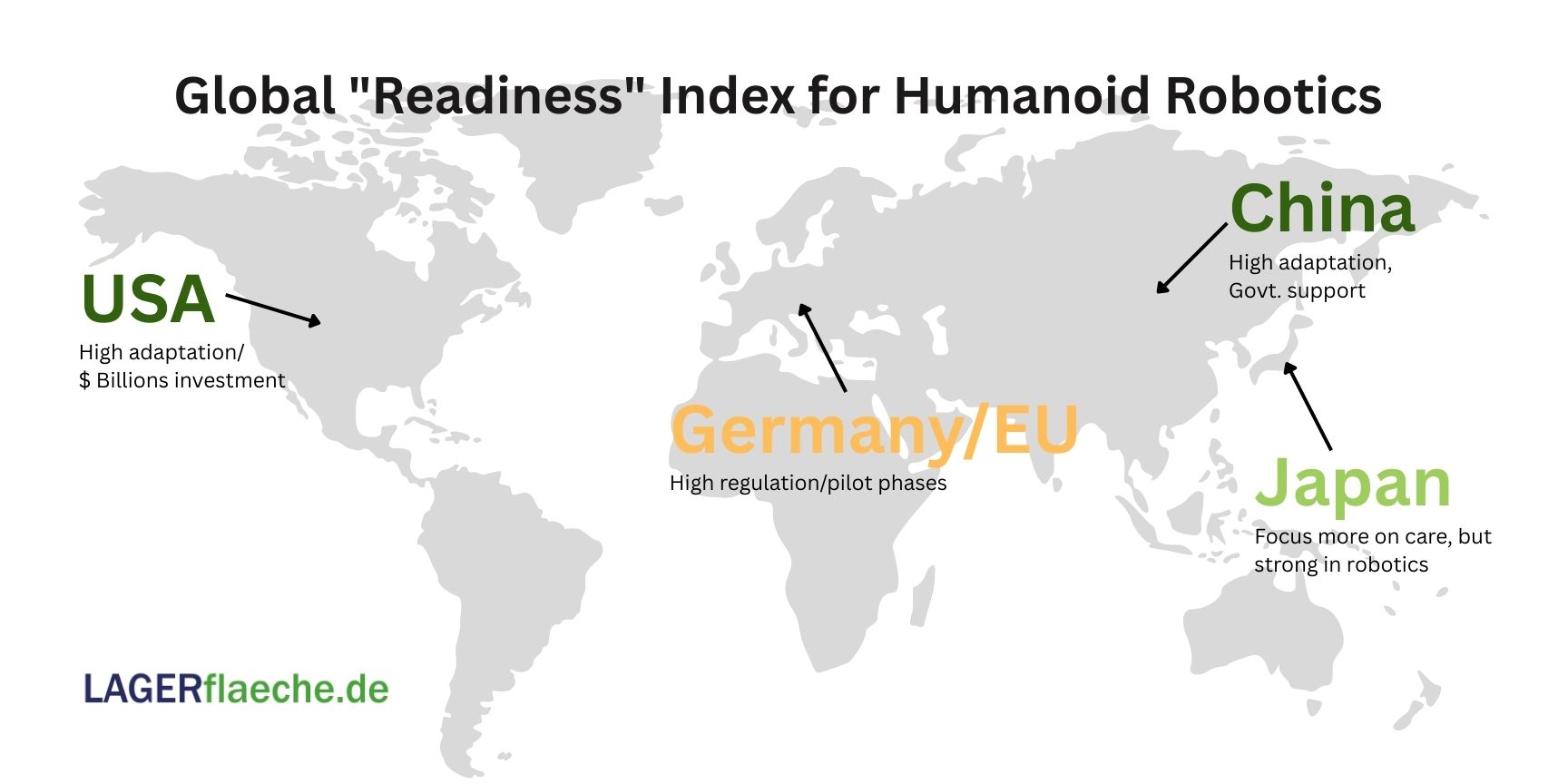
Global comparison: Why Germany is hesitating and the US is rushing
Massive cultural and regulatory rifts are evident here.
USA & China: "Move fast and break things"
In the USA, venture capitalists (VCs) are driving the development. Companies like Tesla or Figure AI have billion-dollar valuations and can drive aggressive pilots.
- China: The government announced in 2023 that it would bring humanoid robots to mass production by 2025 (similar to what was previously the case with electric cars). Companies like Unitree already offer very affordable platforms.
Germany & Europe: "Safety First" and the Works Council
Germany is a high-tech country, but slower in adaptation.
- Safety (CE & ISO): A robot that moves freely between people falls under strict machine guidelines (z.B. ISO 13482 for personal assistance robots). The certification of a 70kg robot, which could theoretically run over a human, is extremely complex in the EU.
- The works council: Works councils are strong in German corporations. The introduction of camera systems (which humanoids absolutely need for orientation) often encounters data protection concerns (DGUV regulations, GDPR).
- The engineering culture: German logistics companies often prefer "perfect", deterministic systems. A humanoid robot that "learns" based on AI and moves slightly differently each time generates skepticism about process stability.
Case study: BMW and Figure AI – A look into practice
A concrete example that bridges the gap between US tech and German industry is the cooperation between BMW Manufacturing and Figure AI (announced in early 2024).
- Location: BMW Plant Spartanburg (USA) – the largest BMW plant in the world.
- The robot: Figure 01 (later Figure 02).
- The task: The robot is used in body construction to handle sheet metal parts that need to be precisely placed.
- The result (so far): The robot learned autonomously through AI training (Neural Networks) to correct errors (e.g. if a part slipped slightly).
- Significance: This is one of the first proofs that "General Purpose Robots" can work in high-speed automotive production (just-in-sequence). But it also shows that BMW is testing this first in the USA, where the regulatory environment is more flexible, before it is rolled out in Dingolfing or Leipzig.
Quote Brett Adcock (CEO Figure): "Robots that think and move like humans will change the way we produce."
Future Outlook: AI Brains in Robotic Bodies
What will logistics look like in 2030?
- From programmed to taught robots: At present, robots are often still elaborately programmed. The future lies in VLA (Vision-Language-Action) models. You simply tell the robot, "Put away the empty pallet there," and the robot understands the context (like ChatGPT, only for physical actions).
- RaaS (Robots as a Service): Since the hardware is expensive (currently often still €100,000+), providers will push rental models. Logisticians do not pay for the robot, but per "successful handle" or per hour. This massively lowers the barrier to entry.
- Battery technology as the key: Currently, many humanoids only last 4-5 hours. For 3-shift operation in logistics, the energy density must increase or the "hot-swapping" (quick battery replacement) must be standardized.
Conclusion
Humanoid robots in contract logistics are no longer a distant utopia, but are in the critical phase of the "proof of concept". While other systems (AMR, AutoStore) are more efficient in standard processes, humanoids win where flexibility and adaptation to human-made environments count. For German companies, it is now a matter of not waiting. Those who test the technology now in pilot projects (sandbox environments) and involve their works councils at an early stage will have a massive competitive advantage in 5 years. If you wait until the technology is "perfect", you will lose touch with international efficiency.
Key takeaways for decision-makers
- Find a niche: Don't automate everything, but identify bottleneck processes (unloading).
- Take employees on board: Early communication that it is about support (co-botting), not replacement.
- Check infrastructure: Humanoids don't need rails, but they do need stable Wi-Fi/5G and clear optical reference points.
- Calculate ROI realistically: Not only calculate personnel costs against robot price, but also include recruitment costs, sick leave and flexibility gains.
References and further reading:
- International Federation of Robotics (IFR): "World Robotics 2024 Report".
- Goldman Sachs Research: "The Global Market for Humanoid Robots", Investorenbericht.
- Agility Robotics Press releases on the use at GXO Logistics.
- BVL (German Logistics Association): Reports on the shortage of skilled workers 2023/2024.
- BMW Group PressClub: "BMW Manufacturing and Figure AI Agreement".
Latest Blog Posts
Stay up to date with the newest trends, insights, and tips in warehouse and logistics. Our latest articles help you navigate the industry with confidence.
Data Centres vs. Logistics Facilities: The Race for Power and Land
Across Europe, logistics operators are competing for more than land and transport access. They increasingly need something much harder to secure: grid capacity. Data centres are intensifying that competition — and changing how logistics locations are evaluated....
Chinese companies discover Europe's logistics real estate
Chinese companies are becoming an increasingly visible user group in Europe's logistics real estate market. What does this mean for warehouse space, 3PL structures and the requirements for European logistics locations?...
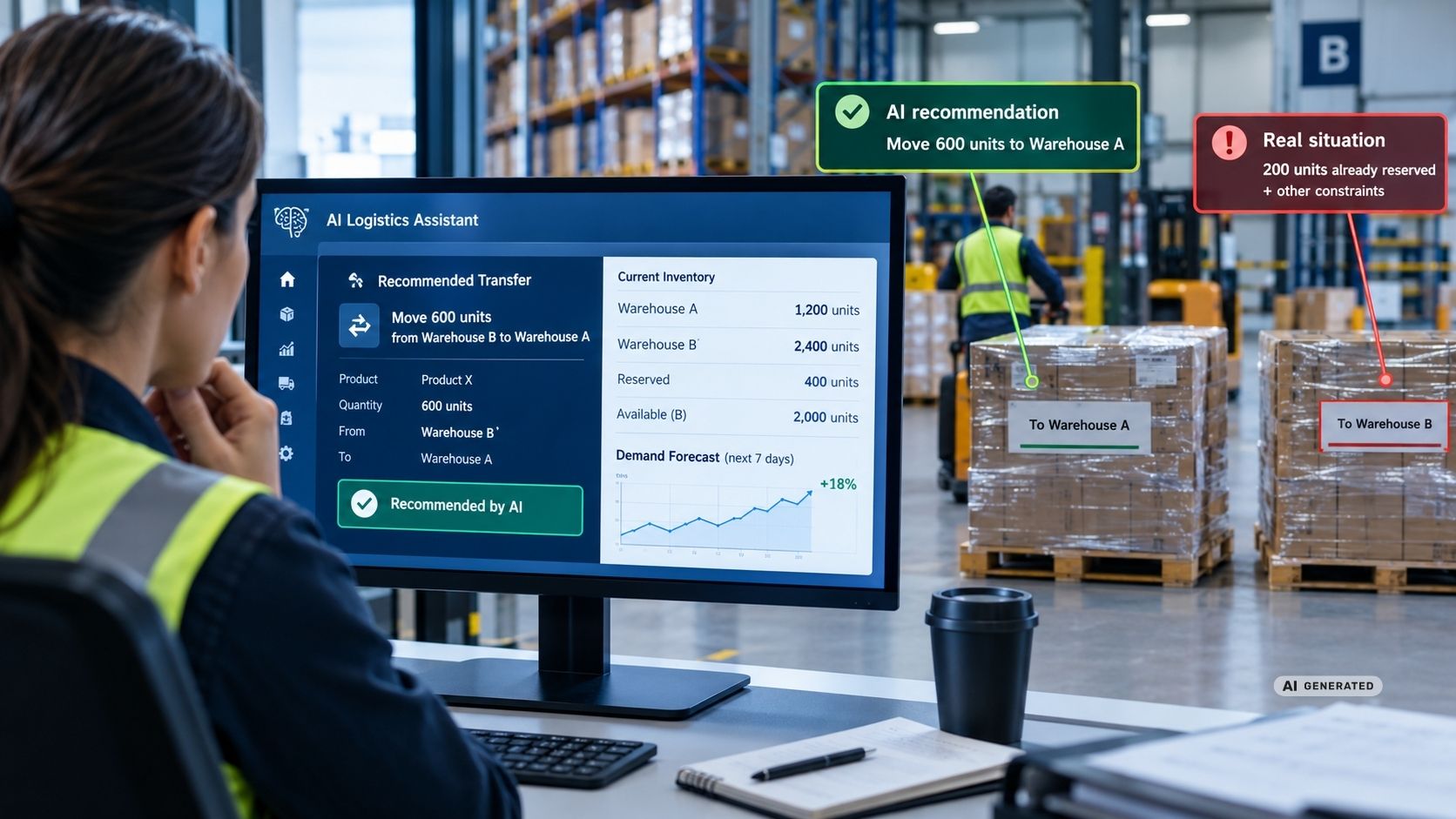
AI Hallucinations in Logistics: When AI Plans the Wrong Delivery
AI can analyze enormous amounts of logistics data — but it can also produce a convincing answer that is simply wrong. The critical question is not whether AI makes mistakes, but what happens when a wrong recommendation becomes an operational decision....
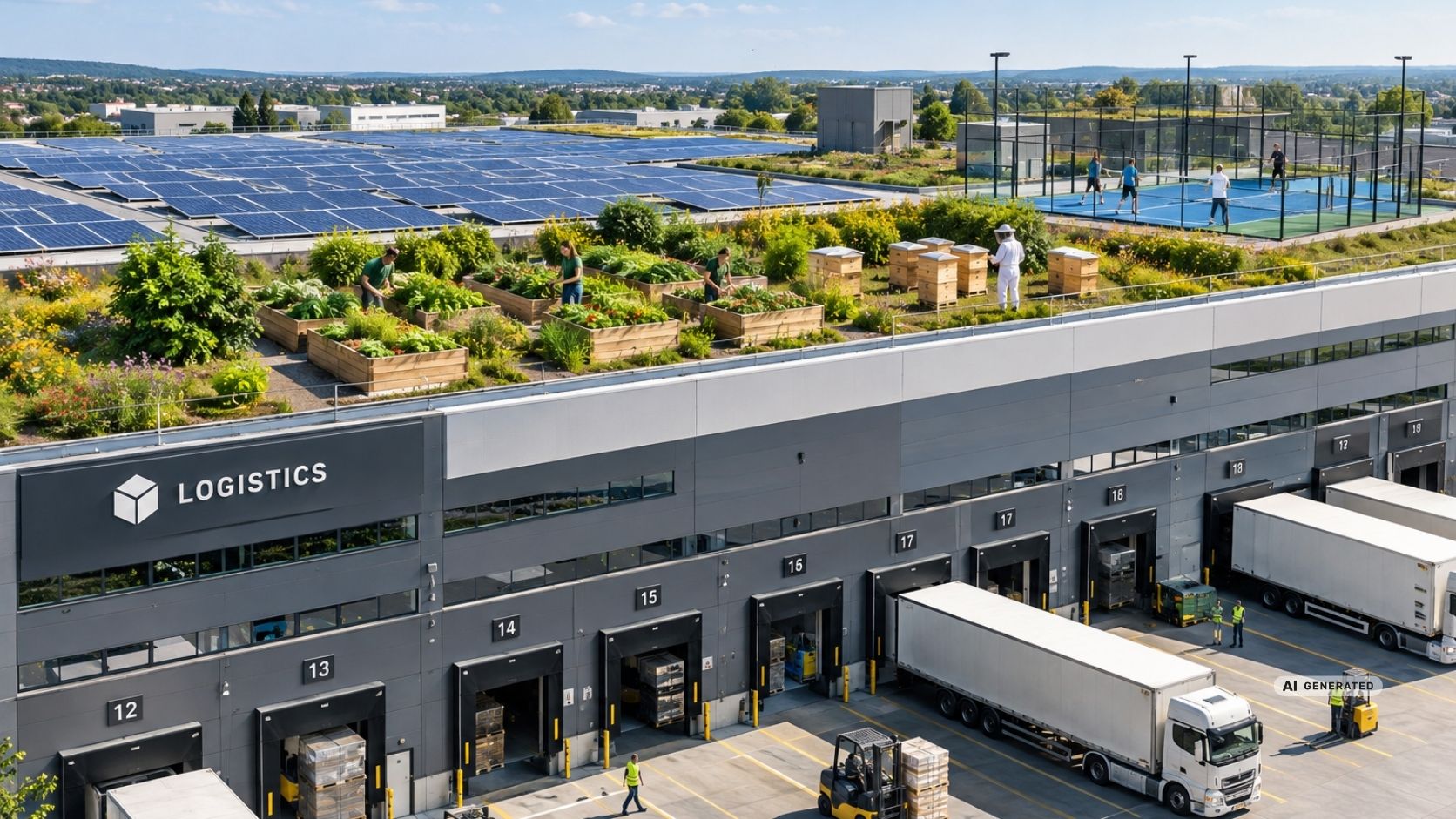
The Green Revolution on the Hall Roof: From Concrete Block to Ecological Power Plant?
Logistics roofs can do more than PV: greening, bees, urban farming and even sports areas turn unused roof space into multifunctional rooms....