



Service Level Agreement (SLA) in Logistics
Table of contents
- What is a Service Level Agreement (SLA)?
- The SLA in Contract Logistics: The Contractual Foundation
- Logistics property and hall: The structural basis for SLA fulfilment
- Figures, data, facts: Measurability through KPIs in the SLA
- Penalties and bonuses: The financial levers in the SLA
- Technology (WMS/WCS) as an SLA guarantor
- FAQ: Frequently asked questions about SLAs in logistics
- Conclusion: Transparency as a success factor
A smooth flow of materials is the backbone of the modern economy. When companies outsource their logistics processes, blind trust in the service provider is not enough. This is where the Service Level Agreement (SLA) comes into play. But what exactly does this document regulate, and why is it so essential in warehouse and contract logistics?
 in der Logistik_1.jpg)
What is a Service Level Agreement (SLA)?
A service level agreement is a detailed contract between a client and a service provider. It precisely defines the quality, scope and speed of a service owed. Instead of making vague promises, an SLA sets measurable key performance indicators (KPIs). If the agreed service level is undercut, predefined sanctions apply; if it is exceeded, bonuses often beckon.
The SLA in Contract Logistics: The Contractual Foundation
Contract logistics is the premier class of strategic partnerships. This is not about short-term transport orders, but about long-term, contractually fixed partnerships that often run for three to five years or longer.
Since the logistics service provider (3PL) is deeply integrated into the customer's value chain, the SLA is the most important operational control instrument. In contract logistics, delivery orders are closely linked to strict service level agreements. A classic example is exact cut-off times: If, for example, a delivery order arrives electronically at the multi-user warehouse by 3:00 p.m., it is guaranteed to be handed over to the carrier on the same day.
Logistics property and hall: The structural basis for SLA fulfilment
At first glance, abstract contracts such as the SLA and the physical shell of a logistics property have little in common. In the practice of intralogistics, however, they are inextricably linked. The architecture and equipment of the warehouse dictate whether a service provider can meet an SLA economically at all.
If, for example, an SLA requires extremely fast cross-docking processes, the hall must have sufficient loading gates. The rule of thumb here is: 1 door per 1,000 m² of hall space. An outdated industrial floor with poor evenness slows down narrow-aisle forklifts and thus delays the processing of each individual order, which can quickly lead to a breach of the SLA specifications.
Figures, data, facts: Measurability through KPIs in the SLA
For an SLA to work in warehouse logistics, it must be measurable. Top performers in the industry are guided by hard facts:
- Order lead time: The time span from the arrival of the delivery order in the Warehouse Management System (WMS) to its provision at the loading dock. Top warehouses achieve values of less than 45 minutes here.
- Error rate: An industry-standard pick error rate is less than 0.3% for paperless picking.
- Fulfillment rate: The SLA target for same-day fulfillment in e-commerce is often 98%.
Penalties and bonuses: The financial levers in the SLA
A modern service level agreement is not just a catalogue of penalties, but an incentive system for joint process optimization. If SLA targets, such as 98% same-day fulfillment, are undercut, contractual penalties apply.
At the same time, bonuses are agreed to promote excellence. A practical example: Instead of a flat storage fee, penalties for pick errors above 0.5% are agreed, coupled with a financial bonus if the error rate falls below 0.2%. This motivates contract logistics companies to invest in new technologies (such as pick-by-wearables).
Technology (WMS/WCS) as an SLA guarantor
Compliance with extremely tight SLAs requires state-of-the-art IT structures in the hall. The Warehouse Control System (WCS) controls all machines every millisecond. Through dynamic route guidance (for example, the rerouting of parcels in the event of imminent congestion on the conveyor line), the logistics service provider guarantees its customers compliance with the contractually fixed SLAs.
 in der Logistik_2.jpg)
FAQ: Frequently asked questions about SLAs in logistics
Question: What happens if the service provider breaks the SLA?
Answer: Initially, contractually stipulated penalties (penalties) are usually due, which are deducted from the monthly invoice. In the event of repeated or serious SLA violations, clients usually have a special right of termination.
Question: Do value-added services (VAS) belong in an SLA?
Answer: Yes, absolutely. If a service provider takes on complex value-added services (VAS) such as pre-assembly or ironing textiles, throughput times and quality quotas must also be precisely documented in the SLA.
Question: How do I check the SLA compliance of my service provider?
Answer: Control is carried out via Quarterly Business Reviews (QBRs). Establish these regular meetings to treat the service provider as a strategic partner and use hard data from the WMS for evaluation.
Conclusion: Transparency as a success factor
A service level agreement is much more than a legal safeguard; it is the operational pacesetter of every supply chain. A well-negotiated SLA protects shippers from hidden costs and poor performance. In order to handle these high standards efficiently, IT integration, experienced contract logistics specialists and a modern logistics property must harmonize uncompromisingly.
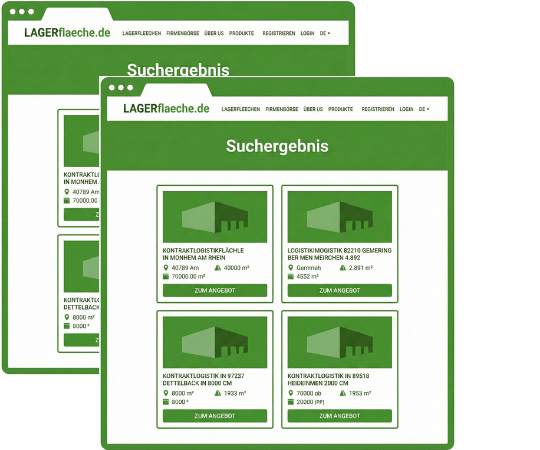
💡 Are you currently looking for the right logistics property to process your delivery orders even faster, or do you need a strong contract logistics specialist for your outsourcing? Discover future-oriented commercial space and the ideal partners for your supply chain on LAGERflaeche.de!
Your Ideal Logistics Warehouse
Browse listings for warehouse space, logistics real estate, industrial land, and contract logistics solutions.
Browse Exposés
Maximize Exposure for Your Warehouse Space
Showcase your logistics properties and attract qualified inquiries.
Discover Products