




Warehouse Control System
Table of contents
- What is a Warehouse Control System (WCS)?
- WMS vs. WCS: What's the Difference?
- The role of the WCS in modern logistics real estate
- Contract Logistics: Competitive Advantages through Automation
- Figures, data, facts: The operational impact
- Structural and technical requirements in the hall
- AI and the future of material flow control
- Frequently Asked Questions (FAQ) about the WCS
What is a Warehouse Control System (WCS)?
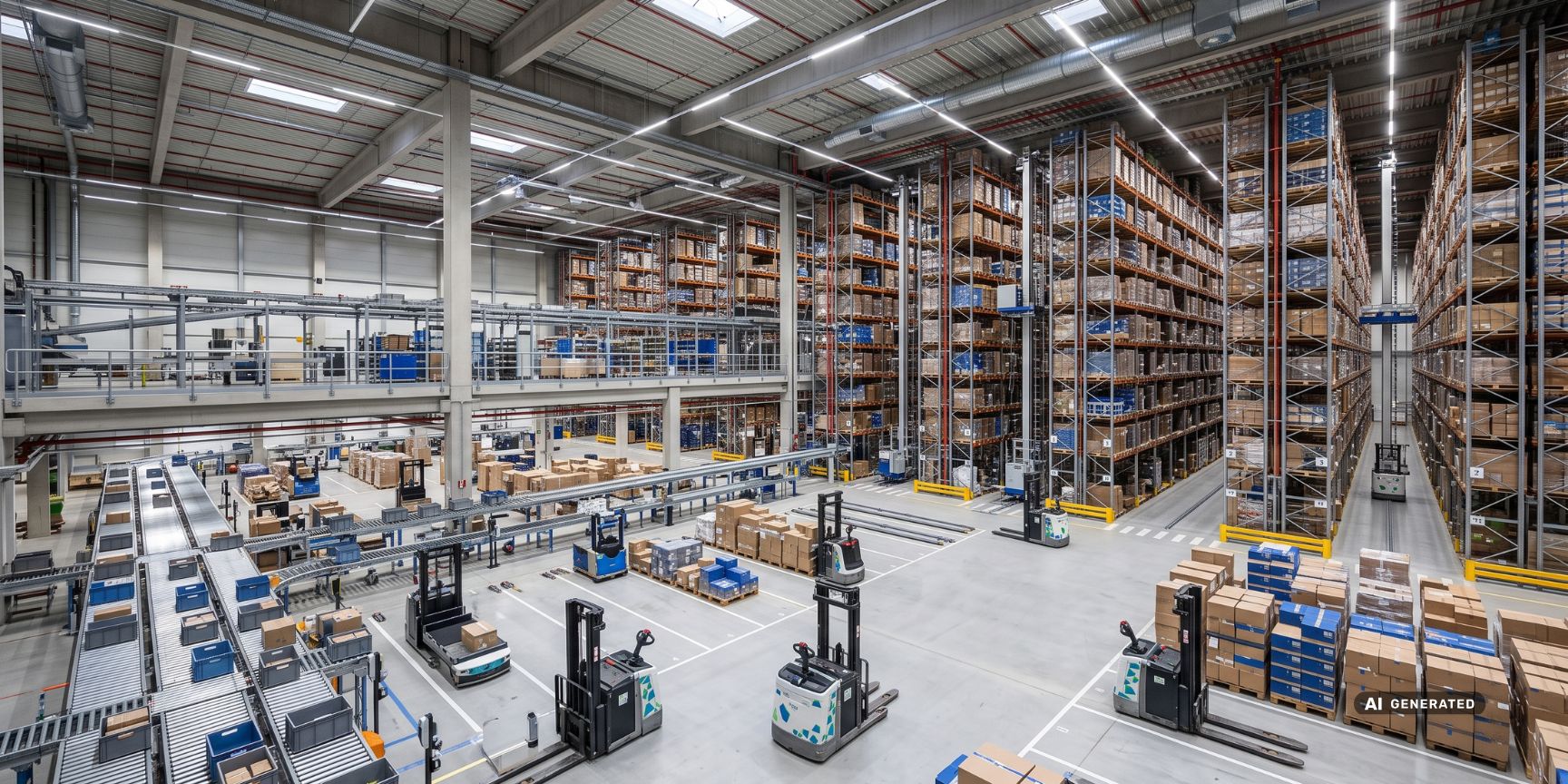
The Warehouse Control System (WCS), often referred to as a material flow computer, is the technological nervous system of a modern logistics property. While traditional warehouses still rely on paper, manual lists or rigid barcode scans, the WCS orchestrates all automated material flows within the hall in real time. It controls conveyor belts, sorters, storage and retrieval machines (SRMs) and automated guided vehicles (AGVs) every millisecond. At a time when warehouse logistics is reaching its capacity limits due to growing e-commerce and same-day delivery, the WCS is the key to smoothly synchronizing physical hardware and digital orders.
WMS vs. WCS: What's the Difference?
In the practice of contract logistics, the terms are often mixed, but their tasks are clearly separated from each other. The Warehouse Management System (WMS) acts as the "brain". It knows the inventories, plans orders and manages the customer database. The WCS, on the other hand, is the "nervous system". As soon as the WMS issues the logical command "Pallet X to loading gate 3", the WCS calculates the exact, collision-free and fastest route through the intralogistics systems of the hall. The system communicates directly with the programmable logic controllers (PLC) of the machines. Without a WCS, the most expensive automation technology in a logistics property would simply be blind and unable to act.
The role of the WCS in modern logistics real estate
A high-performance WCS fundamentally changes the architectural and infrastructural requirements for the logistics property. Automated halls have long since ceased to be simple "grey boxes". The property must be physically prepared for the millisecond communication of the WCS:
- Seamless network coverage: For the control of Autonomous Mobile Robots (AMR) by the WCS, a fail-safe WLAN or a private 5G campus network is mandatory on the entire warehouse area.
- Redundant power supply: When the WCS controls the equipment, a minimal power outage means immediate plant downtime. Uninterruptible power supplies (UPS) and emergency generators in the technical rooms are essential.
- Air-conditioned server rooms: The enormous data processing (often terabytes per day) requires high-performance edge servers directly on site (on-premises), which must be structurally protected and dedicatedly air-conditioned.
Contract Logistics: Competitive Advantages through Automation
For service providers in contract logistics, an agile WCS is a massive strategic competitive advantage. In multi-user warehouses (halls in which several customers are served), operational requirements change frequently. The WCS makes it possible to intelligently link different zones of the hall – such as a fully automated small parts warehouse (AS/RS) for e-commerce customers and a massive pallet high-bay warehouse for industry. Through dynamic route guidance (e.g. rerouting of parcels in the event of imminent traffic jams on the conveyor line), the logistics service provider guarantees its customers compliance with contractually fixed service level agreements (SLAs) and at the same time reduces transaction fees (pick rates) through optimized operating costs (OPEX).
Figures, data, facts: The operational impact
Investments in a material flow system (CAPEX) pay off measurably. The performance of a logistics property often increases exponentially with a WCS:
- Response time: A modern WCS processes sensor data from conveyor systems in less than 20 milliseconds and adjusts the material flow during operation.
- Increased throughput: By avoiding bottlenecks and optimizing routes, the throughput of goods often increases by 20 to 30% compared to systems without dynamic control.
- System availability: Permanent monitoring of hardware conditions (condition monitoring) can reduce downtimes of the hall technology by up to 40%.
Structural and technical requirements in the hall
The most intelligent WCS is of no use if the physical shell – the hall – is limited. Since the WCS orchestrates extremely dense automation solutions, the structural requirements increase massively. The enormous point loads of storage and retrieval machines require industrial floors with a load capacity of well over 50 kN/m². In addition, the strictest flatness tolerances (e.g. according to DIN 15185 for narrow-aisle warehouses) must be adhered to for industrial trucks and robots, which are navigated by the WCS with millimetre precision. The clear height of the hall (UKB) also plays a decisive role: a WCS can manage multi-storey shuttle systems, which is why forward-looking properties are often built 12 to 15 metres high or with mezzanine levels in order to make optimal use of the vertical space.

AI and the future of material flow control
The next evolutionary level in warehouse logistics is the deep integration of artificial intelligence (AI) into the WCS. So-called "predictive routing" algorithms no longer only react to current traffic jams, but predict them before they physically occur. If the system detects that a picking zone will be overloaded in the next 10 minutes, the WCS proactively throttles the conveyor speed in other hall areas or redirects autonomous robots to alternative routes. This transforms the logistics property from a rigid storage facility into a fully autonomous, learning ecosystem.
Frequently Asked Questions (FAQ) about the WCS
Question: Does a manually operated warehouse need a WCS?
Answer: No. A warehouse control system unfolds its operational benefits primarily where automated trades (conveyor belts, robots, sorters) have to be controlled. For a block warehouse operated purely manually with forklift trucks, a classic WMS is completely sufficient.
Question: Can a WCS be retrofitted in an existing property (brownfield)?
Answer: In principle, yes. However, considerable infrastructural adjustments (IT cabling, WLAN illumination, soil remediation for AMR) often have to be made. The WCS software itself is usually connected to the existing WMS via standardised interfaces (APIs).
Question: Who bears the costs for the WCS in contract logistics?
Answer: As a rule, the logistics service provider (3PL) invests in software and automation technology to reduce its internal process costs. These initial investment costs (CAPEX) are amortized by the enormous savings in personnel and are often refinanced via variable transaction fees per pick.

Your Ideal Logistics Warehouse
Browse listings for warehouse space, logistics real estate, industrial land, and contract logistics solutions.
Browse Exposés
Maximize Exposure for Your Warehouse Space
Showcase your logistics properties and attract qualified inquiries.
Discover Products