




Work Equipment in the Warehouse
Table of contents
- 1. Definition: What Is Warehouse Work Equipment?
- 2. Core Categories of Warehouse Work Equipment: A System Overview
- 3. Relevance for the Logistics Property: The Interface Between Hardware and Building Design
- 4. Work Equipment in Contract Logistics: Flexibility and Multi-User Capability
- 5. Facts and Figures: Economic ROI and Benchmarks
- 6. ESG, Occupational Safety and Future Standards
- 7. Frequently Asked Questions (FAQ)
1. Definition: What Is Warehouse Work Equipment?
In the intralogistics and labor law context (including the German Ordinance on Industrial Safety and Health / BetrSichV), the term warehouse work equipment covers all tools, devices, machines, appliances and IT systems used to carry out physical and administrative warehouse processes. The range extends from manual aids (hand pallet trucks, packing tables) and large mobile equipment (industrial trucks, narrow-aisle forklifts) to permanently installed racking systems, automated conveyor systems and software-supported data capture devices (mobile data terminals, barcode scanners). They form the operational link between the architectural shell – the commercial or logistics property – and the intralogistics material flows.
2. Core Categories of Warehouse Work Equipment: A System Overview
In practice, modern work equipment is classified along the workflow from goods receipt (GR) to goods issue (GI):
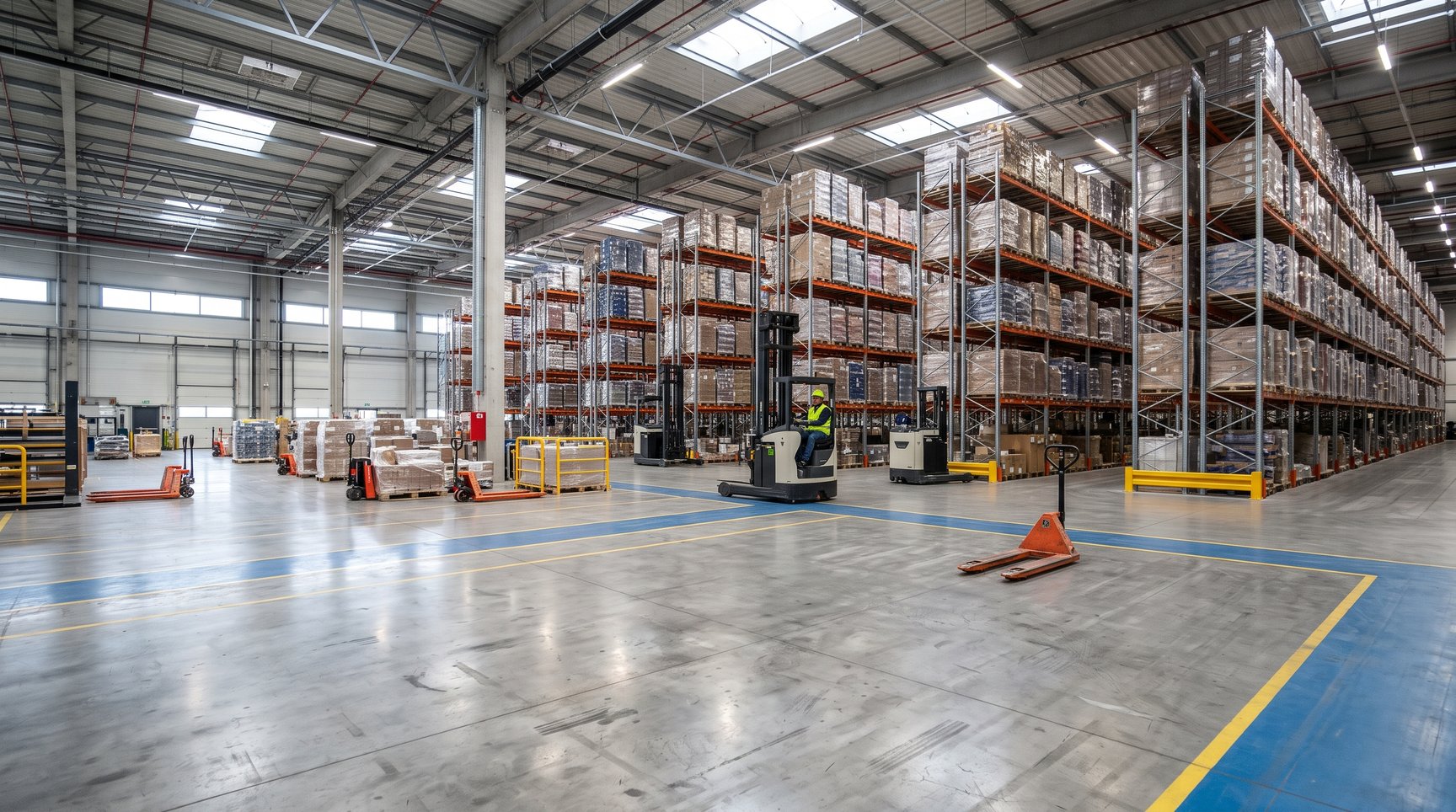
- Conveying equipment & industrial trucks: Pedestrian-operated low-lift trucks, counterbalance forklifts, reach trucks for heights of over 12 meters and automated guided vehicles (AGV/AMR).
- Storage & racking systems: Static pallet racking, shelving systems for small parts, dynamic flow racks and fully automated miniload (AS/RS) and shuttle systems.
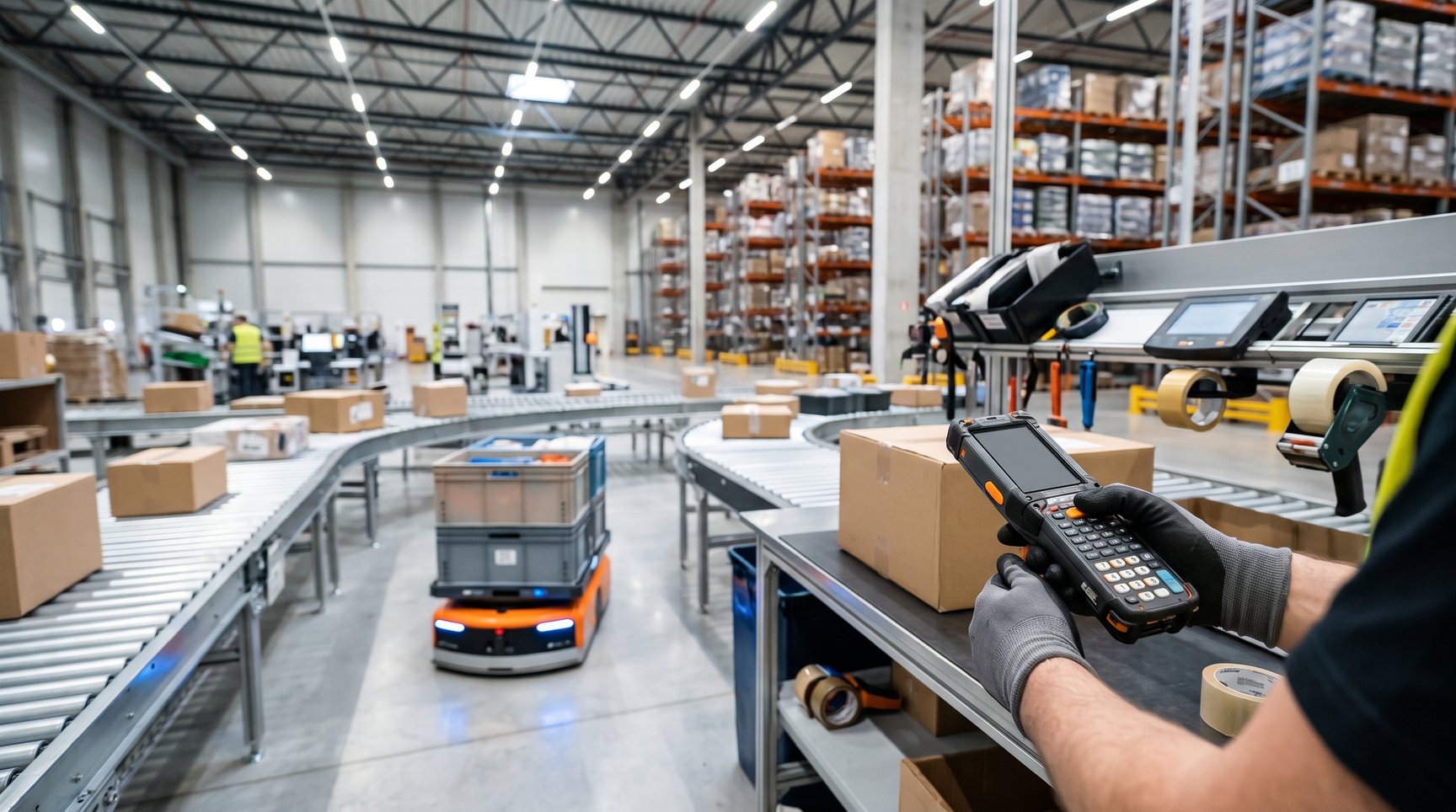
- Digital data capture & communication technology: Mobile data terminals (MDT with IP65/IP67 protection), pick-by-voice headsets, RFID gates and barcode terminals.
- Loading & dock equipment: Hydraulic dock levelers, dock seals, lift tables and truck restraint systems at the loading dock.
- Packaging & value-added service equipment: Ergonomic packing stations, semi-automatic stretch wrappers, carton sealing machines and weighing systems.
3. Relevance for the Logistics Property: The Interface Between Hardware and Building Design
Work equipment does not exist in a vacuum; its performance is directly determined by the structural parameters of the logistics property:
- Floor quality & point loads: Heavy industrial trucks and multi-level racking require heavy-duty industrial floors (standard: ≥ 50 kN/m² distributed load, or approx. 5 t/m²). In narrow-aisle operation with VNA trucks (Very Narrow Aisle), strict flatness tolerances according to DIN 15185 are mandatory.
- Clear hall height (UKB): Modern logistics halls offer clear heights of 10 to 12 meters to the underside of the roof girders. Masts and racking must be calibrated precisely to these heights in order to use vertical space without loss.
- Infrastructure for electric mobility: The switch from lead-acid to lithium-ion batteries requires fire-resistant charging zones with high connected load, modern ventilation and sensor technology.
- Network coverage: For scanner-guided MDT fleets and AGVs, 100 percent wireless coverage (industrial Wi-Fi or a 5G campus network) without shielding by steel girders is a basic prerequisite.
4. Work Equipment in Contract Logistics: Flexibility and Multi-User Capability
In contract logistics (3PL), the flexibility and changeover times of work equipment determine profitability. Since customer contracts often run for 3 to 5 years, rigid special-purpose systems carry risks. Leading service providers therefore rely on:
- Modular work equipment: Boltless shelving systems, flexible multi-user picking carts and universally configurable industrial trucks.
- Software-supported process control: Connecting mobile work equipment to higher-level Warehouse Management Systems (WMS) and Warehouse Control Systems (WCS). This typically reduces picking errors to below 0.1 %.
- Converting CAPEX into OPEX: Increasing use of rental and leasing models for forklift fleets or pay-per-pick concepts to keep fixed costs variable when volumes fluctuate.
5. Facts and Figures: Economic ROI and Benchmarks
- Travel time optimization: In manual warehouses, 50 to 60 % of working time is spent on travel. Using mobile data terminals with optimized WMS route guidance reduces travel times by up to 35 %.
- Space utilization: Modern narrow-aisle and reach truck equipment reduces working aisle widths (Ast) from approx. 3.50 m to under 1.80 m, increasing storage capacity on the same floor area by 25 to 40 %.
- Availability & maintenance: Networking industrial trucks via telematics and sensors (predictive maintenance) reduces unplanned fleet downtime by up to 40 %.
6. ESG, Occupational Safety and Future Standards
Work equipment is at the heart of modern ESG and CSRD requirements. Switching to energy-efficient electric drives, LED-lit masts and ergonomic lifting aids protects staff and reduces Scope 1 and Scope 2 emissions. From a legal perspective, regular inspections according to DGUV Regulation 68 (industrial trucks) and DIN EN 15635 (racking inspections) form the basis for liability-safe operation.
7. Frequently Asked Questions (FAQ)
Question: Which work equipment is part of the basic equipment of every logistics hall?
Answer: The indispensable basic equipment includes manual or electric low-lift pallet trucks, front-loading forklifts, standardized pallet racking, mobile data capture handhelds/scanners and certified work and packing tables with IT connectivity.
Question: What requirements do modern industrial trucks place on the hall floor?
Answer: Standard counterbalance forklifts generally require level floors with a minimum load capacity of 50 kN/m². High-bay and narrow-aisle trucks also place the highest demands on flatness according to DIN 18202 or DIN 15185 in order to prevent vibrations at great heights.
Question: How does work equipment affect the space efficiency of a logistics property?
Answer: Specialized work equipment (e.g. reach trucks, narrow-aisle equipment or mobile racking) makes it possible to reduce aisle widths significantly, so that the enclosed space up to a clear height of 12 meters is used optimally.
Question: Who is liable for the regular inspection of warehouse work equipment?
Answer: According to the BetrSichV and the DGUV regulations, the operator or employer is liable. Racking systems must be inspected by a competent person at least every 12 months in accordance with DIN EN 15635; industrial trucks are subject to the annual FEM 4.004 inspection.
Question: What role do mobile data terminals play in the error rate in the warehouse?
Answer: Thanks to software-guided scan validation directly at the storage location (scanning verification via WMS), the error rate in put-away and picking demonstrably drops to below 0.1 %.
Question: Is it worth buying or renting industrial trucks in contract logistics?
Answer: Because contract terms vary (often 3 to 5 years), contract logistics providers prefer rental and leasing models with full service. This turns high capital expenditure (CAPEX) into variable operating costs (OPEX) that can be flexibly adjusted to project volumes.
Question: How is automation (AMR / AGV) changing the choice of conventional work equipment?
Answer: Autonomous mobile robots (AMR) replace manual pallet trucks on long transport routes. They require standardized load carriers, defined transfer stations and barrier-free, clean travel routes with precise sensor detection.
Your Ideal Logistics Warehouse
Browse listings for warehouse space, logistics real estate, industrial land, and contract logistics solutions.
Browse Exposés
Maximize Exposure for Your Warehouse Space
Showcase your logistics properties and attract qualified inquiries.
Discover Products