




WGK classes in warehouse logistics
Table of contents
- What are WGK classes and why do they dominate warehouse planning?
- The three classifications: WGK 1, WGK 2 and WGK 3 in detail
- Structural requirements for the logistics property: The hall as a trough
- Contract logistics: Risk minimization through intelligent outsourcing
- Practical example: WGK-certified areas in Werneck
- Facts, figures, data: KPIs in the WGK warehouse
- FAQ: Frequently asked questions about WGK storage
- Conclusion: Challenge and strategic opportunity
What are WGK classes and why do they dominate warehouse planning?
Water is our most important resource. In modern warehouse logistics and industrial contract logistics, millions of tons of liquid and solid substances are moved every day, which could cause devastating environmental damage in the event of accidents. In order to protect groundwater and water bodies, the Water Resources Act (WHG) in conjunction with the Ordinance on Installations for the Handling of Water-Polluting Substances (AwSV) applies in Germany. At the heart of these regulations are the water hazard classes (WGK).
For project developers, operators of logistics properties and contract logistics companies, the classification of the goods to be stored in WGK classes is the most critical factor. It decisively decides on the construction costs (CAPEX), the duration of the building permits (often according to the Federal Immission Control Act, BImSchG) and the ongoing operating costs (OPEX) of the hall.
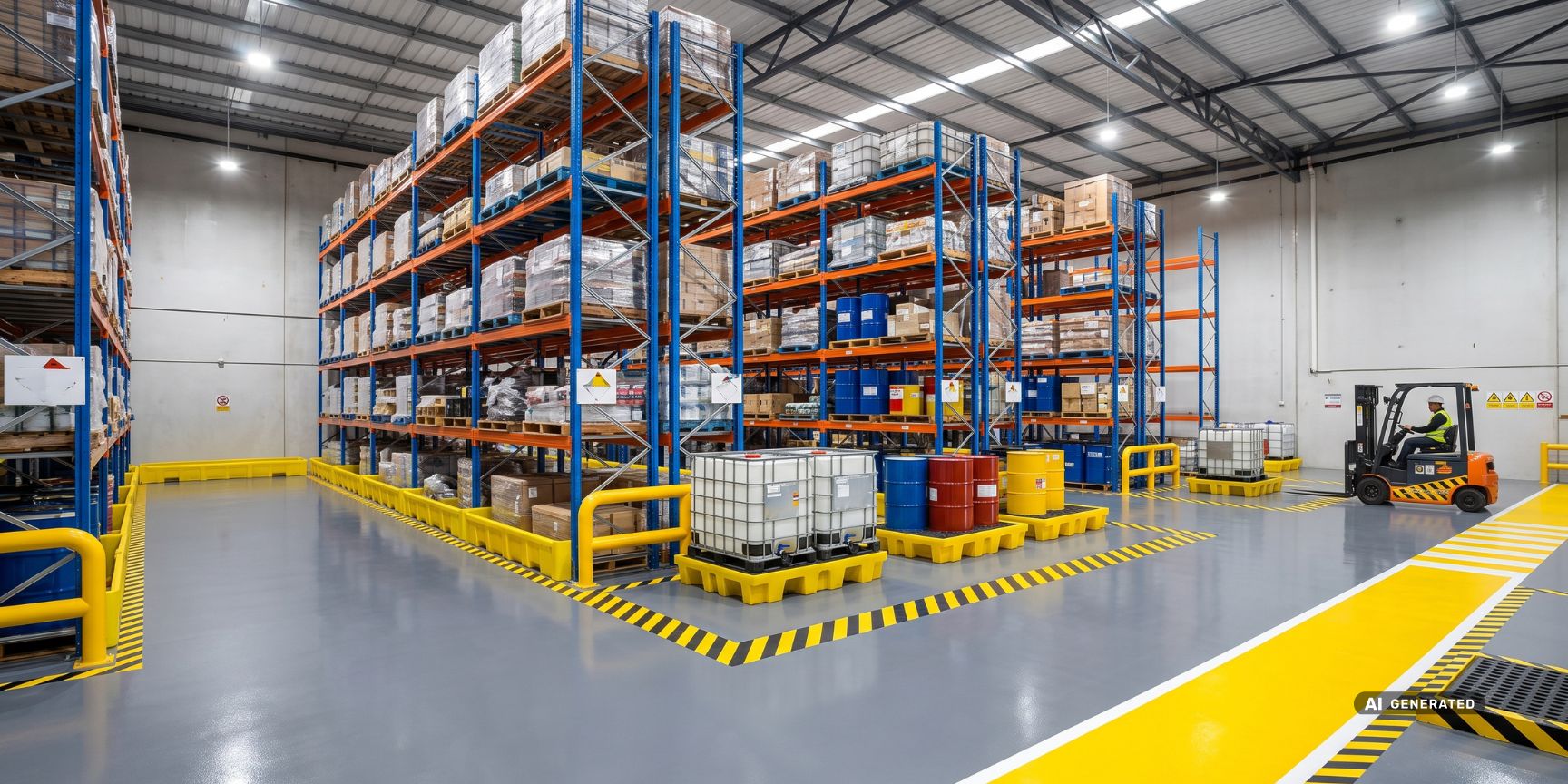
The three classifications: WGK 1, WGK 2 and WGK 3 in detail
The Federal Environment Agency classifies substances and mixtures into three hazard classes based on their toxicity and degradability. For intralogistics, each higher class means an exponential increase in safety requirements:
- WGK 1 – Slightly hazardous to water: These include, for example, diluted acids, certain cleaning agents, ethanol or antifreeze. This is the most common class in standard distribution centers.
- WGK 2 – Clearly hazardous to water: This category includes mineral oils, heating oil, diesel fuels, lubricants and many basic chemicals in the manufacturing industry. Storage already requires massive structural barriers.
- WGK 3 – Highly hazardous to water: This includes waste oils, highly toxic solvents, benzene or concentrated pesticides. Halls for WGK 3 are absolutely special properties with maximum security precautions, which are rarely built speculatively in the real estate industry, but usually as a "build-to-suit" (tailor-made) for special customers.
Structural requirements for the logistics property: The hall as a trough
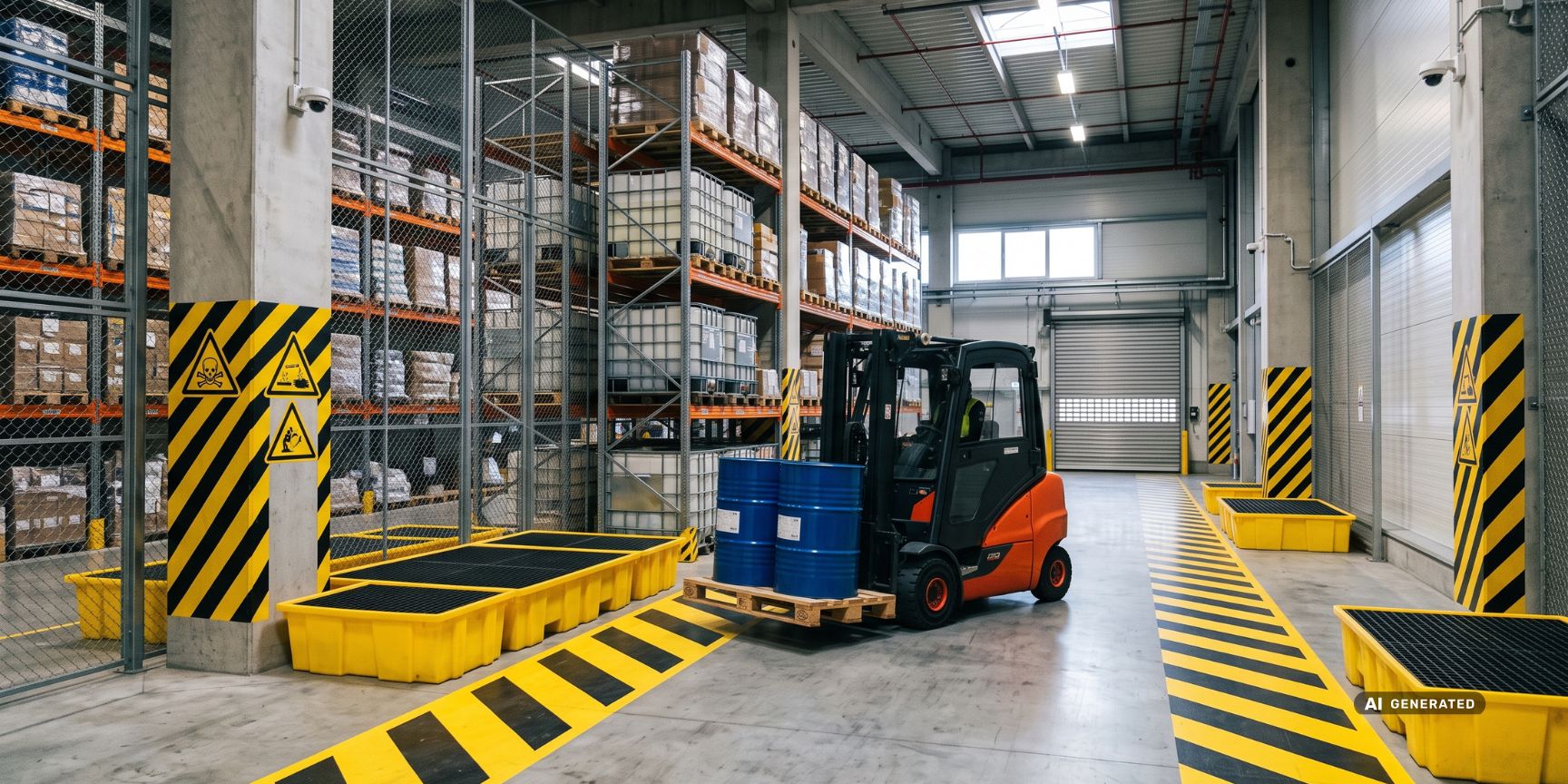
A logistics property in which WGK goods are stored is very different from a simple drying hall for consumer goods. The overriding architectural principle is: restraint. Not a drop is allowed to leave the property unchecked.
The entire floor slab of the hall must be liquid-tight in accordance with WHG specifications. Special, crack-bridging synthetic resin coatings are often applied to the industrial floor. In addition, the logistics hall (or defined fire compartments in it) acts as a huge drip pan. In the area of the loading ramps and loading gates (docks), special, inflatable dock seals and emergency thresholds will be installed. If a drum rolls off the forklift truck during unloading, the escaping liquid must be completely discharged into underground emergency pools. Standard drainage into the municipal sewer system is strictly prohibited.
Contract logistics: Risk minimization through intelligent outsourcing
The storage of water-polluting substances ties up massive amounts of capital. The maintenance of the sensor technology, the legally required inspections by experts (e.g. TÜV) and the high insurance premiums put a strain on the balance sheets of industrial and chemical companies. The strategic answer to this is outsourcing to specialized contract logistics companies.
Logistics service providers (3PL) bundle the WGK volumes of different customers in multi-user hazardous goods warehouses. In this way, the enormous infrastructure costs can be spread over several shoulders. The contract logistics company not only takes care of safe storage, but also takes care of value-added services (VAS) such as decanting, labelling and load securing in accordance with regulations. This is a highly profitable business area for the service provider: Due to the special requirements, customers often commit themselves to the location through contracts of 5 to 10 years.
Practical example: WGK-certified areas in Werneck
An excellent example of the successful implementation of such a highly specialised property in practice is the hazardous materials warehouse of Erich Löb GmbH in Werneck, where 4,000 pallet spaces are available on a modern area of around 5,000 square metres. The system is professionally designed and offers the highest level of safety and approvals for goods in water hazard classes (WGK 1 to 3) and for hazardous substances classes 2 to 9. Thanks to the strategically perfect 24/7 connection to the A7/A70 motorway junction, sensitive goods can be handled here quickly and with legal certainty.
Facts, figures, data: KPIs in the WGK warehouse
The complexity of WGK warehouses is best expressed in hard numbers. Investors and logistics planners usually work with the following industry-standard benchmarks:
- Construction costs (CAPEX) per m²: A standard hall is around 800 to 1,000 euros. WGK 2 / WGK 3 special warehouses are often between 1,400 and 2,200 euros (due to WHG floors, sensor technology and fire protection).
- Extinguishing water retention: While standard halls only have to retain minimal volume, WGK warehouses often require massive underground basins with a capacity of 500 to 2,000 cubic metres.
- Inspection intervals: AwSV systems usually require annual inspections by experts (in contrast to 3- to 5-year intervals for ordinary racking systems).
- Rental prices: Depending on the region, the prime rent of a WGK hall is often 30 to 50% higher than the rent for classic distribution centres (often €8.50 to over €12.00/m²).
FAQ: Frequently asked questions about WGK storage
Question: Are different WGK classes allowed to be stored together in one hall?
Answer: Yes, in principle it is possible. However, the strict storage rules (TRGS 510) must be observed. In addition, the technical equipment of the entire fire compartment is always based on the "worst" substance. So if there is only one pallet of WGK 3 in the warehouse, the retention capacity for this area must be designed at WGK-3 level.
Question: What happens in the event of a major fire in a hazardous materials warehouse?
Answer: The primary focus of protection is on the extinguishing water. Due to the fire and the deployment of the fire brigade (or the ESFR sprinkler system), the water mixes with the toxic WGK substances. The hall is designed in such a way that this highly toxic extinguishing water does not seep into the ground, but is collected in huge, acid-resistant retention basins under the plant and later pumped out and disposed of by specialist companies.
Question: Can outdoor storage facilities be used for water-polluting substances?
Answer: This is highly regulated. If hazardous substances are to be stored outdoors (hazardous goods warehouse), special certified hazardous goods containers with integrated drip trays must be used. In addition, the entire area must be sealed and have coalescing separators (light liquid separators) to prevent toxic substances from being washed out during rain and entering the ground.
Conclusion: Challenge and strategic opportunity
Compliance with WGK requirements is much more than just annoying bureaucracy for operators of logistics properties. At a time when sustainability (ESG) and environmental protection (CSRD) dominate the business world, state-of-the-art, WHG-compliant warehouses are essential building blocks of a clean supply chain. For contract logistics companies and real estate developers who are willing to build up the construction and process know-how, complex WGK logistics is changing from a pure cost factor to an extremely high-margin and future-proof market niche.
Your Ideal Logistics Warehouse
Browse listings for warehouse space, logistics real estate, industrial land, and contract logistics solutions.
Browse Exposés
Maximize Exposure for Your Warehouse Space
Showcase your logistics properties and attract qualified inquiries.
Discover Products