




Delivery order in logistics
Table of Contents
- What is a Delivery order? (Definition & Basics)
- The delivery order from the perspective of warehouse logistics
- Contract Logistics: The Legal and Operational Foundation
- Logistics property & hall: The physical shell dictates the pace
- Facts, figures, data: KPIs of the delivery order
- Digitization & Automation in Order Processing
- Frequently asked questions (FAQ) about the delivery order
- Conclusion: The delivery order as the pulse generator of the supply chain
What is a Delivery order? (Definition & Basics)
A delivery order is the central information technology and operational document in the supply chain that controls the process from order receipt to goods issue. It forms the formal instruction to warehouse personnel or automated systems to assemble specific items in defined quantity, quality and packaging for a customer and to ship them on time.
In modern IT ecosystems, the delivery order is generated in the shipper's Enterprise Resource Planning (ERP) system and transferred to the Warehouse Management System (WMS). There it is translated into concrete pick orders and picking lists. It is therefore the indispensable digital bridge between the commercial sales process and physical intralogistics.

The delivery order from the perspective of warehouse logistics
In operational warehouse logistics, the delivery order is the pacesetter for the entire material flow. As soon as it arrives at the WMS, a highly complex algorithm for route optimization starts. The system decides whether the order is to be processed via single-order picking (one order after the other) or batch picking (bundling of several delivery orders on one route).
Each line on a delivery order corresponds to a pick line (order line). The efficiency of warehouse logistics is measured directly by the processing speed of these lines. A poorly structured delivery order or insufficiently maintained article master data (incorrect volumes or weights) lead to incorrect carton calculations, which massively delays the packing process and drives up shipping costs.
Contract Logistics: The Legal and Operational Foundation
For logistics service providers (3PL) in contract logistics, the delivery order is not just a work instruction, but a billing-relevant document. Each processed delivery order is the basis for invoicing the customer (often billed as "pay-per-order" or "pay-per-pick").
In addition, delivery orders in contract logistics are closely linked to strict service level agreements (SLAs). Exact cut-off times apply: If, for example, a delivery order arrives electronically at the multi-user warehouse by 3:00 p.m., it is guaranteed to be handed over to the carrier (CEP service) on the same day. In addition, many delivery orders today include value-added services (VAS), such as the enclosing of specific delivery notes, flyers, return labels or product-specific outer packaging.
Logistics property & hall: The physical shell dictates the pace
At first glance, an abstract data line (the delivery order) and the building (the logistics property) have little in common. In intralogistics practice, however, they are inextricably linked. The hall layout (e.g. U-Shape, I-Shape or L-Shape) determines how quickly a delivery order can be physically implemented.
If a delivery order requires cross-docking processes (direct handling without storage), the hall must have sufficient loading gates (rule of thumb: 1 door per 1,000 m² of warehouse space) and spacious pre-zones. If a delivery order includes extremely high-speed goods (A-items), the support grids of the logistics property must be planned in such a way that the shelves for these fast-moving goods can be placed in the immediate vicinity of the outgoing goods zone (WA) without blocking routes. An outdated industrial floor with poor evenness slows down narrow-aisle forklifts and thus delays the processing of each individual delivery order.
Facts, figures, data: KPIs of the delivery order
The performance of a warehouse can be precisely measured by key figures (KPIs) related to the delivery order:
- Order lead time: The time span from the arrival of the delivery order in the WMS to its provision at the loading dock. Top warehouses achieve values of less than 45 minutes here.
- Error rate: An industry-standard pick error rate is less than 0.3% for paperless picking. Faulty delivery orders cause expensive returns and put a strain on margins.
- Proportion of travel time: In manual halls without optimal WMS control, up to 60% of the processing time of a delivery order is attributable to the mere walking and driving distances of the personnel.
Digitization & Automation in Order Processing
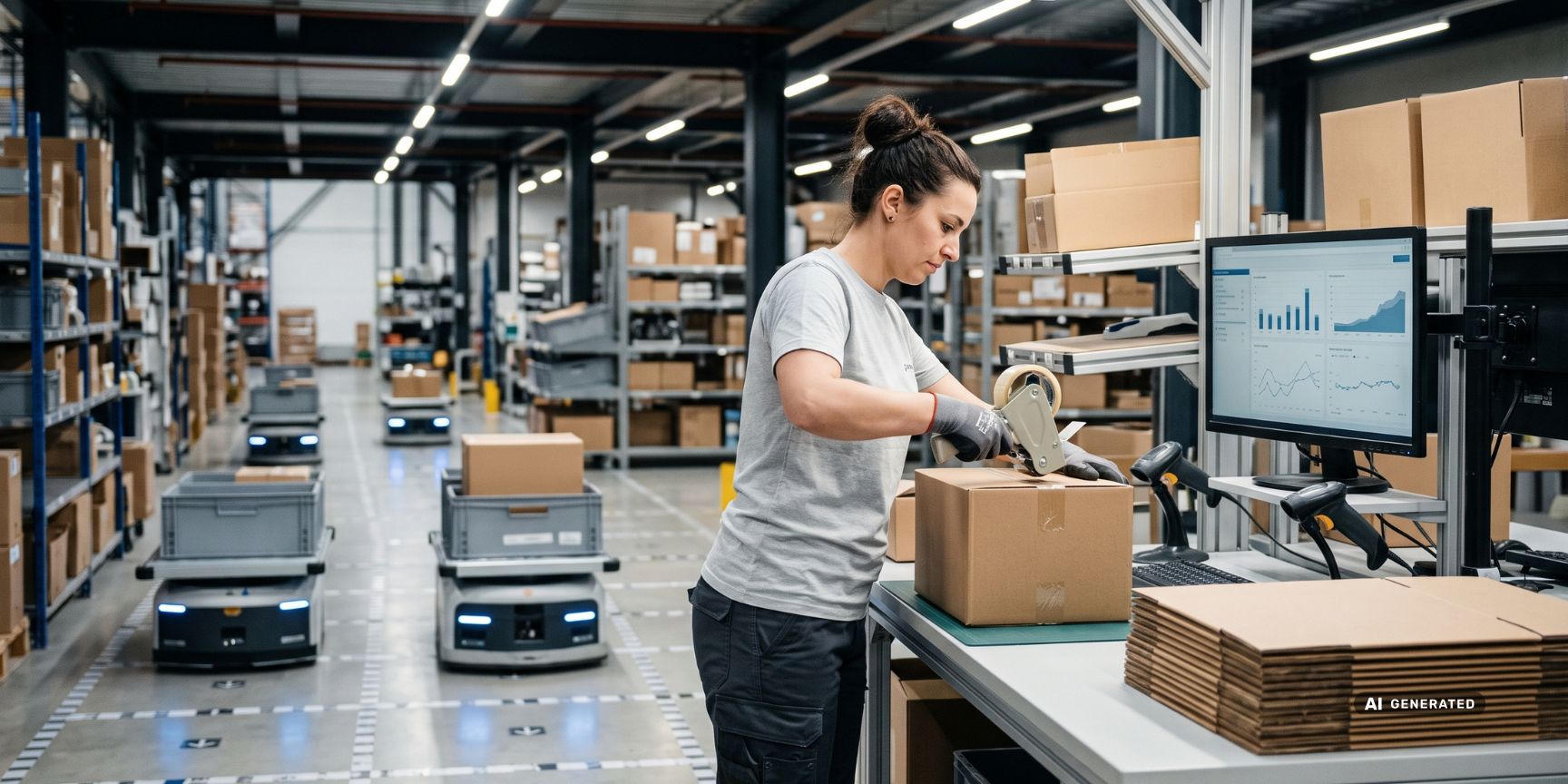
The classic paper delivery note has become obsolete in modern fulfillment. Today, systems communicate in milliseconds. When an end customer clicks "Buy" in e-commerce, the delivery order is sent directly to the Warehouse Control System (WCS) via an API interface.
There, autonomous mobile robots (AMR), pick-by-voice or pick-by-light systems take over the physical implementation. Automation enables dynamic "wave picking", in which hundreds of delivery orders are intelligently grouped into waves in order to perfectly control the load on the conveyor technology and personnel throughout the day. As a result, the hall mutates from a pure storage room to a highly dynamic application machine.
Frequently asked questions (FAQ) about the delivery order
Question: What is the difference between a delivery order and a picking order?
Answer: The delivery order is the higher-level document from the commercial system (What should be delivered to whom?). The WMS splits this delivery order into one or more picking orders (How, where and in what order are the items physically collected in the warehouse?).
Question: How does a delivery order affect warehouse range?
Answer: Every fulfilled delivery order reduces physical inventory. Modern WMS systems analyze the frequency of delivery orders to dynamically adjust reorder levels and thus calculate the optimal warehouse yield without blocking expensive warehouse space.
Question: What role does the delivery order play in the LkSG?
Answer: As part of the Supply Chain Due Diligence Act (LkSG), companies must ensure transparency in their supply chain. The digital delivery order serves as proof of where goods come from, which contract logistics company handled them and whether the associated service providers (e.g. for transport and packaging) work in compliance with the requirements.
Conclusion: The delivery order as the pulse generator of the supply chain
The delivery order is much more than a simple request to ship. It is the heart of operational logistics. Its structure and the speed of its processing are decisive for customer satisfaction and the profitability of a company. In order to process delivery orders as efficiently as possible, three factors must harmonize perfectly: seamless IT integration between ERP and WMS, an experienced contract logistics specialist for operational implementation, and a logistics property whose architecture supports the flow of materials without compromise. Those who master this triad transform the delivery order from an administrative act into a real competitive advantage.
💡 Are you currently looking for the right logistics property to process your delivery orders even faster, or do you need a strong contract logistics specialist for your outsourcing? Discover future-oriented commercial space and the ideal partners for your supply chain on LAGERflaeche.de!
Your Ideal Logistics Warehouse
Browse listings for warehouse space, logistics real estate, industrial land, and contract logistics solutions.
Browse Exposés
Maximize Exposure for Your Warehouse Space
Showcase your logistics properties and attract qualified inquiries.
Discover Products