




Dry storage in warehouse logistics
Table of Contents
- Dry storage: The comprehensive guide to logistics and real estate
- What exactly is a dry storage facility?
- Contract logistics: Which industries use drying halls?
- The Logistics Property: Structural Requirements and Architecture
- Cost-effectiveness: CAPEX, OPEX and third-party usability
- Intralogistics and automation in dry storage
- Frequently Asked Questions (FAQ) about dry storage
- Conclusion: The backbone of the modern supply chain
Dry storage facility: The comprehensive guide to logistics and real estate
In the logistics industry, when people talk about new mega-hubs or regional distribution centres, in the vast majority of cases they are talking about a very specific type of property: dry storage. But what at first glance looks like a simple, covered hall is in fact a highly complex platform for modern contract logistics.
In this guide, we examine dry storage facility from the perspective of logistics service providers, real estate investors and supply chain managers.
What exactly is a dry storage facility?
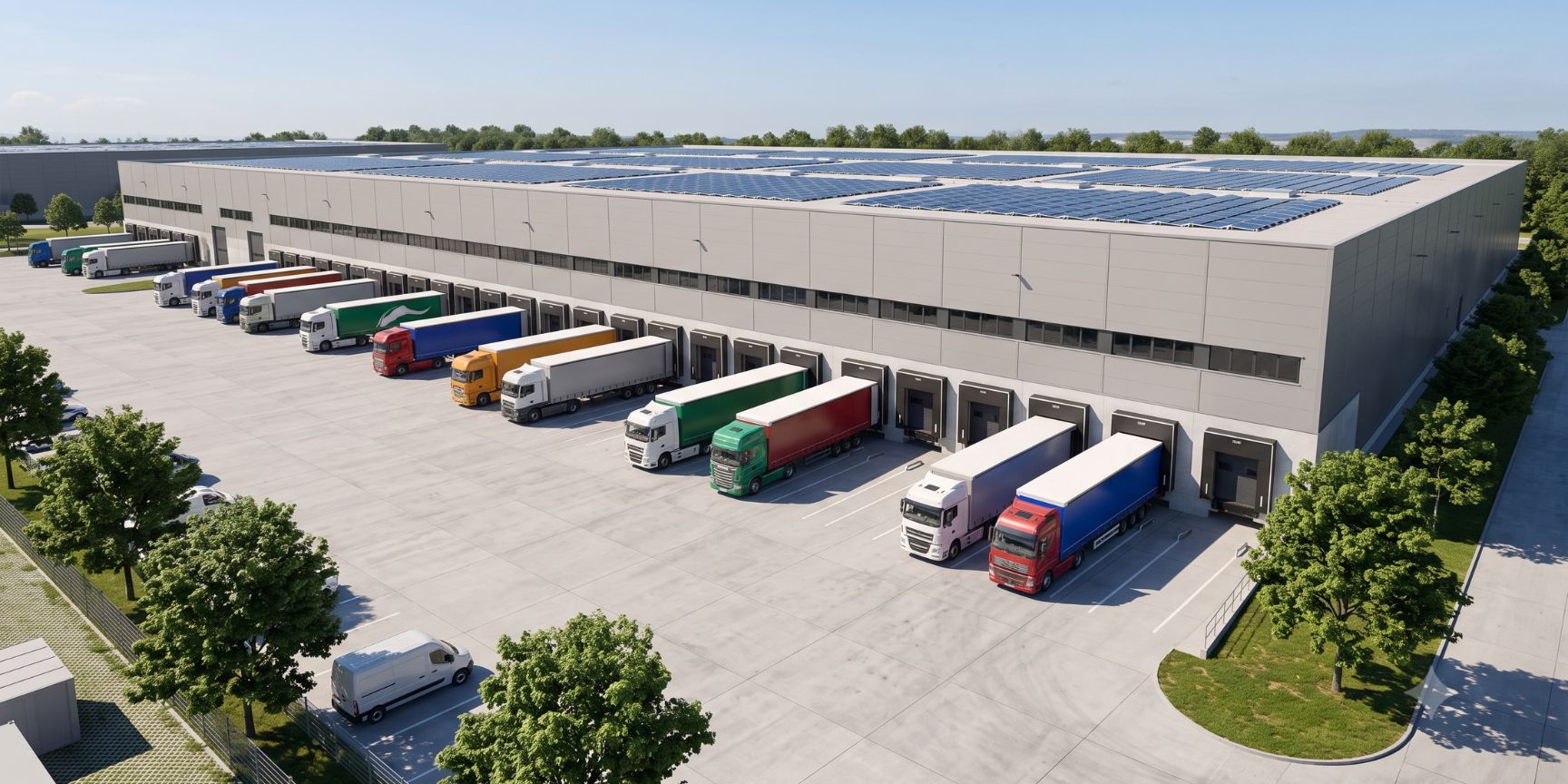
A dry warehouse (often referred to as an ambient warehouse or dry storage facility in an international environment) is a logistics property that is primarily designed to protect goods from direct weather influences such as rain, snow, wind and direct sunlight.
In contrast to cold storage or deep-freeze storage, dry storage does not have active temperature control for cooling. It is only ensured that the hall remains frost-free (usually by dark radiators or heat pumps from approx. +5 °C) and is sufficiently ventilated to avoid heat build-up in summer.
Contract logistics: Which industries use drying halls?
For contract logistics companies, dry storage is the absolute all-purpose weapon. Since the climatic conditions are stable, but not extreme, a wide variety of flows of goods can be bundled here (multi-user concept). Typical goods include:
- E-Commerce & Retail: Apparel, Electronics, Housewares and Furniture.
- FMCG (Fast-Moving Consumer Goods): Non-refrigerated food (canned food, pasta, beverages) and drugstore items.
- Industry & Automotive: Spare parts, packaging materials, raw materials and insensitive components.
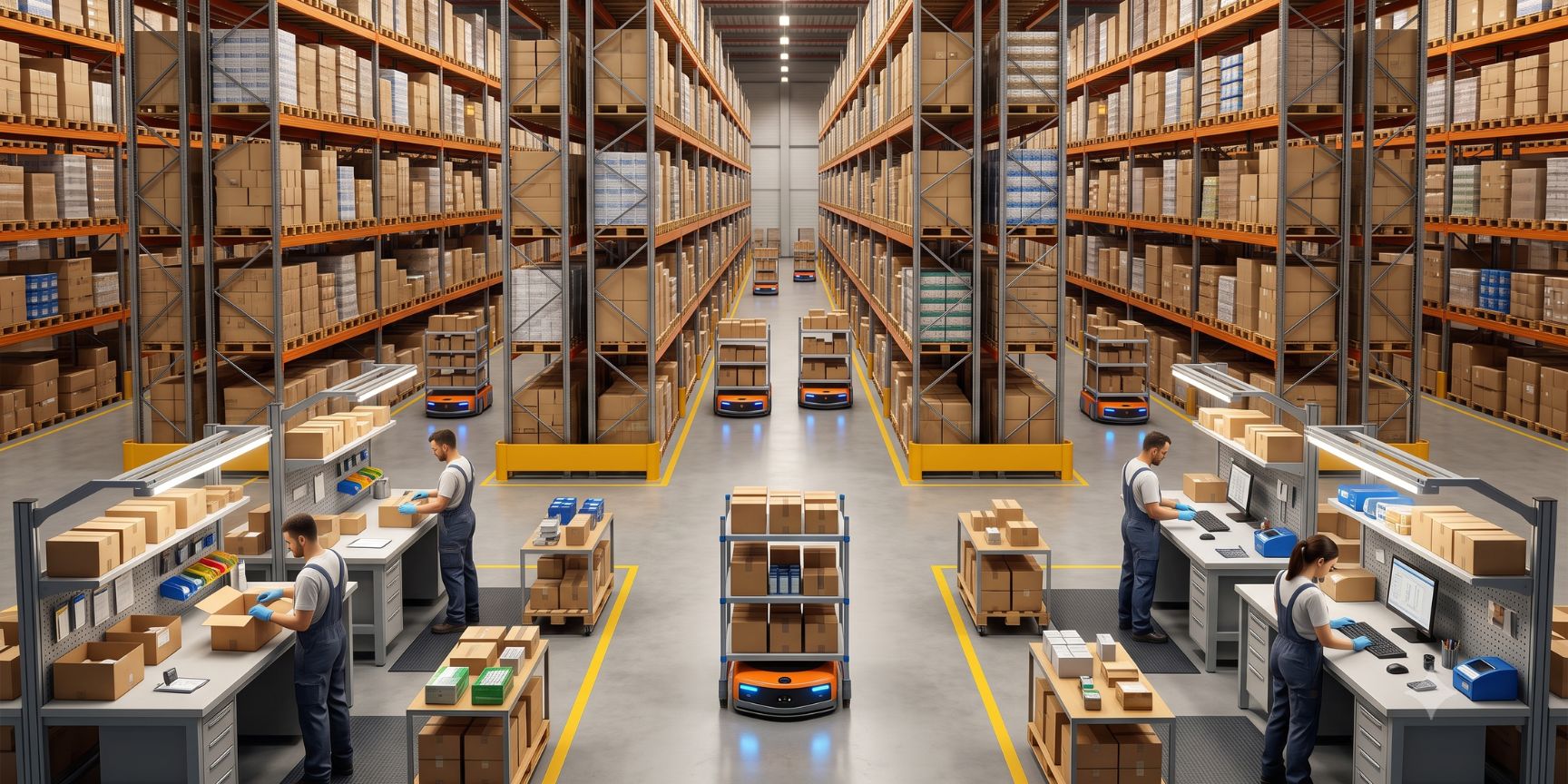
In addition, the dry storage facility offers the ideal environment for Value Added Services (VAS). Since employees do not have to work in thick protective clothing at sub-zero temperatures, complex services such as quality controls, kitting (set formation) or returns management can be carried out highly efficiently directly in the hall.
The Logistics Property: Structural Requirements and Architecture
Even if a dry storage facility does not require refrigeration units, the structural standards are enormously high. Today, investors and project developers are guided by strict standards (often called the "German Standard") in order to keep the property stable in value in the long term. The hard facts (numbers, data) of a modern drying hall include:
- Hall height: The standard clearance height (lower edge truss - UKB) is currently 10 to 12 metres in order to make optimum use of high-bay systems.
- Floor load: The industrial floor (usually steel-fibre-reinforced concrete) must withstand a load capacity of at least 50 kN/m² (equivalent to approx. 5 tonnes per square metre) and be extremely flat (important for industrial trucks).
- Fire protection: Powerful ESFR sprinkler systems (Early Suppression Fast Response) and fire walls are mandatory.
- Delivery: On average, one truck loading door (dock leveller) plus one ground-level sectional door is calculated per 1,000 m² of hall space.
Cost-effectiveness: CAPEX, OPEX and third-party usability
Why do investors love dry storage? The magic word is third-party usability. When a tenant moves out, a standard drying hall (grey box) can be rented to the nearest logistics provider with minimal effort. The risk of vacancy is close to zero.
The concept also scores points in terms of costs (CAPEX = investment costs, OPEX = operating costs). While the construction of a specialized deep-freeze warehouse quickly devours more than 1,200 euros per square meter, modern dry warehouses can often be built for as little as 700 to 900 euros per square meter. By dispensing with energy-intensive cooling technology and using LED lighting and photovoltaics on the roof (ESG compliance), the ongoing energy costs (OPEX) also remain manageable.
Intralogistics and automation in dry storage
The layout of a dry warehouse offers maximum freedom for intralogistics. From simple floor block storage for bulky goods to classic pallet wide-aisle storage to fully automated narrow-aisle storage (VNA), everything is possible.
The current trend is strongly towards automation: Autonomous Mobile Robots (AMRs) and Automated Guided Vehicles (AGVs) are ideal for use in dry storage, as the moderate temperatures do not affect the battery performance of the robots – in contrast to the deep-freeze warehouse.
Frequently Asked Questions (FAQ) about dry storage
Question: Does a dry storage facility need building insulation?
Answer: Yes, absolutely. Even if there is no active cooling, the roof and façade must be excellently insulated (usually by sandwich panels). This prevents the dew point effect. Without insulation, condensation (dripping water) would form on the hall ceiling and rain on the stored goods, leading to massive damage.
Question: What is the humidity in dry storage?
Answer: In a standard dry storage facility, the humidity is usually not actively regulated, it adapts to the outside climate (often between 40% and 65%). For extremely moisture-sensitive goods (such as certain types of paper or electronics), the hall must be upgraded to an air-conditioned warehouse with active dehumidification technology.
Question: Is it allowed to store hazardous substances in normal dry storage?
Answer: Only in very limited, household quantities (small quantity regulation). For real hazardous materials logistics (e.g. chemicals, large quantities of lithium-ion batteries), the dry storage facility has to be massively rebuilt – with special extinguishing water retention basins, separate fire compartments and acid-resistant floors.
Conclusion: The backbone of the modern supply chain
Dry storage is and will remain the absolute linchpin of global warehouse logistics. If you are a shipping company or e-commerce retailer looking for scalable space, you will find the perfect balance of cost efficiency and operational flexibility here. For contract logistics companies, the drying hall offers the ideal setting to generate healthy margins through automation and value-added services.
💡 Are you currently looking for a suitable logistics property to optimize your supply chain, or do you need experienced contract logistics specialists for your warehousing? On LAGERflaeche.de you will find state-of-the-art dry storage facilities throughout Germany and the right partners for your growth!

Your Ideal Logistics Warehouse
Browse listings for warehouse space, logistics real estate, industrial land, and contract logistics solutions.
Browse Exposés
Maximize Exposure for Your Warehouse Space
Showcase your logistics properties and attract qualified inquiries.
Discover Products