


The Logistics Turbo: How the "Right to Repair" will Revolutionize the After-sales Market in 2026
Table of Contents
- The New Spare Parts Obligation 2026: More than just a Warranty Extension
- The Global Comparison: Where does Germany Stand, Where does the World Stand?
- The Economic Dimension: After-sales as a Billion-dollar Market
- Technological Enablers: How AI and 3D Printing Save Stockpiling
- Practical Example: The "Smart-Fix" Approach of an Electronics Manufacturer
- The Role of External Service Providers: Are Manufacturers becoming Pure Distributors?
- Sustainability as ROI: The "Green Logistics" Factor
- Conclusion: Strategic Recommendations for Action for 2026
The throwaway society is facing its legal end. From summer 2026, far-reaching regulatory measures will take effect that will fundamentally change the business model of many manufacturing companies. What is a victory for consumer advocates and a relief for the environment presents the logistics industry with a monumental task: the transformation from linear to circular spare parts logistics.
But what specific requirements will German companies face? How does Germany fare in an international comparison with pioneers such as France or the USA? And above all: How can a profitable new sales market be generated from a legal obligation?
In this technical article, we analyze the depth of the new regulations and show practical solutions for logistics decision-makers.
The New Spare Parts Obligation 2026: More than just a Warranty Extension
The EU Directive on the "Right to Repair" (Directive (EU) 2024/1799) will be transposed into German national law by summer 2026. While in the past the principle of "buying new instead of repairing" often applied after the expiry of the two-year warranty, manufacturers are now obliged to keep spare parts in stock for a period of 5 to 10 years (depending on the product group).
Key points of the new regulation:
- Availability: Spare parts must be available within a reasonable period of time (usually 15 working days).
- Accessibility: Information on repairs and spare parts must be accessible to independent repairers and end users on a non-discriminatory basis.
- Pricing: The cost of spare parts must not have a disproportionately negative influence on the repair decision (prohibition of exorbitant prices for small parts).
The central question for logistics: How do you manage tens of thousands of additional SKUs (stock keeping units) over a decade without storage costs eating up the margin?
The Global Comparison: Where does Germany Stand, Where does the World Stand?
The implementation of the right to repair varies greatly around the world. Companies that operate globally must take these discrepancies into account in their supply chain strategy.
| Land/Region | Status of legislation | Special features | Logistical focus |
| Germany (EU) | Implementation by summer 2026 | Focus on home appliances & consumer electronics. | Central European hubs, fast last-mile. |
| France | Pioneer (since 2021) | "Reparatur-Index" ist Pflicht. | Focus on transparency and local parts availability. |
| United States of America | Fragmented (e.g. New York, California) | Strong movement at the state level; Focus on software locking. | Decentralized warehousing, focus on software updates. |
| China | In development | Focus on industrial standardization and circular economy. | Economies of scale, mass production of standard parts. |
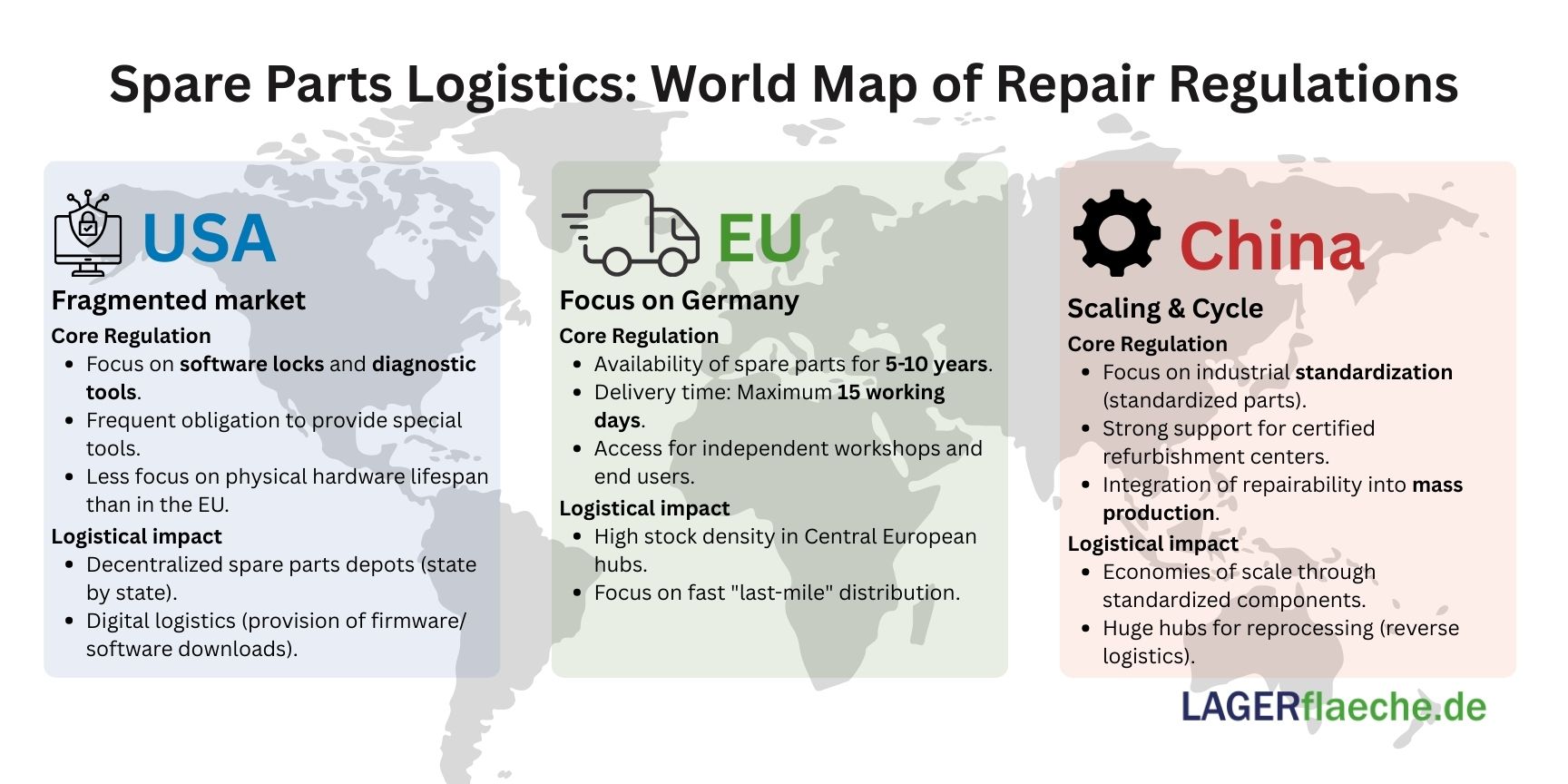
Why these differences? In France, repair is seen as part of the national decarbonization strategy. Due to the strong tech lobby, the USA focuses primarily on access to diagnostic software. Germany, on the other hand, relies on industrial precision and integration into existing Industry 4.0 structures.
The Economic Dimension: After-sales as a Billion-dollar Market
Why is this topic so lucrative for logistics? According to data from Statista and the Wuppertal Institute, e-waste causes over 62 million tons of waste worldwide every year (as of 2022). The economic potential of the repair industry in the EU is estimated at an additional 4.8 billion euros gross domestic product.
For logistics service providers (3PLs), this means:
- Longer storage cycles: Parts no longer have to be kept in stock for 2 years, but for 10 years.
- Reverse logistics: Defective old parts must be returned, checked and, if necessary, refurbished.
- Finishing: Logisticians are increasingly taking on technical inspections or pre-assembly of repair kits.
Technological Enablers: How AI and 3D Printing Save Stockpiling
A warehouse full of "slow-movers" that may never be called up is every CFO's nightmare. This is where modern technologies come in to efficiently fulfill the new obligation.
Predictive Analytics & KI
Through the use of artificial intelligence, probability of failure can be precisely calculated. Instead of storing 10,000 displays on suspicion, the AI calculates the actual demand of about 2,300 units for the next 5 years based on usage data and historical error rates.
- Advantage: Reduction of tied-up capital by up to 30%.
Additive manufacturing (3D printing)
Do we still need to physically store plastic covers for a washing machine from 2026 in 2034? No. The "Virtual Warehouse" is the solution. Companies store digital CAD data and print the spare part only when ordering ("print-on-demand").
- Fact: Gartner estimates that by 2030, around 20% of non-critical spare parts will be additively manufactured.
Practical Example: The "Smart-Fix" Approach of an Electronics Manufacturer
Let's take a look at a medium-sized German company that produces high-quality fully automatic coffee machines.
Challenge:
150 different components per model, 10 years of spare parts obligation for 20 models. This results in 3,000 active SKUs for after-sales alone.
Solution:
- Modularization: Redesign of the devices so that 70% of the spare parts (pumps, grinders) are identical across model series (common parts strategy).
- Logistics outsourcing: A specialized spare parts logistics company not only takes care of the storage, but also operates a "repair center".
- The result: The repair rate increased by 40 points within one year, customer satisfaction (NPS) by 15 points, while logistics costs per part fell due to bundling effects.
The Role of External Service Providers: Are Manufacturers becoming Pure Distributors?
The new regulation expressly allows external service providers to be used for repairs and the provision of spare parts. This opens up a new business area for service logistics companies.
Interesting questions for companies:
- Do I need to build my own network or do I use white-label repair centers?
- How do I guarantee the quality of the repair with external partners?
Answer: Logistics is becoming a guarantee of quality. Through track-and-trace and certified spare parts kits, the logistics specialist ensures that the independent technician in Brandenburg also installs the original part in manufacturer quality.
Sustainability as ROI: The "Green Logistics" Factor
The obligation to supply spare parts is a core component of the circular economy. CO2 balances of companies (Scope 3 emissions) improve massively when products last longer.
Data fact: The production of a new smartphone causes about 80-90% of its total lifetime CO2 emissions. A repair consumes only a fraction of this energy for transport and small parts production (source: European Environmental Bureau).
Logistics companies that offer green supply chains (e-vans for the last mile, reusable packaging for spare parts) are becoming preferred partners for manufacturers who need to meet their sustainability goals.
Conclusion: Strategic Recommendations for Action for 2026
The new spare parts requirement from summer 2026 is not a necessary evil, but a wake-up call for more efficient, digital and sustainable logistics.
What you should do now:
- Data inventory: Analyze your current spare parts inventories and their turnover frequency.
- Push modularization: Talk to product development about "Design for Repair".
- Check partnerships: Look for logistics partners who not only store, but also technically refine and master 3D printing.
- Digital infrastructure: Invest in portals that allow end customers and independent workshops to order parts easily.
Latest Blog Posts
Stay up to date with the newest trends, insights, and tips in warehouse and logistics. Our latest articles help you navigate the industry with confidence.

Data Centres vs. Logistics Facilities: The Race for Power and Land
Across Europe, logistics operators are competing for more than land and transport access. They increasingly need something much harder to secure: grid capacity. Data centres are intensifying that competition — and changing how logistics locations are evaluated....

Chinese companies discover Europe's logistics real estate
Chinese companies are becoming an increasingly visible user group in Europe's logistics real estate market. What does this mean for warehouse space, 3PL structures and the requirements for European logistics locations?...
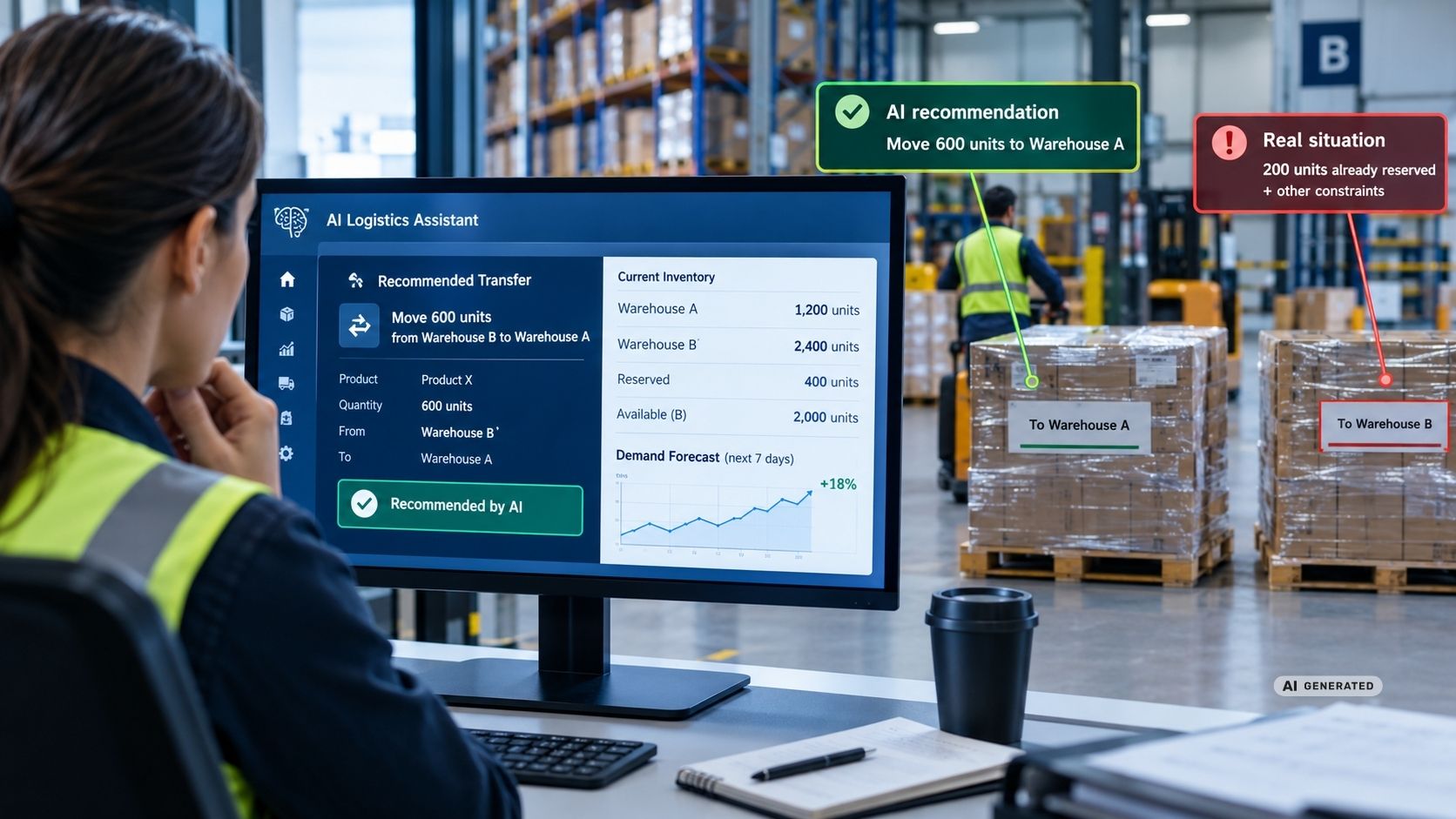
AI Hallucinations in Logistics: When AI Plans the Wrong Delivery
AI can analyze enormous amounts of logistics data — but it can also produce a convincing answer that is simply wrong. The critical question is not whether AI makes mistakes, but what happens when a wrong recommendation becomes an operational decision....
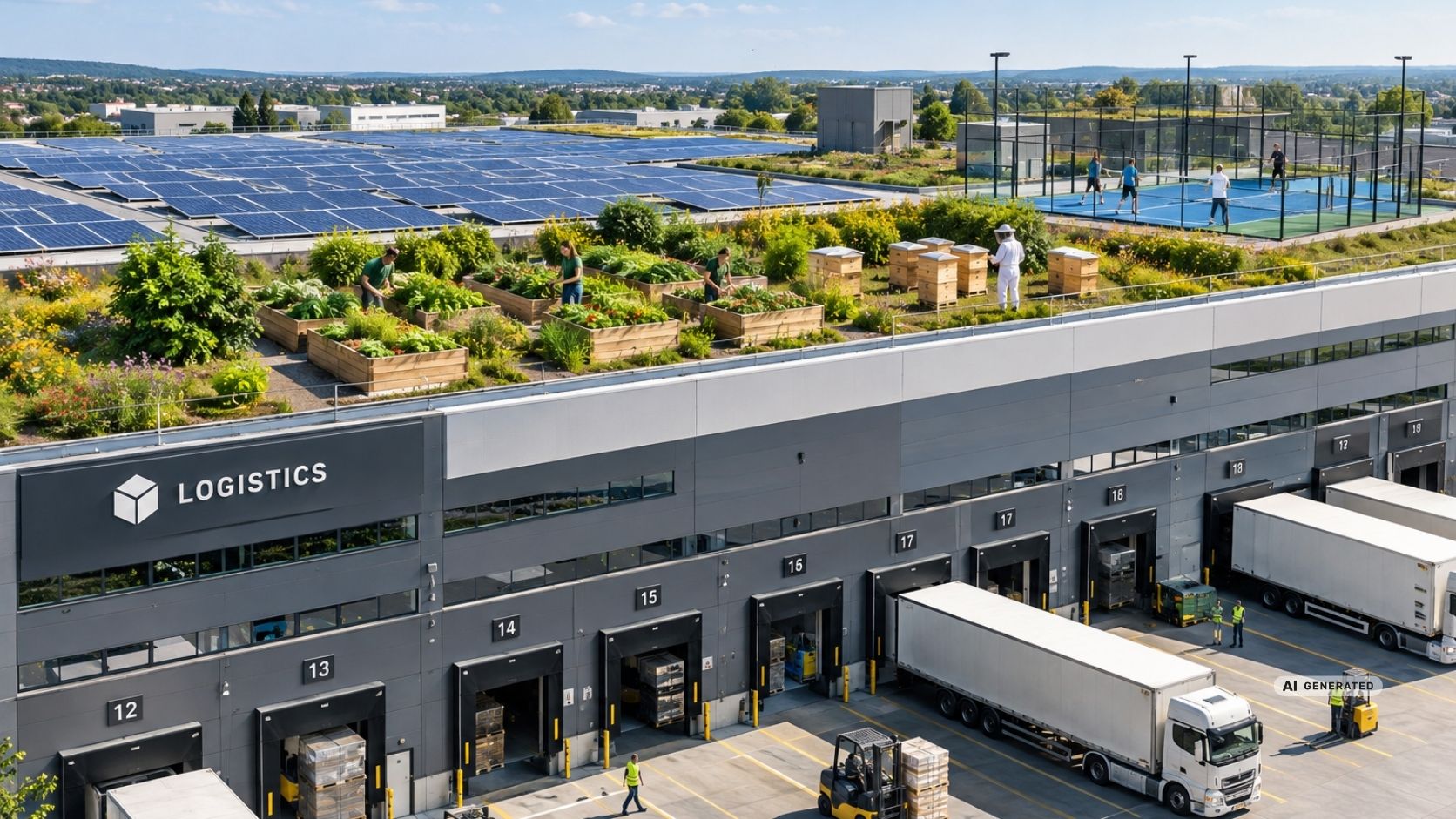
The Green Revolution on the Hall Roof: From Concrete Block to Ecological Power Plant?
Logistics roofs can do more than PV: greening, bees, urban farming and even sports areas turn unused roof space into multifunctional rooms....