



Empties management in beverage logistics: why returns block the yard – and what space, data and zones change
Why empties management turns the yard into a bottleneck: how zones, capture and the right space win back dock time, liquidity and deposit balances. With an empties yard check and a worked example....
Hidden Vacancy: How Unused Industrial and Logistics Space Comes Back to the Market
Logistics space is scarce – yet some buildings stand half empty without ever being listed. We explain what lies behind hidden vacancy, how space holders can measure it and reactivate it on a sound legal footing, and what this means for companies looking for space....
Empties management in beverage logistics: why returns block the yard – and what space, data and zones change
Table of contents
- Empties management: why the yard becomes the bottleneck on returns
- Why empties take so much sorting work in Germany
- Deposit gaps: what wrongly booked empties cost
- The process chain in the yard: from advance notice to zone
- Space and construction: what an empties yard must be able to do
- Our view as a portal: space is the bottleneck
- International comparison: what other markets do differently
- Worked example: what can pay off in the yard
- Where we could be wrong
- Empties yard check
- Conclusion: space first, then technology
Empties management is treated as a side process until the yard is full. Then trucks queue at the gate, stacks of crates are moved from corner to corner, and at month-end the deposit balances do not match. Our thesis: the empties problem is above all a space and yard problem, not a software problem. Software only helps once zones, surfaces, permits and buffer space are right.
Empties are a special case of returnable packaging management: deposits, crates, bottles and seasonal peaks meet in a small space. This article is for beverage logisticians, drinks wholesalers and breweries who want to get their yard under control, and for companies looking for space to do it.
Empties management: why the yard becomes the bottleneck on returns
Deliveries of full goods are tightly scheduled; the return flow usually is not. Trucks come back with mixed crates of own and foreign empties. If the driver has to count every pallet, separate by brand or sign on paper, dwell times grow: trucks queue at the gate, detention charges fall due and the docks become scarcer. We describe waiting times and detention charges in a separate article. The knock-on costs are less visible:
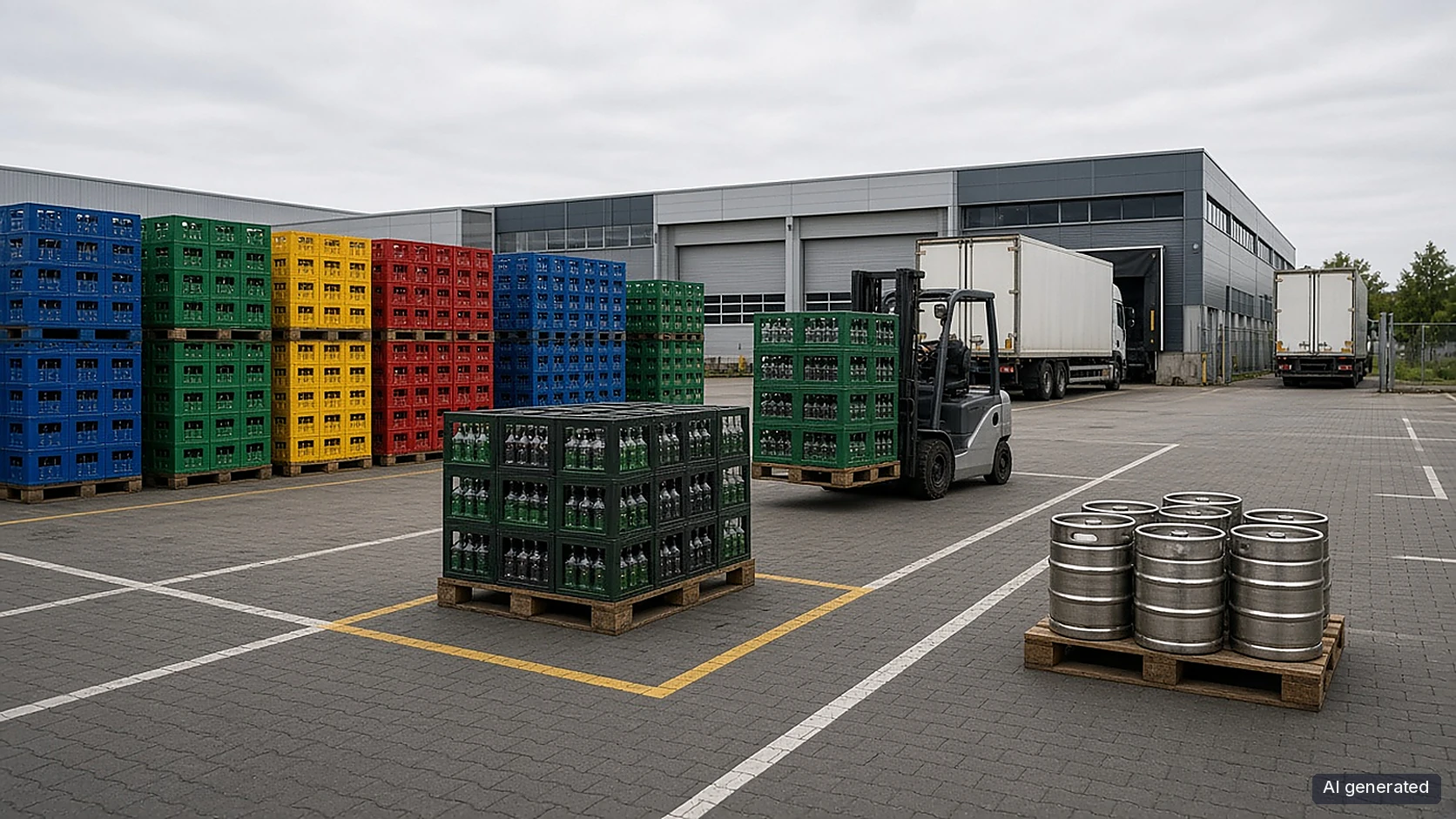
- Space: full goods belong in the hall, protected from the weather, so empties are pushed outdoors. Without clear zones the outdoor store becomes a search store.
- Labour: sorting, searching and re-stacking tie up driver and forklift time.
- Capital and safety: deposits tie up liquidity and are lost when balances do not match. On cluttered open areas the risk of accidents rises.
Why empties take so much sorting work in Germany
The core lies in the reusable system itself. Pool containers such as the Perlenflasche of the Genossenschaft Deutscher Brunnen (GDB) can be used by all connected bottlers; according to the GDB they account for about 67% of the reusable segment of the mineral water market (2025). That saves sorting, because pool empties do not have to go back to one particular producer. Individual bottles with their own embossing and crate, by contrast, are meant to return to exactly one bottler. If they end up in the wrong crate or with the wrong wholesaler, they are foreign empties for that wholesaler.
The logistics consultant Maximilian Huesch (inside Getränke, 2022) describes how far the mixing has gone: 20 years ago a returned 20 × 0.5 l crate from retail held 3 to 5 wrong bottles; today, in some cases, more than half of the crate is mixed. Deposits on reusable bottles are not set by the Packaging Act but by the terms and conditions of the pool operators. Single-use deposit containers at 25 cents are recycled after return, not refilled; for the yard, that means volume rather than sorting.
Deposit gaps: what wrongly booked empties cost
In Germany the deposit is 25 cents per single-use container, 8 to 15 cents per reusable bottle and usually €1.50 per crate. A full GDB crate of twelve therefore carries €3.30 in deposits (€1.50 plus 12 × €0.15). If 1,000 crates are booked wrongly or not at all, that is €3,300.
Wrong bookings also have effects beyond the yard. If empties are booked wrongly or late, the bottler sees too few containers in circulation and reorders bottles and crates although they are standing in the yard. Orders build up along the chain. This is the bullwhip effect described by Lee, Padmanabhan and Whang in 1997.
In 2023, 34.3% of all beverages in Germany were filled in reusable packaging, 78.5% of beer and 45.1% of water (Federal Environment Agency, reference year 2023).
The process chain in the yard: from advance notice to zone
A closed chain starts at the gate and ends in a fixed zone. It rests on five steps:
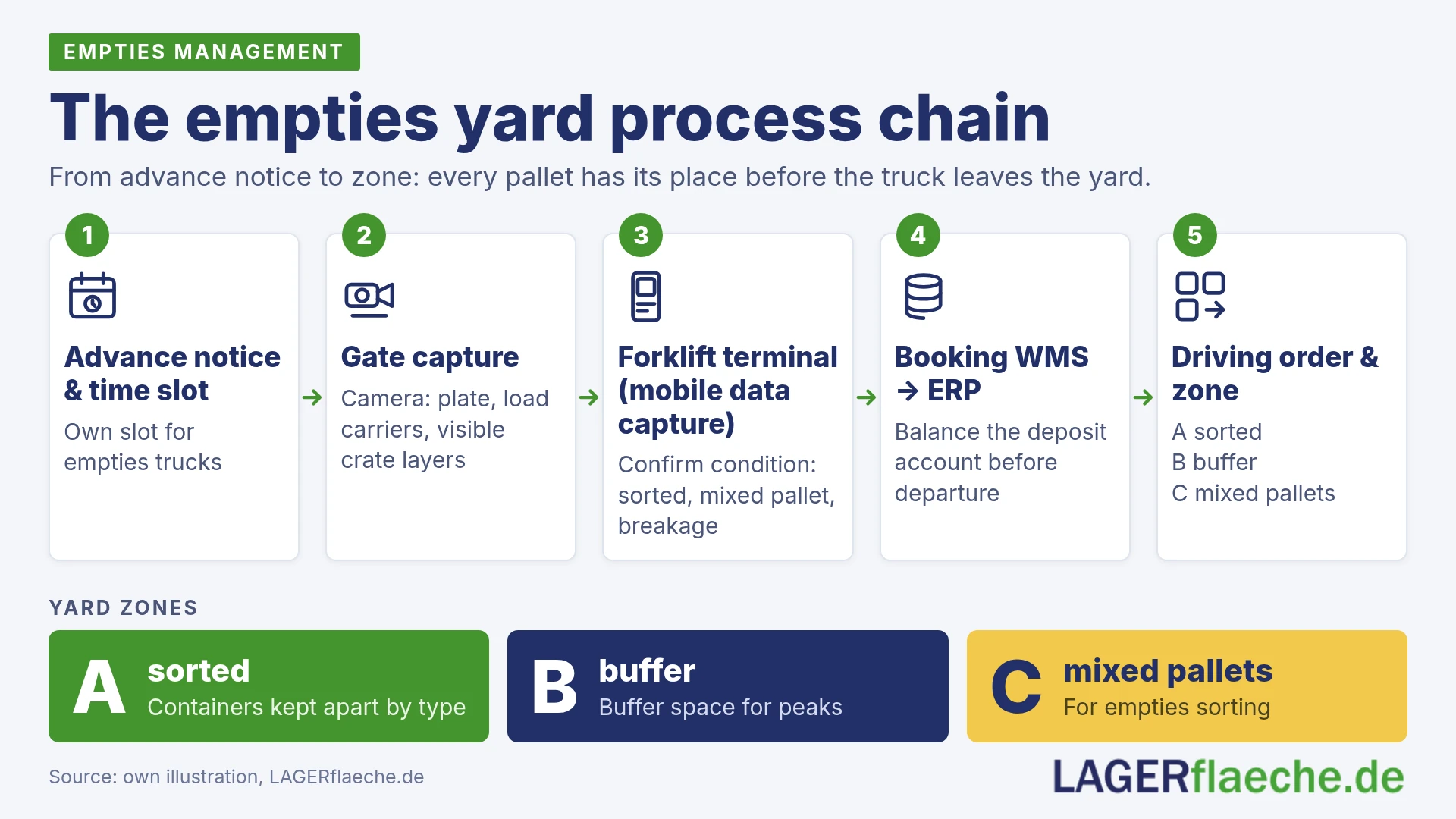
- Advance notice and time slot: empties trucks get their own slot and do not compete with full goods for the dock.
- Gate capture: cameras at the gate record the plate, the load carriers and the visible crate layers and compare them with the advance notice. Counting individual crates and bottles is done by sorting plants after depalletising. We describe how automatic pallet inspection works elsewhere.
- Forklift terminal (mobile data capture): the driver confirms the condition: sorted, mixed pallet, breakage.
- Booking: the scan goes to the warehouse management system (WMS, e.g. SAP EWM) and from there to the ERP. The deposit account is balanced before the truck leaves the site.
- Driving order and zone: sorted containers go to zone A, buffer to zone B, mixed pallets to zone C for empties sorting.
The yard management system (YMS) controls time slots and yard positions, the terminal reports the condition of the load, and the WMS and ERP book stock and deposits. Differences are signed off before departure, so disputes over shortfalls become rarer.
Space and construction: what an empties yard must be able to do
Floor loading. Empty crates are light; what limits the yard is the wheel loads of forklifts, full-goods block stacks and the stability of tall stacks. Paved areas should be designed for forklift traffic and carry around 50 kN/m², like modern halls, so that they can also take full goods when needed. More on outdoor areas: outdoor logistics and open storage.
Drainage. Dirt, broken glass and sugary residues collect in the yard. Under section 55(2) of the Water Resources Act (WHG), rainwater should be infiltrated locally or discharged unless regulations or water-management concerns stand in the way; what applies to a contaminated yard is set by the water authority and the municipal drainage bylaw. Heavy-duty channels and an upstream sedimentation stage are usual, since broken glass and sugar solutions argue for it. Where mineral oils arise, light-liquid separators to DIN EN 858 and DIN 1999-100 are added.
Noise. The TA Lärm applies, measured at the nearest sensitive receptor. Limits: commercial area 65 dB(A) by day and 50 dB(A) at night, industrial area 70 dB(A) day and night, mixed area 60 and 45 dB(A); night runs from 10 pm to 6 am. Anyone handling empties at night needs distance, noise barriers or low-noise processes, otherwise the permit for shift operation fails.
Fire protection. Large stacks of plastic crates and pallets are a fire load. Distances and fire compartments belong in the fire protection concept, agreed with the property insurer.
Our view as a portal: space is the bottleneck
Two observations from a space portal's viewpoint, each with a source:
Seasonal peaks need temporary space. Demand for mineral water is subject to seasonal fluctuation, says the GDB. In the hot summer of 2026 bottlers reported shortages of bottles and crates because empties were still in households. According to WDR (August 2026), small springs often lack the capital to hold stocks of empties, and some businesses do not want crates standing around that are needed for only two or three months a year. In our view as a portal, that is a typical case for temporary space: a buffer area rented for just those weeks can be cheaper than a yard that is permanently too large.
Paved outdoor space is scarce. Colliers describes rising demand and limited supply for industrial outdoor storage; in Great Britain rents at well-connected locations rose by up to 55% in 2024, and Colliers forecasts a comparable development for Germany. In our view as a portal, approved, paved open space is therefore the tightest part of the market. Load capacity, drainage and operating hours belong in the brief before the first viewing.
International comparison: what other markets do differently
| Country | Deposit system | Status and particulars |
| Germany | Single-use deposit 25 cents, reusable deposit 8 or 15 cents, plus crate deposit (usually €1.50) | Reusable share 34.3% (2023); high sorting and booking effort in the yard |
| Norway, Sweden | Single-use deposit on bottles and cans (Infinitum, Returpack/Pantamera) | Return rate 93% in Norway (2024; bottles 92.5%, cans 92.9%), 87.6% in Sweden (2024) |
| Poland | Deposit system since 1 October 2025 | PET bottles up to 3 l and cans up to 1 l (PLN 0.50), reusable glass bottles up to 1.5 l (PLN 1) |
| United Kingdom | Deposit system from 1 October 2027 (England and Northern Ireland; Scotland in parallel under its own rules) | Single-use containers of PET, steel and aluminium from 150 ml to 3 l |
| USA | Bottle bills in 10 states | No nationwide system |
Two things stand out. First, systems that cover only single-use bottles and cans do without the crate and pool sorting that burdens German yards: the effort comes not from the deposit but from the variety of reusable containers. Second, the market is moving. Poland has also covered reusable glass bottles since October 2025, and the UK starts in October 2027. New container flows need new zones and space.
Worked example: what can pay off in the yard
This example is fictional.
Suppose a mid-sized drinks wholesaler handles 120 trucks a day. On its 14,000 m² outdoor area mixed pallets stand wherever there is room; trucks wait 75 minutes on average, and deposit differences of €18,000 build up every month. It sets up zones (A sorted, B buffer, C mixed pallets), equips 12 forklifts with terminals, puts two camera gantries at the entrance and connects its WMS and ERP. After six months the dwell time is 26 minutes, deposit variances have fallen by 92%, and 28% of the yard (about 3,920 m²) serves as a full-goods buffer.
| Item | Calculation | Result |
| Time saved | 49 min × 120 trucks | 98 truck-hours per day |
| Hourly rate | €68.75 net (detention that the Aachen local court considered reasonable for a truck in 2021) | about €6,740 per day, fully valued |
| Share that really saves cost (assumption) | 25% over 250 working days a year | about €421,000 per year |
| Deposit differences | €18,000 × 12 months × 92% | about €199,000 per year |
| Total benefit | about €620,000 per year | |
| Costs (assumption) | €350,000 one-off, €40,000 a year to operate | |
| Payback | €350,000 ÷ (€620,000 − €40,000) | about 7 months |
If only 10% of the time saved is counted, the benefit falls to about €367,000 a year and payback takes about 13 months. The lever is dwell time and deposit differences, and it only works if zones and space are right first.
Where we could be wrong
Our thesis has limits. The consultant Huesch sees the hope for the cycle in automation at direct-delivery wholesalers and sorting service providers; so far only large players rely on it, and smaller ones lack the money. We may therefore underestimate how much software and sorting technology achieve once the space is already right. For small drinks wholesalers a camera gantry rarely pays off in our view; mobile data capture and clear zones are enough. That is an assessment, not a measurement.
Empties yard check
Space and construction
Process
Data
Conclusion: space first, then technology
Anyone who plans empties as a process of its own with its own space wins back dock time, liquidity and yard area. For operators that means: first clarify zones, surfaces, drainage and permit, then digitise capture and booking.
Are you looking for paved open space or a beverage logistics provider with empties expertise? On LAGERflaeche.de you will find suitable outdoor storage and beverage logistics providers.
Sources
- Federal Environment Agency (UBA): Nationwide survey of beverage consumption in reusable beverage packaging, reference year 2023 (UBA Texte 116/2025)
- Genossenschaft Deutscher Brunnen (GDB): Reusable (Mehrweg) – pool bottles; pool management; press release on the general meeting (April 2026)
- inside Getränke: Das Leergut-Dilemma, interview with Maximilian Huesch (28 July 2022)
- Deposit rates: Verbraucherzentrale, Questions and answers on single-use deposits and can deposits (as at 21 April 2026); Getränke Meyer, Leergut-Fibel 3.0 (May 2024)
- Lee, Padmanabhan, Whang: The Bullwhip Effect in Supply Chains, MIT Sloan Management Review (1997)
- Amtsgericht Aachen: judgment of 2 June 2021, case no. 102 C 42/20 (detention charges)
- Law and standards: Water Resources Act (WHG), section 55; DIN EN 858-1 and DIN 1999-100; TA Lärm nos. 6.1 and 6.4
- WDR: Abfüller fordern: Bringt bitte Mineralwasser-Leergut zurück (13 August 2026)
- Colliers: Industrial Outdoor Storage – versatile open areas with high potential (6 March 2025)
- Deposit systems abroad: Infinitum, Annual Report 2024; Returpack/Pantamera, sustainability report 2024; Ministry of Climate and Environment (Poland), System kaucyjny; GOV.UK and gov.scot, Deposit Return Scheme; Bottle Bill Resource Guide