




Inventory 2025: More than just Counting – Your Path to Strategic Inventory Quality
Table of Contents
- Why Inventory is Essential for the Survival of every Company
- The Anatomy of the Population Difference: What are the Causes?
- The Roadmap to Perfect Inventory Quality: 5 Steps to the Goal
- Special Challenges in (Warehouse) Logistics
- Revolution in the Warehouse: How AI and Technology are changing Inventory
- Looking Beyond Borders: Taking Stock in Europe and the World
- News and Trends: What does the Future of Inventory hold?
- Conclusion: Make Inventory your Competitive Advantage
For many, the annual inventory is a necessary evil that disrupts operations and ties up valuable resources. But what if you didn't see inventory as a chore, but as a powerful strategic tool for your business? In a world in which supply chains are becoming more and more complex and competitive pressure is constantly increasing, precise knowledge of one's own inventories is the foundation for efficiency, customer satisfaction and ultimately economic success.
This comprehensive guide examines inventory from all angles. We not only clarify the legal necessities, but also dive deep into the latest technologies, uncover the true causes of stock discrepancies and show you the way to perfect portfolio quality. Are you ready to revolutionize inventory?
Why Inventory is Essential for the Survival of every Company
The legal obligation to take stock is clearly regulated in Germany. According to Section 240 of the German Commercial Code (HGB ), every merchant is obliged to record his assets and liabilities at the end of each financial year. This is done through a physical inventory – the classic counting, measuring and weighing. The result, the inventory, is the basis for the annual balance sheet and thus for the correct determination of the company's profit.
But the necessity goes far beyond pure legal compliance:
- Optimize capital commitment: Every item in the warehouse is tied up capital. A precise inventory reveals "slow sellers" and excess stocks that block liquidity.
- Ensure delivery capability: Only those who know their inventory can make reliable delivery commitments. Stock-outs lead to dissatisfied customers and lost sales.
- Detection of shrinkage: The inventory makes losses due to theft, damage or spoilage visible.
- Database for the future: Accurate inventory data is the basis for well-founded decisions in purchasing, sales and production planning.
The Anatomy of the Population Difference: What are the Causes?
Inventory differences are the enemy of any logistics balance. But where do the discrepancies between the target stock (in the merchandise management system) and the actual stock (on the shelf) come from? The causes are manifold and often a combination of human, processual and systemic errors:
- Human error (approx. 60-70%): Incorrect counting, transposed numbers during manual entry, incorrect item removal (mix-up of similar products) or incorrect storage in the wrong place.
- Administrative errors: Incorrect postings in goods receipt or outgoing goods, unrecorded returns or incorrect master data (e.g. incorrect units of measure).
- Theft and shrinkage: Internal or external theft is a significant, often underestimated, cause. According to a study by the EHI Retail Institute, inventory discrepancies amount to 4.3 billion euros annually in the German retail sector alone, much of which is due to theft (source: EHI Retail Institute, 2019).
- Damage & Spoilage: Undocumented damage or expired goods also lead to differences.
- System errors: Interface problems between different software solutions or faulty system processes.
So the question is not if, but where errors lurk in your processes. A precise analysis of the differences is the first step to improvement.
The Roadmap to Perfect Inventory Quality: 5 Steps to the Goal
Perfect inventory quality is not a coincidence, but the result of a structured process. These five steps form the foundation:
- Preparation is everything: A poorly prepared inventory is doomed to failure. These include:
- Scheduling: Choose a period with low inventory turnover.
- Team training: Every employee must know exactly what to count and how. Clarify counting areas and responsibilities.
- Tidy up warehouses: Keep things tidy. Same items in one place, clear marking of storage locations, separate defective goods.
- Technology check: Do all MDE devices, scanners and printers work? Are the batteries charged?
- Clear implementation with the four-eyes principle: In order to minimize counting errors, the principle of "counting and checking" has proven its worth. One counting team records the herd, a second team carries out a random or complete control count.
- Clean data collection and processing: Clearly mark areas that have already been counted to avoid double counting. Ensure a prompt and error-free transfer of counting data to your merchandise management system.
- The moment of truth: Difference analysis: Don't just write off the differences. Clarify any major deviation. Was it a counting error? A booking error? Are the goods in another place? This analysis is pure gold for process optimization.
- Follow-up and process optimization: The inventory does not end with the posting. Derive concrete measures from the analysis. Need better labels? Training for the incoming goods team? An optimized storage space organization?
Special Challenges in (Warehouse) Logistics
In the dynamic world of logistics and intralogistics, special rules apply. High handling speeds, complex warehouse structures (e.g. high-bay warehouses, chaotic warehousing) and an immense variety of articles make it difficult to take stock. The classic cut-off date inventory, in which the warehouse is closed for several days, is often unthinkable.
More flexible procedures have been established here:
- Permanent inventory: The inventory is not carried out on a key date, but is spread over the entire financial year. Each camp site is thus physically recorded at least once a year. The prerequisite is a seamlessly managed warehouse accounting system.
- Sample inventory (§ 241 HGB): In the case of very large holdings, the legislator allows, under certain conditions, to determine the stock using recognised mathematical-statistical methods. This significantly reduces the effort, but places high demands on data quality and process reliability.
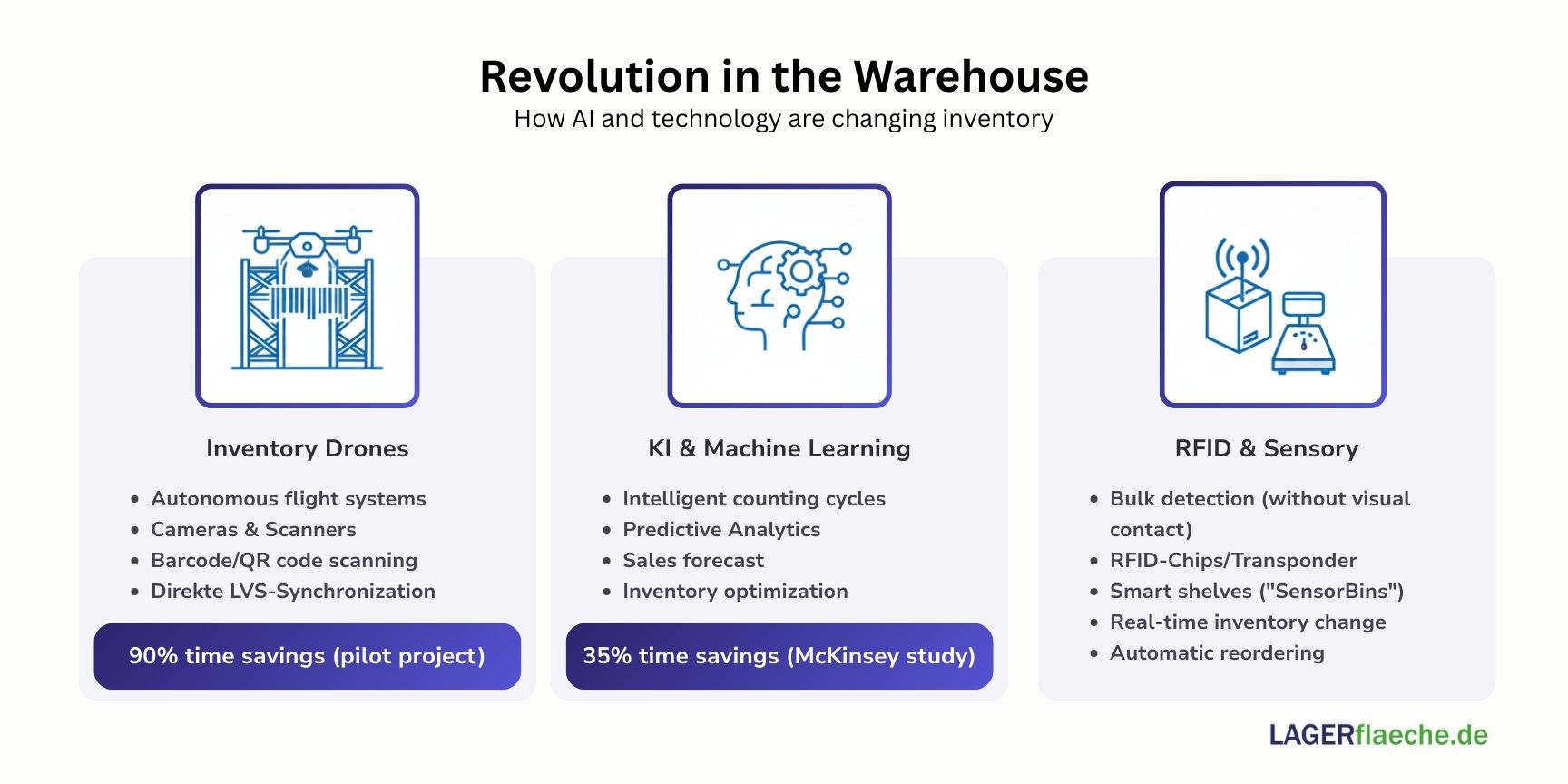
Revolution in the Warehouse: How AI and Technology are changing Inventory
The future of inventory has already begun, and it's automated. Manual counting is increasingly being replaced by intelligent technologies that are not only faster, but also more precise.
- Inventory drones: Autonomously flying drones are the game-changer for high-bay warehouses. Equipped with cameras and scanners, they capture barcodes or QR codes in seconds and compare the data directly with the warehouse management system (WMS). A pilot project at the University of Oldenburg in a beverage warehouse showed a time saving of 90% while at the same time increasing counting quality.
- Artificial Intelligence (AI) & Machine Learning: AI systems optimize permanent inventory by intelligently controlling counting cycles (e.g., counting high-value items more frequently). They also enable precise sales forecasts (predictive analytics) that prevent overstocking from the outset. According to McKinsey, AI-powered supply chain management can reduce inventory costs by up to 35%.
- RFID & sensor technology: RFID chips on pallets or products enable bulk detection in seconds without visual contact. Smart shelves ("SensorBins"), which measure their own weight, report stock changes in real time and can automatically trigger reorders.
These technologies not only reduce effort, but also provide unprecedented visibility into inventories – in real time.
Looking Beyond Borders: Taking Stock in Europe and the World
While the obligation to take stock applies globally, there are considerable differences in detail, which are primarily driven by the respective accounting standards.
- Germany (HGB): Creditor protection is in the foreground (precautionary principle). The physical inventory is clearly regulated. Valuation simplification procedures such as LIFO (Last-In, First-Out) and FIFO (First-In, First-Out) are allowed.
- France (Code de Commerce): Similar to Germany, a complete physical inventory is required by law at least once every 12 months. The aim is to create a valid balance sheet.
- Great Britain (FRS 102): The valuation is carried out according to the strict "lower of cost and estimated selling price" principle. A significant deviation from other standards: The LIFO method is not permitted according to FRS 102.
- USA (US-GAAP): Here, too, a physical inventory is mandatory. A crucial difference to the international standards (IFRS) that apply in many parts of the world: US GAAP explicitly allows the LIFO method. This is often for tax reasons, as lower profits are reported when prices rise.
Why these differences? They reflect different philosophies. While continental European law (as in Germany and FR) often aims at creditor protection and exact accrual demarcation, the Anglo-American approach is more geared to the information needs of investors on the capital market. For global companies, understanding these differences is essential when consolidating their balance sheets.
News and Trends: What does the Future of Inventory hold?
The inventory of the future is "invisible" and permanent. The trend is moving away from disruptive cut-off date inventory to continuous, technology-supported inventory monitoring. By 2025, the following developments will gain momentum:
- Hyper-automation: The combination of robotics (e.g. autonomous robots for ground detection), drones and AI will enable almost fully automated inventory.
- Predictive inventory management: AI will not only count inventory, but proactively predict when and where which items will be needed. This minimizes inventory and maximizes availability.
- Sustainability through transparency: Accurate inventory data helps to avoid waste due to spoilage or overproduction, thus directly contributing to a more sustainable supply chain.
Conclusion: Make Inventory your Competitive Advantage
Inventory is much more than a legal obligation. It is the annual health check for your warehouse and supply chain. Inventory discrepancies are symptoms of deeper problems in your processes. Take the opportunity to identify and fix these problems.
By using modern technologies intelligently and optimizing your inventory processes, you can turn the dreaded count into a strategic tool. They reduce costs, increase customer satisfaction and create a data-based basis for a resilient and future-proof company. Start rethinking your inventory today!
Latest Blog Posts
Stay up to date with the newest trends, insights, and tips in warehouse and logistics. Our latest articles help you navigate the industry with confidence.

Data Centres vs. Logistics Facilities: The Race for Power and Land
Across Europe, logistics operators are competing for more than land and transport access. They increasingly need something much harder to secure: grid capacity. Data centres are intensifying that competition — and changing how logistics locations are evaluated....

Chinese companies discover Europe's logistics real estate
Chinese companies are becoming an increasingly visible user group in Europe's logistics real estate market. What does this mean for warehouse space, 3PL structures and the requirements for European logistics locations?...
AI Hallucinations in Logistics: When AI Plans the Wrong Delivery
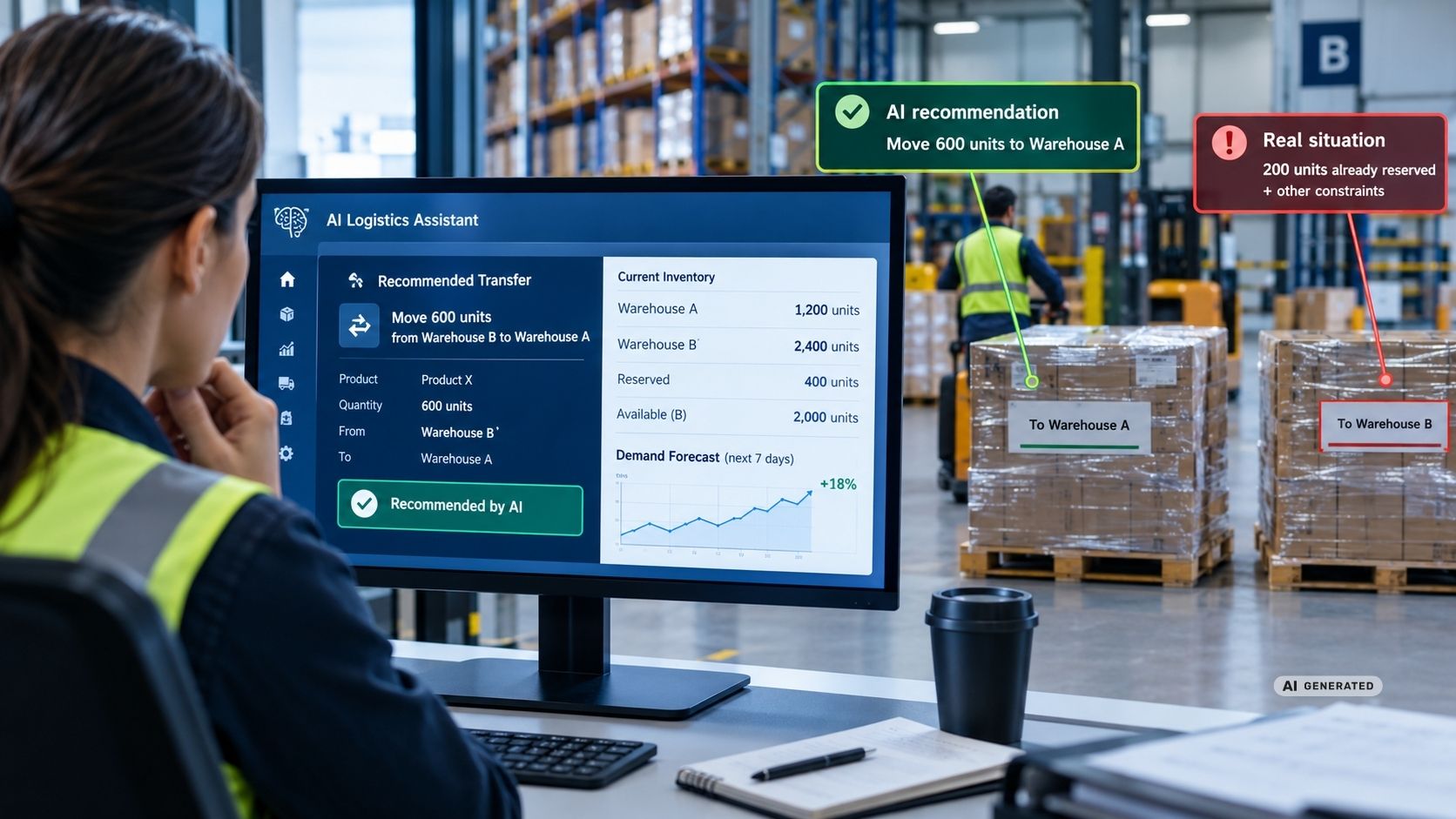
AI can analyze enormous amounts of logistics data — but it can also produce a convincing answer that is simply wrong. The critical question is not whether AI makes mistakes, but what happens when a wrong recommendation becomes an operational decision....

The Green Revolution on the Hall Roof: From Concrete Block to Ecological Power Plant?
Logistics roofs can do more than PV: greening, bees, urban farming and even sports areas turn unused roof space into multifunctional rooms....