



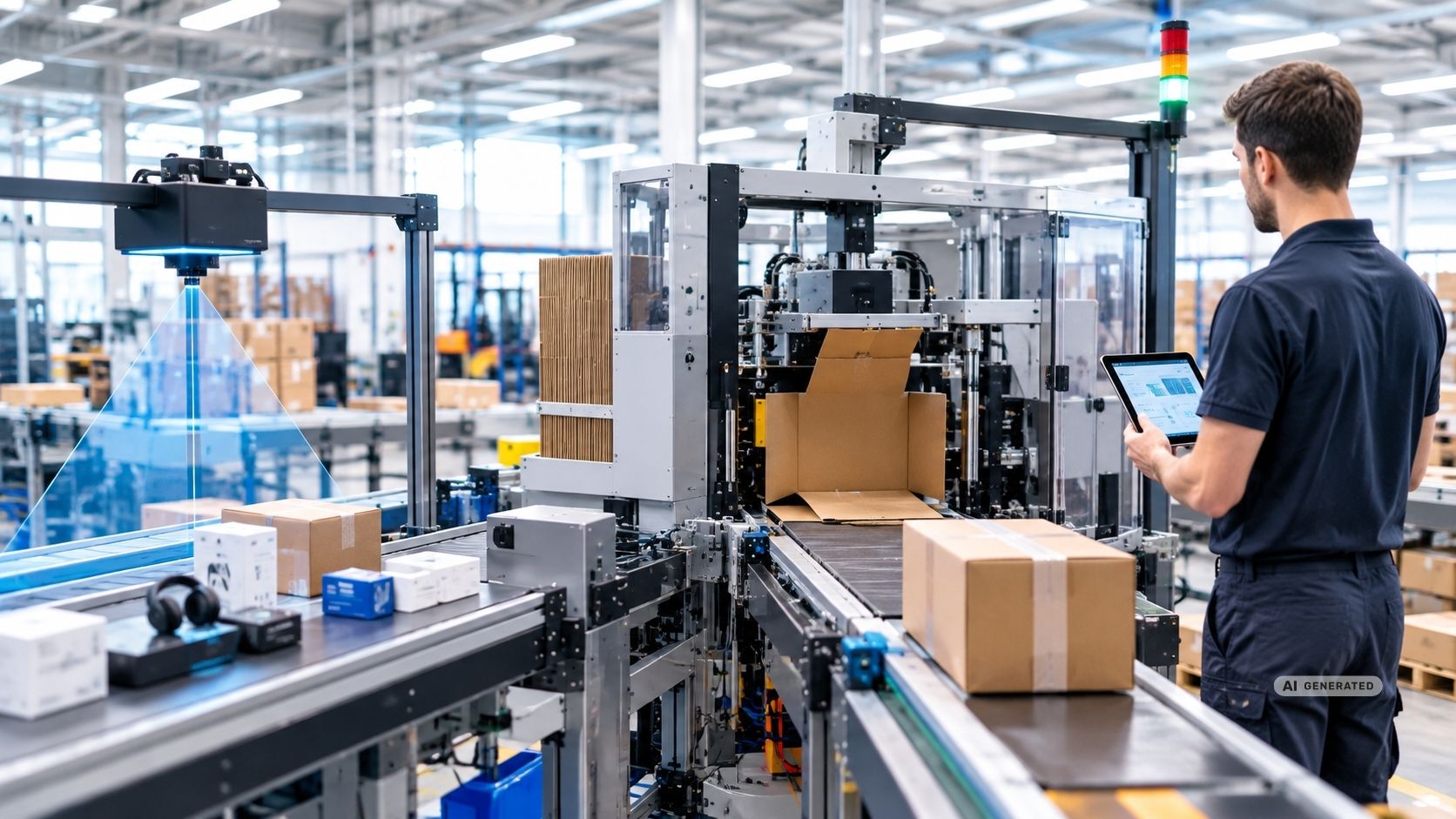
Automated Packaging in the Warehouse: Costs, ROI and Investment Decision
Table of Contents
- When Does the Packing Table Become an Economic Bottleneck?
- Where Automated Packaging can Affect Costs
- CAPEX vs. OPEX: The Actual Investment Calculation
- When is Automated Packaging Worthwhile?
- Full Automation or Partial Automation?
- Right-Sized Packaging: Technology as a Cost Lever
- WMS, WCS and ERP: The Interfaces are Decisive
- For Which Warehouse is the Investment Particularly Interesting?
- When does Full Automation not Make Sense?
- Three Real-life Examples
- What Needs to be Measured before Investing?
- Sustainability as Part of the Business Case
- Conclusion: It's not the Machine that Decides the ROI – but the Process
When Does the Packing Table Become an Economic Bottleneck?
In a fulfillment center, order picking is underway, evening loading is approaching and at the same time the queue at the packing stations is growing. The goods have already been assembled – but the outgoing goods department is not keeping up fast enough.
The bottleneck often lies in the last manual work step: selecting the box, erecting it, loading the goods, filling in cavities, sealing, labeling and handing them over to shipping.
This works without any problems with low shipment volumes. However, as the volume grows, the amount of work, the number of packing stations, material consumption and space requirements increase.
This is exactly where the business case for automated packaging begins.
The central question is therefore not: Which packaging machine is the fastest?
But: Which costs of our current packaging process can be permanently changed by automation – and when will the investment pay off?
Where Automated Packaging can Affect Costs
Cost-effectiveness is not created by a single factor, but by the interaction of personnel, material, transport and throughput.
Personnel deployment
Manual packaging binds employees to repetitive activities. Automation can reduce this effort or free up employees for other tasks.
A case published by YPS shows the magnitude: At an online retailer, the number of packing benches was reduced from 15 to 6. YPS reports a payback of less than twelve months. Source: YPS
Packaging material
Standard boxes do not always fit the actual product size. Packaging that is too large requires more cardboard and often additional filling material.
In the mymuesli case, Packsize reports a 50% reduction in packaging volume. At the same time, according to Packsize, the transport volume fell by 30%. Source: Packsize
Transport volume
Not only the weight of a parcel is relevant. Its dimensions also influence the utilization of vehicles and, depending on the tariff model, can increase shipping costs.
More compact packaging can therefore generate economic effects beyond the packaging department.
Throughput
Automation can create additional capacity without having to increase the number of manual packing stations proportionally.
In the mymuesli case, Packsize cites an output of up to 1,100 cartons per hour and up to 15,000 parcels on peak days. Source: Packsize
However, the benefit depends on whether picking, conveyor technology, sorting and shipping can also cope with the additional throughput.
CAPEX vs. OPEX: The Actual Investment Calculation
The crucial question is not only:
"How much does the packaging machine cost?"
But:
"What running costs can it change?"
On the investment side, for example, there are:
- Machine and feeding technology
- Scanners and sensors
- Software and interfaces
- Installation and commissioning
- Possible structural adjustments
This is offset by running costs:
- Staff
- Packaging and filling material
- Energy
- Maintenance
- Follow-up work
- Process and downtime costs
For the business case, these items should be considered over a period of several years.
The other logistics costs must also be taken into account. The blog "The Anatomy of Logistics Costs: What You Really Pay for Storage, Transport & Co." shows why individual cost items should not be evaluated in isolation.
When is Automated Packaging Worthwhile?
There is no general package quantity for break-even.
Above all, the following are decisive:
Shipment volume: Higher and predictable utilization improves profitability.
Uptime: Multi-shift operation can spread the investment over more shipments.
Product mix: Standardizable products are usually better suited than highly heterogeneous goods.
Personnel costs: The more labor-intensive the existing process, the greater the savings potential can be.
Material consumption: With a lot of empty space and high use of filling material, there is additional potential.
Transportation costs: Where package dimensions greatly affect shipping costs, right-sized packaging can be particularly interesting.
Therefore, a blanket threshold such as "from 2,000 or 3,000 parcels per day" would not be serious.
The better question is:
What are the costs of a shipment today – and how will they change after automation?
Full Automation or Partial Automation?
Not every company needs a fully automated line.
Manual packaging: This makes sense for small quantities, many special cases and highly individualized products.
Partial automation: It is interesting when individual work steps – such as feeding, sealing or labelling – slow down the process.
Automated packaging: Particularly interesting for high and plannable shipment volumes.
Fully automated line: Suitable for large volumes and an overall highly automated fulfillment process.
The best solution is therefore not automatically the most technically complex, but the one whose capacity and degree of automation match your own process.
Right-Sized Packaging: Technology as a Cost Lever
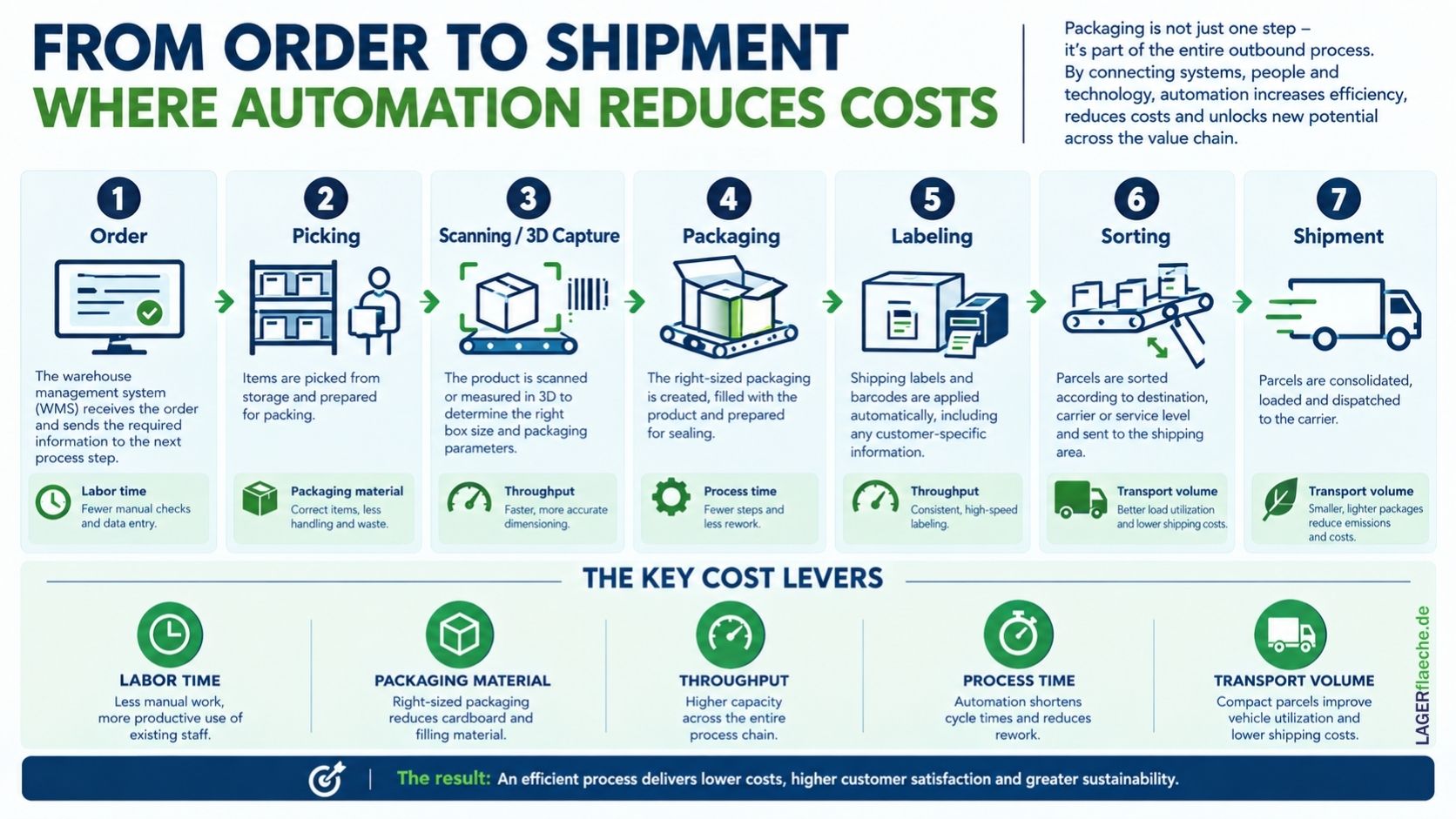
Modern systems automatically detect products and determine the required packaging dimensions. Depending on the system, cardboard boxes are then cut, shaped, sealed and marked.
The simplified process is:
Capture → Dimensioning → Packing → Sealing → Labeling → Shipping
The economic advantage comes from the combination of speed and needs-based packaging.
The mymuesli example shows this clearly: Packsize reports 50% less packaging volume and 30% less transport volume. Source: Packsize
The technology should therefore not be considered in isolation. The decisive factor is the effect it has on the entire process chain.
WMS, WCS and ERP: The Interfaces are Decisive
A packaging system should not be planned as an isolated solution.
Before investing, it must be clarified which information is transferred to the system and which status data is reported back.
These include, for example:
- Order and article information
- Barcode data
- Packaging Parameters
- Shipping Information
- Label data
- Status Messages
Equally important are exceptional cases:
What happens if a barcode is unreadable?
How are plus sizes treated?
What happens in the event of a plant shutdown?
Can an order be ejected manually?
The more closely the packaging is connected to WMS, WCS and ERP, the more important it becomes to have a functioning error management system.
For Which Warehouse is the Investment Particularly Interesting?
Automation becomes particularly interesting when several factors come together:
High and plannable shipment volumes: The system can be used to sufficient capacity.
Strong growth: More orders are to be handled without proportionally more packing stations.
High manual work intensity: Many repetitive activities create automation potential.
Regular peak times: Seasonal peaks can overload manual processes.
High void space: Standard cartons regularly create unnecessary volume.
High importance of parcel volume: Package dimensions have a noticeable effect on shipping costs.
Capacity planning is crucial, especially in peak times. The blog "The ultimate checklist for peak seasons: How e-commerce retailers and logistics companies master the discount battles" fits in with this.
When does Full Automation not Make Sense?
Full automation can be difficult in the case of:
- Rapidly changing product shapes
- very large or unusual packages
- frequent special processes
- low shipment volumes
- strongly fluctuating capacity utilisation
- Insufficient article and order data
This is where partial automation can make more economic sense.
The goal should not be to replace as many manual activities as possible at any price. The decisive factor is a process chain in which people and technology are used where they generate the greatest benefit.
Three Real-life Examples
Individual customer projects are not general industry benchmarks. However, they do show which effects have been documented in specific applications.
15 on 6 packing benches
At an online retailer documented by YPS, the number of packing benches was reduced from 15 to 6. YPS reports a payback of less than twelve months. Source: YPS
Around 240 to more than 350 packages per hour
In another YPS case, the packaging output increased from around 240 to over 350 packages per hour. The basis was previously four manual packing stations. According to YPS, the employees were then used for other tasks. Here, too, a payback of less than a year was expected. Source: YPS
32,000 working hours per year
Pregis reports 32,000 man-hours saved per year in an online retailer's case study. The automated process was 55% faster than the previous manual process, according to Pregis. Source: Pregis
What Needs to be Measured before Investing?
Before investing, the existing process should be recorded as accurately as possible:
Throughput: How many shipments are processed per hour and shift?
Staff: How many working hours are spent on packaging?
Material: How much cardboard and filling material is used?
Package size: How big is the actual white space?
Transport: What influence do dimensions and dimensional weight have on shipping costs?
Special cases: How many shipments require a manual process?
Follow-up work: How often do errors, damage or additional work steps occur?
From this data, the current cost-per-shipment value can be compared with the expected value after automation.
Sustainability as Part of the Business Case
Less packaging material and lower transport volume can generate not only cost but also sustainability effects.
In the mymuesli case, for example, Packsize reports 50% less packaging volume and 30% less transport volume. Source: Packsize
However, such values should not be transferred to other companies without checking. Real consumption, parcel and shipping data are the better basis for your own business case.
Conclusion: It's not the Machine that Decides the ROI – but the Process
The practical examples show that automated packaging can influence several economic levers at the same time.
For one YPS customer, the number of packing benches fell from 15 to 6, while at the same time the payback was reported in less than twelve months. In another case, packaging output increased from around 240 to over 350 packages per hour. Pregis reports 32,000 working hours saved per year and a 55% faster process at another online retailer. Sources: YPS; Pregis
These values are not general industry benchmarks. Rather, they show what effects are possible in specific applications.
Therefore, the decisive question should not be:
"Which packaging machine is the most modern?"
But:
"Which automation solution improves our specific packaging process and pays for itself under our real conditions?"
If you systematically record throughput, personnel, material, transport volume, packing stations and special cases, you can answer this question more well-founded.
Automated packaging is therefore less a pure machine decision than an investment in the entire process chain of outgoing goods.
Sources:
- YPS: End-to-End Automated Packaging System – from 15 to 6 packing stations, payback in under twelve months.
- YPS: Automated ecommerce bagging – from approximately 240 to over 350 packages per hour, staff redeployment, payback in under a year.
- Pregis: Automated bagging – 32,000 working hours saved annually, 55% faster.
- Packsize: mymuesli – 50% less packaging volume, 30% less transport volume, up to 15,000 packages on peak days, 1,100 cartons per hour.
Latest Blog Posts
Stay up to date with the newest trends, insights, and tips in warehouse and logistics. Our latest articles help you navigate the industry with confidence.
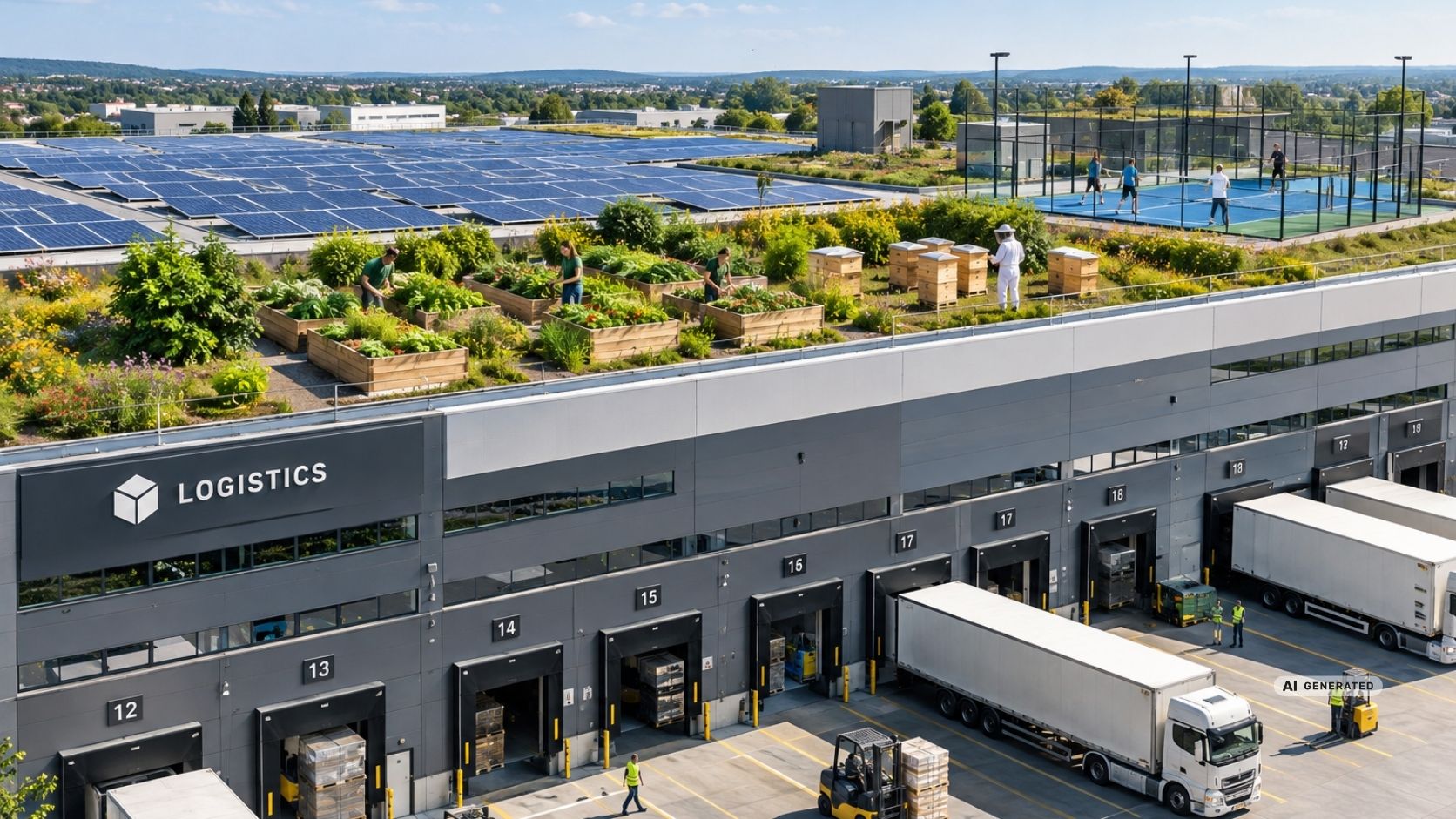
The Green Revolution on the Hall Roof: From Concrete Block to Ecological Power Plant?
Logistics roofs can do more than PV: greening, bees, urban farming and even sports areas turn unused roof space into multifunctional rooms....
Automated Packaging in the Warehouse: Costs, ROI and Investment Decision
Automated packaging can reduce staff shortages, material consumption and shipping volume. However, it is not the technology alone that is decisive, but whether it is economically suitable for your own shipping process....
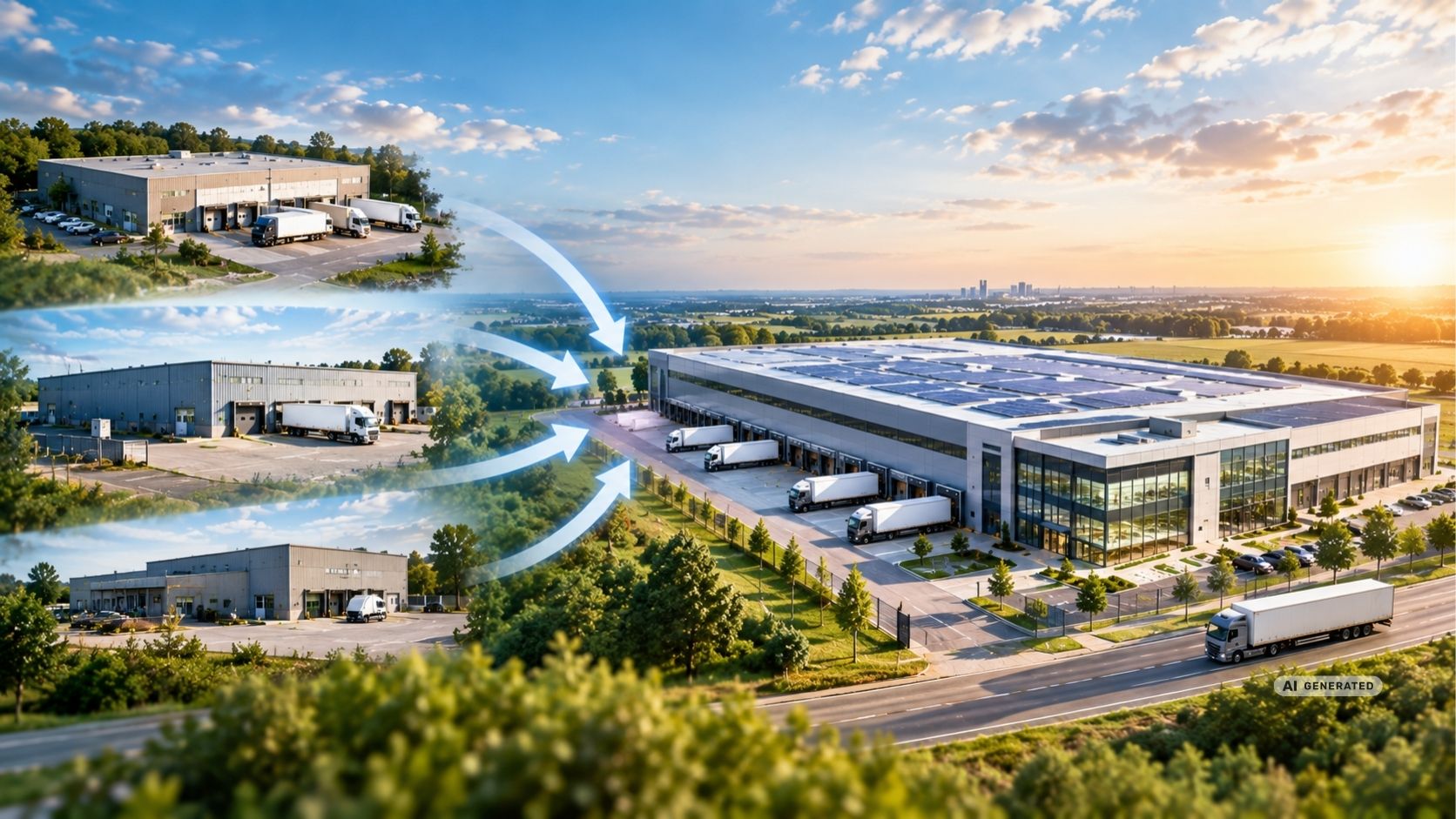
Location Consolidation in Logistics: When is it Worthwhile to Merge Several Warehouse Locations?
Multiple warehouse locations can grow for years without their structures growing with them. Find out when site consolidation becomes a strategic advantage – and when it creates new risks....
10 Logistics Myths that will no Longer be True in 2026
10 common assumptions about warehouses, logistics properties and supply chains will no longer stand up to scrutiny in 2026. This fact check shows which logistics myths are outdated – and what companies should consider instead....