




Telescopic dock leveler in warehouse logistics
Table of Contents
- Definition: What is a Telescopic dock leveler in a logistical context?
- The Telescopic dock leveler in Logistics Property: Why Planning Starts Here
- The Technical Deep Dive: Facts, Figures, Data
- Feed vs. folding wedge: A strategic comparison
- Maintenance and safety: More than just an inspection
- Profitability and ROI in contract logistics
- FAQ – Frequently asked questions from practice
- Conclusion: The Telescopic dock leveler as an Investment in the Future
Definition: What is a Telescopic dock leveler in a logistical context?
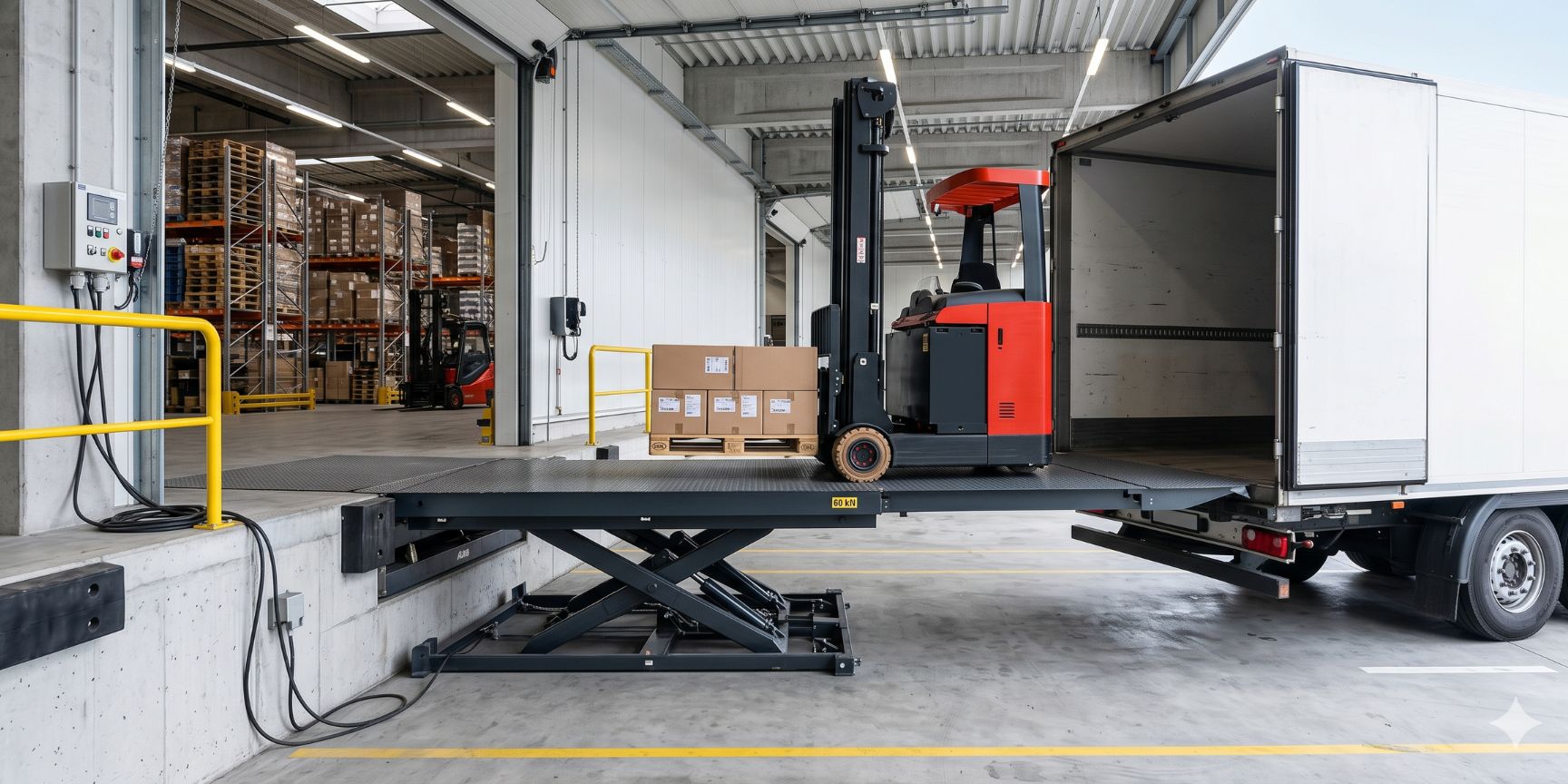
The leveller (technically correct: dock leveller with telescopic lip) is a mechanical or hydraulic design that bridges the difference in height and the horizontal distance between a stationary loading ramp and the loading area of a transport vehicle.
In contrast to the classic bascule wedge bridge, the lip (the contact surface on the truck) is not folded out, but extended continuously. This "feed" allows the lip to be positioned on the loading area with centimetre precision. In warehouse logistics, it is the heart of the loading and unloading station, as it has a significant influence on how quickly and safely goods flow from the warehouse to the vehicle (and vice versa).
The Telescopic dock leveler in Logistics Property: Why Planning Starts Here
When designing a logistics property, the choice of loading technology is crucial for its subsequent third-party usability. A Telescopic dock leveler offers maximum flexibility here.
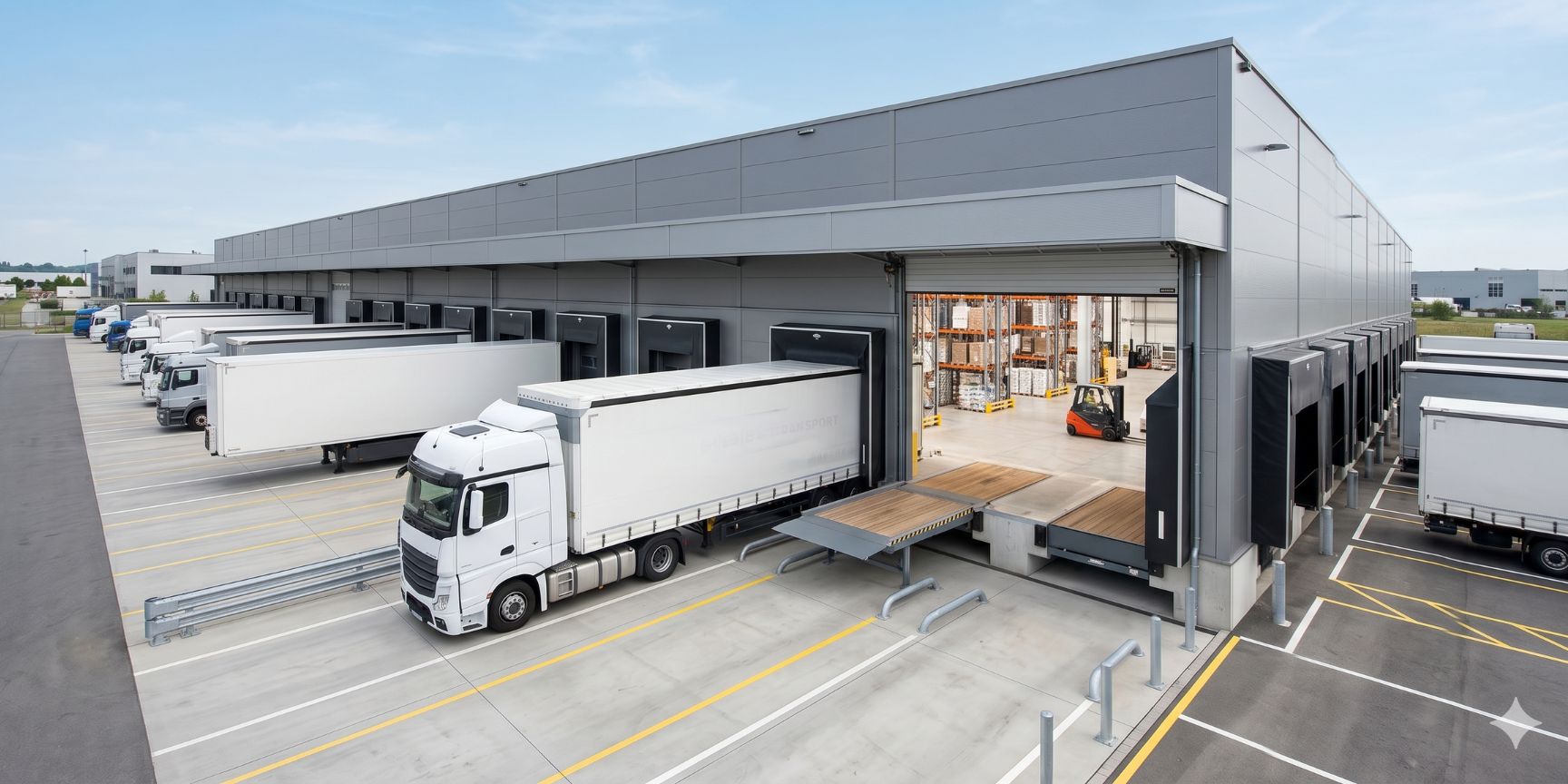
- ISO loading docks: In temperature-controlled warehouses (cold storage), the Telescopic dock leveler is often installed behind the sectional door. The telescopic lip allows the gate in front of the bridge to be closed to the ground (the insulation).
- Underpassability: High-quality halls often plan for an "underpass". This means that the tail lift of the truck can retract under the bridge. This saves time during docking, as the driver does not have to fold down the side wall in advance.
The Technical Deep Dive: Facts, Figures, Data
To grasp the depth of the topic, we need to look at the technical parameters regulated by DIN EN 1398 :
- Payload: Standard models are designed for a dynamic payload of 60 kN (6 tons). In heavy-duty logistics, there are special designs up to 100 kN.
- Feed length: The telescopic lip usually has a length of 500 mm to 1,000 mm. A longer feed increases safety in the event of inaccurate docking.
- Inclination angle: According to the standard, the inclination must not exceed 12.5% (approx. 7°) during operation to prevent industrial trucks from tipping over.
- Platform width: Between 1,750 mm and 2,250 mm as standard. Wide bridges are popular in contract logistics for safely loading wide load carriers (e.g. machine components).
Feed vs. folding wedge: A strategic comparison
In the professional world, it is often discussed whether the additional price of a launching bridge compared to the bascule wedge bridge is justified. Here, the answer is usually a clear yes from the point of view of contract logistics:
| Feature | Bascule wedge bridge | Telescopic dock leveler |
| Precision | Limited (fixed folding radius) | High (stepless telescopic focuser) |
| Use of the loading area | Requires space for radius | Can be loaded to the last pallet |
| Security | Risk of being placed on the goods | Millimetre-precise touchdown |
| Costs | Cheaper to buy | Higher investment, lower follow-up costs |
The pusher body shows its strengths especially when loading containers at the rear, as the lip can be moved deep into the container without the frame of the bridge getting caught on the edge of the container.
Maintenance and safety: More than just an inspection
A Telescopic dock leveler is a system that requires monitoring. In Germany, DGUV Rule 108-006 prescribes an annual inspection.
A critical point in practice is the floating position. Since the truck rises or lowers due to the suspension during loading and unloading, the bridge must automatically follow these movements. A malfunction in this area will inevitably lead to damage to the bridge or – worse – the crash of the forklift. Modern systems use hydraulic emergency stop valves that immediately block the bridge in the event of a sudden sag (e.g. if the truck drives away prematurely).
Profitability and ROI in contract logistics
In contract logistics, where margins are often small, every second counts when it comes to transshipment. A Telescopic dock leveler pays for itself by:
- Time saving: Less manoeuvring effort for the truck, as the lip compensates for inaccuracies during docking (to a certain extent).
- Damage prevention: Stepless positioning prevents the lip from damaging the goods or pallets from "bouncing" when driving over them.
- Energy efficiency: Integration with ISO charging solutions minimizes cold losses, which reduces the hall's energy costs.
FAQ – Frequently asked questions from practice
Question: Can each leveller be used for any type of truck?
Answer: In principle, yes, but there are limits. With very small vans (Sprinter class), the difference in height to the ramp is often too great. For this purpose, there are special variants with low overall height or swivel lips that are optimized for lower load capacities.
Question: How long should the feed ideally be?
Answer: In the standard logistics property, 500 mm to 600 mm feed is sufficient. However, if sea containers are frequently loaded, a feed rate of 1,000 mm is recommended in order to safely bridge the distance between the edge of the ramp and the loading floor.
Question: What happens in the event of a power outage?
Answer: Most hydraulic feeder bridges have a manual emergency drain valve to safely bring the bridge to the resting position. However, loading is usually not possible without electricity, as the hydraulic pump needs the pressure to extend the telescope.
Conclusion: The Telescopic dock leveler as an Investment in the Future
Anyone who builds a logistics property today or wants to operate a warehouse efficiently cannot avoid the Telescopic dock leveler. It offers the necessary flexibility for the modern mix of goods and meets the high requirements for occupational safety and energy efficiency. While the acquisition costs are about 20-30% higher than a bascule bridge, the higher handling speed and durability justify this investment in almost any professional logistics environment.
For specialist planners, the following applies: The specification of the Telescopic dock leveler should never be considered in isolation, but always in the triad of gate, sealing and bridge in order to guarantee a seamless logistics chain at the ramp interface.