




Truck Scales in Warehouse Logistics
Table of Contents
- The Truck Scale: The Foundation of Transport Control
- Construction Methods and Construction in the Context of Logistics Real Estate
- The Truck Scale in Contract Logistics: More than just Weight
- Technical Components: The Load Cell at the Heart
- Legal Framework: Calibration Obligation and SOLAS
- Location Planning and Traffic Flow in the Logistics Property
- Questions and Answers (Q&A)
- Conclusion for practice
The Truck Scale: The Foundation of Transport Control
A truck scale (often referred to as a weighbridge) is a large scale used to determine the total weight of vehicles. In logistics, it forms the interface between the flow of goods and data management. The principle is simple: the net weight of the load is determined by measuring the difference between gross (loaded) and tare weight (empty).
In practice, we differentiate between stationary and mobile systems as well as between static and dynamic scales (WIM – Weigh-in-Motion). While static scales weigh the vehicle at a standstill, dynamic systems detect the weight during the crossing, which significantly accelerates the flow of traffic on the company premises.
Construction Methods and Construction in the Context of Logistics Real Estate
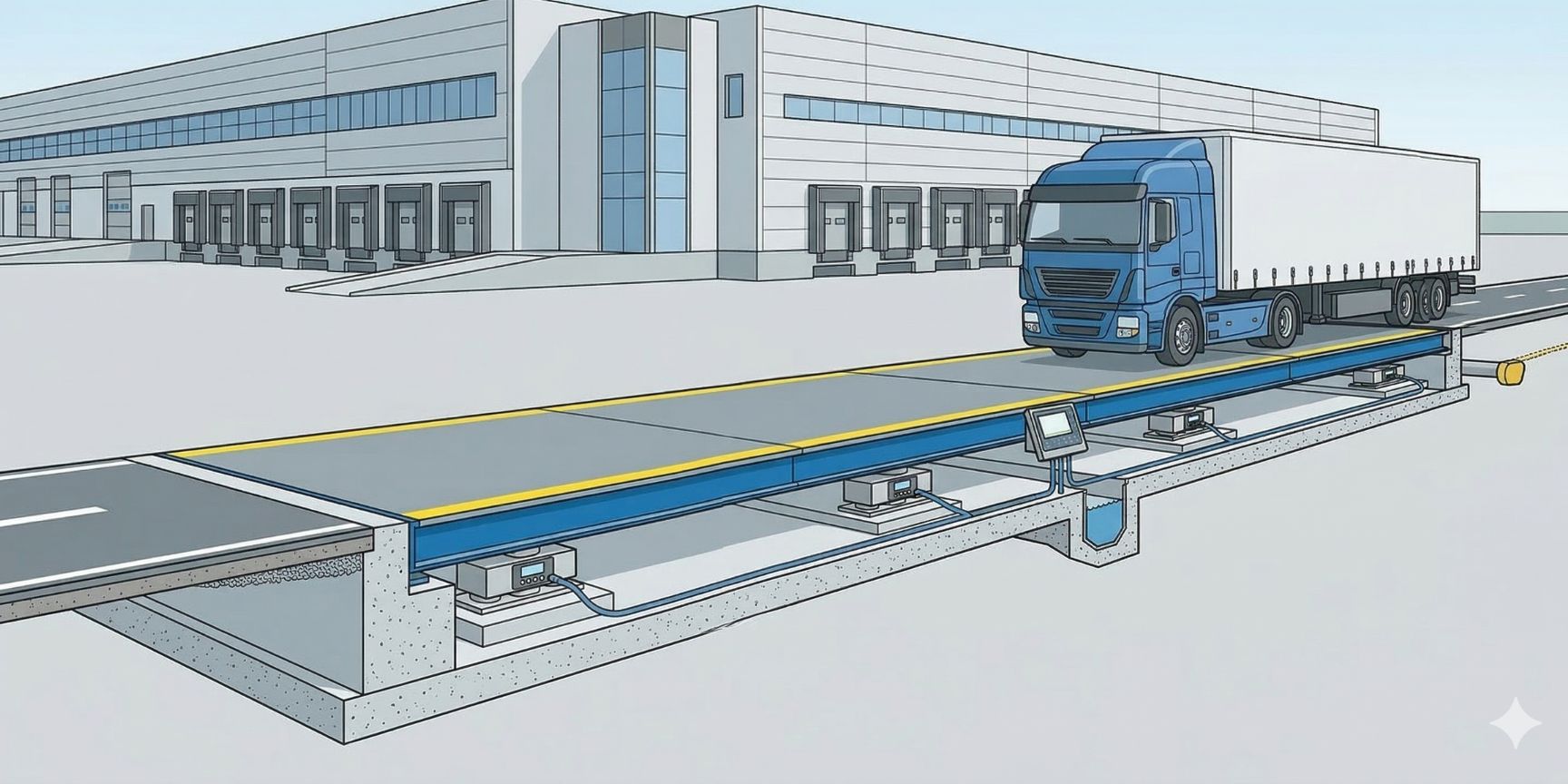
When building or planning a logistics property, the choice of scale construction is a strategic decision. There are two main designs:
- Above-ground scales: These stand on the floor.
- Advantage: Low civil engineering costs and easy cleaning.
- Disadvantage: You need ramps for the driveway, which increases the space required and can be an obstacle for the rest of the traffic.
- Underfloor scales (pit installation): The scale is flush with the roadway. This is the preferred solution for logistics properties with high traffic volumes, as they can be driven over from all sides.
Facts & Figures: A standard truck scale usually has a length of 18 to 24 meters and a width of 3 meters. The load capacity is usually 50 to 60 tonnes, whereby the scale must be designed for point loads (axle loads) that go far beyond this.
The Truck Scale in Contract Logistics: More than just Weight
In contract logistics, where service providers take on complex tasks for customers, the truck scale is a tool for billing accuracy. If services are billed by weight (e.g. disposal logistics or bulk materials), a calibrated scale is mandatory.
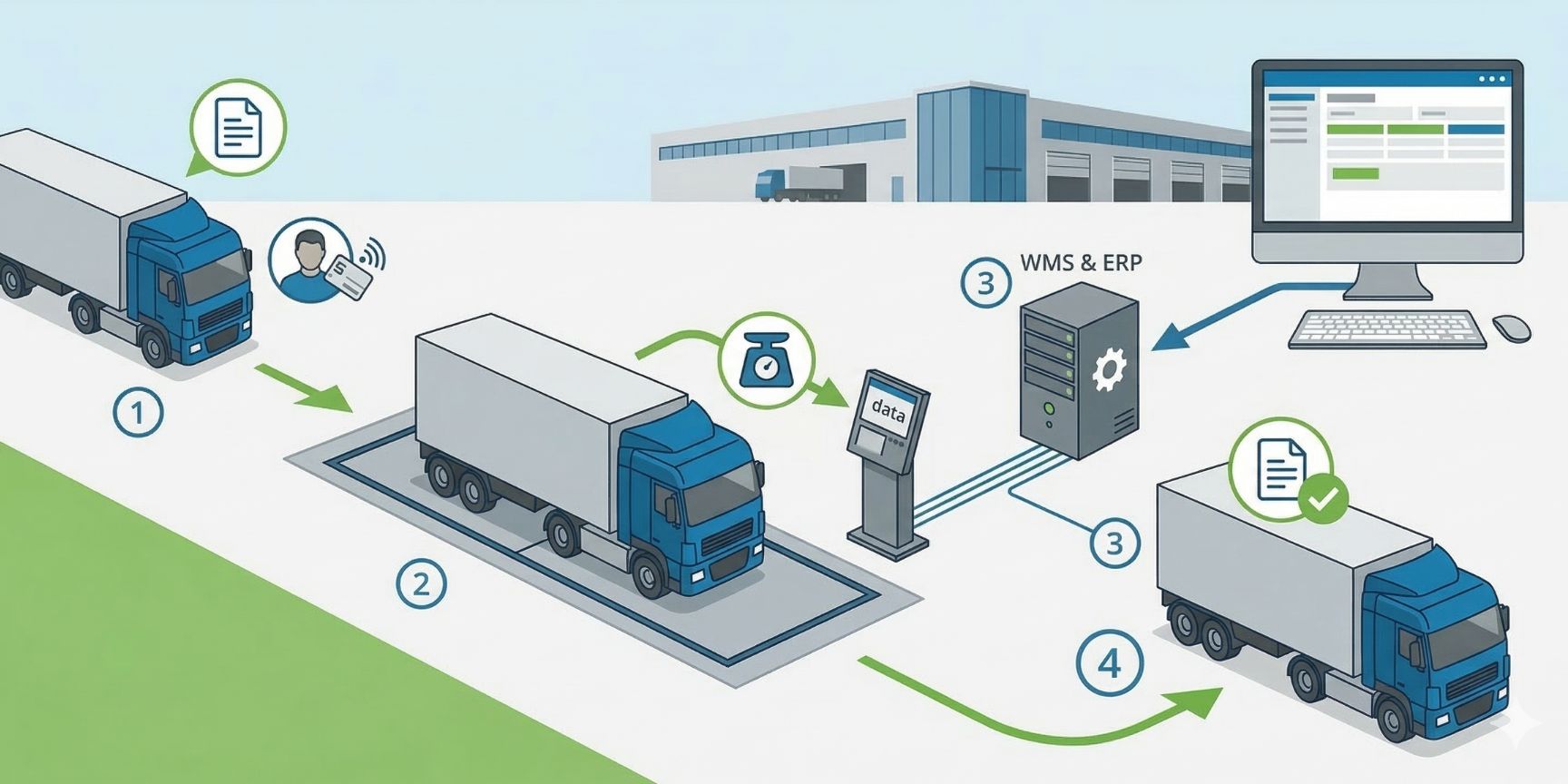
In addition, it serves as a plausibility check. Does the weighed weight match the packing lists in the Warehouse Management System (WMS)? Deviations can indicate picking errors or theft. The integration of the balance devices via interface (e.g. REST API or Profibus) into the ERP system is the decisive lever for automation here.
Technical Components: The Load Cell at the Heart
The precision of a scale depends on the load cells. Modern systems use digital load cells, which offer the following advantages:
- Higher signal stability: Insensitive to humidity and temperature fluctuations.
- Self-diagnosis: The system detects defective cells immediately before incorrect measurements occur.
- Lightning protection: High-quality cells are protected against overvoltages, a common reason for failures in outdoor systems.
For warehouse logistics, this means minimal downtime. A defective scale can bring the entire handling process to a standstill at one lift.
Legal Framework: Calibration Obligation and SOLAS
If goods are sold or transported by weight, the scales are subject to the calibration obligation according to the Measurement and Verification Act (MessEG). In Germany, truck scales usually have to be inspected every two years by the calibration office or a state-recognized body.
Another important point is the SOLAS Directive (Safety of Life at Sea). Since 2016, the gross weight of containers must be verified before loading onto a ship (VGM – Verified Gross Mass). Logistics locations with port connections or container staging therefore require certified weighing equipment in order to exclude liability risks.
Location Planning and Traffic Flow in the Logistics Property
The placement of the scales on the site is crucial for the efficiency of the hall.
- Storage spaces: Sufficient advance routes must be planned so that waiting trucks do not block the public road or internal roads.
- Swept curves: The approach and departure must be designed in such a way that long trucks (EuroCombi) can also drive on the scales without manoeuvring.
- Automation: Self-service terminals (touchscreen columns, RFID card readers) allow weighing without getting out, which increases safety and can reduce the turnaround time per truck to less than 2 minutes.
Questions and Answers (Q&A)
Question: Is an axle load scale sufficient for the official weight determination?
Answer: Axle load scales are very helpful for checking the road traffic regulations (avoiding overloading). However, a complete vehicle scale is usually required for business transactions (billing by weight), as the sum formation of axle loads has inherent inaccuracies in the system and is often not calibratable for the total weight.
Question: What maintenance costs do operators of logistics halls have to pay?
Answer: In addition to calibration every two years, annual maintenance and cleaning (especially in the pits for underfloor scales) should be planned. Calculate with approx. 1,500 to 3,000 euros per year, depending on the frequency of use and technology.
Question: Can a truck scale be integrated into an existing WMS?
Answer: Yes, modern weighing terminals have standard interfaces. Data transmission is usually done via Ethernet. The WMS can thus automatically pull the tare weight from the master data and calculate and post the net weight during weighing.
Conclusion for practice
The truck scale is a strategic asset. In the logistics property, a well-placed underfloor scale saves valuable manoeuvring time. In contract logistics, it ensures transparency towards the client. Anyone investing today should rely on digital load cells and fully automated data collection in order to meet the requirements of Logistics 4.0. A standstill at the scale is a standstill in the supply flow – quality and robustness are therefore the top priority.