




Temperature-controlled Warehouse
Table of Contents
- Definition: What does "Temperature-Controlled" Mean in the Logistics Context?
- The Logistics Property: Requirements for the Building Envelope
- Contract Logistics: Complexity in the Process Chain
- Technology and Energy Efficiency: The Cost Factor
- Legal Framework and Certifications
- Special Focus: Intralogistics in the Cold
- Expert Q&A: Practical Questions Answered in a Nutshell
- Conclusion for Planning and Operation
Definition: What does "Temperature-Controlled" Mean in the Logistics Context?
Temperature-controlled logistics refers to the transport and storage of goods under defined thermal conditions. The aim is to maintain the cold chain in order to prevent chemical, biological or physical changes to the stored goods. While the term is often associated with "cooling", it also includes the heating of halls (e.g. frost protection for paints/varnishes) or stabilization within a narrow tolerance range (e.g. pharmaceutical products).
Experts distinguish between different temperature regimes:
- Ambient (room temperature): +15 °C to +25 °C.
- Chilled: +2 °C to +8 °C.
- Frozen: -18 °C to -25 °C.
- Ultra-low: down to -70 °C (especially for vaccines or biological samples).
The Logistics Property: Requirements for the Building Envelope
A temperature-controlled hall is fundamentally different from a standard logistics property. Thermal separation is in the foreground here.
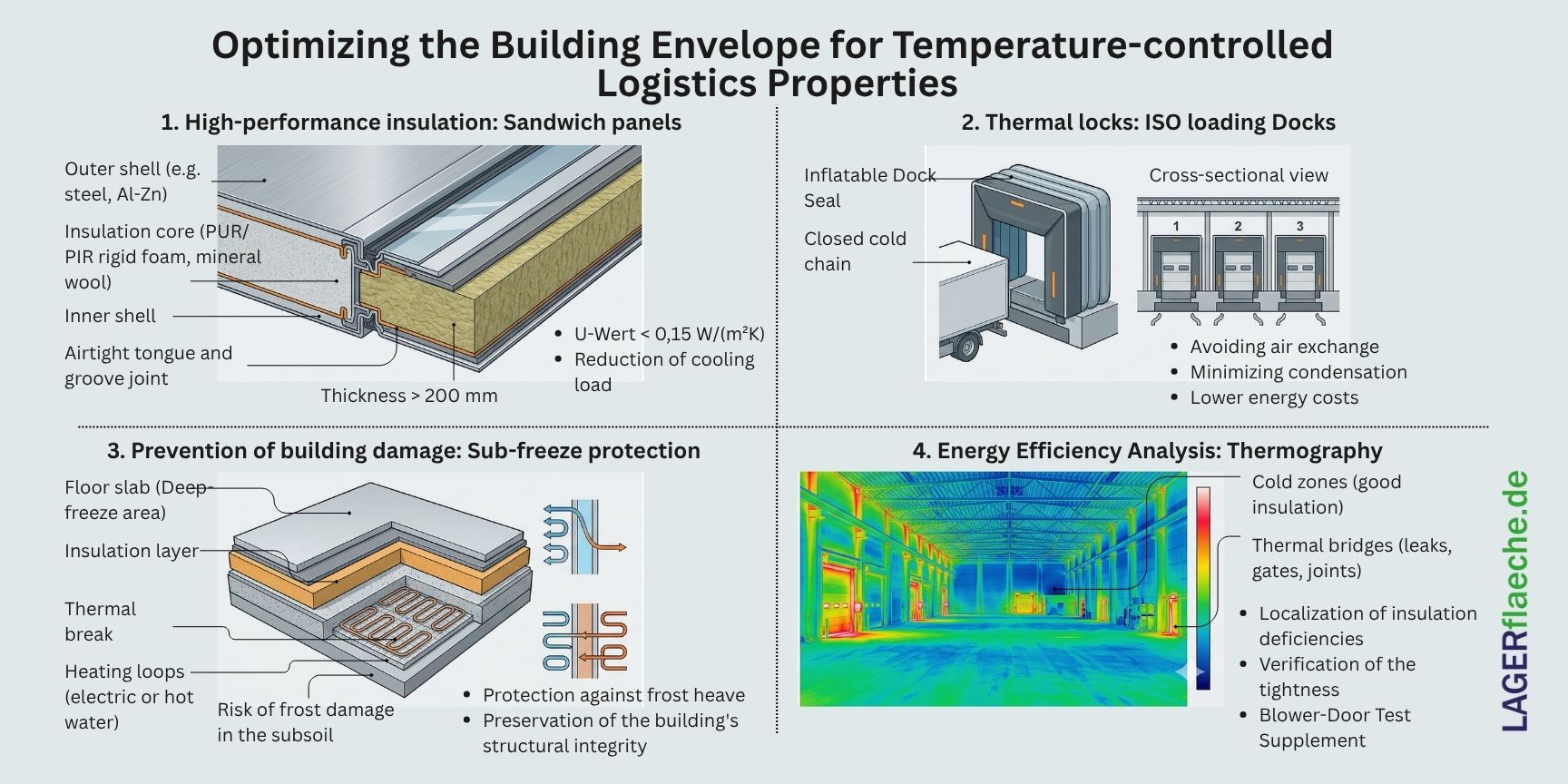
- Insulation: Sandwich panels with cores made of polyurethane (PUR) or mineral wool are used. In deep-freeze warehouses, the wall thickness is often over 200 mm.
- U-values: A low heat transfer coefficient (U-value) is crucial for operating costs. Modern halls aim for values of < 0.15 W/(m²K) in the roof area.
- Thermal separation of the floor: In deep-freeze halls, an anti-freeze heater must be installed under the floor slab to prevent the floor from freezing and the associated damage to the building (frost lifting).
- Lock systems: ISO loading points are used at the gates. In this case, the door of the truck only opens after it has docked in order to minimize thermal exchange with the outside air.
Contract Logistics: Complexity in the Process Chain
In contract logistics, the service provider not only takes care of storage, but often also value-added services (VAS) under temperature conditions. This increases the level of difficulty:
- Incoming goods inspection: Core temperature measurement using penetration sensors or infrared is mandatory.
- Picking: In refrigerated areas, employees must be equipped with special PPE (Personal Protective Equipment). Experience has shown that the picking performance in frozen zones decreases by 10–20% due to the more difficult working conditions.
- Batch traceability: Especially in the case of food (HACCP) and pharmaceuticals (GDP), the complete documentation of every temperature fluctuation is required by law.
Technology and Energy Efficiency: The Cost Factor
Energy costs account for up to 40-50% of total operating costs in temperature-controlled warehouses (excluding personnel).
| Area | Technology / Measure | Benefits |
| Refrigeration technology | NH3 (ammonia) or CO2 systems | Higher efficiency and environmental friendliness compared to F-gases |
| Lighting | LED with sensor technology | Lower heat radiation reduces cooling load |
| Intralogistics | Automated high-bay warehouses (HRL) | Smaller volume per pallet space saves energy |
| Heat recovery | Waste heat recovery from the refrigeration system | Heating of office spaces or social rooms |
Legal Framework and Certifications
A specialist portal must emphasize the relevance of standards. Non-compliance can lead to the total loss of the goods and the withdrawal of the operating license.
- GDP (Good Distribution Practice): Mandatory for medicinal products for human use. Promotes qualified warehouses and validated IT systems.
- IFS Logistics / HACCP: Focus on food safety. The focus here is on avoiding contamination and maintaining the cold chain.
- EnEV / GEG: Building energy requirements that are also becoming increasingly stringent for cold stores.
Special Focus: Intralogistics in the Cold
Mechanical components are sensitive to extreme temperatures. In deep-freeze warehouses, lubricants must remain viscous, steels must not become brittle and sensors must be protected against condensation (condensation). During the transition from cold to warm, moisture is created, which promotes corrosion. As a result, industrial trucks usually remain permanently in the cold zone, while battery exchange stations are often located in temperature-controlled pre-zones.
Expert Q&A: Practical Questions Answered in a Nutshell
Question: Why is humidity so important?
Answer: In cold stores, too high humidity leads to frost formation on evaporators and black ice on the roads. In pharmaceutical logistics, on the other hand, too low humidity can endanger the stability of capsules.
Question: Is it worth investing in your own photovoltaic (PV) system?
Answer: Absolutely. The load profile of a cold store correlates ideally with solar radiation: When it is hottest outside, the cooling requirement is highest – this is exactly when the PV system delivers the maximum yield.
Question: What is "thermal mapping"?
Answer: It is the systematic measurement of the temperature distribution in the empty and filled warehouse over a period of time (usually 72 hours in summer/winter) in order to identify "hot spots" or "cold spots" before the goods are stored.
Conclusion for Planning and Operation
Temperature-controlled logistics is a high-tech branch of logistics. Success depends on avoiding interface problems. A perfectly insulated hall is of little use if the loading processes take too long or the refrigeration technology is not designed redundantly. For investors and operators, the total cost of ownership (TCO) must be controlled by energy efficiency, not by the initial construction costs.