




Less than Truckload (LTL) in Logistics
Table of contents
- 1. What is less than truckload (LTL)? Definition and distinctions
- 2. Groupage, part load or full truckload? Shipment size decides
- 3. How a part load is charged: loading metres and chargeable weight
- 4. Warehouse logistics perspective: multi-stop tours at the dock and staging area
- 5. Contract logistics and part-load networks: where part loads are consolidated
- 6. Requirements for the logistics property and hall
- 7. Facts and figures: part loads in practice
- 8. Conclusion: the part load as a bridge between groupage and full truckload
- 9. Frequently asked questions (FAQ) about less than truckload (LTL)
Less than truckload (LTL) closes the gap between classic groupage and full truckload: several shippers share one truck and are charged by loading metre – which keeps medium-sized shipments flexible and makes good use of the load space.
1. What is less than truckload (LTL)? Definition and distinctions
Dispatchers face the same question day after day: the shipment is too large for classic groupage, but nowhere near enough to fill an entire articulated lorry. This is exactly where the part load comes in – internationally known as less than truckload (LTL), in German Teilladung.
In road freight, a part load is a shipment that uses only part of a truck's load space or payload but is too large or bulky for the groupage network. To make the journey pay, the freight forwarder or carrier puts part loads from several customers on the same vehicle (co-loading). In German forwarding practice, part loads usually range from around 2.5 to 14 tonnes or 6 to 20 Euro pallets (roughly 2.5 to 8 loading metres). These limits are not standardised: depending on the provider, a part load may start at around 2 to 2.5 loading metres and go up to just below a full trailer. In North American usage, "LTL" even covers shipments from a single pallet – in other words, what is called groupage (Stückgut) in Germany.
- Downwards to groupage: Small consignments (usually 1 to 5 pallets) run through scheduled hub-and-spoke networks with repeated handling at depots and hubs.
- The part load itself: It usually travels as a direct service with intermediate stops for loading and unloading, or via no more than one transhipment point (cross-dock).
- Upwards to full truckload (FTL): One shipper books the entire load space – 33 Euro pallets and, at a gross vehicle weight of 40 tonnes, a payload of around 24 to 25 tonnes – as a direct service without intermediate stops.
2. Groupage, part load or full truckload? Shipment size decides
Which shipping method fits depends mainly on the quantity, weight and stackability of the goods – and on how often they may be handled along the way. The overview shows typical values from practice:
| Criterion | Groupage | Part load (LTL) | Full truckload (FTL) |
| Typical quantity | 1 to 5 Euro pallets | approx. 6 to 20 Euro pallets (approx. 2.5 to 14 t) | from approx. 15–20 up to 33 Euro pallets (up to around 24–25 t) |
| Charging | weight or pallet-space rate per consignment | by loading metre or chargeable weight | flat rate per vehicle and route |
| Route | hub-and-spoke network with repeated handling | direct service with stops or no more than 1 transhipment | direct service without stops |
| Domestic transit time (typical) | usually 24 to 48 hours | usually 24 to 48 hours, up to 72 hours with transhipment | usually around 24 hours |
| Risk of damage | higher (repeated reloading) | medium (little handling, but partial unloading) | low (loaded once, sealed on request) |
For many shippers, the step from groupage to part load matters most: from around 5 to 6 pallets, or with bulky goods, the groupage network with its repeated handling often becomes more expensive and more prone to damage than co-loading. At the upper end, a rule of thumb applies: from around 15 to 20 pallets or around 12 tonnes, a full truckload is often more economical. The exact point depends on the route, market prices and type of cargo.
3. How a part load is charged: loading metres and chargeable weight
Part loads are usually charged not by pallet but by the space they occupy on the load bed. The unit for this is the loading metre (LDM): one running metre of load space at a reference width of 2.40 metres, i.e. 2.40 m². A Euro pallet (120 × 80 cm) takes up 0.4 LDM, an industrial pallet (120 × 100 cm) 0.5 LDM; a standard trailer offers 13.6 LDM.
- Chargeable weight: The charge is based on the highest of actual weight, loading-metre weight and, where applicable, volumetric weight.
- Loading-metre weight: The conversion factor is not set by law but in the forwarder's tariff. 1,750 to 1,850 kg per loading metre is common, though some tariffs are considerably lower.
- Worked example: 12 Euro pallets weighing 450 kg each take up 4.8 LDM. At a tariff factor of 1,850 kg per LDM, 8,880 kg are charged, even though the shipment weighs only 5,400 kg.
- Stackability as a lever: If the pallets may be double-stacked, the space required drops to 2.4 LDM and the loading-metre weight to 4,440 kg. The actual weight of 5,400 kg then applies – and the freight becomes noticeably cheaper.
Anyone who ships part loads regularly should therefore state pallet height, stackability and weight accurately in the order. How transport prices are made up of distance, weight, volume and tolls is explained in the blog post The Anatomy of Logistics Costs: What You Really Pay for Storage, Transport & Co..
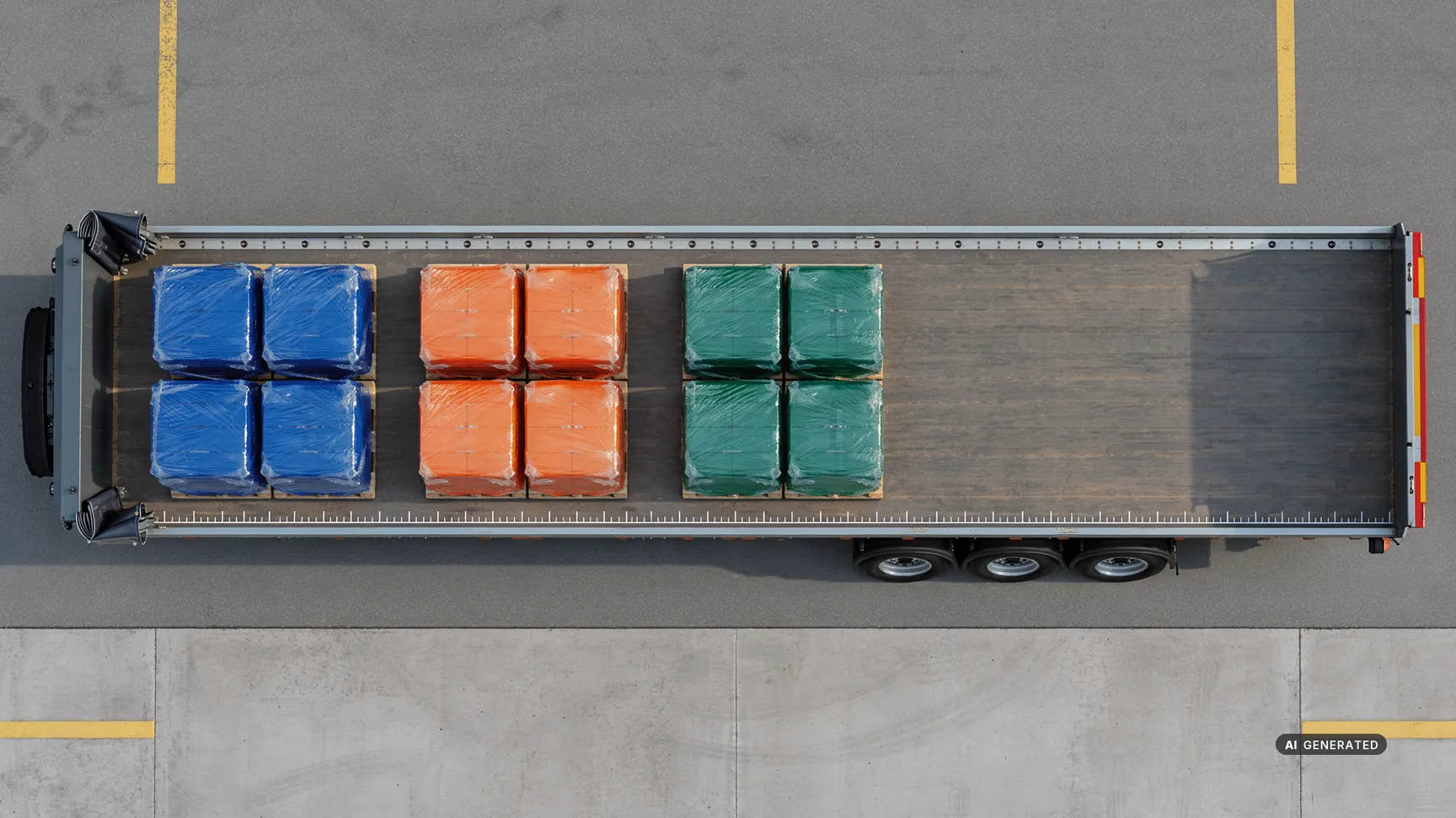
What is charged is the space used: for part loads, loading metres and the stackability of the goods determine the freight price.
4. Warehouse logistics perspective: multi-stop tours at the dock and staging area
For day-to-day warehouse operations, part loads are more demanding than full truckloads. While an FTL vehicle is loaded or unloaded at one dock in a single operation, a part load needs precise tour and sequence planning:
- Loading in reverse order of unloading: In goods-out, pallets are staged so that the shipment for the last stop is loaded first and the one for the first stop last (last in, first out for the tour). Otherwise the driver has to clear half the trailer at the first consignee.
- Load distribution and securing after every stop: Each partial unload changes axle loads and leaves gaps on the load bed. The remaining cargo has to be secured again after every stop.
- Pre-advice for each stop: Every consignee needs its own time slot. If one stop is delayed, all the following ones shift too.
- More deliveries in goods-in: Because part loads arrive on many different vehicles, the number of trucks per day rises. Without digital time slot management, queues quickly build up at the docks, along with waiting charges (in German law: Standgeld) for time beyond the agreed loading and unloading time (Source: Section 412 HGB – in German, para. 3).
- More checking effort: Partial quantities from different suppliers increase the effort for receiving, label checks (SSCC scan) and stock posting in the warehouse management system (WMS).
What waiting times at the dock cost and how downtime can be avoided is shown in the blog post The Billion-Dollar Grave: Why Waiting Is the Biggest Unsolved Problem in Logistics.
5. Contract logistics and part-load networks: where part loads are consolidated
In contract logistics (3PL), part loads are everyday business, especially in multi-user warehouses. Many providers collect smaller inbound flows from several suppliers in a regional warehouse and send them on in bundled form. Two further fields of use are typical for the part load itself:
- Seasonal flexibility: Volumes fluctuate strongly in e-commerce and retail. Part loads make it possible to replenish stock as needed without keeping buffer space for full truckloads.
- Part-load networks: Mid-sized forwarders pool their part loads in networks instead of maintaining their own fleets for every route. The ELVIS part-load system, for example, brings part loads together every day at a central hub in Knüllwald, Germany; around 150 national and 30 international depots are connected, and cargo is handled at ground level with side loading and unloading (Source: ELVIS AG – in German).
Which logistics networks exist and how they work is described in the blog post Logistics Networks: Lifeline for SMEs or Real Competition for the Industry Giants?.
6. Requirements for the logistics property and hall
A high share of part loads changes the requirements for a logistics property or commercial hall, above all at the dock, in the staging area and in the yard:
- Door density: As a rule of thumb, at least one loading door per 1,000 m² of hall space applies; many modern halls plan one door per 800 to 1,000 m² (Source: f+h 10/2022, Perspektiven BVL – in German). In cross-dock halls handling many part loads, door density is considerably higher, sometimes one door per 500 m² or less.
- Deep sorting and staging zones: Behind the doors, shipments are pre-sorted by tour, stop and postcode. In practice, column-free staging areas 15 to 20 metres deep are common for this – more than for pure full-truckload traffic. The exact figure depends on the number of doors and throughput.
- Mixed docking: Besides dock doors with dock levellers for articulated lorries (dock height approx. 1.20 m), ground-level sectional doors are needed, because part loads are often delivered on the final leg by 7.5- or 12-tonne trucks with tail lifts or by vans.
- Side loading: Bulky or long part loads are easier to load from the side on curtainsider trailers. A covered, ground-level area for this is an advantage.
- Floor and lighting: The industrial floor should meet the standard of at least 50 kN/m². Under the German workplace rule ASR A3.4, loading ramps and loading areas require at least 150 lx, and dispatch and packing areas at least 300 lx (Source: BAuA, ASR A3.4 – in German).
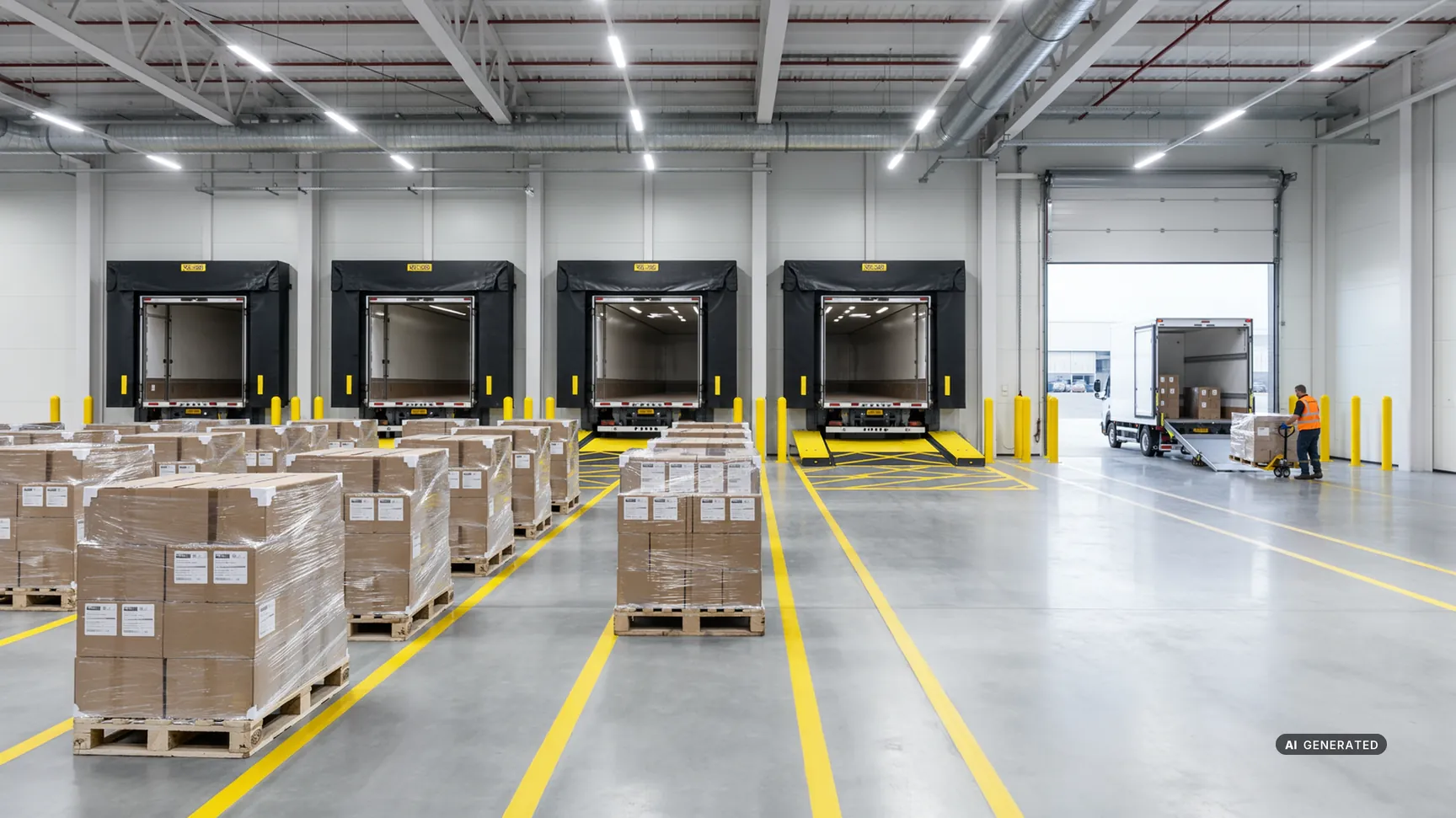
Many part loads need deep sorting areas behind the doors and, besides the loading dock, ground-level doors for smaller trucks.
7. Facts and figures: part loads in practice
- Loading-metre basics: 1 LDM = 1 m of load length at a width of 2.40 m; Euro pallet 0.4 LDM, industrial pallet 0.5 LDM; one loading metre holds 2.5 Euro pallets or 2 industrial pallets, and a standard trailer has 13.6 LDM.
- Break-even point: From around 15 to 20 Euro pallets (about 6 to 8 LDM) or around 12 tonnes, a full truckload is often cheaper than a part load.
- Utilisation: According to Eurostat, a laden truck in the EU carried an average of 14.4 tonnes in 2025 (13.6 tonnes national, 15.9 tonnes international). With a payload of around 24 to 25 tonnes for an articulated lorry, this corresponds, by our own calculation, to roughly 60% of the possible load (Source: Eurostat, Road freight transport by journey characteristics, 2025 data).
- Empty running: In 2025, 21.8% of the vehicle-kilometres of EU trucks were driven empty – 26.0% in national transport and 12.9% in international transport (source: Eurostat, see above). Well-consolidated part loads are one lever for reducing empty kilometres and shippers' Scope 3 emissions.
8. Conclusion: the part load as a bridge between groupage and full truckload
A part load pays off when a shipment is too large for the groupage network and too small for a truck of its own. Loading metres and the stackability of the goods are decisive for the price. For the warehouse, a high share of part loads means more deliveries, tours with several stops and a dock that keeps pace with deep sorting areas, enough doors and ground-level access.
9. Frequently asked questions (FAQ) about less than truckload (LTL)
Question: What exactly does LTL mean in logistics?
Answer: LTL stands for less than truckload, in German Teilladung. It refers to a shipment that only partly fills a truck and is transported on the same vehicle together with part loads from other customers.
Question: What is the difference between a part load and groupage?
Answer: Groupage covers smaller consignments (usually 1 to 5 pallets) that are sorted and reloaded several times at depots and hubs. Part loads (approx. 6 to 20 pallets) are larger and are usually delivered directly by co-loading or via no more than one transhipment point.
Question: How are part loads priced?
Answer: The freight rate depends on loading metres, weight and distance. The charge is based on the highest of actual weight, loading-metre weight and, where applicable, volumetric weight. The factor per loading metre depends on the tariff; 1,750 to 1,850 kg is common.
Question: How do I convert pallets into loading metres?
Answer: Divide the floor area of the shipment by 2.40 m. A Euro pallet equals 0.4 LDM, an industrial pallet 0.5 LDM. So 10 Euro pallets take up 4 LDM, or only 2 LDM if double-stacked.
Question: Which doors does a warehouse with many part loads need?
Answer: Besides dock doors with dock levellers for articulated lorries, ground-level doors for 7.5- and 12-tonne trucks with tail lifts or for vans make sense. Add to this a higher door density, deep sorting areas behind the doors and time slot management for the many deliveries.
Question: What role does LTL play in contract logistics?
Answer: Contract logistics providers use part loads to handle fluctuating volumes flexibly, replenish stock as needed and consolidate inbound flows from several suppliers in the warehouse.
Question: Is a part load as fast as a full truckload?
Answer: Usually not quite. A full truckload often reaches its destination within around 24 hours domestically. A part load usually needs 24 to 48 hours, up to 72 hours with transhipment – so depending on the number of stops, up to one or two days longer.
Your Ideal Logistics Warehouse
Browse listings for warehouse space, logistics real estate, industrial land, and contract logistics solutions.
Browse Exposés
Maximize Exposure for Your Warehouse Space
Showcase your logistics properties and attract qualified inquiries.
Discover Products