



Full Truckload (FTL) in Logistics
Table of contents
- 1. What Is a Full Truckload (FTL)? Definition and Distinction
- 2. FTL Compared with LTL: When Is Which Option Worthwhile?
- 3. Warehouse Logistics Perspective: Setting the Pace in Goods Receipt and Dispatch
- 4. Contract Logistics: FTL as a Lever for Multi-User Concepts and Cross-Docking
- 5. Impact on Logistics Property and Warehouse Architecture
- 6. Facts and Figures: FTL in Practice
- 7. Conclusion: The Full Truckload as the Link Between Road and Warehouse
- 8. Frequently Asked Questions (FAQ) About Full Truckloads (FTL)
A full truckload (FTL) is the backbone of direct freight transport: one shipper reserves the entire load space of a truck exclusively, and the goods travel to the consignee without transhipment – with short transit times and a low handling risk.
In the modern supply chain, choosing the right mode of transport has a major impact on transit times, damage rates and warehouse utilisation. The full truckload (FTL) – in German Komplettladung – is one of the most efficient shipping methods in road freight. But what exactly does the term mean, and how does FTL traffic influence the planning of logistics warehouses and the work of contract logistics providers?
1. What Is a Full Truckload (FTL)? Definition and Distinction
A full truckload (FTL) exists whenever a single customer (shipper) uses the entire loading capacity of a truck, semi-trailer or swap body combination exclusively for its consignment. The vehicle travels in so-called direct transport (point-to-point) without intermediate stops or transhipment in consolidation hubs, straight from the shipper’s loading dock to the consignee.
Important for dispatching: An FTL shipment is not necessarily defined by 100 per cent physical utilisation up to the roof. Even if a shipper sends only 20 pallets but books and pays for the entire load space for reasons of transport security, fixed delivery dates (just-in-time) or sensitive goods, it is contractually and in terms of costing a full truckload. In contrast, there is the part load (LTL – less than truckload) and classic general cargo traffic, where consignments from different customers are consolidated and routed via central transhipment warehouses (hubs).
Who takes on which role in transport – freight forwarder, carrier or contract logistics provider – is explained in the blog post Freight Forwarder, Carrier or Contract Logistics Provider? Deciphering the Great Confusion of Terms in Logistics.
2. FTL Compared with LTL: When Is Which Option Worthwhile?
The decision between FTL and LTL depends on shipment volume, time sensitivity and budget:
- Capacity and weight: A standard European articulated lorry (13.60 metres loading length, approx. 2.48 metres internal width) holds 33 Euro pallets (or 26 industrial pallets) on one level. With a permissible gross weight of 40 tonnes, the payload is around 24 to 25 tonnes, depending on the vehicle. As a rule of thumb, FTL is often more economical than an LTL shipment from around 15 to 20 pallets or about 12 tonnes; the exact break-even point depends on the route, market prices and type of load.
- Transit time and reliability: As there are no intermediate stops, FTL usually achieves transit times of around 24 hours in national long-distance transport and 48 to 72 hours in European cross-border transport, depending on the distance.
- Damage risk: Every transhipment in a hub carries risks. With FTL, the goods are loaded once, sealed if required and only opened again at the consignee – which significantly reduces the risk of handling damage.
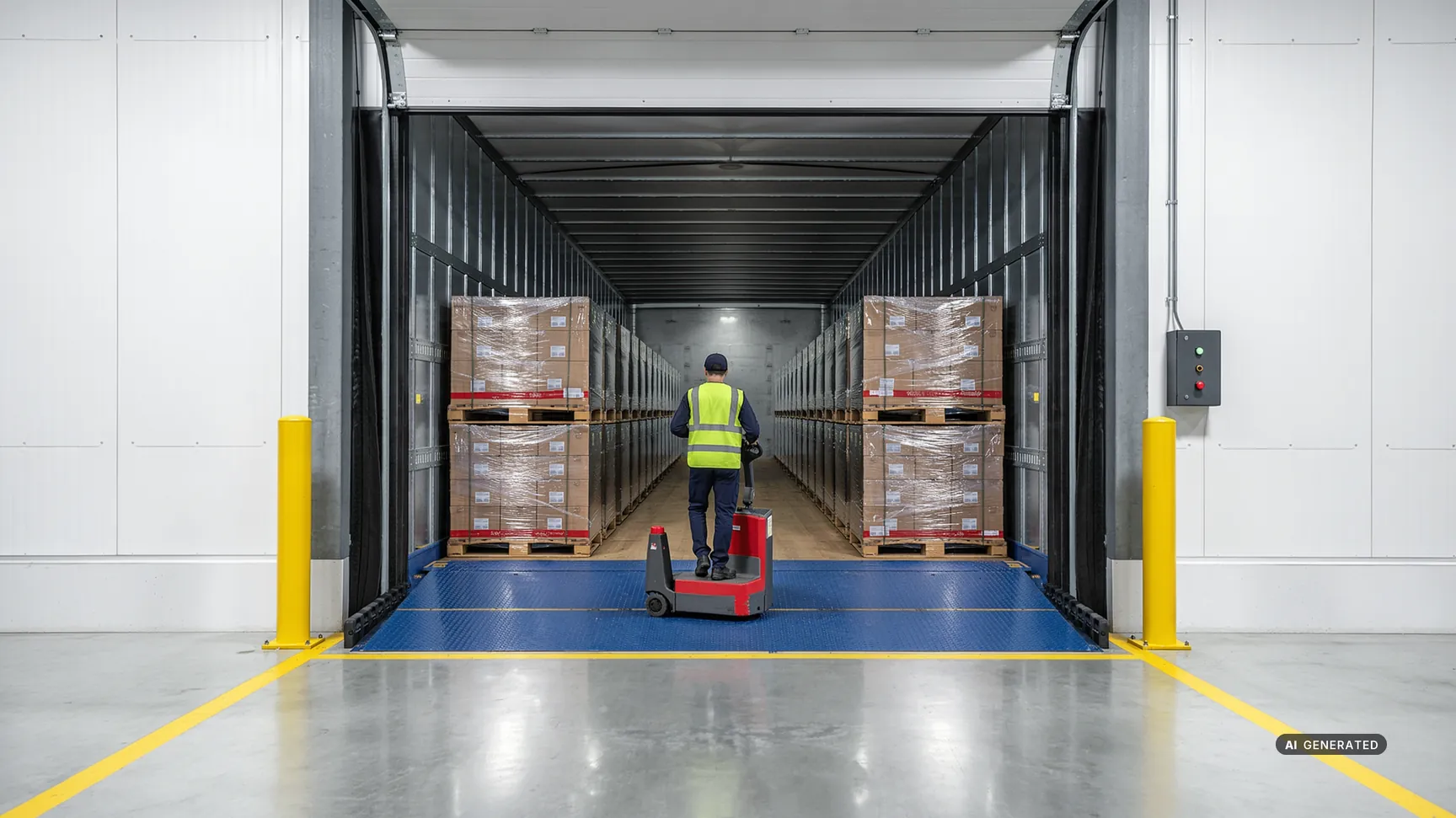
A full truckload means one shipper books the entire load space. Up to 33 Euro pallets travel to the consignee without transhipment, often cheaper than a part load from around 15 to 20 pallets.
3. Warehouse Logistics Perspective: Setting the Pace in Goods Receipt and Dispatch
In operational warehouse logistics, full truckloads require precise synchronisation of staff, industrial trucks and IT systems (warehouse management system – WMS):
- Goods dispatch (outbound): FTL shipments are usually picked in advance, wrapped and buffered in defined staging areas in loading sequence – so that load distribution and axle loads in the trailer are correct. As soon as the truck docks, it is loaded via dock levellers within a compact time window, in practice often 30 to 45 minutes.
- Goods receipt (inbound): If a full truckload arrives unannounced, unloading and receiving (quality inspection, barcode/RFID scan, put-away) immediately tie up considerable capacity. Digital time slot management and yard management solutions are therefore essential to avoid congestion in the yard and costly waiting charges (in German law: Standgeld) for time beyond the agreed loading and unloading time (Source: Section 412 HGB – in German, para. 3).
What waiting times at the dock cost and how downtime can be avoided is shown in the blog post The Billion-Dollar Grave: Why Waiting Is the Biggest Unsolved Problem in Logistics.
4. Contract Logistics: FTL as a Lever for Multi-User Concepts and Cross-Docking
For contract logistics providers (3PL), full truckloads form the foundation of profitable value chains. Service providers mainly use FTL traffic in three scenarios:
- Plant supply and consolidation: On behalf of industrial or retail companies, the contract logistics provider bundles smaller pre-carriage shipments in a regional warehouse, takes on value added services (VAS) such as labelling, display construction or quality checks and sends consolidated FTL tours directly to central warehouses or production lines.
- Cross-docking: Incoming FTL deliveries are unloaded at the docks, moved straight through the warehouse, sorted by consignee and transferred to outgoing FTL or LTL vehicles without longer storage.
- Freight networks and fewer empty runs: Through forwarding and load networks such as ELVIS AG (European load network of international freight forwarders), medium-sized logistics service providers find return loads more easily, reduce empty kilometres and improve their utilisation (Source: ELVIS AG – in German).
How such cooperations work and which networks exist is described in the blog post Logistics Networks: Lifeline for SMEs or Real Competition for the Industry Giants?.
5. Impact on Logistics Property and Warehouse Architecture
A high share of FTL traffic places specific structural requirements on modern logistics properties and commercial warehouses:
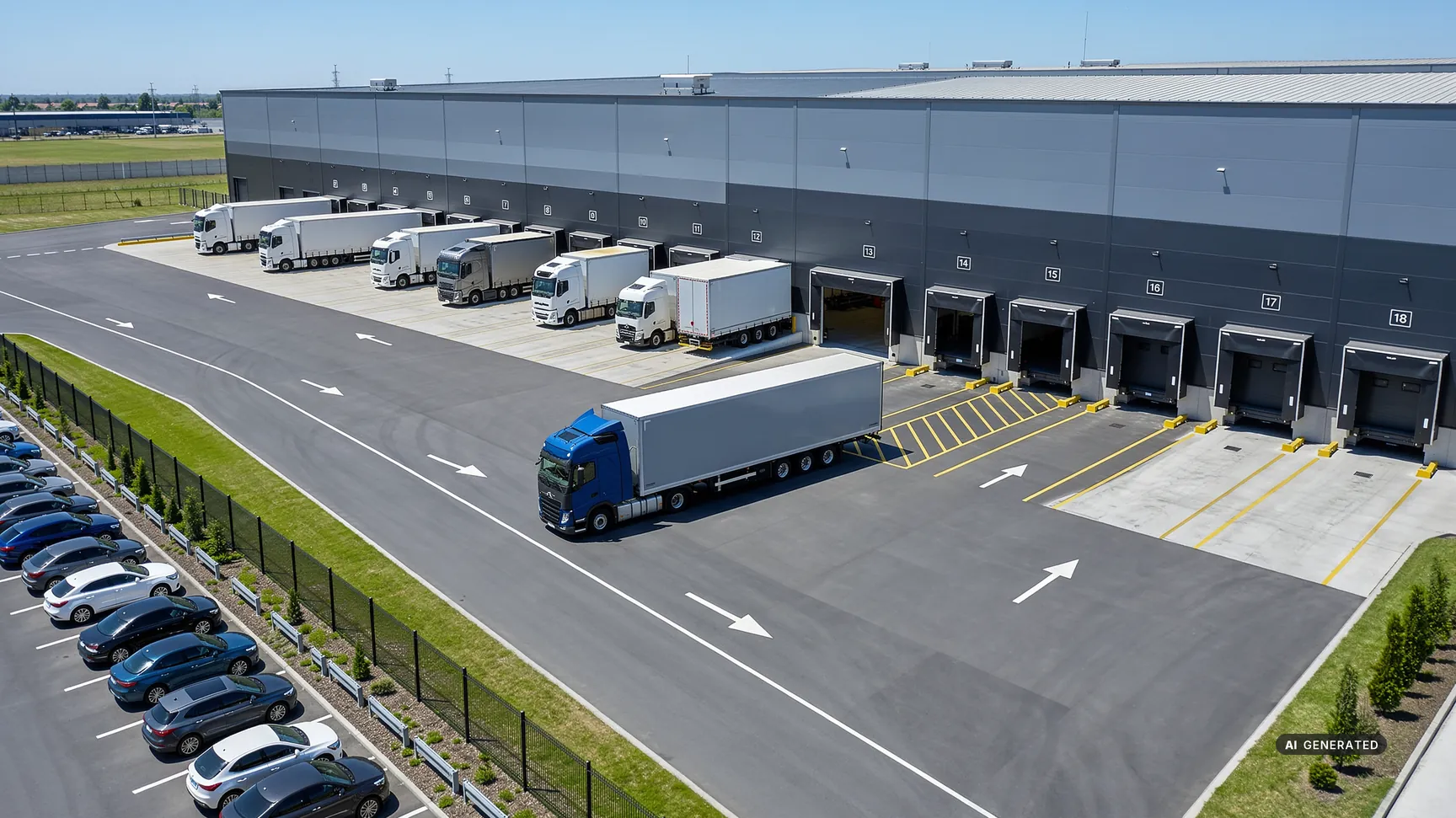
A high share of full truckloads needs many dock doors and a deep yard: the rule of thumb is around one door per 1,000 m² of warehouse space and at least 35 metres of manoeuvring space in front of the docks.
- Door density and dock technology: The rule of thumb is at least one dock door per 1,000 m² of warehouse space; many modern warehouses plan one door per 800 to 1,000 m² (Source: f+h 10/2022, Perspektiven BVL – in German). In pure transhipment warehouses (cross-docks), door density is considerably higher, sometimes one door per 500 m² or less. Hydraulic dock levellers, dock shelters and truck guides are standard.
- Yard geometry (yard depth): Articulated lorries with an overall length of 16.50 metres need a manoeuvring area of at least around 35 metres in front of the loading docks so that they can reverse to the dock quickly and safely. For longer trucks (gigaliners), 38 metres are recommended (Source: DIWG, Logistics Properties Trend Report 2021).
- Staging zones and floor loads: Generous, column-free staging zones must be planned behind the doors; in practice, a depth of 12 to 15 metres is common, depending on the number of doors and throughput. The industrial floor should bear a distributed load of at least 50 kN/m² (5 t/m²) – considered the standard for logistics warehouses suitable for third-party use (Source: DIWG, Logistics Properties Trend Report 2021). Wheel loads of forklifts and point loads under rack uprights are verified separately.
6. Facts and Figures: FTL in Practice
- Standard capacity: A 13.60 m curtainsider (tautliner) offers around 90 m³ of loading volume (mega trailers up to about 100 m³) for 33 Euro pallets on one level. With stackable goods or double-deck trailers, up to 66 Euro pallets are possible, as long as the payload allows.
- Empty-run potential: According to Eurostat, around one fifth (21.8%) of the vehicle-kilometres driven by EU-registered trucks in 2025 were empty; in national transport the figure was 26.0%, in international transport 12.9% (Source: Eurostat, Road freight transport by journey characteristics, 2025 data). Digital freight matching and return loads via freight exchanges are considered an important lever for reducing this rate and shippers’ Scope 3 CO₂ emissions.
- Turnaround time: With pre-picked staging zones and standardised dock-to-dock processes, the time an FTL truck spends at the dock can be cut to under an hour, often to around 30 to 45 minutes.
7. Conclusion: The Full Truckload as the Link Between Road and Warehouse
The full truckload takes goods directly from shipper to consignee without transhipment. It saves time and reduces the risk of damage, but only pays off above a certain volume or when delivery dates are tight. For FTL traffic to run smoothly, the warehouse has to play its part: enough dock doors, a deep yard, generous staging zones and time slot control at the dock.
8. Frequently Asked Questions (FAQ) About Full Truckloads (FTL)
Question: What exactly does FTL mean in logistics?
Answer: FTL stands for full truckload (German: Komplettladung) and describes a shipment in which a single shipper books the entire capacity of a truck. The goods are transported directly from the shipper to the consignee without transhipment in intermediate warehouses.
Question: From how many pallets is a full truckload worthwhile?
Answer: As a rule of thumb, FTL usually pays off from 15 to 20 Euro pallets or a shipment weight of around 12 tonnes. FTL can also make sense for smaller quantities if high schedule reliability is required or sensitive goods should not be transhipped.
Question: How many pallets fit into a standard FTL truck?
Answer: A standard European semi-trailer (13.60 m loading length) holds 33 Euro pallets (80 × 120 cm) or 26 industrial pallets (100 × 120 cm) on one level. With stackable goods or double-deck trailers, up to 66 Euro pallets are possible, provided the permissible gross weight of 40 tonnes (around 24 to 25 tonnes payload) is not exceeded.
Question: What is the difference between FTL and LTL?
Answer: With FTL, one customer uses the entire truck in direct transport. With LTL (less than truckload / part load), several customers share the load space of one vehicle, which usually involves intermediate stops or transhipment via regional hubs.
Question: What requirements does FTL traffic place on a logistics warehouse?
Answer: The key factors are a sufficient number of dock doors with dock levellers, a yard depth of at least around 35 metres in front of the docks, column-free staging zones behind the doors and digital time slot management.
Question: Who is responsible for loading and load securing in FTL transport?
Answer: Under Section 412 of the German Commercial Code (HGB), the shipper must load, stow and secure the goods safely for transport and unload them, unless circumstances or common practice indicate otherwise. The carrier ensures that loading is operationally safe, for example with regard to axle loads and weight distribution. The parties may agree otherwise in the contract. Regardless of this, German road traffic law (Section 22 StVO) requires the load to be stowed safely for road traffic.
Question: What role do Incoterms play in FTL transport?
Answer: Incoterms (such as FCA, DAP or DDP) determine whether the buyer or the seller organises and pays for the FTL transport, where the risk passes and who loads and unloads at the dock.
Your Ideal Logistics Warehouse
Browse listings for warehouse space, logistics real estate, industrial land, and contract logistics solutions.
Browse Exposés
Maximize Exposure for Your Warehouse Space
Showcase your logistics properties and attract qualified inquiries.
Discover Products