



Contract Packers in Warehouse Logistics
Table of contents
- 1. What is a contract packer? Definition and operational role
- 2. Contract packers in warehouse and contract logistics: added value beyond standard handling
- 3. The logistics property: technical requirements for a co-packing facility
- 4. Facts and figures: cost-effectiveness and leverage
- 5. IT architecture and connectivity: ERP, WMS and traceability
- 6. Conclusion: the contract packer as a value-adding partner at the warehouse
- 7. Frequently asked questions (FAQ) about contract packers
As a highly specialised interface between production, warehousing and distribution, contract packers transform static warehouse space into value-adding process centres for tailor-made packaging solutions.
1. What is a contract packer? Definition and operational role
A contract packer (often called a co-packer) is a specialised logistics and packaging service provider that handles the professional primary, secondary or tertiary packaging of goods on behalf of industrial, brand and retail companies.
Unlike a pure toll packer (Lohnverpacker) working order by order, the modern contract packer operates on the basis of medium- to long-term service contracts. It integrates its packing lines directly into the intralogistics material flows and links pure warehousing with industrial-style finishing processes.
It is important to distinguish the terms: co-packing describes the activity, i.e. packing, finishing and bundling on behalf of a client. The contract packer is the service provider that performs this activity on a contractual basis and directly at the warehouse location.
2. Contract packers in warehouse and contract logistics: added value beyond standard handling
In contract logistics, co-packing is one of the highest-margin and most complex building blocks of value added services (VAS). Instead of passing palletised goods through untouched, contract packers intervene directly in the goods structure at the warehouse location:
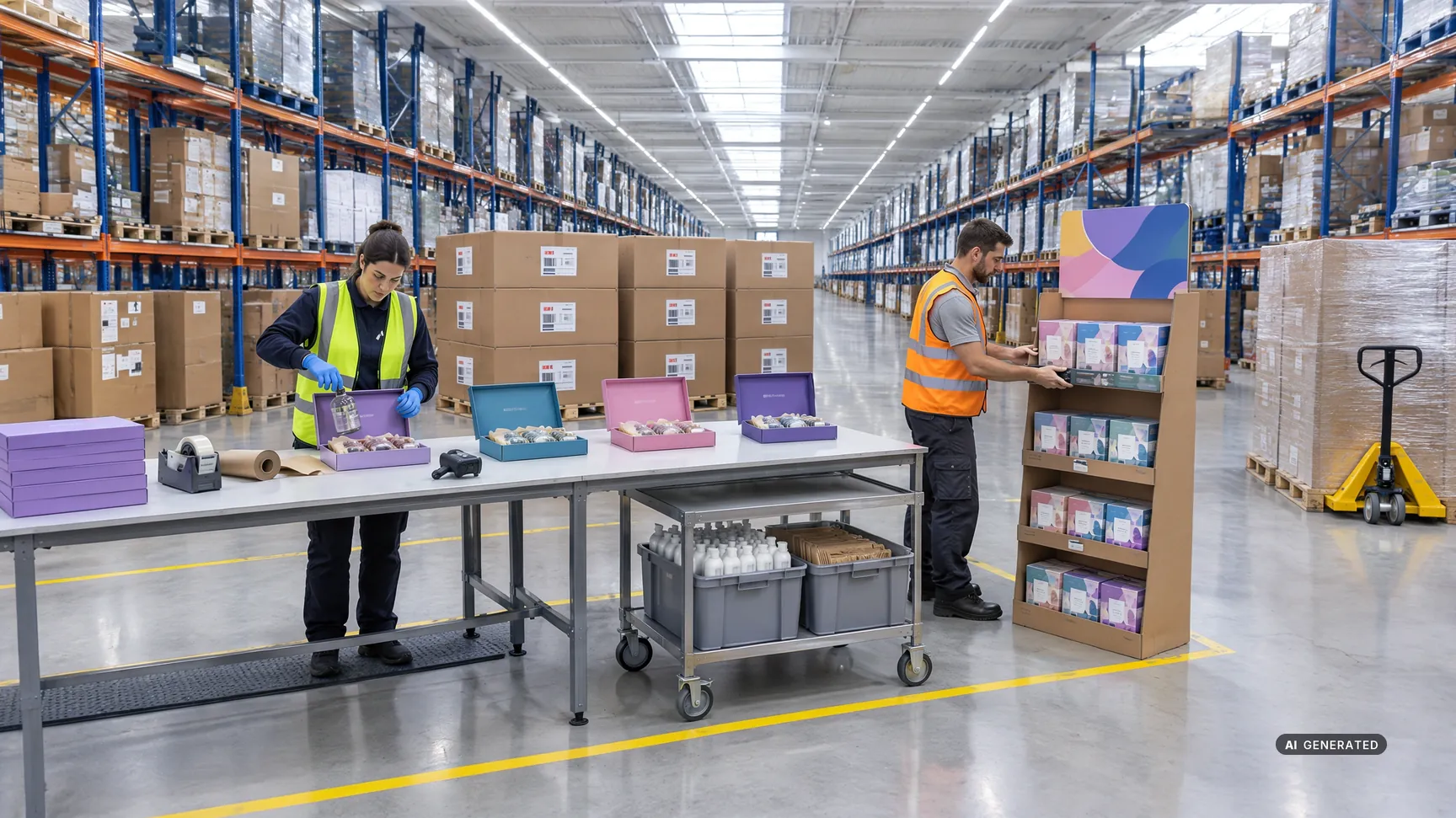
Kitting and display assembly right in the warehouse: the contract packer turns palletised goods into retail-ready sets and stocked POS displays, with no detour via an external packing plant.
- Kitting & set building: Combining heterogeneous individual components (SKUs) into retail-ready bundles, bundling promotional sets and seasonal multipacks. Practical example: for a Christmas promotion, the contract packer combines shower gel, body lotion and a gift box into a set with its own EAN, which is managed as a separate item in the WMS from October.
- Display assembly & finishing: Erecting eye-catching point-of-sale displays (POS displays) securely for transport and stocking them for food retail and drugstore chains. Practical example: for a nationwide promotion, several thousand quarter-pallet displays are stocked according to a planogram within a few weeks and picked store by store.
- Labelling & country customising: Country-specific marking with serial numbers, barcodes, safety and warning notices, plus inserting localised operating instructions. Practical example: a batch of electronics delivered in neutral packaging is customised in the warehouse with a country-specific plug, language label and manual for several EU markets, instead of producing a separate variant for each country.
- Repacking & shrink processes: Repacking large overseas containers into consumer-friendly formats using shrink tunnels (shrink-wrapping) or blister hoods. Practical example: after arrival, an overseas container of bulk packs is repacked into trade units (e.g. shrink-wrapped 6-unit trays) and delivered straight to retail as store-ready goods.
How value added services are changing the role of the logistics service provider as a whole is described in the blog article More than just transport: how value added services are changing logistics for good.
3. The logistics property: technical requirements for a co-packing facility
Integrating packaging processes changes the requirements profile for the commercial property dramatically. Pure high-bay warehouses quickly reach their functional limits, which is why specific structural specifications must be met for new builds and new leases:
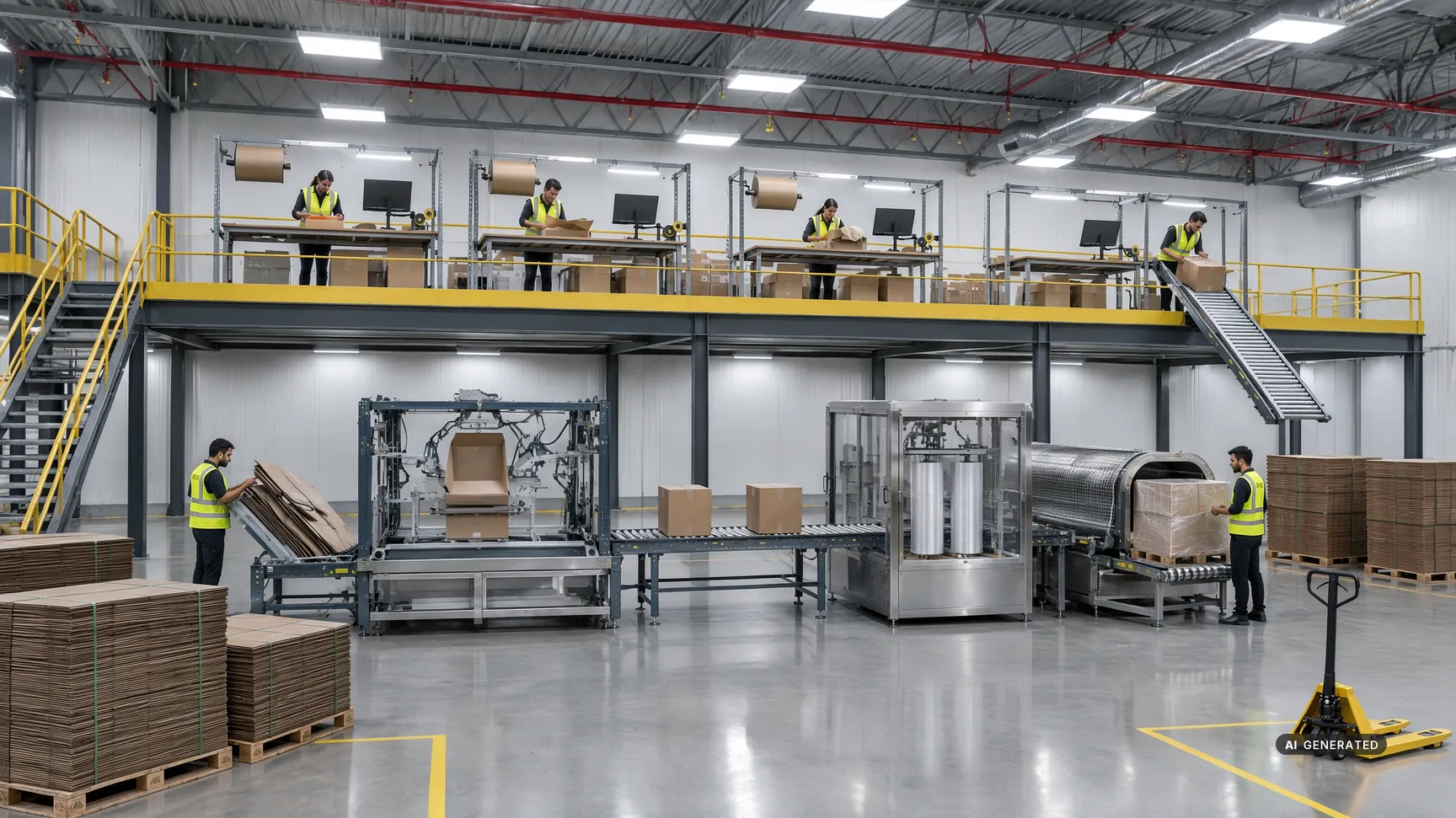
Manual packing stations move up to the mezzanine while machines stay on the load-bearing floor: stored cardboard raises the fire load and calls for powerful sprinkler, power and compressed-air networks.
- Space configuration & mezzanine: Because packing lines tie up valuable floor space, manual and semi-automatic stations are often located on mezzanine floors. For packing and shipping areas, the German workplace regulation ASR A3.4 requires glare-free lighting of at least 300 lux.
- Floor load capacity: Static areas for automatic bagging or cartoning machines require level industrial floors with a distributed load capacity of at least 50 kN/m² (approx. 5 tonnes/m²) and sufficiently high point loads (in kN) for machine feet and rack uprights.
- Fire protection infrastructure: Permanently storing corrugated board, cartons and films creates considerable fire loads. Standard sprinklers are rarely sufficient; high-performance ESFR ceiling sprinklers to VdS CEA 4001 or NFPA 13 are required – supplemented by in-rack sprinklers where they are not sufficient for the goods or storage height – along with structural fire compartmentation.
- Power & compressed air supply: High-performance sealing and shrink-wrap lines require protected three-phase power connections (400 V, in some cases with individual fuses of 63 to 125 A) and permanent compressed air networks (6 to 8 bar) across the building grid.
4. Facts and figures: cost-effectiveness and leverage
Using contract packers converts plant-intensive fixed costs (CAPEX) into purely volume-dependent operating costs (OPEX). The following figures are typical project values; in individual cases they depend heavily on the product range, packaging and process:
- Volume optimisation: Typical project value: Sensor-based, millimetre-precise 3D cutting systems and made-to-measure primary packaging reduce the empty space in shipping cartons by 30 to 40%.
- Transport utilisation: Typical project value: Reducing dead air space in the outer carton makes it possible to carry 25 to 30% more packages on a standard articulated lorry, which brings direct freight and CO₂ cost benefits.
- Shorter lead times: On-site finishing in the distribution centre eliminates intermediate transports between the factory and an external packing plant; the time saved along the supply chain is typically 24 to 48 hours.
- Transaction-based billing: Common billing structures are based on transaction-specific KPIs such as pay-per-piece, pay-per-display or mixed models combining cycle-time rates and set-up fees.
When automated, right-sized packaging pays off and what should be measured before investing is shown in the blog article Automated packaging in the warehouse: costs, ROI and investment decision.
5. IT architecture and connectivity: ERP, WMS and traceability
A modern contract packer does not work in isolation but as a digital hub. Via standardised EDI interfaces (e.g. EDIFACT messages over AS2) or modern REST APIs, data is synchronised bidirectionally with the client's ERP and the warehouse management system (WMS) at the site.
For goods subject to batch tracking and serialisation (e.g. food and feed traceability under Regulation (EC) No 178/2002 or the serialisation of medicinal products under Delegated Regulation (EU) 2016/161), 2D DataMatrix and GS1 scans record every packing operation seamlessly, rebook stock in real time and provide auditable histories.
6. Conclusion: the contract packer as a value-adding partner at the warehouse
Contract packers combine storage, packaging and distribution under one roof and turn pure warehouse space into value-adding process centres. Outsourcing co-packing converts investments in in-house lines into variable costs and creates flexibility for promotions and peaks. The prerequisite is a logistics property that provides the lighting, floor loads, fire protection and power and compressed air supply that packaging processes require.
7. Frequently asked questions (FAQ) about contract packers
Question: What distinguishes a contract packer from a traditional toll packer?
Answer: A pure toll packer usually handles isolated individual orders with precisely defined material and no permanent connection. The contract packer, on the other hand, is firmly integrated into the supply chain via medium-term framework agreements. It often operates directly within multi-user or dedicated logistics facilities and seamlessly links packaging activities with warehousing, transport logistics and returns management.
Question: When is a contract packer better than an in-house packing line?
Answer: Above all when packing volumes fluctuate strongly or occur only seasonally, for example for promotions, Black Friday peaks, Easter or Christmas. An in-house line ties up capital, space and staff even in weak months; the contract packer, by contrast, bills per piece, display or set and scales staff and packing stations with the order. Outsourcing is usually also more economical when there are many variants (country versions, sets, displays), short lead times or no warehouse space of your own. An in-house line tends to pay off for consistently high, standardised volumes in few formats.
Question: Which criteria must a co-packing facility layout meet?
Answer: Required are flexible mezzanine or separate ground-level packing zones with glare-free workstation lighting (at least 300 lux under ASR A3.4), a high distributed floor load capacity (≥ 50 kN/m²) and sufficient point loads, sufficient three-phase power and compressed air connections, and VdS-compliant ESFR ceiling sprinklers to control the fire load from packaging waste.
Question: How do contract packers bill their services in practice?
Answer: Common are transaction-based unit prices such as cost per piece (pay-per-unit), case or display prices, or billing per finished set. In addition, variable set-up times, machine hourly rates and tiered prices based on minimum order volumes are agreed.
Question: Which certifications are relevant for contract packers?
Answer: Depending on the goods, clients require quality management to ISO 9001. In the food sector, IFS Food, IFS PACsecure for packaging businesses or BRCGS Standard apply, in the cosmetics sector ISO 22716 (cosmetics GMP), and in pharmaceutical logistics strict GMP and GDP approvals. TAPA FSR standards apply to high-security areas. An overview of the most important logistics certificates is given in the blog article The certificate compass for logistics.
Question: How does sustainability (ESG) influence contract packing?
Answer: Contract packers drive the reduction of packaging waste (zero void fill), optimise the separation of recyclates and replace fossil single-use padding with tailor-made, bio-based corrugated inlays. This directly supports Scope 3 emission reductions and compliance with regulatory requirements such as the EU Packaging and Packaging Waste Regulation (PPWR).
Question: Which geographical location factors determine the choice of contract packer?
Answer: The decisive factors are a location directly at primary motorway junctions and proximity to central freight and parcel (CEP) hubs. Short distances ensure late cut-off times and make sure that newly packed goods are fed directly into scheduled line services without an overnight stop.
Your Ideal Logistics Warehouse
Browse listings for warehouse space, logistics real estate, industrial land, and contract logistics solutions.
Browse Exposés
Maximize Exposure for Your Warehouse Space
Showcase your logistics properties and attract qualified inquiries.
Discover Products