



Click and Delivery in Logistics
Table of contents
- 1. Definition: What Does Click and Delivery Mean?
- 2. Click and Delivery in Warehouse Logistics: Speed Measured in Seconds
- 3. The Role of Contract Logistics: Scalability and Value Added Services (VAS)
- 4. Structural and Infrastructural Requirements for the Logistics Property
- 5. Geographic Factors (GEO) & Site Selection: The Battle for the Last Mile
- 6. Data, Figures and Facts: The Key KPIs at a Glance
- 7. Frequently Asked Questions (FAQ) about Click and Delivery
- 8. Conclusion: The Key to Success Is the Interplay of IT, Service Provider and Property
1. Definition: What Does Click and Delivery Mean?
Click and Delivery describes the end-to-end e-commerce process in which consumers or business customers order goods with a click on a digital platform (web shop, app, marketplace) and have them delivered directly to their destination – usually the front door (B2C) or the loading dock/workshop (B2B). Unlike concepts such as Click and Collect (order online, pick up in a physical store), there is no physical customer contact at the point of sale at all.
For the supply chain, Click and Delivery means a substantial operational up-front effort: the digital purchase impulse must be translated into physical warehouse and transport processes in real time. The concept forms the backbone of global distance selling and places the highest demands on inventory accuracy, picking speed and the integration of IT and intralogistics.
2. Click and Delivery in Warehouse Logistics: Speed Measured in Seconds
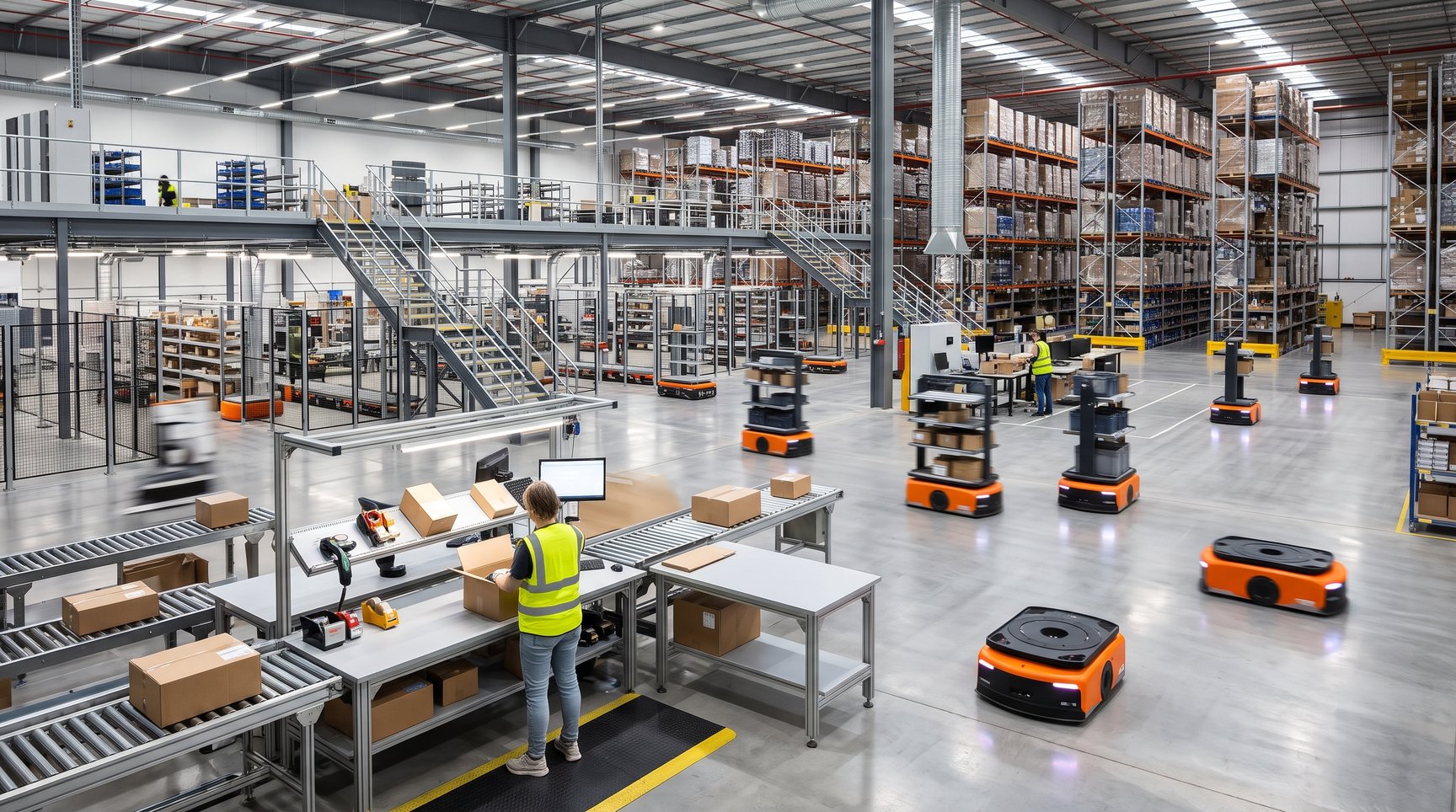
In operational warehouse logistics, Click and Delivery turns static warehouses into high-frequency throughput machines. As soon as the shopping cart is paid, the Warehouse Management System (WMS) generates pick orders immediately. Since customers today expect standard delivery times of under 24 to 48 hours (next-day or same-day delivery), smooth material flows are indispensable:
- Dynamic picking: Instead of time-consuming single-order processing, methods such as multi-order picking, batch picking or automated wave picking are used.
- Minimizing travel times: In traditional warehouses, up to 60 % of working time is spent on walking and transport routes alone. With ABC zoning, fast-moving items (A items) are placed directly at the staging area or the packing lines to shorten routes drastically.
- Error-free consolidation: Barcode and RFID scanning typically bring the pick error rate in e-commerce down to below 0.1 to 0.3 %, which avoids costly misdeliveries and returns.
3. The Role of Contract Logistics: Scalability and Value Added Services (VAS)
Hardly any retailer today still operates its Click and Delivery fulfillment networks entirely in-house. Specialized 3PL and 4PL contract logistics providers take over the full range of services under multi-year contracts (typically 3 to 5 years):
- Multi-user capability & cost sharing: By pooling several clients in large-scale warehouses, staff, conveyor technology and IT systems can be shared flexibly.
- Variable cost structures (CAPEX to OPEX): Instead of heavy investment in their own logistics properties and technology, shippers pay usage-based transaction fees such as pay-per-pick, pay-per-parcel or pay-per-pallet.
- Value Added Services (VAS): Beyond mere “moving boxes”, contract logistics providers handle customer-specific assembly and packaging, kitting (set formation), country-specific inserts and time-critical returns management (reverse logistics), including quality control and refurbishment.
4. Structural and Infrastructural Requirements for the Logistics Property
The architecture of a commercial hall either limits or maximizes the success of Click and Delivery. Standard halls quickly reach their limits at high small-parts throughput. Modern e-commerce fulfillment centers therefore rely on specific features:
- Clear hall height (UKB): A clear height of 10.00 to 12.20 meters under the roof truss is standard in order to use high-bay racking vertically or to integrate multi-level rack platforms.
- Mezzanine levels: E-commerce fulfillment requires a lot of manual and semi-automated packing space. Load-bearing mezzanines (5 to 10 kN/m² load capacity) double or triple the picking and packing areas without increasing the property's footprint.
- Floor load capacity & flatness: Automated conveyor systems, autonomous mobile robots (AMR) and narrow-aisle trucks require an extremely flat industrial floor with a minimum load capacity of 50 kN/m² (approx. 5 t/m²).
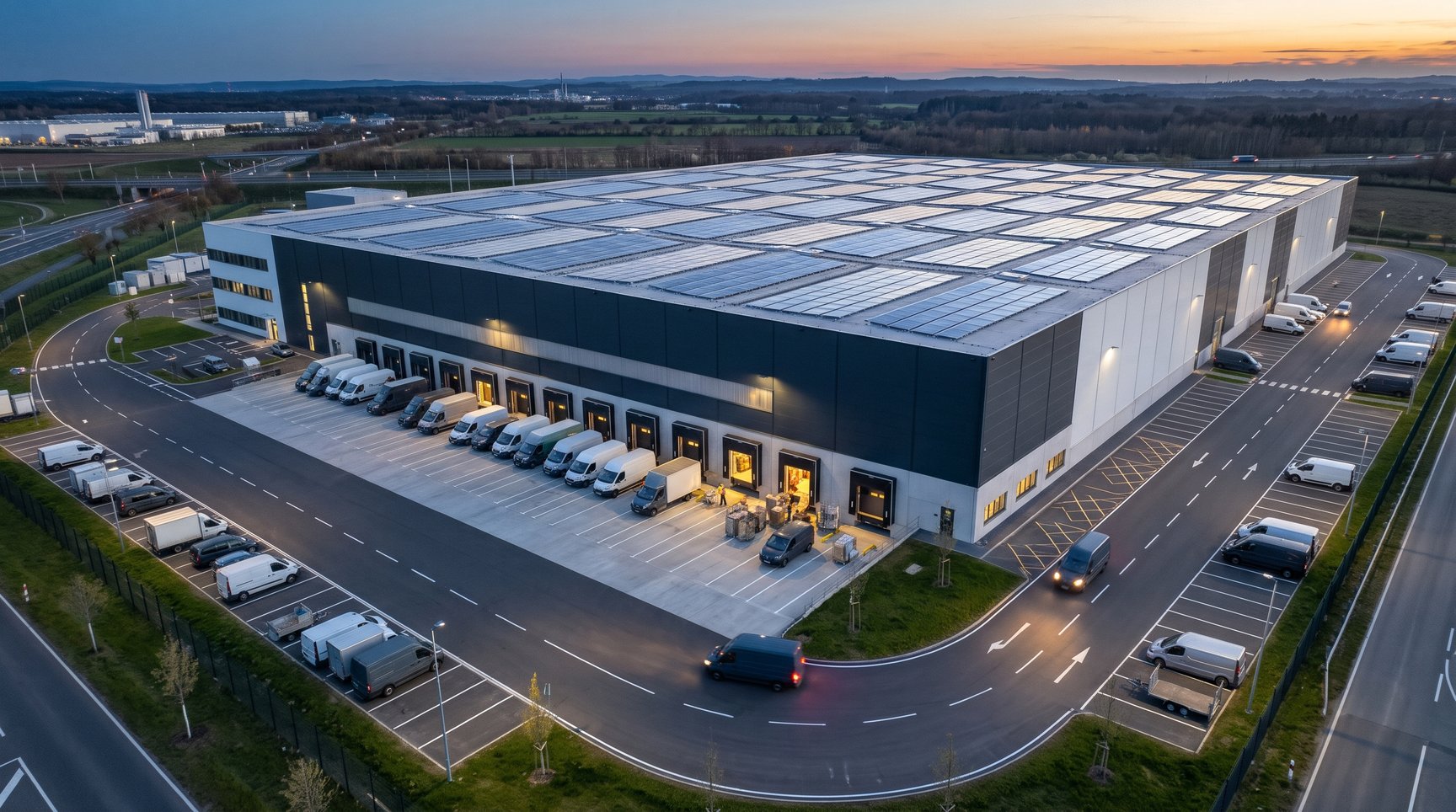
- Dock door density: As a rule of thumb, at least 1 loading door (dock leveler) per 1,000 m² of hall space. For Click and Delivery transshipment (cross-docking), ground-level sectional doors for van and light-truck fleets are also crucial.
- Fire protection & ESG: Large volumes of packaging material and cardboard require area-wide ESFR sprinkler systems. For ESG-compliant tenants and investors, rooftop photovoltaic systems, heat pumps and DGNB or BREEAM certifications have become standard.
5. Geographic Factors (GEO) & Site Selection: The Battle for the Last Mile
In Click and Delivery logistics, the macro and micro location determines economic success. The “last mile” is the most expensive section of the entire distribution chain:
- Urban city hubs & micro-fulfillment: To enable same-day delivery in metropolitan areas, smaller hall space close to the city or revitalized commercial properties (brownfields) are needed.
- Motorway junctions & proximity to parcel carriers: Nationwide fulfillment centers require a direct motorway connection (prime locations along the A1, A2, A3, A7) as well as immediate proximity to the central hubs of the major CEP (courier, express and parcel) providers (DHL, DPD, GLS, UPS). This allows extremely late order cut-off times (up to 6:00 p.m. or 8:00 p.m.) with guaranteed next-day delivery.
- Rent ranges by location: Prime rents for new-build space in top logistics regions (e.g. Rhine-Main, Munich, Berlin) range from €8.50 to over €11.50/m², while secondary locations and surrounding areas remain stable at €6.50 to €8.50/m².
6. Data, Figures and Facts: The Key KPIs at a Glance
The performance of a Click and Delivery network is reflected in precise performance indicators:
| Metric / KPI | Benchmark in best-practice warehouses | Significance for the overall process |
|---|---|---|
| Order lead time (throughput time) | < 45 to 60 minutes | Time from order receipt in the WMS to the loading dock |
| Pick error rate | < 0.1 % to 0.3 % | Error-free picking minimizes costly complaints |
| Return rate (fashion vs. B2B) | 20 % – 45 % (fashion) / < 5 % (B2B) | Determines the space required for returns and reprocessing hubs |
| Hall space utilization rate | 75 % – 85 % | Optimal balance between storage density and free travel/buffer aisles |
| Dock door density | 1 door per 800 – 1,000 m² | Avoids bottlenecks in goods receipt and goods issue |
7. Frequently Asked Questions (FAQ) about Click and Delivery
Question: What is the difference between Click and Delivery and Click and Collect?
Answer: With Click and Delivery, the goods are handed over directly to the customer's chosen address by parcel carrier or freight forwarder after the online order. With Click and Collect, the customer handles the transport themselves by collecting the goods, picked in advance at the warehouse, in a store or at a pick-up station.
Question: What role does the WMS (Warehouse Management System) play in Click and Delivery shipping?
Answer: The WMS is the digital brain of the warehouse. It synchronizes inventory with online shops in real time, optimizes the picking routes of staff or robots, controls automated packing lines and generates shipping and return labels in milliseconds.
Question: Why is Click and Delivery so attractive for contract logistics providers?
Answer: It allows logistics service providers to move away from low-margin pure space rental. Value Added Services (VAS) such as packaging optimization, kitting and returns management, combined with volume-based transaction fees, enable higher contribution margins and long-term customer retention.
Question: What hall height is ideal for an e-commerce fulfillment center?
Answer: The industry standard is a clear height of 10 to 12 meters (under the roof truss). This height allows either the installation of fully automated high-bay warehouses/AutoStore systems or the addition of mezzanine levels for manual small-parts picking.
Question: How does the return rate influence hall planning for Click and Delivery?
Answer: Particularly in consumer goods and fashion, return rates of up to 40 % require dedicated, generously sized zones for returns registration, inspection, reconditioning (refurbishment) and restocking. Without this space, returns clog the regular goods receipt and goods issue areas.
Question: When does outsourcing Click and Delivery to a 3PL provider pay off?
Answer: Outsourcing pays off as soon as order volumes fluctuate strongly (seasonal peaks such as Black Friday), investment in your own hall construction (CAPEX) is to be avoided, or the in-house know-how for highly complex IT and conveyor technology is lacking.
Question: Why are the GEO factor and proximity to parcel carriers critical to the success of Click and Delivery hubs?
Answer: The closer the hall is to a main transshipment hub of courier, express and parcel services, the later the daily order “cut-off” can be set. Orders received at 6:00 p.m. can still be fed in late in the evening and delivered nationwide the next morning.
8. Conclusion: The Key to Success Is the Interplay of IT, Service Provider and Property
Click and Delivery is no longer a mere marketing or sales promise, but a highly demanding intralogistics challenge. Companies that want to operate sustainably and profitably in this market must optimize their logistics chain holistically: from state-of-the-art Warehouse Management Systems and agile contract logistics partners with modular billing models to highly functional, well-connected logistics properties. Only when the physical warehouse, cutting-edge automation technology and well-considered locations work hand in hand does a click in an online shop become a punctual and cost-effective delivery to the customer's front door.
💡 Are you currently looking for a suitable logistics property with mezzanine space and optimal parcel carrier access for your Click and Delivery business? Or do you need an experienced contract logistics provider for your e-commerce fulfillment? Discover vetted commercial warehouses and the ideal fulfillment partners for your supply chain on LAGERflaeche.de!
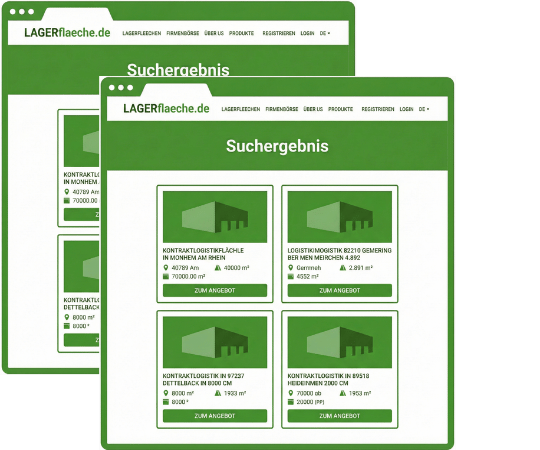
Your Ideal Logistics Warehouse
Browse listings for warehouse space, logistics real estate, industrial land, and contract logistics solutions.
Browse Exposés
Maximize Exposure for Your Warehouse Space
Showcase your logistics properties and attract qualified inquiries.
Discover Products