


Commission-free offer
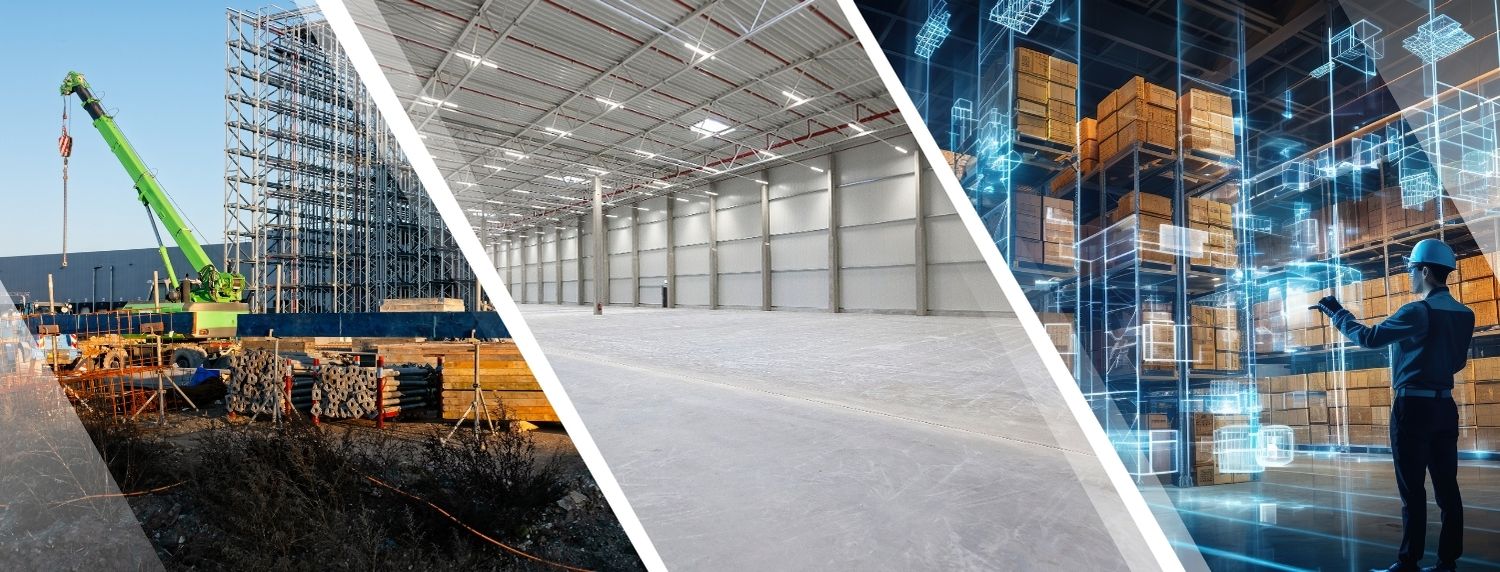
Gewerbehalle in attraktiver Lage
Object no.: 10182
Logistics real estate
Rental
Germany
34399 Oedelsheim
16.000 m²
Price on request

The Northern European Powerhouse for Trimodal Logistics
» GVZ Rostock: The Northern European Powerhouse for Trimodal Logistics – An In-Depth Analysis
» General Description and Strategic Positioning
» Infrastructure and Modality: The Trimodal Hub
» Key Facts at a Glance (Facts & Figures)
» Top Logistics Region: Why Rostock Rises in the Ranking
» Economic Indicators: Rental Prices, Land Prices and Taxes
» Workforce and Skilled Workers: Human Capital
» Special Features of the Rostock Freight Village
» Local Companies and Economic Development
» Conclusion and Outlook: Is Rostock worth it?
Rostock has long been more than just a cruise port or a holiday destination. The Hanseatic city has developed into an indispensable hub for the global supply chain. But what makes the Rostock freight village so attractive in direct comparison to competitors such as Hamburg or Lübeck? In times of disrupted supply chains and rising costs, is the location the "safe haven" solution for traffic to Scandinavia and Eastern Europe?
The GVZ Rostock not only analyses this description of the location on the surface, but also delves deep into the infrastructural conditions, the cost structures and the future potential. We shed light on why international players are investing here and what synergies the location actually offers.
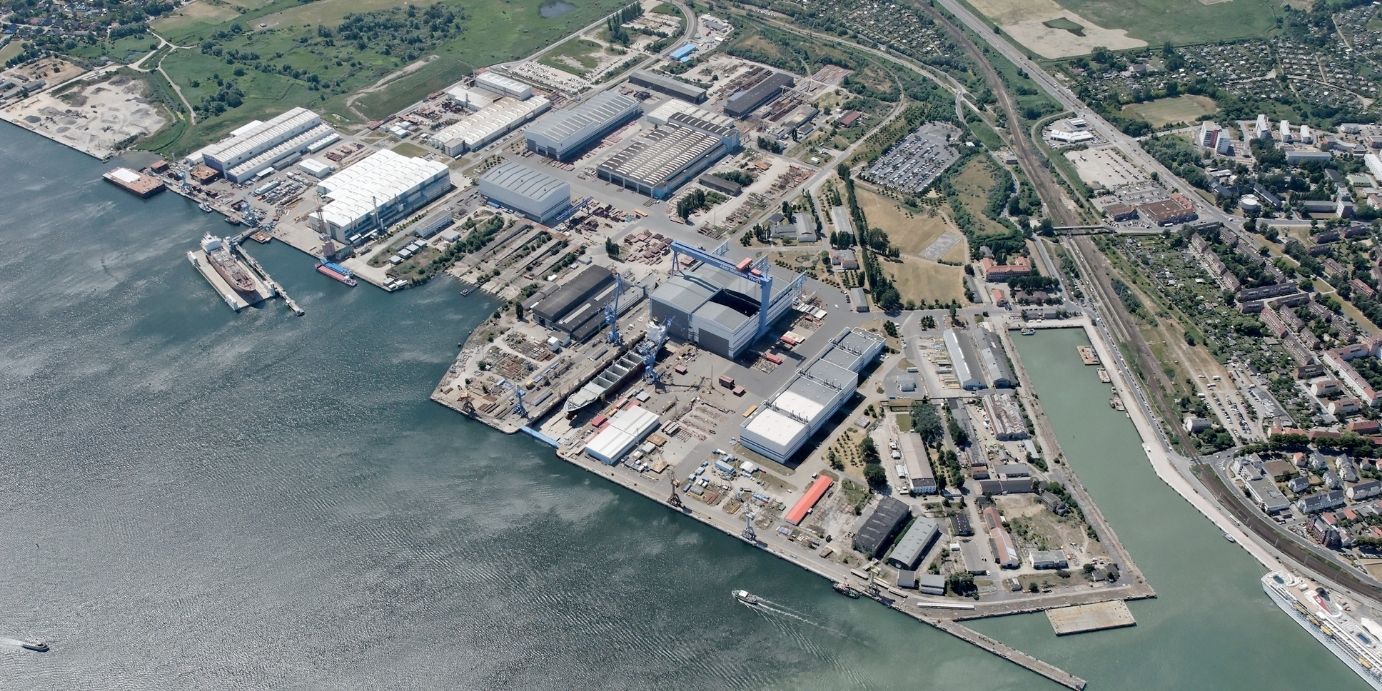
The freight transport centre in Rostock is not an isolated industrial park on a greenfield site, but a logistical symbiosis with Rostock 's overseas port. It is the largest universal port on the German Baltic Sea coast. The special feature lies in the spatial and functional integration of port management and classic logistics.
The GVZ acts as an interface between the international flows of goods on the north-south axis (Scandinavia-Italy) and the east-west axis (Baltic-Western Europe). Due to its embedding in the Trans-European Transport Networks (TEN-T) network, especially the Scandinavia-Mediterranean corridor, Rostock has a key European function.
Why is this definition important? Many locations call themselves logistics centers. A real GVZ, as classified by the German GVZ Society (DGG), is characterized by the connection to at least two modes of transport (bimodal). Rostock goes one step further: it is trimodal (road, rail, water) and even quadrimodally connected by the nearby airport.
The question for every logistics manager is: How quickly and reliably do I get my goods from ship to rail or truck? Rostock provides answers to these questions through extremely short distances and state-of-the-art handling technologies.
The harbour is the centrepiece. It can be reached by ships with a draught of up to 13 metres (sometimes up to 14.50 m in the sea channel), which makes it attractive for large RoRo ferries and feeder vessels, but also for bulkers.
Is the track in Rostock competitive? Yes. The terminal for combined cargo transport (CT terminal) has been massively expanded in recent years.
The bottleneck of many ports is hinterland traffic by truck, where Rostock benefits from a location that is less prone to congestion than Hamburg.
Rostock-Laage Airport (RLG) is about 30 kilometres to the south. Although it is not a primary cargo hub like Leipzig/Halle, it offers a 24-hour operating permit for cargo flights and acts as an important alternative and ad-hoc logistics location for time-critical services.
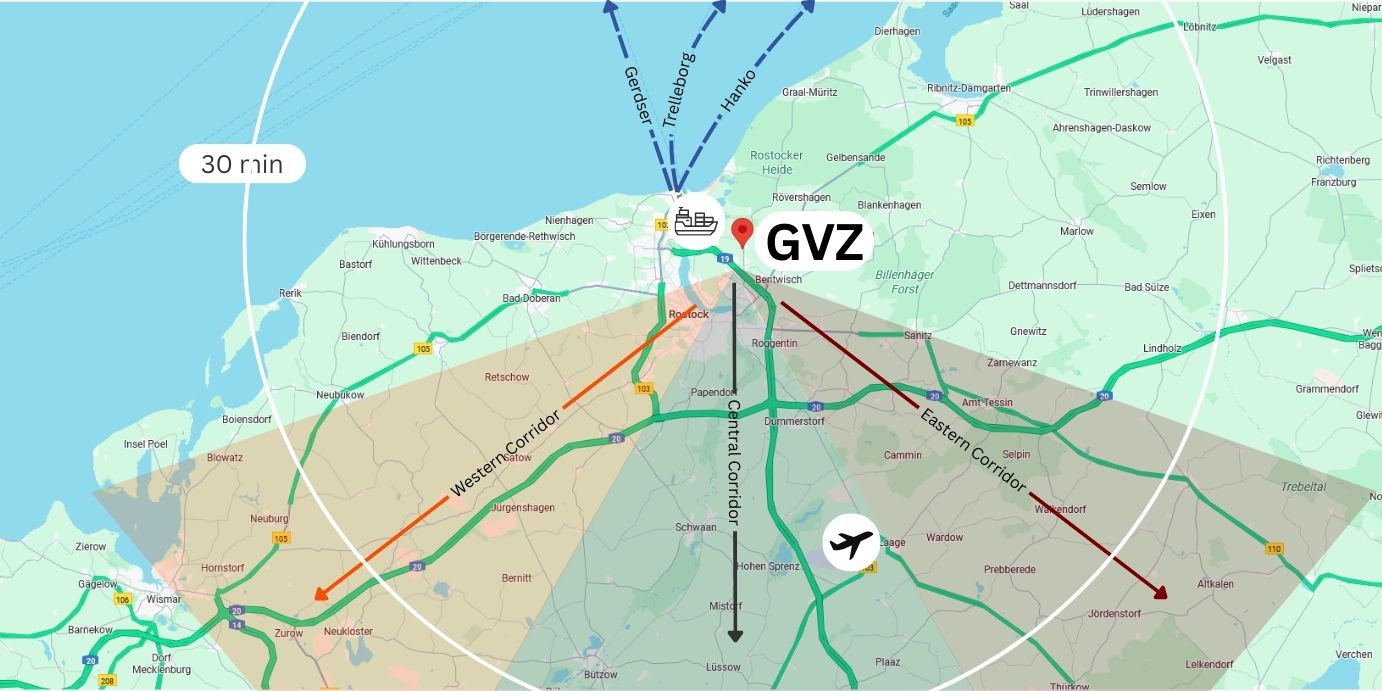
To simplify the basis for decision-making, here is an overview of the hard facts:
| Category | Facts / Figures |
| Total area port/freight village | approx. 750 hectares (industrial and logistics areas) |
| Quay edge length | approx. 11 kilometres (47 berths) |
| Envelope (Total) | approx. 29 - 31 million tons p.a. (Source: Rostock Port, fluctuations depending on the year) |
| Intermodal transshipment | > 130,000 units p.a. (and rising) |
| Modes of transport | Ship, rail, truck (trimodal) |
| Highway | A19 (north-south), A20 (east-west) |
| Trade tax | 455 % (City of Rostock) |
| Focus Industry | Wind Energy, Mechanical Engineering, Paper, RoRo/Ferry Transport, Project Cargo |
In the rankings of the Fraunhofer Working Group for Supply Chain Services (SCS), the Rostock region is regularly listed as an independent and growing logistics region.
For investors, this section is the decisive one. Is the location financially worthwhile compared to A locations?
(Note: The following prices are market benchmarks as of the end of 2024/beginning of 2025 and may vary depending on the specific location and equipment.)
Rostock is more expensive than rural Mecklenburg-Western Pomerania, but significantly cheaper than Hamburg or Berlin.
The running costs are determined by the assessment rates. Rostock is in the nationwide midfield for large cities.
→ Berlin Freight Center
→ Bremen Freight Center
→ Kiel Freight Center
Can you still find staff in Rostock? This is the most pressing question in the industry. Mecklenburg-Western Pomerania has developed from a "poorhouse" to a land of opportunity, but is suffering from demographic change.
What distinguishes Rostock from other GVZs such as Bremen or Nuremberg?
The success of a GVZ is measured by its tenants. Rostock has a healthy mix of production and logistics services.
Economic development: Despite geopolitical tensions (Russia sanctions affecting Baltic Sea trade), Rostock is growing. The loss of Russian cargo was partially offset by increased energy imports (oil, LNG, coal) and an intensification of trade with Scandinavia and the Baltic States.
The Rostock freight centre is more than an alternative to Hamburg; it is a strategic necessity for transport to Northern and Eastern Europe. The advantages are obvious:
The challenges remain the shortage of skilled workers, which does not stop at MV, as well as the geopolitical situation in the east, which blocks traditional trade routes (Russia). Nevertheless, the development of throughput figures in the CT terminal shows that Rostock is excellently positioned for "green logistics" (shift from road to rail/ship).
For companies that serve Scandinavia or handle heavy goods, there is hardly any way around Rostock.
Sources:
Commercial property, logistics property and contract logistics in Hesse at a glance - LAGERflaeche.de!
Object no.: 10182
Rental
Germany
34399 Oedelsheim
Price on request
Object no.: 10181
Rental
Germany
34385 Bad Karlshafen-Helmarshausen
Price on request
Object no.: 10104
Warehousing (warehouse with management)
Germany
64646 Heppenheim
Price on request
Object no.: 10073
Warehousing (warehouse with management)
Germany
34582 Borken
Price on request