
Commission-free offer
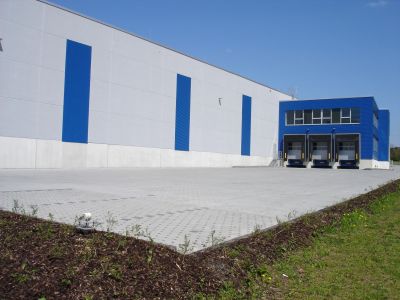
Lagerfläche, Lagerhalle, Block, Regal, Produktion
Object no.: 2288
Logistics real estate
Rental
Germany
56587 Oberhonnefeld/Westerwald
10000 m²
20000 (PP)
Price on request

The logistical heart at the German Corner
Object no.: 2288
Rental
Germany
56587 Oberhonnefeld/Westerwald
Price on request
» General Description: More than just an Industrial Park
» Location and Geographical Embeddedness: The Power of Centrality
» Infrastructure and Modality: The Trimodal Powerhouse
» Top Logistics Region: Why Koblenz Plays in the Champions League
» Economic Development and Companies Located
» Workforce and Skilled Worker Situation
» Key Facts: Rental Prices, Taxes and Land Prices
» Special Features and Future Outlook: Where is Koblenz Heading?
» Questions from Practice (FAQ)
» Conclusion: The "Hidden Champion" on the Middle Rhine
Why is a location that is world-famous for romance and tourism at the same time one of the toughest performers in the German logistics industry? The answer lies in geography. Koblenz is not only the place where "Mother Moselle" meets "Father Rhine", but a strategic hub that connects the seaports in the north with the consumer centers in the south.
In this detailed location analysis, we shed light on the logistics ecosystem around Koblenz. We are not only analyzing the freight center (GVZ) in the narrower sense, but also looking at the functional combination of the A61 industrial park and the Rhine port of Koblenz, which together act as a trimodal hub.
Anyone who talks about logistics in Koblenz must distinguish between two geographical focal points that form a functional unit: the Rhine port of Koblenz (directly on the water) and the industrial park on the A61 (the classic GVZ area).
The Koblenz logistics center acts as an interface for the European movement of goods. It is not a pure "warehousing area", but a high-frequency transshipment point. Due to its location in Rhineland-Palatinate, it serves as a hinge between the Rhine-Ruhr metropolitan region in the north and the Rhine-Main metropolitan region in the south.
Why is this location systemically relevant? Inland shipping on the Rhine is the lifeline for supplying southern German and Swiss industry. Koblenz offers the necessary redundancy and handling capacity to break, store and finely distribute flows of goods. The city has developed from a purely administrative location to a modern hub for value-added services .
Note on the definition: In technical jargon, the term "GVZ Koblenz" is often used to refer to the functional merger of the trimodal port facilities with the space-intensive logistics parks on the motorway.
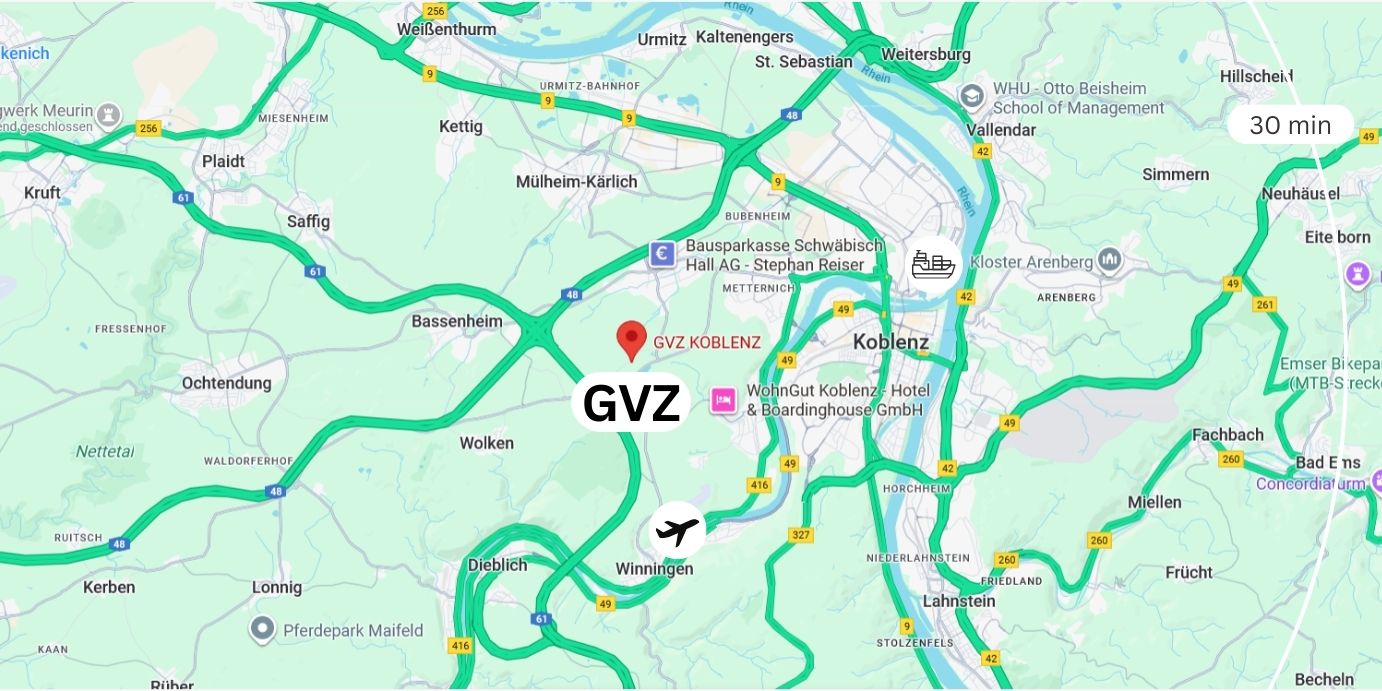
The location of a logistics location is its most important asset. Koblenz scores here with an almost unbeatable accessibility in Central Europe.
However, the topography also poses a challenge: the Middle Rhine Valley is narrow. Space is scarce and precious, which limits expansion but ensures the stability of the value of existing properties.
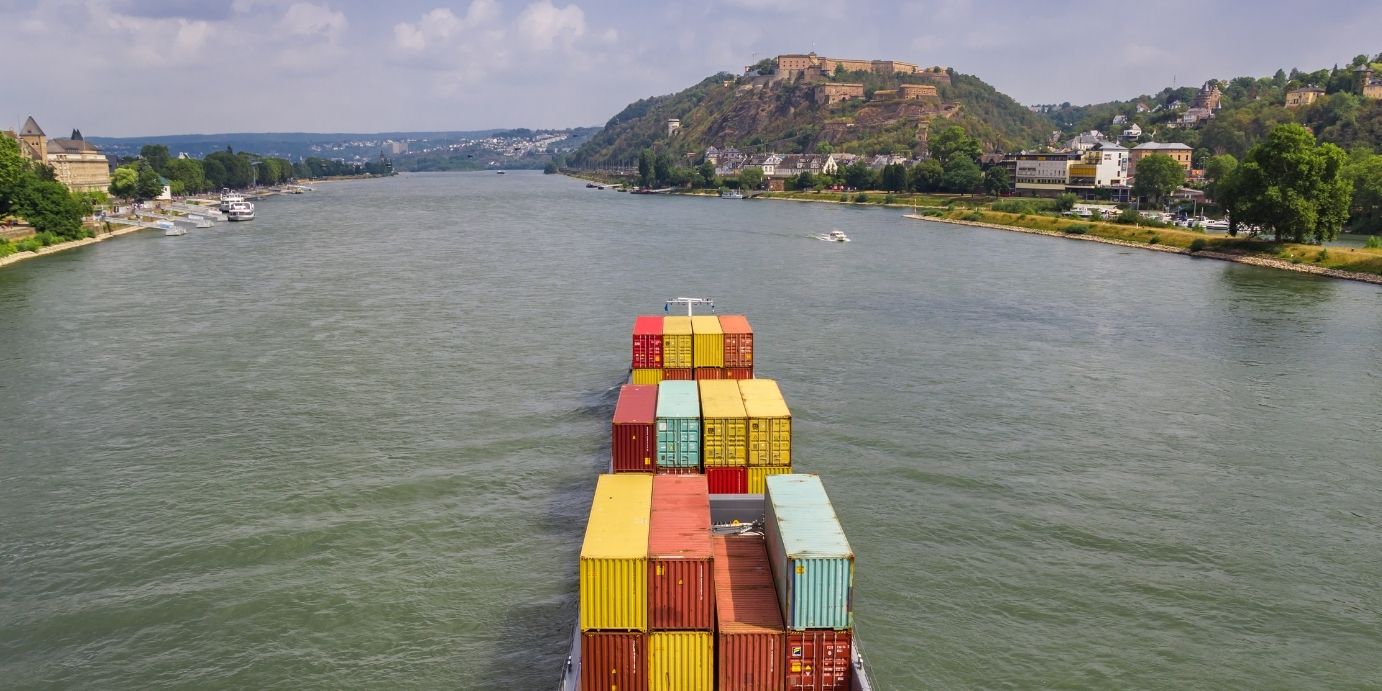
Is a location without a water connection still sustainable today? For heavy and bulk logistics, the answer is often "no". Koblenz is playing its biggest card here: trimodality.
The Rhine port of Koblenz is the heart of the city. It covers a total area of about 75 hectares.
The connection to the highway network is excellent and redundantly designed:
The Rhine port has an efficient industrial rail network.
Why is the Koblenz/Middle Rhine region often highlighted positively in rankings (e.g. Fraunhofer SCS)?
Graphic placeholder: (A map would be ideal here that shows the "Rhineland-Palatinate North Logistics Region" and visualizes the distances to FRA, CGN and the Ruhr area. Source: Own illustration based on Google Maps data)
The change from heavy industry to service has been completed in Koblenz. The A61 industrial park is almost fully occupied, which underlines its attractiveness.
Who has settled here? (Examples)
Economic dynamism: The demand for space significantly exceeds supply. This leads to "densification" – old brownfield sites are reactivated (brownfield development), and logistics properties are planned to be multi-story or more efficient.
As in the whole of Germany, the shortage of skilled workers is also noticeable in Koblenz, but with regional peculiarities.
→ Herne Emscher Freight Center
→ Kassel Freight Center
→ Cologne-Eifeltor Freight Center
For investors and tenants, the hard figures are decisive. Note: The following values are guideline values (as of approx. 2023/2024) and may be subject to market dynamic fluctuations. For exact daily prices, a consultation with local brokers (e.g. JLL, CBRE, Sparkasse) is necessary.
Due to the shortage of space in the Middle Rhine Valley, prices have risen in recent years, but are often still below the level of Frankfurt or Cologne.
| Category | Price range (estimated) | Note |
| Rent Logistics New Building | €6.50 - €8.00 / m² | Highly dependent on equipment (WGK, sprinkler, height) |
| Rent stock | €4.50 - €6.00 / m² | Older halls in the port area |
| Land prices | 120 € - 250 € / m² | Commercial building land (developed), if available |
The tax burden is a decisive location factor.
Sources for data: Statistical Office of the State of Rhineland-Palatinate, budget statutes of the city of Koblenz, market reports of large real estate brokerage houses.
What makes this location unique and what are the risks?
The "Smart Port" is also an issue in Koblenz.
Question: Is Koblenz suitable for start-ups in e-commerce?
Answer: Yes, absolutely. The proximity to the parcel centers of the major CEP service providers (DHL, Hermes, UPS in the region) enables late "cut-off" times. This means that customers can order later and still receive the goods the next day.
Question: Are there still free areas for large settlements (> 50,000 m²)?
Answer: In the direct urban area of Koblenz (Industrial Park A61) this is extremely difficult (brownfield only). Expansion tends to take place in the surrounding area (Mayen-Koblenz district), while maintaining the logistical connection to the port of Koblenz.
The Koblenz freight village or the Koblenz logistics location is much more than a transit point. It is a high-performance trimodal machine that benefits from its geographical inevitability. Anyone who needs to move goods efficiently between the North Sea ports and southern Germany can hardly avoid Koblenz.
For companies, the location offers stability, excellent infrastructure and access to labor. The challenges lie in the limited space and the relatively high trade tax rate. However, the advantages of multimodality – in particular the combination of strong rail, waterway and A61 – usually outweigh these disadvantages for logistics-intensive companies.
Next step for interested parties: Don't just check the rental prices, but calculate the transport cost savings through trimodality. A discussion with the Koblenz Economic Development Agency or the municipal utilities (port operators) is the recommended first step for a detailed feasibility study.
Commercial property, logistics property and contract logistics in Hesse at a glance - LAGERflaeche.de!
Object no.: 10182
Rental
Germany
34399 Oedelsheim
Price on request
Object no.: 10181
Rental
Germany
34385 Bad Karlshafen-Helmarshausen
Price on request
Object no.: 10104
Warehousing (warehouse with management)
Germany
64646 Heppenheim
Price on request
Object no.: 10073
Warehousing (warehouse with management)
Germany
34582 Borken
Price on request